May 22, 2026
The Industrial Waste Sitting Beneath the Global Rare Earth Crisis
The modern clean energy economy runs on a paradox. Wind turbines, electric vehicle motors, and advanced defence systems all depend on a narrow group of metals that most people have never heard of, sourced from a supply chain so concentrated it represents one of the most significant strategic vulnerabilities in industrial history. While governments and corporations scramble to diversify that supply chain, one of the most compelling unconventional sources has been sitting in containment ponds across the Caribbean for decades, disguised as waste.
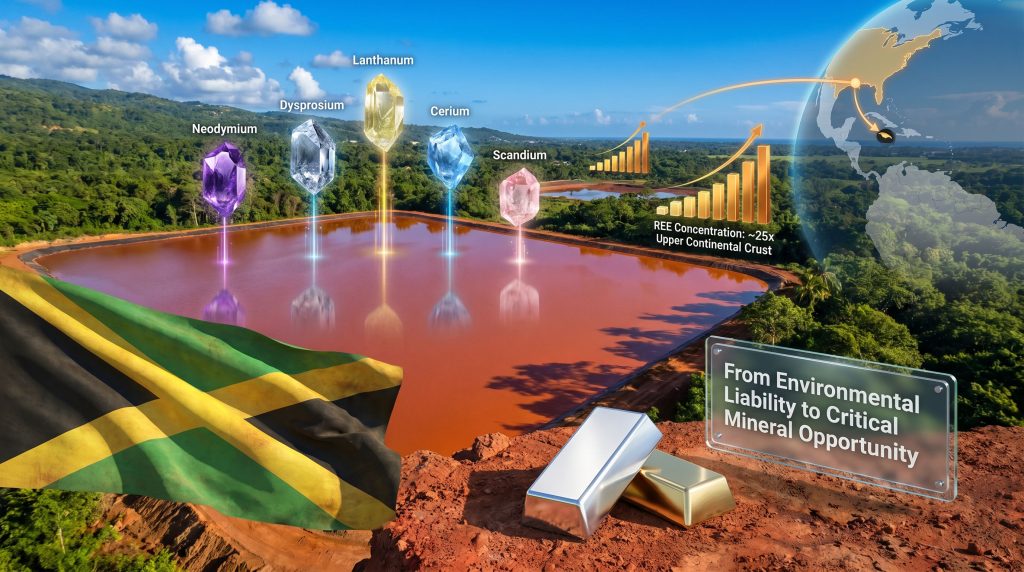
Jamaica red mud rare earth elements are drawing renewed attention from policymakers, researchers, and investors. The reason is geochemical. Analysis conducted through a collaboration between the Jamaica Bauxite Institute and Japanese aluminium industry firm Nippon Light Metal found rare earth element concentrations in Jamaica's red mud running at approximately 25 times the levels typically found in upper continental crust material. That figure is not just a scientific curiosity. It places Jamaica's industrial waste stockpile in genuinely rare territory among the world's assessed REE-bearing materials.
Understanding why that matters requires stepping back from the headline number and examining the structural problem it could help solve.
When big ASX news breaks, our subscribers know first
What Rare Earth Elements Actually Are and Why Supply Concentration Is a Crisis
The 17 Elements Powering the Energy Transition
Rare earth elements comprise the 17-member lanthanide series plus scandium and yttrium. Despite the name, most are not geologically scarce. The challenge is that they rarely concentrate in economically extractable deposits, and refining them requires sophisticated chemical separation processes that few nations have mastered at industrial scale.
Their applications span some of the most strategically important technologies currently in production:
| Rare Earth Element | Primary Application | Strategic Importance |
|---|---|---|
| Neodymium | EV motors, wind turbine magnets | Core to energy transition hardware |
| Dysprosium | High-temperature permanent magnets | Defence and aerospace systems |
| Lanthanum | Petroleum refining catalysts | Broad industrial processing |
| Cerium | Polishing compounds and catalysts | Wide industrial deployment |
| Scandium | Lightweight aluminium alloys | Aerospace and additive manufacturing |
A single dominant producer currently controls the majority of the world's refined REE output. This concentration creates a structural fragility across Western manufacturing supply chains that becomes more acute with every gigawatt of wind capacity installed and every electric vehicle rolled off a production line. Furthermore, the surge in critical minerals demand is only amplifying the urgency to find alternative sources.
Why Unconventional Sources Are Now Being Taken Seriously
The search for alternative REE sources has historically focused on new primary ore deposits. Greenfield mine development for REEs is notoriously slow, typically requiring seven to fifteen years from discovery through to commercial production, and carries significant environmental permitting complexity.
This has pushed strategic thinkers toward a different category of source material: industrial residues that already exist, sit on known sites, and have partially characterised mineral content. Bauxite residue sits at the top of that candidate list globally, not just in Jamaica.
The European Union's Critical Raw Materials Act is funding REE recovery research from Mediterranean alumina refinery residues, reflecting the broader push for green transition raw materials that can be sourced outside existing geopolitical chokepoints. Brazil, Guinea, and Australia are conducting assessments of their own red mud stockpiles. In Louisiana, the Gramercy facility operated under the ElementUSA framework is pursuing a zero-solid-waste processing concept that would recover REEs from bauxite residue with high reported concentrations. Jamaica's programme is part of a structural global shift, not an isolated policy experiment.
The distinction that matters most in evaluating these programmes is not REE presence but REE recoverability. Many industrial residues contain trace rare earth concentrations that are detectable but not extractable at any commercially viable cost. Jamaica's red mud has cleared both thresholds, a combination most candidate materials never achieve simultaneously.
What Makes Jamaica's Red Mud Geochemically Unusual
The 25x Multiplier and What It Actually Means
When geochemists refer to upper continental crust concentrations, they are describing the baseline average REE levels found across the uppermost portion of Earth's landmass. This figure is the standard reference point for assessing whether a material is REE-enriched relative to ordinary rock. A concentration 25 times that baseline in an industrial waste stream is genuinely anomalous.
Jamaica's bauxite geology contributes to this enrichment. The island's bauxite deposits formed through intense tropical weathering of limestone and volcanic rock over millions of years. This lateritic weathering process naturally concentrates elements that resist mobilisation, including iron, aluminium, and, critically, rare earth elements. When alumina refiners process this bauxite through the Bayer process, the aluminium dissolves into solution and is recovered, while the iron-rich residual fraction — the red mud — retains and further concentrates the REEs left behind. Understanding global bauxite production helps contextualise why Jamaica's particular geology produces such an unusually enriched residue compared to other major producing nations.
The Critical Distinction Between Detection and Recoverability
A common misunderstanding in media coverage of REE-bearing waste streams is treating elemental detection as equivalent to economic opportunity. The two are separated by a substantial technical gap.
Pilot-scale extraction work on Jamaica's red mud has confirmed that REEs are not merely present but physically separable using existing hydrometallurgical techniques. This puts Jamaica's bauxite residue in a materially stronger position than many other candidate waste streams currently being assessed globally, where only geochemical surveys have been completed without extraction testing.
The red mud's alkaline chemistry, a consequence of the Bayer process using caustic soda, means that selective REE leaching requires careful process chemistry. The iron and aluminium matrix surrounding the REEs must be chemically navigated without co-extracting excessive volumes of contaminant elements, which would inflate downstream processing costs. That technical challenge has been partially addressed at pilot scale, however replicating it at commercial throughput rates remains the central engineering problem yet to be fully solved.
The Research Journey: From Japanese Collaboration to Commercial Ambition
How the Initial Discovery Unfolded
Approximately a decade ago, Nippon Light Metal and the Jamaica Bauxite Institute undertook what was initially a compositional characterisation study. The REE enrichment they identified was significant enough to prompt a second phase of work focused on extraction feasibility. Pilot-scale results confirmed that the REE concentrations were not only high but accessible through existing processing methodologies.
Despite this, the programme did not advance to commercial development. Two barriers combined to halt progress:
- REE price volatility: Global rare earth markets experienced sharp price declines following a period of speculation-driven peaks, making the economics of a dedicated processing facility in Jamaica impossible to justify on a merchant basis.
- Infrastructure absence: No purpose-built REE extraction facility existed in Jamaica. The gap between pilot-plant results and a funded, permitted, commercial operation proved unbridgeable under the economic conditions of the time.
This failure pattern is not unique to Jamaica. It is the standard trajectory for REE projects globally. Resource confirmation consistently fails to translate into production without sustained price support and committed capital for processing infrastructure.
What Has Changed in 2025 and 2026
Several structural factors have shifted the calculus since the initial research phase stalled. REE demand projections linked to electric vehicle adoption and renewable energy deployment have reinforced the long-term price case for diversified supply. Geopolitical pressure on existing rare earth supply chains has elevated the strategic premium attached to Western Hemisphere REE sources. And Jamaica's government has moved from passive awareness of the resource to active commercialisation planning.
According to reporting by AL Circle, discussions between the Jamaica Bauxite Institute and the relevant licence holder reached an advanced stage as of May 2026, with a two-year investment and development programme expected to commence following the completion of an extensive sampling exercise across existing red mud stockpiles. The formalisation of the commercial arrangement is anticipated in the near term.
Jamaica's Legal and Regulatory Architecture: Closing the Gaps
The Mineral Ownership Question Nobody Expected
One of the least-discussed dimensions of Jamaica's red mud strategy involves a genuinely novel legal question. Jamaica's Mining Act requires licence holders to report the discovery of additional minerals and to pay the corresponding royalties. The straightforward application of this obligation becomes complicated when the mineral-bearing residue has been physically transported out of Jamaica.
A portion of Jamaica's bauxite residue has historically been shipped to Louisiana, where it has been stored or used in processing operations. This creates an unresolved jurisdictional question: do Jamaican reporting and royalty obligations follow the material across international borders?
Jamaica's Attorney General has been engaged to provide formal guidance on this question. If the legal determination confirms that obligations travel with the material, it would establish a precedent for cross-border mineral ownership in bauxite residue that has no clear parallel in existing international mining law. Amendments to the Mining Act are also being prepared to eliminate any remaining ambiguity regardless of how the Attorney General's guidance resolves the cross-border dimension.
Building a Fiscal Framework for REE Production
Alongside the legal reform process, Jamaica is constructing a dedicated fiscal architecture for REE extraction. This includes royalty structures, export revenue mechanisms, and investment incentive frameworks designed to ensure the country captures long-term financial benefit if commercial-scale production is achieved.
The dual-track approach — running commercial development negotiations alongside regulatory reform — reflects a more sophisticated policy posture than the reactive engagement that characterised previous attempts. It also signals that the government understands the lesson from the last failure: resource confirmation without a legal and fiscal framework to monetise it creates no durable national benefit.
The Real Barriers to Commercial Production
Processing Technology and Per-Tonne Economics
REE extraction from bauxite residue involves a fundamentally different processing challenge compared to conventional REE ore bodies. Primary REE ores, such as bastnäsite or monazite-bearing deposits, present the REEs in relatively concentrated mineral phases that respond to established separation chemistry. Red mud presents REEs distributed through a complex iron-aluminium-silica matrix at lower per-tonne concentrations, requiring more aggressive and selective chemical treatment.
Hydrometallurgical approaches — specifically acid leaching followed by solvent extraction or ion exchange separation — are the leading candidates for red mud REE recovery. The rare earth processing challenges associated with residue streams mean processing costs per tonne of recovered REE are typically higher than from primary ores, making economics more sensitive to the price environment at time of production.
The absence of a purpose-built processing facility in Jamaica remains the single largest operational constraint. Pilot plants demonstrate feasibility but do not generate the throughput data needed to design a commercial facility with confidence in capital and operating cost estimates.
Comparing Red Mud Recovery to Conventional Mine Development
Despite its processing complexity, the red mud pathway holds structural advantages over greenfield mine development that are frequently underappreciated:
| Factor | Jamaica Red Mud Recovery | Conventional REE Mine |
|---|---|---|
| Resource confirmation | Completed at pilot scale | Requires extensive drilling campaigns |
| Environmental footprint | Lower (existing waste site) | Higher (new land disturbance) |
| Permitting complexity | Moderate | High to very high |
| Processing infrastructure | Not yet built | Not yet built |
| Price sensitivity | High | High |
| Strategic positioning | Waste-to-value recovery | Primary extraction |
| Timeline to production | 2 to 5 years (estimated) | 7 to 15 years (typical) |
Environmental and Community Dimensions
Red mud is strongly alkaline, with pH levels typically between 10 and 13 depending on the age of the material and post-disposal weathering. Any extraction process must demonstrate pH management, control of heavy metal co-extraction risks, and containment of process effluents. Environmental permitting for a commercial facility will require comprehensive impact assessment.
Community engagement around existing red mud storage sites is also essential. Some Jamaican red mud ponds have been in operation for decades and are embedded in local landscapes and groundwater systems. Research published in Nature has highlighted the environmental complexity of managing bauxite residue at scale. Social licence, particularly for communities near existing storage sites, will consequently be a prerequisite for any large-scale commercial development.
The next major ASX story will hit our subscribers first
Jamaica's Broader Mining Expansion: A Sector in Structural Acceleration
Industrial Minerals and Quarrying Growth
The Jamaica red mud rare earth elements story is unfolding within a broader expansion of Jamaica's mining sector. Approximately 70% of the country's industrial mineral output is consumed domestically, primarily by the construction industry. Quarry production climbed from roughly 3.7 million tonnes in 2024 to approximately 5.9 million tonnes in 2025, a year-on-year increase of close to 59%, driven by expanding infrastructure and reconstruction activity.
The government has identified revenue collection efficiency from non-bauxite mineral operations as a priority, alongside encouraging investors to pursue higher-value product streams rather than basic aggregate extraction.
High-Purity Limestone: The Overlooked Value-Add Opportunity
Jamaica holds reserves of high-purity limestone suitable for pharmaceutical-grade and food-grade processing. Applications include calcium carbonate compounds used in antacid medications and abrasive compounds in dental hygiene products. These markets command substantially higher prices per tonne than construction aggregate, and the government is actively encouraging capital deployment into processing rather than raw extraction.
Major Mining Capital Entering Jamaica's Metallic Sector
Two of the world's largest mining corporations have entered exploration partnerships with junior companies targeting Jamaica's metallic mineral potential:
| Partnership | Committed Investment | Target Minerals |
|---|---|---|
| Freeport-McMoRan and C3 Metals Inc. | USD 75 million | Copper and gold |
| Barrick Mining Corporation and Geophysx Jamaica Limited | USD 20 million (initial tranche) | Copper and gold |
Preliminary findings from C3 Metals' exploration programme have indicated possible substantial copper deposits, with further investigative drilling planned. If commercially viable metallic mineral deposits are confirmed, the economic implications for Jamaica would extend well beyond royalty income into foreign exchange earnings, employment, and tax receipts.
Three Scenarios for Jamaica's Red Mud REE Programme
Scenario 1: Accelerated Commercialisation
The two-year investment programme proceeds on schedule. A commercially designed processing facility is financed, permitted, and commissioned within five years. REE prices sustain levels above the minimum economic threshold throughout the construction period. Jamaica establishes itself as a Western Hemisphere REE supplier with strategic relevance to North American, European, and Japanese industrial partners seeking supply chain diversification.
Scenario 2: Extended Development Timeline
Technical challenges in scaling the extraction process, combined with moderate REE price volatility, extend the timeline beyond the initial two-year programme. A partial offtake agreement with an industrial partner — possibly Japanese given the existing Nippon Light Metal research relationship — provides sufficient price certainty to attract processing facility investment. Commercial production is consequently achieved within a five to ten year window.
Scenario 3: Second Stall
REE prices deteriorate, processing cost estimates from pilot-to-commercial scale-up prove higher than projected, and the programme returns to a holding pattern. Jamaica's red mud remains a documented, partially characterised, uncommercialised resource awaiting the next cyclical price recovery.
The single most powerful de-risking mechanism for any of these scenarios converging on production is a long-term offtake agreement with a creditworthy industrial buyer. Such an agreement transforms an uncertain price exposure into a bankable revenue stream, which is the threshold most project finance lenders require before committing to infrastructure capital. Without it, the gap between pilot results and commercial operation is likely to persist regardless of geochemical quality.
Frequently Asked Questions: Jamaica Red Mud and Rare Earth Elements
What is red mud and why does Jamaica have so much of it?
Red mud is the iron-rich alkaline residue produced when bauxite ore is refined into alumina using the Bayer process. For every tonne of alumina produced, approximately one to two tonnes of red mud are generated, depending on bauxite ore grade. Jamaica has been a significant bauxite producer since the 1950s, accumulating substantial volumes of red mud across containment facilities near its alumina refineries.
Why are REE concentrations in Jamaica's red mud so high relative to other red mud stockpiles?
Jamaica's bauxite formed through intense tropical weathering of carbonate and volcanic parent rock, a process that selectively concentrates elements resistant to chemical mobilisation. This geological history produces bauxite and the resulting red mud with elevated trace element concentrations, including REEs, compared to bauxite derived from less intensively weathered parent rock in other jurisdictions.
Has commercial REE extraction from red mud been achieved anywhere in the world?
As of 2026, no programme has achieved full commercial-scale REE production from bauxite residue. Multiple initiatives — including those in Louisiana, across the European Union, and in Jamaica — are at various stages of pilot or pre-commercial development. The technical feasibility is established. The commercial viability at sustained production scale has not yet been demonstrated at any site globally. Academic analysis of red mud waste management further underscores the economic complexity of transforming these residues into viable production streams.
What legal changes is Jamaica pursuing to protect its REE interests?
Jamaica is preparing amendments to its Mining Act to clarify that mineral reporting and royalty obligations apply to bauxite residue regardless of where it has been physically transported. The Attorney General has been engaged to advise on the jurisdictional scope of existing obligations, particularly in relation to Jamaican-origin red mud currently held in Louisiana. A dedicated fiscal framework for REE extraction and production is also under development.
What would successful commercialisation mean for Jamaica's economy?
The economic benefits would include increased foreign exchange earnings from REE exports, higher royalty revenues under the new fiscal framework, employment creation in a technically specialised sector, and greater foreign direct investment. The scale of those benefits would be contingent on prevailing REE prices at time of production, the volume of recoverable material confirmed through the expanded sampling programme, and the fiscal terms ultimately negotiated. In this regard, Jamaica red mud rare earth elements represent not just a technical opportunity but a genuine economic inflection point for the nation's resource sector.
This article contains forward-looking statements and scenario projections that involve inherent uncertainty. Readers should not treat any scenario or timeline estimate as a guarantee of outcomes. Investment and commercial decisions should be based on independent research and professional advice. REE market prices are subject to significant volatility and are influenced by factors outside any single project's control.
Want to Know When the Next Major Mineral Discovery Hits the ASX?
Discovery Alert's proprietary Discovery IQ model delivers real-time alerts on significant ASX mineral discoveries — including critical and rare earth minerals driving the global energy transition — instantly translating complex geological data into actionable investment insights for both new and experienced investors. Explore how historic discoveries have generated substantial returns and begin your 14-day free trial today to position yourself ahead of the market.