May 22, 2026
The Rare Earth Bottleneck That Western Industry Can No Longer Ignore
Permanent magnet supply chains have quietly become one of the most consequential vulnerabilities in the global energy transition. The sintered neodymium-iron-boron (NdFeB) magnet sits at the heart of every electric vehicle traction motor, every direct-drive offshore wind turbine, and a growing array of defence systems. Yet the feedstock that makes these magnets possible, specifically neodymium and praseodymium oxide, flows almost entirely through a single national processing system.
For Western manufacturers, that concentration risk has shifted from a theoretical concern to an operational one, particularly following export restriction policies enacted between 2023 and 2025 that exposed just how thin the margins of rare earth supply chains actually are. Furthermore, these disruptions have accelerated demand for alternative sourcing strategies across the Western world.
Against this backdrop, the Greenland Mines Sarfartoq rare earths project acquisition takes on a significance that extends well beyond a routine junior mining transaction. It represents a deliberate attempt to anchor a high-grade Nd-Pr resource within a Western-aligned jurisdiction, pair it with an established downstream processing partner, and create the kind of vertically integrated supply chain architecture that policy frameworks in the US and EU have been calling for but the private sector has struggled to deliver.
When big ASX news breaks, our subscribers know first
Understanding Why Nd-Pr Is the Critical Rare Earth Pairing
Not all rare earths carry equal strategic weight. The 17 elements grouped under the rare earth umbrella vary enormously in both demand profile and supply risk. Neodymium and praseodymium, however, occupy a unique position because their demand is structurally coupled to two of the fastest-growing sectors in the global economy: electric vehicles and renewable energy generation.
Why Do NdFeB Magnets Matter So Much?
NdFeB permanent magnets, which require Nd-Pr oxides as their primary input, deliver the highest energy density of any commercially available magnet technology. This performance characteristic is non-negotiable for EV traction motors, where weight and power output are both critical design constraints. Unlike many heavy rare earths, whose demand remains relatively niche, Nd-Pr consumption scales directly with EV production volumes and wind turbine installations.
Any shortfall in Nd-Pr feedstock therefore translates directly into a bottleneck for the clean energy hardware supply chain. The rare earth geopolitical impact of this vulnerability has become increasingly apparent to policymakers and industry alike.
China currently controls an estimated 85 to 90 percent of global rare earth processing capacity, with particular dominance over magnet-grade Nd-Pr output. Nd-Pr oxide prices have risen to approximately double the levels recorded in 2011, reflecting both structural demand growth and the market's growing awareness of supply concentration risk. Consequently, for any project developer able to bring a significant Western-jurisdiction Nd-Pr resource toward production, the economic and strategic timing is arguably as favourable as it has ever been.
What Makes the Sarfartoq Deposit Geologically Distinctive
The Sarfartoq project is hosted within a carbonatite intrusive system in southwest Greenland, a geological setting that carries specific advantages for rare earth development. Carbonatite-hosted deposits are known for yielding elevated concentrations of light rare earth elements (LREEs), the category that includes neodymium and praseodymium. This contrasts with ion-adsorption clay deposits, which involve more complex and environmentally sensitive processing pathways.
How Does Sarfartoq Compare to Peer Deposits?
What distinguishes Sarfartoq within the carbonatite category is the proportion of total recoverable oxides attributable to Nd and Pr specifically. Most carbonatite rare earth deposits carry Nd-Pr fractions in the range of 15 to 22 percent of total rare earth oxide content. Sarfartoq's reported range of 25 to 40 percent Nd-Pr as a share of total recoverable oxides is therefore materially above the carbonatite peer group average, which directly amplifies revenue potential per tonne of ore processed.
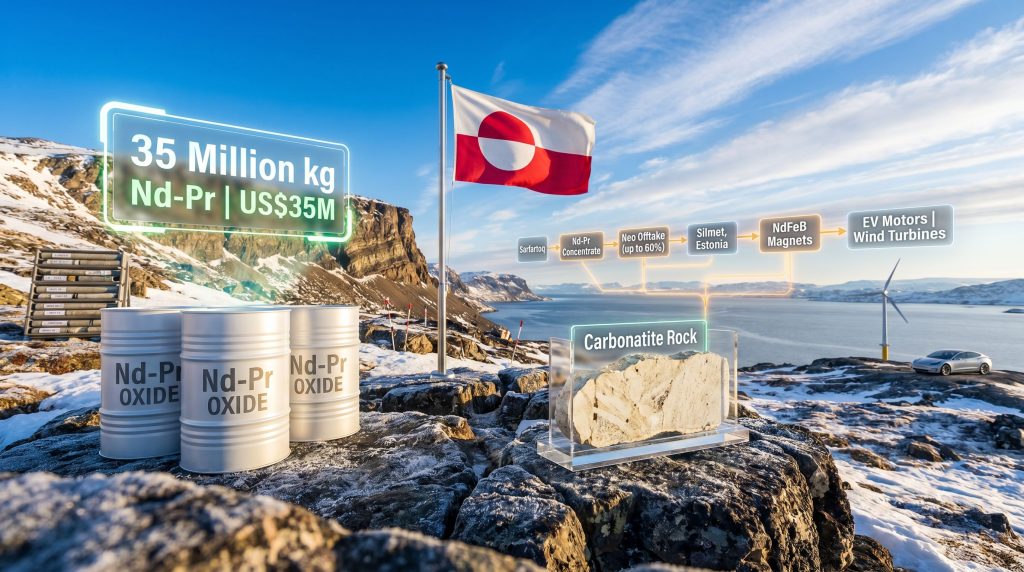
The deposit contains 35 million kilograms of combined neodymium and praseodymium, underpinned by more than 23,000 metres of historical drilling. This drill database, accumulated over multiple campaigns, substantially reduces the exploration risk profile of the asset and provides a solid foundation for the updated technical study that Greenland Mines has committed to fast-tracking.
A high Nd-Pr fraction within total rare earth oxide content is not merely a geological curiosity. It is the single metric most directly connected to project revenue, because only Nd and Pr command the premium pricing associated with magnet-grade feedstock. Cerium and lanthanum, which typically dominate the oxide mix in lower-quality carbonatite systems, remain chronically oversupplied and carry minimal commercial value.
Breaking Down the Transaction Structure and Its Strategic Logic
The Greenland Mines Sarfartoq rare earths project acquisition was structured as a US$35 million transaction, split between US$20 million in cash and US$15 million in newly issued Greenland Mines shares. The seller, TSX-listed Neo Performance Materials, does not exit the project entirely. Neo retains offtake rights covering up to 60% of future Sarfartoq production and holds an ongoing equity stake in Greenland Mines through the share consideration component.
This architecture reflects a sophisticated alignment of interests rather than a clean divestiture. The key elements of the deal structure are worth examining individually:
| Transaction Element | Detail |
|---|---|
| Total consideration | US$35 million |
| Cash component | US$20 million |
| Equity component | US$15 million in new Greenland Mines shares |
| Neo retained offtake | Up to 60% of future production |
| Neo equity exposure | Ongoing via Greenland Mines shareholding |
| Acquirer listing | Nasdaq |
| Seller listing | TSX |
From Neo's perspective, the transaction is consistent with a clearly defined corporate identity as a midstream and downstream advanced materials business. Neo's Silmet facility in Estonia is one of the very few operational rare earth separation plants outside of China, giving the company genuine processing infrastructure rather than aspirational downstream ambitions. By monetising the exploration-stage upstream asset while retaining feedstock rights and equity upside, Neo executes a capital-efficient repositioning that preserves its exposure to Sarfartoq's potential.
Neo's leadership characterised the transaction as consistent with a disciplined approach to capital allocation, reinforcing the company's focus on the processing and manufacturing stages of the value chain where it generates the most differentiated value. Furthermore, the structure ensures that both parties retain meaningful exposure to any upside that emerges as the project advances.
The Value Chain Architecture: From Greenland to the Magnet Factory
One of the most analytically compelling aspects of this transaction is the integrated supply chain logic it establishes. Most Western rare earth development narratives stop at concentrate production, leaving the critical separation and alloying steps either unaddressed or dependent on hypothetical future infrastructure. The Sarfartoq-Neo partnership is different because a credible downstream anchor already exists.
How Does the Supply Chain Flow?
The proposed value chain flows as follows:
- Sarfartoq mine site in southwest Greenland produces rare earth concentrate with high Nd-Pr content.
- Concentrate shipment to Neo's Silmet rare earth separation facility in Estonia, one of only a handful of operational separation plants in the Western world.
- Separation and refining at Silmet produces magnet-grade Nd-Pr oxide or alloy feedstock.
- Downstream distribution to NdFeB magnet manufacturers supplying EV motor and wind turbine customers across Europe and beyond.
This is not a theoretical supply chain. Silmet is an operating facility with established separation chemistry and a track record of producing rare earth materials for industrial customers. In addition, the geographic positioning of the chain, from Greenland through Estonia to European end markets, keeps the entire value-add process within Western jurisdictions. This is precisely the kind of structure that both US and EU critical minerals frameworks identify as a priority, and it directly addresses the rare earth processing challenges that have long hampered Western supply chain independence.
Greenland's Dual-Asset Critical Minerals Platform
The Sarfartoq acquisition does not stand alone within Greenland Mines' portfolio. The company also holds the Skaergaard asset, which hosts palladium, gold, and platinum resources, with potential by-products that include vanadium, gallium, iron ore, and titanium. The combination of a rare earth project and a platinum group metals and precious metals project creates a multi-commodity critical minerals exposure profile that is unusual among junior developers.
Greenland critical minerals represent an increasingly important focus for Western governments and industry alike, and Greenland's geological endowment supports this diversification thesis strongly. The island's Precambrian shield geology hosts a range of deposit types, from the carbonatite systems that carry rare earths to the layered mafic intrusions associated with PGM mineralisation.
The Greenland minerals race is intensifying as global powers recognise the island's extraordinary resource potential. Together, the two assets position Greenland Mines as a potential single-jurisdiction platform for multiple critical minerals categories, all located outside Chinese supply chain influence and geographically proximate to both North American and European markets.
The next major ASX story will hit our subscribers first
Why the 2011 PEA Update Is the Immediate Value Catalyst
The most recent formal economic study on Sarfartoq, a preliminary economic assessment completed in 2011, is no longer fit for purpose as a valuation reference point. The price assumptions embedded in that study reflect a rare earth market that has undergone fundamental structural change. Nd-Pr oxide prices are currently approximately double the 2011 benchmark levels, meaning any net present value or internal rate of return calculation derived from the old study systematically understates the project's potential economics under current conditions.
The updated technical and economic study that Greenland Mines has committed to fast-tracking will need to address several interconnected variables:
- Revised Nd-Pr pricing assumptions calibrated to current spot prices and medium-term demand forecasts from the EV and wind energy sectors
- Full integration of the 23,000+ metre drill database, including all results generated after the 2011 resource estimate was completed
- Processing route optimisation specific to Sarfartoq's carbonatite mineralogy, incorporating advances in rare earth beneficiation technology developed over the past 15 years
- Updated capital cost benchmarks reflecting current construction cost inflation, particularly relevant for remote Arctic-adjacent operating environments
- Environmental and social baseline studies aligned with current Greenlandic regulatory requirements, which have evolved considerably since 2011
- Infrastructure and logistics assessment for southwest Greenland, including port access, energy supply, and workforce considerations
The completion of this updated study will be the primary near-term catalyst for the project's valuation trajectory. Investors should watch for study commissioning announcements, interim resource estimate updates, and any indication of processing route decisions as leading indicators of progress.
Assessing Development Risk: A Balanced Framework
Intellectual honesty requires acknowledging that the Sarfartoq acquisition represents a bet on future development, not near-term production. Greenland has not yet produced a single tonne of rare earth oxides commercially, and the absence of an established local mining supply chain adds a layer of capital intensity and logistical complexity that is easy to underestimate from a distance.
What Supports the Investment Case?
Factors supporting the investment case:
- Above-average Nd-Pr fraction (25-40% of TREO) maximises revenue quality per tonne processed
- Committed offtake partner with real downstream infrastructure, not a memorandum of understanding with an aspirational processor
- Substantial existing drill database reduces technical uncertainty relative to greenfield exploration
- Western-aligned jurisdiction with proximity to US and European end markets
- Structurally elevated Nd-Pr prices relative to historical benchmarks
What Are the Key Development Risks?
Factors introducing development risk:
- No operating rare earth mine precedent in Greenland creates execution uncertainty
- Sub-Arctic operating conditions elevate capital intensity and seasonal logistics complexity
- Rare earth prices remain subject to downside volatility if Chinese production policy shifts
- Permitting involves both Danish and Greenlandic regulatory authorities, adding process complexity
- Capital requirements to reach commercial production are likely to be substantial, potentially in the range of hundreds of millions of dollars
Disclaimer: This article contains forward-looking assessments based on publicly available information. It does not constitute financial advice. Investors should conduct independent due diligence before making any investment decisions related to early-stage mining projects.
Key Milestones Investors and Industry Observers Should Track
For those monitoring the Greenland Mines Sarfartoq rare earths project acquisition and its development trajectory, the following milestones represent the most meaningful progress indicators:
| Milestone | Why It Matters |
|---|---|
| Updated technical study completion | Establishes revised NPV/IRR under current pricing |
| Binding offtake agreement with Neo | Validates revenue model for project finance discussions |
| Environmental impact assessment initiation | Sets permitting timeline and critical path |
| Feasibility study mandate | Required precursor for construction financing |
| Resource estimate update | Quantifies drill database expansion since 2011 |
| Processing route decision | Determines capital intensity and operating cost profile |
The speed at which Greenland Mines progresses through these milestones will be the primary determinant of whether the strategic logic of this acquisition translates into tangible project value. The foundation, in terms of resource scale, geological quality, and supply chain partnership, is more credible than most Western rare earth development stories. However, the execution challenge that lies ahead is considerable, even as the context in which it is being attempted has rarely been more strategically favourable for Nd-Pr feedstock development outside of Chinese jurisdiction.
Want to Know When the Next Major Mineral Discovery Hits the ASX?
Discovery Alert's proprietary Discovery IQ model delivers real-time alerts on significant ASX mineral discoveries — including critical minerals like rare earths — turning complex data into actionable insights for investors at every level. Explore Discovery Alert's dedicated discoveries page to understand how historic discoveries have generated substantial returns, and begin your 14-day free trial today to position yourself ahead of the market.