May 22, 2026
Europe's Ancient Bedrock and the Race for Resource Independence
The geology beneath northern Europe has remained largely unchanged for billions of years. Yet the strategic significance of what lies within that ancient rock is shifting at a pace that would have seemed implausible a decade ago. Across the Fennoscandian Shield, one of the planet's oldest and most mineral-rich geological formations, renewed exploration activity is intersecting with an urgent European policy agenda that has fundamentally redefined what it means to secure an industrial future.
For investors, policymakers, and mining professionals tracking the Scandinavia critical materials potential story, the question is no longer whether the region holds meaningful resources. The geology has always been compelling. The question now is whether the political will, capital mobilisation, and infrastructure investment can convert that endowment into reliable supply before Europe's industrial dependencies become acute vulnerabilities.
When big ASX news breaks, our subscribers know first
The Structural Vulnerability Beneath Europe's Green Ambitions
Europe's exposure to concentrated critical materials supply chains is one of the most consequential industrial risks facing the continent. The European Commission has acknowledged that the EU sources more than 90% of its rare earth elements from China, while cobalt supply remains dominated by the Democratic Republic of Congo and lithium continues to flow primarily from Chile and Australia. For specialty metals with explicit defence applications, including antimony, gallium, and tungsten, Chinese market share in both mining and processing is even more pronounced.
This dependency is not merely an economic inconvenience. In a post-2022 geopolitical environment shaped by the Russian invasion of Ukraine and escalating trade tensions across the Indo-Pacific, access to critical materials has become inseparable from national security planning. The EU's Critical Raw Materials Act (CRMA), which entered into force in 2024, represents the legislative response to this reality. Among its core ambitions, the CRMA targets sourcing at least 10% of the EU's annual consumption of critical materials from domestic extraction by 2030, with processing and recycling targets extending beyond that.
"The CRMA does not simply set aspirational goals. It creates a framework of strategic project designations, streamlined permitting pathways, and access to EU funding mechanisms that are designed to accelerate development of deposits within member state territories."
Within that framework, Scandinavia occupies a position that no other European sub-region can match. Furthermore, the establishment of a critical raw materials facility underscores the EU's commitment to translating policy ambition into operational infrastructure.
The Fennoscandian Shield: Why Ancient Geology Creates Modern Opportunity
Understanding the Formation That Underpins Nordic Mining
The Fennoscandian Shield, also referred to as the Baltic Shield, is a Precambrian geological formation estimated to be between 1.7 and 3.8 billion years old. Spanning Sweden, Finland, Norway, and extending into parts of Estonia and northwestern Russia, it represents one of the most mineralogically diverse basement rock complexes on Earth.
The shield's critical minerals significance arises from a combination of geological processes operating over immense timescales:
- Magmatic intrusions during Precambrian orogenic events concentrated platinum group metals (PGMs), nickel, and cobalt in layered mafic and ultramafic bodies
- Hydrothermal systems associated with ancient tectonic activity created vein and disseminated deposits bearing rare earth elements, tungsten, antimony, and bismuth
- Carbonatite and alkaline intrusive complexes created conditions particularly favourable for rare earth element (REE) mineralisation, similar to the geological settings hosting world-class REE deposits globally
- Metamorphic and sedimentary sequences preserved graphite-bearing formations across Sweden and Finland
Critically, the region has experienced relatively limited systematic modern exploration compared to its geological prospectivity. Unlike Australia's Pilbara or Canada's Quebec, where decades of intensive drilling have substantially matured the resource base, large portions of the Fennoscandian Shield remain underexplored at depth and across strike extensions.
How Nordic Geology Compares to Other Global Critical Mineral Provinces
| Region | Primary Critical Minerals | Exploration Maturity | Strategic Significance |
|---|---|---|---|
| Scandinavia (Nordic) | REEs, cobalt, graphite, PGMs, lithium, nickel | Moderate to High | EU supply chain anchor |
| Democratic Republic of Congo | Cobalt, coltan | High | Global cobalt dominance |
| China (Inner Mongolia, Sichuan) | REEs, graphite, lithium | Very High | Global processing monopoly |
| Australia | Lithium, nickel, cobalt | High | Indo-Pacific supply chain |
| Greenland | REEs, niobium | Low to Moderate | High potential, high risk |
One technical detail that is not widely appreciated outside geological and exploration circles is the importance of light versus heavy rare earth element (LREE vs HREE) distribution across the Fennoscandian Shield. While light REEs such as neodymium and praseodymium are more commonly encountered globally, heavy REEs including dysprosium, terbium, and yttrium are considerably scarcer and command significantly higher pricing premiums. Certain Fennoscandian carbonatite complexes carry elevated HREE signatures relative to typical light REE-dominated deposits, adding a qualitative dimension to the region's REE endowment that raw tonnage figures alone do not fully capture.
Which Countries Hold the Greatest Scandinavia Critical Materials Potential?
Sweden: The Regional Heavyweight
Sweden consistently emerges as the most strategically significant Nordic nation for critical raw materials, a judgment supported by both geological evidence and existing industrial infrastructure. The Swedish Geological Survey has systematically documented the country's mineral inventory, identifying documented resources across at least nine EU-designated critical raw materials, including rare earth elements, cobalt, graphite, platinum group metals, antimony, fluorite, bismuth, tungsten, and phosphate minerals.
The most prominent development in recent years involves LKAB's Per Geijer deposit complex near Kiruna in northern Sweden. Initial resource estimates from LKAB have positioned the deposit as potentially one of Europe's largest known rare earth oxide concentrations, associated with the iron oxide apatite mineralisation that already underpins LKAB's world-class iron ore operation. The strategic significance of a co-located iron ore and REE operation cannot be overstated from a processing economics standpoint, as shared infrastructure and existing metallurgical knowledge reduce the capital intensity of REE development relative to a greenfield project.
Sweden also benefits from what geologists term structural corridors running through its Precambrian basement, zones where repeated tectonic events have stacked mineralising events atop one another. These corridors have historically been productive for base metals and are increasingly being re-evaluated for critical mineral assemblages that earlier exploration programmes were not specifically targeting.
Finland: Battery Mineral Alignment
Finland's Fennoscandian geology is particularly well-suited to nickel, copper, cobalt, and PGM mineralisation, driven by the presence of layered mafic intrusions that are geochemically favourable for magmatic sulphide systems. The country hosts an established mining and metallurgical processing sector, and Finnish deposits demonstrate strong alignment with EV battery supply chain requirements given their cobalt and nickel profiles.
One underappreciated aspect of Finnish mineral potential is the northern territory's limited modern drilling coverage. Historic Soviet-era geological mapping that influenced early Finnish survey work applied methodologies not optimised for identifying the disseminated low-grade but large-tonnage deposits that modern bulk mining economics favour. In addition, critical metals and minerals in Fennoscandia assessments from the Geological Survey of Finland highlight the region's considerable untapped prospectivity.
Norway, Greenland, and the Broader Nordic Perimeter
Norway's critical minerals profile differs from its neighbours, reflecting a geological transition away from the core Fennoscandian Shield toward Atlantic margin sequences. Known Norwegian potential centres on nickel, vanadium, and select battery-relevant mineralisation, though the country's critical materials strategy is still maturing relative to Sweden and Finland.
Greenland commands disproportionate international attention due to the scale of its known rare earth prospects. The Tanbreez REE deposit and the Kringlerne deposit complex in southern Greenland are among the largest known REE accumulations globally by contained tonnage. However, translating that endowment into supply faces compounding constraints: Greenland's environmental regulations, the rights and concerns of Indigenous communities, and persistent geopolitical sensitivities around resource sovereignty create a development timeline that most analysts place well beyond 2035 under even optimistic assumptions. Greenland should consequently be viewed as a long-duration option on European REE supply rather than a near-term solution.
Estonia's inclusion in Fennoscandian critical minerals mapping reflects the shield's southeastern extent, with specific potential across mineral sands and phosphate-related resources. A pan-Nordic approach to critical materials strategy, rather than fragmented country-by-country initiatives, would better capture the region's collective supply potential.
What Critical Materials Does the Nordic Region Actually Host?
| Critical Material | Nordic Countries with Known Resources | Primary End-Use Application | EU Import Dependency |
|---|---|---|---|
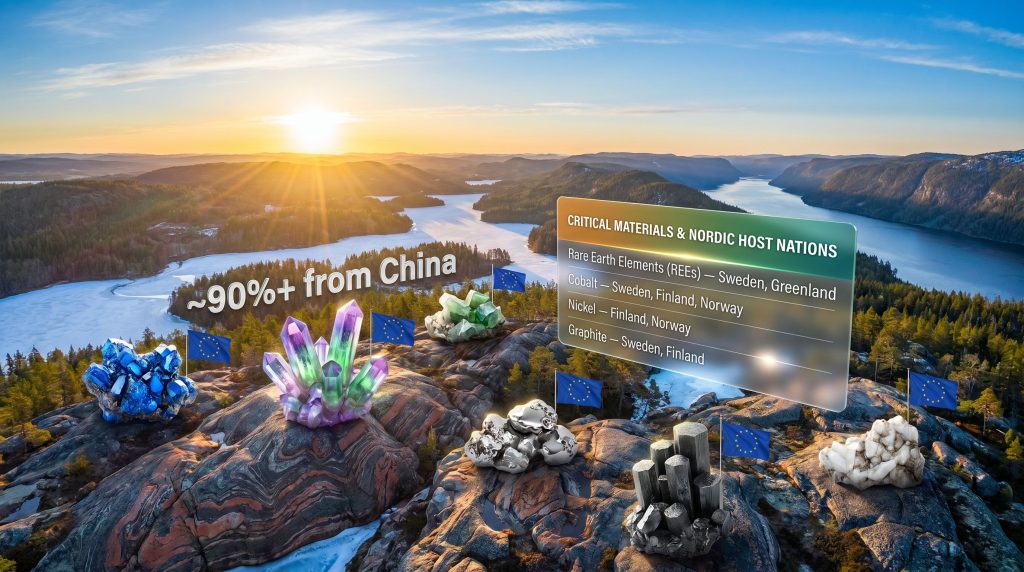
| Rare Earth Elements | Sweden, Greenland | EV motors, wind turbines, defence | Approx. 90%+ from China |
| Cobalt | Sweden, Finland, Norway | EV batteries, aerospace alloys | High, DRC dominant |
| Graphite | Sweden, Finland | Battery anodes, lubricants | High, China dominant |
| Lithium | Sweden, Finland | EV batteries, grid storage | High, Chile/Australia |
| Nickel | Finland, Norway | Battery cathodes, stainless steel | Moderate, Russia/Indonesia |
| Platinum Group Metals | Sweden, Finland | Catalysts, hydrogen fuel cells | High, South Africa/Russia |
| Vanadium | Norway, Sweden | Grid-scale batteries, steel alloys | Moderate |
| Niobium | Greenland, Sweden | High-strength steel, superconductors | High, Brazil dominant |
| Antimony | Sweden | Defence, flame retardants, semiconductors | High, China dominant |
| Bismuth | Sweden | Pharmaceuticals, electronics | Moderate |
How EU Policy Is Reshaping the Nordic Exploration Landscape
The Critical Raw Materials Act in Practice
The CRMA's provisions extend well beyond target-setting. Strategic project designation pathways created under the Act are intended to reduce permitting timelines for qualifying projects within member states. European Investment Bank instruments and Horizon Europe research funding are increasingly being directed toward feasibility work and processing technology development for critical mineral projects within EU borders.
For Nordic projects specifically, this policy architecture matters because it addresses one of the most persistent barriers to mine development in European jurisdictions: timeline uncertainty. The average development pathway from discovery to first production in European mining typically exceeds ten to fifteen years, driven by multi-stage environmental assessment requirements, community consultation obligations, and judicial review exposure. The CRMA's strategic designation framework is designed to introduce coordination and timeline certainty without bypassing environmental rigour.
From Energy Transition to Defence: The Broadening Definition of Critical
A significant and somewhat underreported development is the broadening of what regulators and policymakers classify as strategically critical. The initial wave of critical materials policy, roughly spanning 2015 to 2022, was primarily framed around the green transition: lithium and cobalt for batteries, neodymium and dysprosium for permanent magnets in wind turbines and EV motors, silicon metal for solar panels.
The post-2022 environment has introduced a second dimension: defence and dual-use applications. The antimony supply risks associated with materials used in armour-piercing ammunition and flame retardants, alongside tungsten for ballistic applications and gallium for military-grade semiconductors, have gained considerable prominence in EU critical materials assessments that previously focused almost exclusively on energy transition demand.
"The Nordic region's ongoing update to its 2021 regional critical minerals study explicitly incorporates this defence and security dimension, reflecting a fundamental broadening of what qualifies as critical in the current geopolitical context."
Sweden's documented antimony resources are consequently attracting attention that extends beyond energy transition circles, as European defence procurement strategies increasingly incorporate materials security into planning frameworks. Finland's NATO membership, formalised in 2023, and Sweden's accession in 2024 add an alliance-level strategic dimension to the conversation that was absent from earlier Nordic mining discussions.
The next major ASX story will hit our subscribers first
Real-World Barriers: The Gap Between Geology and Production
Permitting Complexity and Timeline Reality
Acknowledging the Fennoscandian Shield's geological endowment does not resolve the practical challenges of converting that endowment into verified supply. European permitting environments vary significantly across Nordic jurisdictions:
- Sweden maintains a relatively structured permitting framework through its Environmental Code and the Swedish Mining Inspectorate (Bergsstaten), though recent years have seen increased judicial scrutiny of mining applications
- Finland has generally been regarded as offering more streamlined permitting pathways relative to other EU mining jurisdictions
- Norway applies strict environmental assessment requirements, particularly in Arctic and sub-Arctic zones
- Greenland combines Greenlandic self-government environmental regulations with requirements around free, prior, and informed consent from affected Indigenous communities
Even in the most favourable Nordic permitting environment, a project moving from discovery to feasibility study, through environmental impact assessment, to construction and first production faces a realistic minimum timeline of eight to twelve years under current regulatory structures.
The Processing Gap: Mining Without Refining Solves Half the Problem
A critical dimension that is sometimes overlooked in enthusiasm about Nordic geological endowment is the value-chain gap between raw ore extraction and battery-grade or magnet-grade material production. Europe currently lacks sufficient rare earth separation and processing capacity, battery-grade lithium refining infrastructure, and specialty metal smelting capability to convert Nordic ore into the intermediate or final materials that industrial consumers actually need.
China's dominance in critical materials is only partly a mining story. It is primarily a processing and refining dominance built over decades of deliberate industrial policy investment. Even if Nordic REE mining were to scale significantly over the next decade, without parallel investment in European separation and processing facilities, the ore would require export to third-country refiners, negating much of the supply chain security rationale.
This creates an investment logic that extends well beyond mine development financing and into midstream processing infrastructure, a capital requirement that typical junior mining company balance sheets cannot accommodate without substantial industrial partnership or public co-investment.
Environmental and Social Licence Considerations
Northern Sweden, Norway's Arctic territories, and Greenland all include areas of ecological sensitivity and Indigenous land use that introduce social licence requirements into project development timelines. Sweden's Sami community has legal standing in environmental impact assessments affecting traditional reindeer herding lands, and Norwegian and Greenlandic Indigenous rights frameworks carry similar weight.
Importantly, experienced Nordic mining operators increasingly recognise that proactive community engagement and robust ESG frameworks are not compliance exercises but genuine competitive differentiators in a policy environment where project social licence can determine permitting outcomes. Companies that invest early in community relationships and transparent environmental disclosure tend to demonstrate faster progression through regulatory processes.
Recycling and the Circular Economy as a Complementary Supply Source
Why the Nordic Region Is Positioned to Lead in Secondary Supply
The Nordic countries collectively have some of Europe's most advanced circular economy policy frameworks and industrial recycling infrastructure. This positions the region to develop meaningful secondary supply chains for critical materials through:
- End-of-life EV battery processing, recovering lithium, cobalt, nickel, and manganese
- Rare earth magnet recycling from motors, wind turbine generators, and consumer electronics
- Electronic waste processing targeting gallium, indium, and PGMs present in semiconductor and catalyst applications
- Industrial process residue recovery, particularly from steel and aluminium smelting byproducts containing vanadium and other specialty metals
Urban mining, which involves systematically recovering critical materials from manufactured goods at end of life, is gaining traction in Scandinavian industrial policy as a complement to primary extraction. While secondary supply cannot substitute for primary mining in the near to medium term given the scale of new demand driven by electrification and defence spending, it reduces the quantity of primary supply that must be developed and improves the overall circularity of Nordic critical materials systems.
The Investment Landscape: Where Capital Is Flowing
Exploration investment across the Fennoscandian region is being driven by a combination of state-backed entities, established mid-tier miners, and junior exploration companies, often backed by North American, Australian, or Asian capital. The junior mining sector plays a particularly important role in early-stage geological risk-taking, with state-backed entities like LKAB and Finnish industry participants more typically engaging at later development stages.
Key geological corridors attracting active drilling programmes include:
- Northern Sweden's iron oxide copper-gold and REE corridors extending from Kiruna southward through Norrbotten County
- Central Finnish nickel-cobalt belt systems associated with Archean and Proterozoic greenstone sequences
- The Fen Complex in Norway, a carbonatite intrusion with known REE mineralisation that has attracted renewed attention given shifting policy priorities
- Various graphite-bearing metamorphic sequences across central Sweden and southern Finland
Bilateral agreements between Nordic nations and major consuming economies, including the United States, Japan, and South Korea, are introducing long-term offtake framework discussions that provide the demand visibility needed to underwrite major capital expenditure decisions. These frameworks do not guarantee project development, but they reduce the commercial risk premium that investors and lenders would otherwise apply to projects without secured end-markets.
Furthermore, Europe's critical minerals supply chain diversification agenda continues to accelerate, providing a strong policy tailwind for projects that can demonstrate strategic alignment with EU domestic sourcing targets.
Scenario Analysis: What Can Scandinavia Realistically Deliver by 2035?
| Scenario | Key Assumptions | Likely Outcome |
|---|---|---|
| Conservative | Permitting delays persist, processing gaps unresolved | Modest contribution to 1-2 EU critical material categories |
| Base Case | Flagship projects advance, partial processing investment | Meaningful supply across REEs, cobalt, and nickel |
| Optimistic | Integrated extraction, processing, and recycling ecosystem | Material reduction in EU import dependency across 5+ categories |
Realising the optimistic scenario requires a sequence of interconnected developments:
- Permitting reform that reduces timeline uncertainty without compromising environmental standards
- Coordinated pan-Nordic geological data infrastructure investment to identify and prioritise the most prospective targets
- Downstream processing capacity built in parallel with, not subsequent to, upstream mine development
- Long-term offtake agreements with European industrial consumers to underwrite project economics from an early stage
- Sustained and consistent political commitment at both national and EU level that outlasts electoral cycles
"Scandinavia's ancient bedrock holds genuine potential to reshape Europe's critical materials landscape. But translating geological endowment into strategic supply security requires coordinated policy action, patient capital, and a willingness to balance environmental stewardship with industrial necessity."
Frequently Asked Questions: Scandinavia's Critical Materials Potential
What critical raw materials are found in Scandinavia?
The Nordic region hosts documented resources of rare earth elements, cobalt, graphite, lithium, nickel, platinum group metals, vanadium, niobium, antimony, bismuth, tungsten, and fluorite, distributed across Sweden, Finland, Norway, Greenland, and Estonia.
Why is Sweden considered the most important Nordic country for critical minerals?
Sweden's Fennoscandian geology, active mining sector, comprehensive geological survey data, and documented presence of at least nine EU-designated critical raw materials, including rare earth elements, cobalt, and platinum group metals, make it the most strategically significant Nordic nation for European supply chain diversification.
How does the EU Critical Raw Materials Act affect Nordic mining?
The CRMA creates strategic project designation pathways, streamlined permitting frameworks, and access to EU funding mechanisms that directly benefit Nordic critical mineral projects, while setting domestic extraction targets that increase the policy urgency of developing regional deposits.
Is Greenland part of Europe's critical minerals strategy?
Greenland holds some of the world's largest known rare earth deposits, but development is constrained by environmental policy, Indigenous rights considerations, and geopolitical complexity. It is included in broader EU critical materials discussions but represents a longer-duration and higher-risk supply option relative to mainland Nordic projects.
What role does recycling play in Nordic critical materials supply?
The Nordic region's strong circular economy infrastructure positions it to develop meaningful secondary supply chains through EV battery recycling, rare earth recovery, and urban mining, complementing primary extraction from geological deposits over the medium to long term.
Disclaimer: This article is intended for informational and educational purposes only and does not constitute financial advice or investment recommendations. Forward-looking statements and scenario projections are inherently uncertain and should not be relied upon as predictions of future outcomes. Readers should conduct their own due diligence before making any investment decisions related to the mining sector or critical materials themes discussed herein.
Want to Invest in the Next Major Critical Mineral Discovery Before the Broader Market?
Discovery Alert's proprietary Discovery IQ model delivers real-time alerts on significant ASX mineral discoveries — from rare earths to battery metals — instantly translating complex geological data into actionable investment insights for both short-term traders and long-term investors. Explore how historic discoveries have generated substantial returns on Discovery Alert's dedicated discoveries page, and begin your 14-day free trial today to position yourself ahead of the market.