June 23, 2026
## Why BHP and Rio Tinto Electric Haul Trucks in Pilbara Matter Beyond a Single Trial
Mining decarbonisation often sounds straightforward in presentations and far harder in the pit. Replacing light vehicles, adding solar capacity, or improving processing efficiency can all help, but none of those steps fully address the largest direct fuel burn at many open-cut iron ore operations. The real test sits on haul roads, where ultra-class trucks move hundreds of tonnes per cycle, around the clock, in heat, dust, and on punishing gradients.
That is why BHP and Rio Tinto electric haul trucks in Pilbara have become such a closely watched theme across mining and industrial technology. In Western Australia’s iron ore heartland, both miners are now testing whether battery-electric haulage can perform at the scale required for tier-one production systems, not just in demonstration environments.
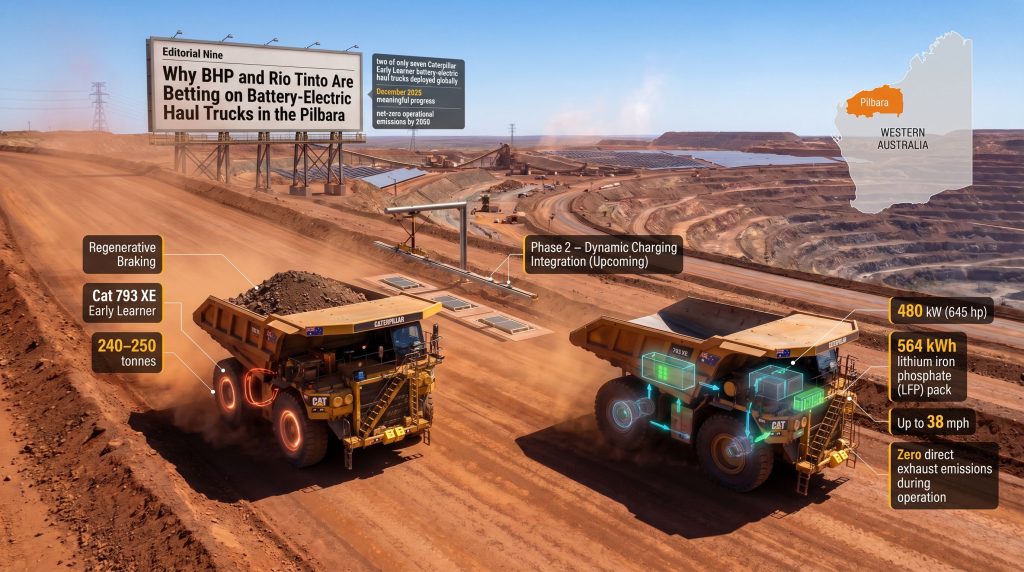
The immediate focus is Caterpillar’s Cat 793 XE Early Learner platform at BHP’s Jimblebar mine, where an initial three-month trial of two battery-electric haul trucks has been completed. According to company reports and industry coverage, including Rio Tinto’s update on the first Caterpillar battery-electric haul trucks in the Pilbara, the first stage delivered meaningful progress.
Furthermore, a second phase is set to examine charging while the trucks are operating. For investors, suppliers, and mining engineers, the significance is larger than one OEM trial. If battery-electric haul trucks work in the Pilbara, they stand a stronger chance of working almost anywhere in open-cut bulk mining.
This article discusses industrial technology, mining operations, and public company strategy. It is not financial advice, and any forward-looking statements about fleet electrification, costs, or adoption pathways remain uncertain.
## The Core Problem: Why Haul Trucks Dominate Mine Decarbonisation
In open-pit iron ore mining, diesel haulage is typically one of the biggest contributors to Scope 1 operational emissions. That is a structural issue, not a marginal one. Huge trucks run continuously, consume large volumes of fuel, and directly underpin mine throughput.
Both BHP and Rio Tinto have stated ambitions to reach net-zero operational emissions by 2050, which makes haulage decarbonisation especially important. While rail, processing plants, and stationary assets can sometimes decarbonise through power sourcing decisions, haul trucks require a different solution because they are mobile, energy-intensive, and productivity-critical.
In addition, the broader mining energy transition depends on solving these harder operational emissions rather than focusing only on easier wins. Several factors make haul truck electrification uniquely difficult:
- Payload sensitivity, because battery weight must not materially reduce tonnes moved per cycle
- High utilisation rates, leaving little room for downtime
- Extreme ambient temperatures in the Pilbara
- Long haul distances and elevation changes
- Infrastructure integration across power, charging, maintenance, and traffic flow
This is why battery-electric haul trucks are not simply a mining version of passenger EVs. Their economics and engineering must be judged at the system level.
## What the Cat 793 XE Early Learner Brings to the Trial
The truck being tested is not a paper concept or static prototype. It is an operating machine designed for real mine conditions.
### Key technical specifications
| Specification | Detail |
|---|---|
| Truck model | Caterpillar Cat 793 XE Early Learner |
| Payload capacity | 240 to 250 tonnes |
| Battery pack | 564 kWh lithium iron phosphate LFP |
| Motor output | 480 kW or about 645 hp |
| Top operating speed | Up to 38 mph, broadly in line with diesel equivalent |
| Tailpipe emissions | Zero direct exhaust emissions during operation |
| Energy recovery | Regenerative braking on downhill segments |
| Next trial step | Dynamic in-motion charging under evaluation |
The use of LFP chemistry is particularly notable. In mining, the highest energy density battery is not always the best choice. LFP generally offers:
- Better thermal stability
- Strong cycle life
- Lower thermal runaway risk
- A chemistry profile suited to repetitive heavy-duty work
Those trade-offs matter in the Pilbara, where heat, uptime requirements, and safety protocols can outweigh the benefits of maximum energy density.
### Why regenerative braking could be a major advantage
For heavy mining trucks, downhill loaded travel creates an unusual opportunity. Instead of wasting energy through braking, the truck can recover part of it. Consequently, in some haul profiles, regenerative braking can materially extend usable operating time.
However, that does not guarantee charge-neutral performance across every mine. Much depends on:
- Ramp gradients
- Cycle length
- Loaded versus empty travel
- Traffic delays and queueing
- Ambient heat and battery cooling load
In other words, mine geometry matters almost as much as the truck itself.
## Why Jimblebar Is a High-Value Test Site
BHP’s Jimblebar operation in the Pilbara is not a gentle proving ground. It is a large-scale iron ore mine operating under the same production pressures that future commercial battery fleets would face.
The site appears well suited for three reasons:
- It reflects real production intensity
- It exposes trucks to Pilbara heat, dust, and 24-hour operations
- It generates data transferable to other large iron ore systems
A further point adds to the trial’s significance: Jimblebar hosts two of only seven Caterpillar Early Learner battery-electric haul trucks deployed globally. That means the Pilbara contains a meaningful share of Caterpillar’s real-world learning fleet.
According to industry reporting on the battery-electric truck delivery, the arrival of these units underlines how strategically important the Pilbara has become for heavy mining electrification.
### Trial phases at Jimblebar
| Phase | Status | Main objective |
|---|---|---|
| Phase 1 | Completed | Establish baseline data on productivity, availability, and energy use |
| Phase 2 | Pending | Test in-motion charging while trucks continue operating |
The second phase could prove decisive. If in-motion charging works reliably, it may reduce the need for scheduled charging pauses. That would materially improve the commercial case because lost utilisation is one of the biggest risks in electrified haulage.
## Why This Is a Shared Trial Between Competitors
One of the most interesting aspects of the programme is the collaboration model. The initiative involves BHP, Rio Tinto, Caterpillar, and WesTrac, rather than a single miner quietly testing equipment on its own.
That structure reflects a reality often overlooked by generalist markets: early mining technology adoption is expensive, operationally risky, and heavily site-specific. Sharing initial learnings can therefore make sense when the challenge is industry-wide and the capital stakes are large.
For both miners, this approach may offer several benefits:
- Faster access to early operational data
- Reduced duplication of first-stage trial costs
- Better understanding of OEM support requirements
- A clearer benchmark for future fleet planning
After the joint learning stage, each company can still make independent decisions on deployment pace, vendor choices, and capital allocation.
## How the Pilbara Compares With Other Electric Haul Truck Programmes
Battery-electric mining truck development is accelerating globally, but not all trials are equally demanding. The current program also fits within wider mining electrification trends, where major producers are testing multiple pathways to cut diesel use.
### Selected programmes in the market
| Program | Operator | Truck model | Status |
|---|---|---|---|
| Jimblebar joint trial | BHP / Rio Tinto | Cat 793 XE Early Learner | Active, Phase 1 complete |
| Rio Tinto separate trial | Rio Tinto | Komatsu 930E battery-electric | Expected from 2026 |
| Caterpillar early learner fleet | Multiple sites | Cat 793 XE | 7 units globally |
| Other OEM development programmes | Multiple operators | Liebherr T 264, Komatsu variants | Various phases |
The Pilbara stands apart because it combines:
- Large production volumes
- Long asset operating hours
- Harsh climate conditions
- Complex haulage networks
- Investor visibility
A truck that performs well here earns a high level of credibility with the broader mining sector. That matters especially given the region’s central role in the global iron ore market outlook.
## The Three Infrastructure Bottlenecks That Still Need Solving
Even if truck performance is encouraging, fleet-wide electrification cannot happen without supporting systems.
### 1. Power supply and grid capacity
A fleet of trucks with 564 kWh battery packs creates substantial electricity demand. The challenge is not just total energy consumption, but also timing. Charging many high-capacity assets at similar times can create sharp demand peaks.
Key issues include:
- On-site grid strength
- Integration with renewable power for mines
- Storage buffering needs
- Reliability during extreme weather and maintenance events
### 2. Charging architecture
Static chargers are easier to understand but can create queueing, idle time, and layout constraints. Dynamic charging, if proven, could lower those frictions by embedding energy transfer into operating cycles.
However, dynamic systems raise their own questions:
- Where should charging segments be installed?
- How much haul road redesign is needed?
- What maintenance burden will the charging system add?
- Can it operate safely in dust-heavy, high-vibration conditions?
### 3. Battery life-cycle support
A crucial but less visible issue is the downstream service chain. Large-format mining batteries need:
- Inspection capability
- Cooling system support
- Replacement planning
- End-of-life handling and recycling pathways
Western Australia does not yet have a fully mature large-scale replacement and recycling ecosystem for battery packs of this type.
## What BHP and Rio Tinto Are Really Measuring
The headline question is not whether the trucks can move. It is whether they can move ore competitively. This is the commercial lens through which BHP and Rio Tinto electric haul trucks in Pilbara will ultimately be judged.
The most important metrics likely include:
- Availability
- Utilisation
- Productivity per cycle
- Total cost of ownership
- Scalability
This is where investor psychology often gets ahead of the data. Markets may celebrate low-emission narratives quickly, but miners usually commit only when productivity, reliability, and economics align.
In bulk commodities, decarbonisation technology is rarely adopted because it is interesting. It is adopted when it protects volume, reduces risk, and becomes financeable at scale.
## Rio Tinto’s Dual-OEM Approach Adds a Strategic Layer
Alongside the Caterpillar programme at Jimblebar, Rio Tinto is also expected to conduct an independent trial of Komatsu 930E battery-electric haul trucks beginning in 2026.
That matters because it suggests Rio is not treating electrification as a single-vendor decision. A parallel OEM approach can help with:
- Benchmarking performance across platforms
- Avoiding technology lock-in
- Strengthening procurement leverage
- Matching truck architecture to mine-specific haul profiles
For very large miners, vendor diversification can be a strategic risk-management tool. In addition, wider interest in zero-emission mine trucks shows the sector is still assessing multiple long-term haulage technologies.
## FAQs About BHP and Rio Tinto Electric Haul Trucks in Pilbara
### Where is the trial taking place?
The Caterpillar battery-electric haul truck trial is taking place at BHP’s Jimblebar iron ore mine in the Pilbara region of Western Australia.
### How many trucks are involved?
Two Cat 793 XE Early Learner battery-electric haul trucks are operating at Jimblebar.
### When did the trial begin?
On-site testing followed truck delivery in December 2025, and the initial three-month phase has now been completed.
### What happens next?
The upcoming phase is expected to test in-motion charging, with the goal of assessing whether trucks can recharge while still working.
### Have BHP or Rio Tinto committed to full fleet electrification?
No confirmed full-fleet commitment has been announced. Both companies are first testing whether the technology is operationally and commercially viable in Pilbara conditions.
## What Success Would Mean for the Mining Industry
If the Jimblebar trial eventually supports commercial rollout, the implications could be significant across Australian mining and beyond. Success for BHP and Rio Tinto electric haul trucks in Pilbara would show that electrified heavy haulage can function in one of the toughest bulk mining environments in the world.
Potential effects include:
- Lower long-term diesel dependence in bulk mining
- Greater demand for mine-site electrification infrastructure
- Expanded battery maintenance and recycling capability in Western Australia
- Faster OEM competition around ultra-class electric haul trucks
- A stronger operating template for iron ore decarbonisation globally
Still, investors and industry observers should stay grounded. A successful pilot does not automatically translate into rapid fleet replacement. Capital cycles, infrastructure lead times, OEM manufacturing capacity, and site-by-site haul profiles will all shape adoption.
For now, BHP and Rio Tinto electric haul trucks in Pilbara represent one of the most important live experiments in heavy industrial electrification. The early signal is encouraging, but the true test will come when engineering promise meets full-scale mining reality.
Could The Next Major ASX Discovery Change A Portfolio?
Discovery Alert’s proprietary Discovery IQ model delivers real-time alerts on significant ASX mineral discoveries, helping investors spot actionable opportunities as soon as they are announced. See how historic discoveries have delivered exceptional returns on Discovery Alert’s discoveries page and begin a 14-day free trial through the Discovery Alert home page.