June 23, 2026
When Science Confronts Speculation: Inside the Liberia Oil Discovery in Grand Bassa County
Frontier resource markets have a well-documented tendency to generate powerful narratives long before the geology can support them. Across sub-Saharan Africa, unverified discoveries have repeatedly triggered cycles of public excitement, political pressure, and eventual regulatory correction. The sequence is familiar: a visual observation sparks social media speculation, local communities begin anticipating economic transformation, and government institutions find themselves racing to verify claims that have already taken on a life of their own. The Liberia oil discovery in Grand Bassa County follows this pattern with remarkable precision, and the scientific and institutional response it has triggered offers an instructive case study in how frontier nations manage the tension between resource hope and empirical reality. Readers interested in frontier resource markets more broadly will find familiar dynamics at play here.
When big ASX news breaks, our subscribers know first
What the Laboratories Actually Found
The chain of events began in November 2025, when residents of Beon's Town, a community within Grand Bassa County, observed a thick black substance surfacing on a local river. The visual was striking enough to generate immediate speculation across social media platforms, with widespread claims circulating that Liberia had finally made its long-awaited crude oil breakthrough.
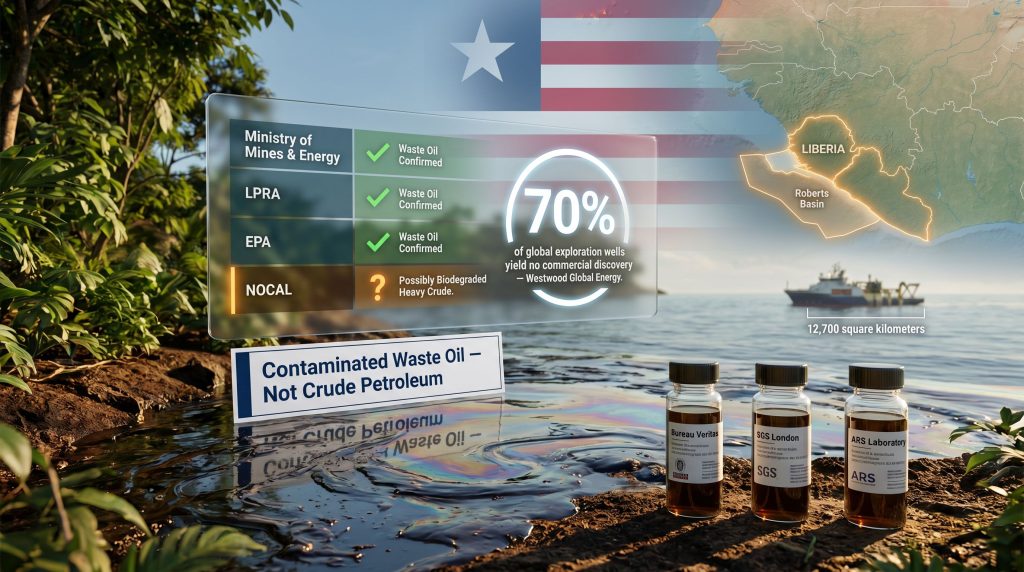
What followed was a structured, multi-laboratory scientific investigation involving some of the most credible testing institutions available to the Liberian government. Three internationally accredited facilities conducted independent analysis of site samples:
- Bureau Veritas, a globally recognised inspection, testing, and certification organisation
- SGS London, part of one of the world's largest testing and verification networks
- ARS Laboratory in the Czech Republic, providing independent European-based analysis
All three institutions reached the same conclusion. The substance recovered from the site does not exhibit the chemical or physical characteristics of naturally occurring crude petroleum. The material was identified as contaminated waste oil mixed with pollutants, consistent with industrial discharge rather than a subsurface hydrocarbon deposit.
Liberia's Ministry of Mines and Energy, led by Minister R. Matenokay Tingban, formally clarified the findings directly to the Legislature, stating that the recovered material lacks the properties associated with petroleum. Laboratory testing was conducted not only through the three accredited facilities mentioned above, but also through partner institutions in Ghana and Kenya, reflecting Liberia's practical reliance on regional and international scientific infrastructure for hydrocarbon verification work.
The convergence of three independent international laboratories on the same conclusion carries significant scientific weight. In petroleum geochemistry, independent replication is the standard threshold for scientific reliability.
The Institutional Disagreement That Complicates the Picture
What makes the Grand Bassa situation analytically interesting is not the majority scientific verdict, but the dissenting voice within Liberia's own state apparatus. The National Oil Company of Liberia (NOCAL) has advanced an alternative interpretation, suggesting the substance may represent highly biodegraded heavy crude oil rather than industrial waste contamination.
This is not a frivolous scientific position. Heavy crude oil that has undergone extensive biodegradation over geological timescales can lose many of the molecular markers that standard laboratory testing uses to identify petroleum. The lighter hydrocarbon fractions evaporate or are consumed by microorganisms, leaving behind a dense, viscous residue that can be chemically ambiguous under conventional testing protocols.
The institutional positions across Liberia's key regulatory bodies currently stand as follows:
| Institution | Scientific Position | Recommended Path Forward |
|---|---|---|
| Ministry of Mines and Energy | Contaminated waste oil confirmed | Further geological studies in Roberts Basin |
| Liberia Petroleum Regulatory Authority (LPRA) | Waste oil based on physical properties | No commercial exploration warranted at this stage |
| Environmental Protection Agency (EPA) | Contaminated substance, not crude petroleum | Environmental remediation should be prioritised |
| National Oil Company of Liberia (NOCAL) | Possibly highly biodegraded heavy crude | Advanced geochemical fingerprinting required |
This four-way split, where one state-owned enterprise disagrees with three other government bodies examining the same substance, has become the central governance tension driving the legislature's intervention. It also highlights a deeper challenge in frontier hydrocarbon assessment: standard testing methodologies have limitations when applied to heavily weathered or biodegraded materials.
Advanced Geochemistry: Why Standard Tests May Not Be Enough
NOCAL's position deserves closer examination from a technical standpoint, because it introduces a dimension of the debate that is rarely explained in public reporting. In petroleum geochemistry, the identification of crude oil relies heavily on the presence of specific biomarkers, molecular compounds that survive the transformation of organic matter into petroleum and serve as chemical fingerprints linking oil samples to their source rocks.
When crude oil undergoes severe biodegradation, these biomarkers can be selectively destroyed or altered, making identification increasingly difficult with conventional testing. The analytical techniques required to resolve such ambiguity include:
- Gas chromatography-mass spectrometry (GC-MS) to identify residual molecular fragments even in heavily degraded samples
- Stable isotope analysis to determine whether the carbon isotope ratios in the substance match known petroleum systems in the region
- Biomarker fingerprinting to compare the molecular architecture of the substance against regional crude oil reference libraries
- Thermogenic versus biogenic source discrimination, which determines whether any hydrocarbons present originated from deep thermal processes or surface-level biological activity
These techniques collectively constitute what is referred to as geochemical fingerprinting, and they represent the next logical scientific step regardless of which institutional interpretation proves correct. Furthermore, the legislature's Hydrocarbons Committee has explicitly called for this work to be conducted, reflecting a scientifically sound approach to resolving the ambiguity.
Parliament Steps In: The June 19 Vote and Its Significance
On June 19, 2026, Liberia's House of Representatives took the unusual step of unanimously adopting the findings of its Hydrocarbons Committee, placing formal legislative weight behind the scientific consensus. The committee's conclusions were unambiguous:
- There is no confirmed crude oil recovery operation in Grand Bassa County
- There is no commercially viable hydrocarbon discovery on record
- There is no evidence of proven petroleum reserves in the area
Committee Chairman and Representative Sam P. Jallah underscored that any declaration of an oil discovery must meet the threshold of independent scientific verification before it can be treated as credible. The committee's recommendations extended beyond the immediate question of the substance's identity, calling for a structured scientific programme that includes geological and geophysical studies across the Roberts Basin.
The unanimity of the parliamentary vote is significant. It signals that Liberia's legislative body is choosing institutional credibility and scientific rigour over the short-term political appeal of declaring a resource breakthrough, a posture that matters considerably for the country's long-term standing with foreign investors and exploration partners.
The Roberts Basin reference is particularly noteworthy from an exploration standpoint. This offshore sedimentary basin has been identified as Liberia's most prospective hydrocarbon structure, and directing future scientific attention toward it represents a substantive forward-looking recommendation rather than simply a conclusion about the current situation.
Two Decades of Exploration Without Commercial Success
Understanding the Grand Bassa episode requires situating it within Liberia's broader petroleum history, which stretches back more than two decades without yielding a single commercial discovery. The broader question of exploration risk and discovery is, consequently, central to how international investors assess Liberia's potential.
From the early 2000s onward, Liberia actively courted international energy majors in pursuit of its first oil production. Several of the world's most technically capable exploration companies held offshore licences at various points:
- Chevron (United States)
- ExxonMobil (United States)
- Repsol (Spain)
Despite multiple offshore drilling campaigns across prospective acreage, none of these programmes produced a commercially viable result. Liberia today imports 100% of its petroleum products, making it entirely dependent on global oil markets for domestic energy supply. For context on broader price dynamics affecting import-dependent nations, the crude oil market update for 2025 illustrates the fiscal pressures such dependency creates.
This exploration track record is, statistically speaking, unremarkable. According to data from Westwood Global Energy, approximately 70% of all exploration wells drilled globally do not result in a commercially viable discovery. Liberia's outcomes are consistent with this global norm, not an outlier. The country's geology may be prospective in theory, but prospectivity does not translate automatically to commercial viability.
The next major ASX story will hit our subscribers first
TotalEnergies and the Offshore Pathway
The most credible near-term pathway to a legitimate Liberia oil discovery currently sits offshore, not in any riverine community in Grand Bassa County. In September 2025, the Liberian government awarded four offshore exploration blocks to TotalEnergies of France, covering a combined area of 12,700 square kilometres.
| Metric | Detail |
|---|---|
| Number of Blocks Awarded | 4 offshore exploration blocks |
| Total Acreage | 12,700 square kilometres |
| Awarded Company | TotalEnergies (France) |
| Award Date | September 2025 |
| Immediate Priority | 3D seismic data acquisition |
| Drilling Decision Status | Pending seismic interpretation |
TotalEnergies has indicated that its immediate focus is the acquisition of three-dimensional seismic data across the awarded blocks before committing to any drilling programme. This approach reflects modern exploration best practice. Three-dimensional seismic surveys provide detailed subsurface imaging that allows geologists to identify structural traps, map sedimentary sequences, and assess reservoir potential with substantially greater confidence than older two-dimensional methods.
The decision to invest in seismic acquisition before drilling is also an investor-grade risk management discipline. Drilling a single deepwater exploration well can cost anywhere from $50 million to over $150 million depending on water depth and well complexity. Seismic data that reduces the probability of a dry hole, however, represents a substantial capital efficiency improvement.
No public drilling timeline has been announced by TotalEnergies for its Liberian blocks.
Environmental Consequences: A Problem Regardless of Origin
One dimension of the Grand Bassa situation that risks being overshadowed by the petroleum debate is the immediate environmental concern. Whether the black substance in the river ultimately proves to be industrial waste oil or a degraded petroleum seep, its presence in a riverine environment constitutes a contamination event that carries real consequences for local communities.
The Environmental Protection Agency's involvement signals awareness of this dimension, and the risks are not trivial:
- Freshwater ecosystem disruption, affecting aquatic species and the broader riverine food chain
- Contamination of community water sources used for drinking and agricultural irrigation
- Direct health risks to residents who come into physical contact with the substance or consume water from affected areas
- Long-term soil contamination in areas where the substance has spread beyond the river channel
Liberian authorities have explicitly advised residents to avoid contact with the substance and to disregard unverified social media reports about its origin. This public health advisory applies regardless of how the scientific debate about the substance's nature is ultimately resolved.
The EPA's focus on environmental remediation is the appropriate near-term priority, and it is a response that serves community welfare independently of whether NOCAL's biodegraded heavy crude theory or the Ministry's waste oil conclusion proves correct.
The Misinformation Dynamic in Frontier Resource Markets
The speed with which unverified oil discovery claims spread across social media platforms in the Grand Bassa case is not unique to Liberia. Across frontier resource markets, the combination of economically aspirational communities, limited access to real-time scientific information, and the virality of social media creates a structural vulnerability to premature resource speculation. In addition, the broader resource geopolitics overview for 2025 demonstrates how quickly institutional credibility can be undermined when verification lags behind public narrative.
What makes this dynamic particularly consequential is that it can generate political pressure that distorts the governance response. When large numbers of citizens believe a major discovery has occurred, there can be institutional incentives to validate rather than investigate, to announce rather than verify. The unanimous parliamentary vote of June 19 demonstrates that Liberia's legislative institutions have, in this instance, resisted that pressure.
Proactive government science communication, including timely public updates from credible institutional sources, is increasingly recognised as a necessary governance tool in frontier markets where resource speculation travels faster than laboratory results.
The gap between what residents observed in November 2025 and what three international laboratories confirmed by mid-2026 represents a roughly seven-month period during which public expectations and scientific reality existed in significant tension. Managing that gap more efficiently in the future will require investment in both analytical capacity and communication infrastructure.
Frequently Asked Questions: Liberia Oil Discovery in Grand Bassa County
Has crude oil been confirmed in Grand Bassa County, Liberia?
No. As of June 2026, three internationally accredited laboratories including Bureau Veritas, SGS London, and ARS Laboratory have identified the substance as contaminated waste oil rather than naturally occurring petroleum. No commercially viable crude oil has been confirmed in the Liberia oil discovery in Grand Bassa County investigation.
Why does NOCAL's position differ from the other government agencies?
NOCAL has suggested the substance may be highly biodegraded heavy crude, which loses standard petroleum markers over time and requires advanced geochemical testing to properly characterise. The Ministry of Mines, the LPRA, and the EPA, however, maintain it is waste oil based on currently available evidence.
What did Liberia's Parliament decide in June 2026?
On June 19, 2026, the House of Representatives unanimously adopted findings from its Hydrocarbons Committee, concluding there is no confirmed crude oil recovery, no commercially viable discovery, and no proven reserves in Grand Bassa County. Additional geological, geophysical, and geochemical studies were recommended. The full legislative record from the Hydrocarbons Committee provides further detail on the House's position.
What is geochemical fingerprinting and why does it matter here?
Geochemical fingerprinting uses techniques such as GC-MS analysis and stable isotope profiling to determine whether a substance shares a molecular signature with known petroleum systems. It can resolve ambiguity in cases where standard testing is insufficient, particularly for heavily biodegraded materials.
What is TotalEnergies doing in Liberia?
TotalEnergies was awarded four offshore exploration blocks covering 12,700 square kilometres in September 2025. The company is prioritising 3D seismic data acquisition before making any drilling decisions, with no public timeline announced for drilling.
Is the substance in Grand Bassa dangerous to local residents?
Authorities have advised residents to avoid direct contact with the substance. Contaminated waste oil in riverine environments poses risks to water quality, aquatic ecosystems, and human health regardless of the substance's ultimate origin.
Readers seeking broader context on West African energy sector developments can explore ongoing coverage from Ecofin Agency, which tracks African hydrocarbon exploration and energy policy across the continent.
Want to Stay Ahead of the Next Significant Mineral Discovery?
While frontier hydrocarbon stories like Liberia's Grand Bassa investigation unfold over months of laboratory analysis and parliamentary debate, Discovery Alert's proprietary Discovery IQ model delivers real-time notifications the moment significant ASX mineral discoveries are announced — explore historic discoveries and their returns to understand what early positioning can mean, then begin your 14-day free trial to ensure you're never behind the market again.