May 15, 2026
Mining sector valuations fundamentally depend on operational throughput rather than speculative trading patterns. For BHP Group Ltd (ASX: BHP), this relationship becomes particularly evident when examining five-year performance data through production-focused analytical frameworks. BHP share price analysis reveals how operational excellence drives sustainable valuation premiums despite broader commodity market volatility.
Understanding Production Performance Through Operational Metrics
Production Volume Analysis (April 2021 vs April 2026)
| Production Metric | April 2021 | April 2026 | Performance Change |
|---|---|---|---|
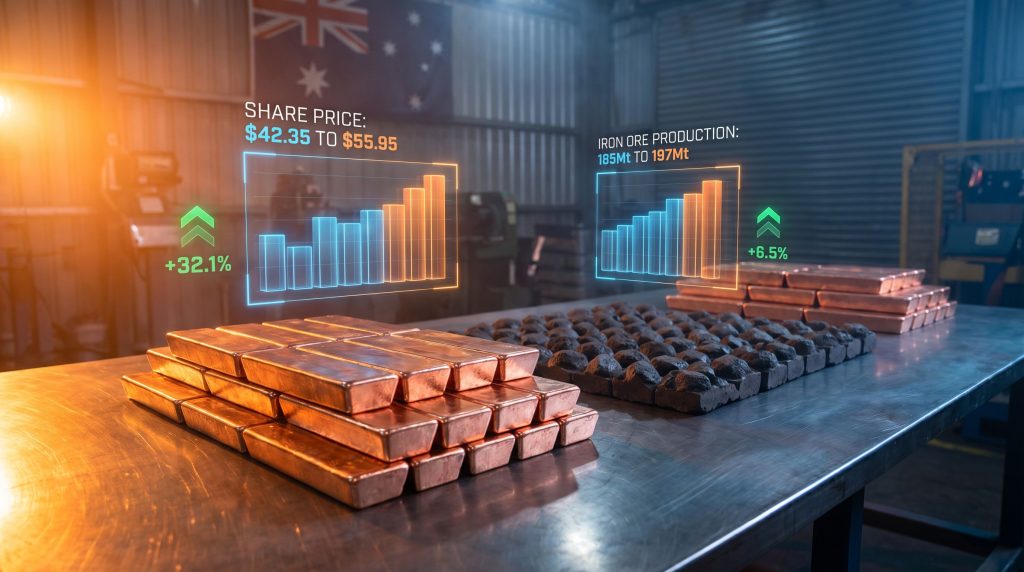
| Iron Ore (9-month period) | ~185 million tonnes | 197 million tonnes | +6.5% increase |
| Copper (9-month period) | ~1.51 million tonnes | 1.461 million tonnes | -3.2% decrease |
| Share Price (AUD) | $42.35 | $55.95 | +32.1% appreciation |
| Investment Efficiency | 118 shares per $5,000 | 89 shares per $5,000 | -24.6% purchase capacity |
The Western Australia Iron Ore operations achieved record production levels during this assessment period. This production efficiency creates a foundation for sustainable cash flow generation that extends beyond short-term price fluctuations.
Mining companies typically generate returns through three primary mechanisms: volume optimisation, cost management, and quality premiums. BHP's integrated operations model provides advantages across all three categories through port-to-pit coordination systems that reduce logistics expenses while maximising extraction efficiency.
When big ASX news breaks, our subscribers know first
Market Cycle Dynamics and Commodity Price Correlations
Resource sector equities demonstrate stronger sensitivity to underlying commodity fundamentals than general market sentiment. Furthermore, iron ore price trends and copper market dynamics operate independently of broader equity market trends.
Commodity Market Influence Factors:
• Iron ore price stabilisation driven by sustained Chinese infrastructure demand
• Copper supply constraints creating premium pricing environments
• Operational leverage amplifying commodity price movements through fixed-cost structures
• Quality premiums for high-grade ore maintaining margin resilience
The 32% share price appreciation from April 2021 to April 2026 reflects these underlying commodity dynamics rather than speculative trading activity. Iron ore production increases of 6.5% during this period demonstrate capacity utilisation improvements that translate directly to revenue generation capabilities.
Cyclical sector positioning requires understanding economic cycle timing and commodity demand patterns. Australia's mining sector currently benefits from the global transition toward renewable energy infrastructure, which drives sustained demand for copper-intensive technologies.
Market Psychology Insight: Mining sector valuations often disconnect from operational reality during sentiment-driven trading periods, creating opportunities for investors focused on production metrics and long-term commodity demand trends.
However, iron ore markets face different dynamics with anticipated supply increases from African and Brazilian operations potentially pressuring pricing through 2026. In addition, moderating Chinese steel demand creates a more complex valuation environment for diversified miners like BHP.
What Are the Current Analyst Consensus Views?
Professional analyst coverage provides insight into how institutional investors evaluate operational performance against share price positioning. Current consensus data from 20 tracked analysts reveals divided sentiment regarding near-term performance expectations.
Analyst Rating Distribution (April 2026):
| Rating Category | Number of Analysts | Percentage | Consensus Target |
|---|---|---|---|
| Hold | 11 | 55% | Neutral positioning |
| Buy/Strong Buy | 7 | 35% | Bullish outlook |
| Sell | 2 | 10% | Bearish assessment |
| Average Target Price | $54.06 | 100% | 4% downside implied |
This analyst distribution suggests uncertainty about near-term catalysts following the strong annual rally performance. The ASX data shows the average target price of $54.06 compared to the current $55.95 trading level indicates potential consolidation expectations rather than continued momentum.
Integrated Operations Model and Competitive Positioning
BHP's strategic advantages stem from operational integration rather than pure scale economics. For instance, the company's port-to-pit coordination systems create cost efficiencies that extend beyond simple production volume benefits.
Operational Integration Benefits:
• Logistics Optimisation: Direct coordination between mining sites and export facilities reduces transportation costs and inventory carrying expenses
• Technology Deployment: Centralised systems enable consistent application of extraction optimisation technologies across multiple sites
• Scale Economics: Multi-commodity operations provide diversification benefits and shared infrastructure utilisation
• Quality Control: Integrated processing ensures consistent product specifications that command premium pricing
The company maintains dividend sustainability through low-cost operational positioning rather than commodity price dependence. This approach enables continued shareholder returns during market downturns while preserving capital for expansion opportunities during favourable conditions.
BHP's dividend framework targets yields between 4-6% with full franking benefits, supported by operational cash flow generation rather than balance sheet management. The company's dividend history extends to 2006 with consistent payments maintained through multiple commodity cycles.
Operational Excellence Framework: Sustainable competitive advantages in mining require operational capabilities that competitors cannot easily replicate, including integrated logistics systems, technology deployment, and cost structure optimisation.
Technology investments focus on data-driven mining operations that optimise extraction rates while reducing operational costs. These investments create productivity improvements that translate to margin expansion during favourable commodity price environments.
Leadership Transition and Strategic Direction
Executive leadership changes in major mining companies often signal strategic direction shifts that affect operational priorities and capital allocation decisions. BHP's upcoming CEO transition represents continuity in operational strategy while potentially adjusting geographical and commodity focus.
Leadership Transition Timeline:
• Current CEO: Mike Henry (tenure: six and a half years)
• Incoming CEO: Brandon Craig (effective July 1, 2026)
• Previous Role: President, Americas operations
• Strategic Implications: Enhanced focus on Western Hemisphere operations and copper-centric growth
Brandon Craig's background in Americas operations suggests potential emphasis on copper operations expansion. Consequently, this aligns with energy transition catalysts and copper demand trends.
The leadership continuity approach indicates strategic consistency rather than dramatic operational changes. This stability supports current operational frameworks while enabling tactical adjustments for emerging market opportunities.
How Do Energy Transition Requirements Affect BHP's Strategy?
Long-term mining sector performance increasingly depends on alignment with global energy transition requirements. BHP's commodity portfolio positioning provides exposure to both traditional infrastructure metals and renewable energy transition materials.
Copper Demand Growth Drivers:
• Electric Vehicle Adoption: Each electric vehicle requires approximately 4x more copper than conventional vehicles for motors, batteries, and charging infrastructure
• Renewable Energy Infrastructure: Wind turbines and solar installations require significant copper content for electrical components and grid connectivity
• Grid Modernisation: Smart grid technologies and energy storage systems create sustained copper demand for conductivity applications
• Industrial Electrification: Manufacturing process electrification increases copper requirements across multiple industrial sectors
Copper supply constraints result from limited new project development and extended project development timelines. Major copper deposits require 7-15 years from discovery to production, creating structural supply deficits during demand growth periods.
Iron Ore Market Rebalancing:
Iron ore demand faces more complex dynamics with Chinese steel demand moderation offsetting infrastructure investment in other regions. Supply increases from African and Brazilian operations may pressure pricing through increased global availability.
Investment Consideration: Energy transition metal exposure provides portfolio diversification benefits during economic transitions, but requires understanding of technological adoption rates and policy implementation timelines.
Quality premiums for high-grade iron ore may persist due to environmental regulations favouring efficient steel production processes. BHP's high-grade Australian ore maintains advantages in markets prioritising reduced carbon emissions from steel manufacturing.
Operational Performance Evaluation Framework
Investor assessment of mining companies requires focus on operational metrics that indicate sustainable competitive positioning. BHP share price analysis should emphasise production efficiency, cost management, and reserve replacement capabilities rather than short-term financial results.
Primary Operational Key Performance Indicators:
1. Production Volume Metrics
- Quarterly production growth rates compared to capacity utilisation
- Production consistency across commodity cycles
- Ability to increase output during favourable market conditions
2. Cost Management Benchmarking
- Cash cost per tonne positioning on industry cost curves
- Cost inflation management during economic expansion periods
- Operational efficiency improvements through technology deployment
3. Reserve Life and Replacement
- Exploration success rates extending mine life estimates
- Resource quality maintenance or improvement through development
- Capital efficiency in reserve development and production capacity expansion
4. Safety and Environmental Performance
- Lost time injury frequency rates compared to industry standards
- Environmental compliance record and permit maintenance
- Community relations and social licence sustainability
Dividend Sustainability Analysis Framework:
BHP's dividend reliability stems from operational flexibility enabling cash flow generation across commodity cycles. The company's integrated operations model provides cost advantages that support dividend payments during market downturns.
| Dividend Metric | Performance Indicator | Sustainability Factor |
|---|---|---|
| Yield Range | 4-6% fully franked | Operational cash flow backed |
| Payment History | Consistent since 2006 | Multiple cycle resilience |
| Coverage Ratio | Operational cash flow based | Production volume flexibility |
| Cycle Resilience | Maintained during downturns | Low-cost positioning |
The fully franked dividend structure provides Australian investors with tax efficiency benefits that enhance after-tax returns compared to unfranked alternatives. This taxation advantage creates additional value for domestic investors evaluating income-focused strategies.
What Are the Key Risk Factors for BHP Investors?
Mining sector investments require comprehensive risk evaluation encompassing operational, commodity, and regulatory factors. However, BHP's diversified commodity exposure provides both risk mitigation and complexity in assessment requirements.
Primary Risk Categories:
Commodity Price Volatility
- Iron ore price sensitivity to Chinese infrastructure demand
- Copper price correlation with global economic growth and electrification rates
- Currency exchange rate impacts on revenue translation
Operational Risk Factors
- Production disruption potential from weather, equipment, or labour issues
- Cost inflation pressures from energy, labour, and equipment expenses
- Technology implementation challenges affecting productivity targets
Regulatory and Environmental Considerations
- Environmental compliance costs and permit renewal requirements
- Carbon pricing impacts on operational cost structures
- Community relations and social licence maintenance
Climate Transition Risks
- Fossil fuel exposure through metallurgical coal operations
- Carbon emission reduction requirements affecting operational processes
- Stranded asset potential from energy transition acceleration
The company also faces tariff market risks that could affect international trade dynamics and commodity pricing structures.
Scenario Modelling Framework:
Bull Case Development:
- Copper supply deficits driving sustained premium pricing above $4.50/lb
- Iron ore quality premiums expanding margins by $15-20/tonne
- Operational efficiency gains reducing unit costs by 5-10%
Base Case Assumptions:
- Commodity prices stabilising near current levels with cyclical variation
- Production volume growth maintaining 3-5% annual increases
- Cost inflation management through operational efficiency improvements
Bear Case Considerations:
- Chinese demand slowdown reducing iron ore volumes by 15-20%
- Copper substitution technologies reducing long-term demand growth
- Carbon pricing increasing operational costs by 8-12%
Risk Management Insight: Diversified commodity exposure provides portfolio benefits during economic transitions, but requires active monitoring of individual commodity cycle timing and regulatory development impacts.
The next major ASX story will hit our subscribers first
Investment Framework and Strategic Positioning
BHP's investment proposition centres on operational capabilities that generate sustainable returns across commodity cycles rather than pure commodity price speculation. Furthermore, copper investment insights reveal how the company's production efficiency, integrated logistics, and strategic commodity positioning create defensive characteristics during market volatility.
Investment Framework Summary:
Current Valuation Assessment: Share price reflects operational efficiency premiums and production record achievements, with analyst consensus suggesting fair value near current levels
Dividend Sustainability Factors: Low-cost operational positioning supports 4-6% fully franked yields through commodity cycles with 20-year payment consistency
Growth Catalyst Identification: Copper-focused expansion opportunities aligned with energy transition demand provide long-term volume growth potential
Risk Management Approach: Diversified commodity exposure with operational flexibility enables performance sustainability during individual commodity market downturns
The company's Western Australia Iron Ore systems demonstrate operational excellence through record production achievements while maintaining cost competitiveness. This operational foundation provides stability for dividend payments and capital allocation flexibility during market transitions.
Comprehensive financial analysis supports the view that operational integration and technology deployment create competitive advantages that support premium valuations during favourable market conditions.
Strategic Positioning Evaluation:
• Commodity Portfolio: Balanced exposure to infrastructure metals (iron ore) and energy transition materials (copper)
• Operational Efficiency: Integrated systems providing cost advantages and production flexibility
• Capital Discipline: Consistent dividend policy supported by operational cash flow generation
• Technology Investment: Automation and optimisation systems enhancing productivity and cost management
• Geographic Diversification: Operations across stable jurisdictions with established regulatory frameworks
Current market positioning suggests BHP shares offer defensive characteristics for investors seeking commodity sector exposure with operational excellence backing. Consequently, BHP share price analysis demonstrates how the company's production record and strategic positioning provide foundation for sustained performance evaluation beyond short-term trading volatility.
Ready to Identify the Next Major Mineral Discovery?
Discovery Alert instantly alerts investors to significant ASX mineral discoveries using its proprietary Discovery IQ model, turning complex mineral data into actionable insights for both short-term traders and long-term investors. Understand why major mineral discoveries can generate substantial returns and begin your 14-day free trial today to position yourself ahead of the market.