
May 15, 2026
When the Rules of Copper Demand Get Rewritten
For most of the past century, copper's fate was tied almost entirely to construction activity, manufacturing output, and the pace of industrial urbanisation. Analysts modelled copper demand around steel mills, housing starts, and electrical grid rollouts in emerging economies. That framework worked well enough for decades, and the commodity moved in predictable cycles tied to Chinese growth rates and global infrastructure spending.
Then two things happened simultaneously. The electrification transition began reshaping long-term copper demand in ways that traditional cycle models struggled to quantify. And before the investment community had fully priced in that structural shift, a second and arguably more immediate demand driver emerged from an entirely unexpected direction: the artificial intelligence infrastructure boom and the explosive growth of data centre construction.
Understanding how these two forces interact, and how the Morgan Stanley BHP share price target of A$67.50 reflects that intersection, requires unpacking both the mechanics of the copper demand drivers and the strategic positioning of BHP Group Ltd (ASX: BHP) within what is becoming a genuinely transformed commodity landscape.
When big ASX news breaks, our subscribers know first
Why the Morgan Stanley BHP Share Price Target Sits Above the Crowd
What Analyst Price Targets Actually Mean for Investors
Before examining Morgan Stanley's specific position, it is worth clarifying what a price target actually represents in practice. An analyst's 12-month price target is a forward valuation estimate constructed from modelled earnings, assumed commodity prices, applied discount rates, and production ramp timelines. It is not a guaranteed outcome, a trading signal, or an endorsement in isolation.
The distinction between an Overweight rating and a Buy recommendation matters here. An Overweight rating signals that the analyst expects the stock to outperform its sector peers over a defined period, typically 12 months. A Buy recommendation is a more absolute statement suggesting the stock should be purchased regardless of relative positioning. Morgan Stanley maintains an Overweight rating on BHP, meaning the conviction is primarily about relative outperformance against sector comparisons rather than an absolute return guarantee.
A price target reduction paired with a maintained Overweight rating does not constitute a bearish signal. It represents a recalibration of expected upside magnitude while preserving the underlying conviction that the stock will outperform its peers.
This nuance is frequently missed by retail investors who interpret any downward revision as a warning sign. In practice, the rating is the more structurally significant signal, and Morgan Stanley has held its Overweight conviction on BHP through multiple target adjustments.
Morgan Stanley's BHP Target: From A$43.50 to A$67.50
The Morgan Stanley BHP share price target has undergone a notable directional journey across 2025 and into 2026. Tracking that progression reveals how the firm's underlying commodity assumptions and production outlook have evolved.
| Period | ASX Price Target (AUD) | Rating | Primary Driver |
|---|---|---|---|
| April 2025 | A$57.50 | Overweight | Upward commodity assumptions revision |
| Mid-2025 | A$44.00 | Overweight | Base and bull case recalibration |
| Late 2025 | A$43.50 | Overweight | Bear case improvement; FY2025 cash stronger than modelled |
| May 2026 | A$67.50 | Overweight | Structural copper demand uplift; AI data centre growth |
The trajectory from A$43.50 to A$67.50 across approximately six months represents a 55% increase in the stated price target, driven by a fundamental reassessment of copper's demand architecture. Morgan Stanley's separate valuation of BHP's U.S.-listed ADR line (BHPLF) was revised to a range of $41.00 to $41.27, with the variance between the two figures reflecting currency dynamics and structural differences in how the American depositary receipt is priced relative to the ASX-listed security.
The improvement in the bear case scenario between late 2025 and May 2026 is also worth noting. A stronger-than-expected FY2025 cash position gave BHP's balance sheet additional resilience, effectively raising the floor on downside scenarios even before factoring in copper upside.
The Copper Demand Thesis Driving BHP's Re-Rating
Two Demand Drivers Colliding at the Same Time
Copper has historically operated on a single dominant demand cycle at any given time. For much of the 2010s, that cycle was Chinese infrastructure and property construction. From approximately 2020 onward, the dominant narrative shifted toward electrification: electric vehicles, grid modernisation, and renewable energy installations. Each of these applications requires meaningful copper inputs, and the cumulative effect created a demand floor that was structurally higher than prior-cycle models anticipated.
What makes the current moment unusual is that a second major demand driver has emerged while the energy transition is still accelerating rather than plateauing. Furthermore, the copper supply crunch compounds this dynamic, as Morgan Stanley's research identifies AI-driven data centre construction as a material and growing source of copper consumption that operates largely independently of the electrification cycle.
The quantitative framing Morgan Stanley applies to this trend is striking in its scale:
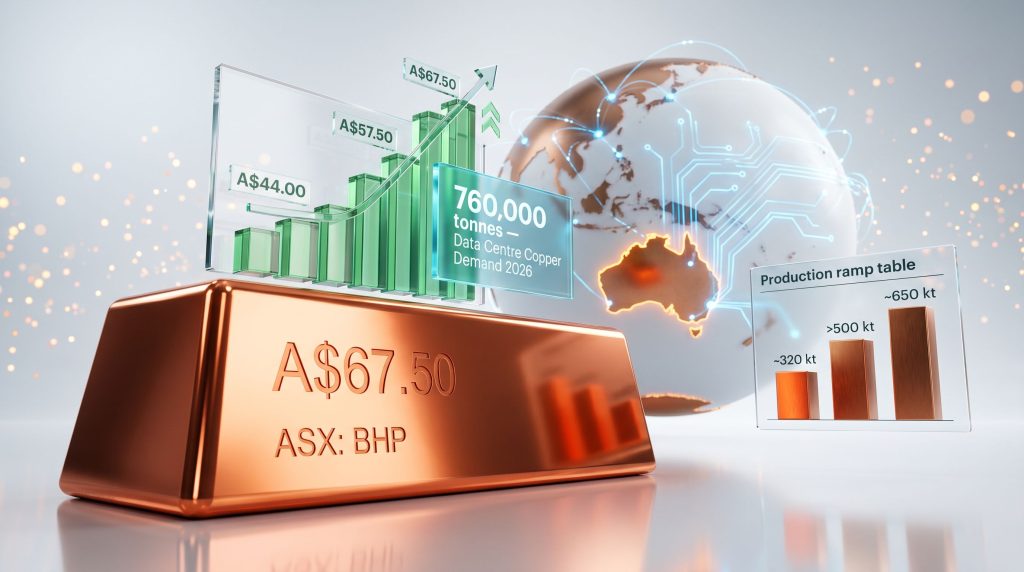
- Data centre copper demand is estimated to reach approximately 760,000 tonnes in 2026
- That figure is projected to grow to approximately 1.1 million tonnes by 2027
- The year-on-year increase in 2026 alone, roughly 250,000 tonnes, would account for approximately 26% of total global copper demand growth for that year
- In a higher-demand scenario, data centre copper consumption could represent approximately 4.9% of global copper demand by 2027, a proportion comparable to electric vehicle demand at roughly 5.1%
These figures reframe the data centre story from a peripheral demand contributor to a demand driver of comparable scale to the EV sector, an asset class that has been central to copper bull cases for years.
Where Copper Goes Inside a Data Centre
A detail that is frequently overlooked in generalist coverage of the AI-copper demand thesis is precisely where within data centre infrastructure the copper is consumed. The assumption that server hardware drives consumption is largely incorrect.
Morgan Stanley's research indicates that approximately 75% of copper demand within data centres is tied to power distribution infrastructure rather than server components or cooling systems. This includes cables, busbars, connectors, and grounding systems, all of which must scale proportionally with the facility's power capacity rather than its computational density.
This matters for demand modelling because power infrastructure copper requirements scale with facility capacity expansion in a relatively linear fashion. As data centres grow larger and more numerous to support AI workloads, power distribution copper demand grows in direct proportion.
The power infrastructure fraction of data centre copper demand is largely insensitive to improvements in semiconductor efficiency. Chips may consume less power per calculation, but the total power envelope of global data centre capacity continues to expand, meaning copper demand for distribution infrastructure follows total capacity rather than computational efficiency ratios.
Against a backdrop of supply constraints in major copper-producing regions, this additional layer of structural demand reinforces the tightness Morgan Stanley sees in the copper market through the forecast period.
BHP's Copper South Australia: A Province-Scale Growth Engine
How the Smelter and Refinery Expansion Changes the Production Calculus
BHP's strategic pivot toward copper is most visibly expressed through its Copper South Australia operations, a portfolio of assets centred on Olympic Dam but extending to Prominent Hill and Carrapateena, with potential future integration of Oak Dam. These copper expansion plans reflect a broader industry pivot toward positioning for structural demand growth.
The smelter and refinery expansion (SRE) at Olympic Dam is the operational cornerstone of this strategy. Rather than functioning as an isolated processing facility serving only Olympic Dam's own production, the expanded system is designed to operate as a centralised processing hub for a broader network of satellite mines.
| Production Phase | Copper Output Target | Key Enabler |
|---|---|---|
| Current | ~320 ktpa | Existing Olympic Dam operations |
| Phase 1 (Post-SRE) | >500 ktpa | SRE completion; feed blending from satellite operations |
| Long-Term Target | ~650 ktpa | Full province-scale integration; Oak Dam and third-party feed |
The production pathway from approximately 320,000 tonnes per annum today to a long-term target of approximately 650,000 tonnes per annum represents a potential 103% increase in copper output from the South Australia province alone, without requiring the discovery and development of entirely new mining jurisdictions.
Feed Blending as a Competitive Advantage
One of the less discussed technical aspects of the SRE is its feed blending capability. Olympic Dam's ore body produces a concentrate with distinctive characteristics, including uranium content and specific mineralogical composition, that create processing complexity. By enabling the facility to import and blend concentrate feed from Prominent Hill and Carrapateena, the expanded system can optimise the composition of material entering the furnace.
This blending function delivers several operational benefits simultaneously:
- Improved furnace stability through more consistent feed composition
- Higher acid capture rates, reducing both environmental impact and reagent costs
- Expanded refining capacity allowing higher throughput with existing infrastructure footprint
- Enhanced precious metals recovery, improving by-product revenue from gold and silver streams
- Reduced processing variability, which directly improves unit economics and production cost predictability
The ability to process third-party concentrate through Olympic Dam also creates a potential revenue stream beyond BHP's own production, effectively monetising spare processing capacity during periods when satellite feed volumes are lower than maximum throughput.
How Morgan Stanley's Target Compares to the Broader Analyst Consensus
Understanding the Gap Between Morgan Stanley and the Market
The Morgan Stanley BHP share price target of A$67.50 sits in notably different territory from the broader analyst consensus. According to analyst forecasts, the average 12-month price target across all covering analysts sits at approximately A$44.02, with the full range spanning from a low of approximately A$28.57 to a high of approximately A$52.00.
Morgan Stanley's target of A$67.50 therefore sits approximately 30% above the previous consensus high and more than 53% above the consensus average. This is a substantial divergence for a major-index constituent with widespread analyst coverage.
| Metric | Value |
|---|---|
| Consensus Average Target | ~A$44.02 |
| Consensus Range Low | ~A$28.57 |
| Consensus Range High | ~A$52.00 |
| Morgan Stanley Target | A$67.50 |
| MS Premium to Consensus Average | ~53.3% |
| MS Premium to Consensus High | ~29.8% |
Divergences of this magnitude from a major institution typically reflect one of three structural differences in the underlying analytical framework: a materially higher commodity price assumption, a more aggressive production ramp timeline applied to Copper South Australia, or a higher earnings multiple reflecting a premium for strategic positioning in structural demand themes. Morgan Stanley's explicit emphasis on the data centre-driven copper demand thesis suggests the differentiation is primarily demand-side, though production ramp optimism around the SRE timeline likely also contributes.
What the Ratings Distribution Tells Us
Across all analysts covering BHP, the distribution of ratings shows a majority in the Buy or Overweight category, a moderate minority in Hold or Neutral territory, and only a small proportion in Sell or Underweight. This broad bullish lean reflects consensus agreement on BHP's quality as a business and its strategic positioning in key commodities. However, significant disagreement exists on the precise level of upside, particularly given the commodity price performance sensitivity inherent in commodity price performance outcomes for major miners.
The factors creating divergence between bullish and more cautious analyst positions break down predictably:
Factors supporting more bullish targets:
- Copper structural demand uplift from both the energy transition and AI infrastructure
- Iron ore volume stability supporting consistent free cash flow generation
- Balance sheet strength providing resilience across commodity scenarios
- Copper South Australia growth optionality at multiple production scales
Factors creating more cautious positions:
- Iron ore price sensitivity to the China steel outlook and property cycle
- Execution risk associated with the Olympic Dam SRE timeline and cost management
- Broader commodity cycle timing uncertainty if global growth moderates
- Currency risk from AUD movements affecting translated earnings
BHP Share Price Context and What the Morgan Stanley Target Implies
Where the Shares Have Travelled and the Implied Return
BHP shares recently traded at approximately A$60.38, representing a substantial recovery from their 12-month low of approximately A$35.52. The scale of this recovery, roughly A$24.86 per share or approximately 70% from trough to the recent trading level, already reflects meaningful re-rating of BHP's copper assets and a broader resources sector recovery.
At A$60.38, BHP's market capitalisation sits at approximately A$315.4 billion, placing it among the largest companies on the ASX by total market value.
| Metric | Value |
|---|---|
| Recent Share Price | ~A$60.38 |
| 12-Month Low | ~A$35.52 |
| Recovery from Trough | ~70% |
| Morgan Stanley Price Target | A$67.50 |
| Implied Upside to MS Target | ~11.8% |
| Current Dividend Yield | ~3.15% |
| Total Return Potential (if target reached) | ~15% |
The implied upside of approximately 11.8% from the recent trading price to Morgan Stanley's A$67.50 target is more modest than the target's headline figure might suggest given the significant recovery already embedded in the share price. Adding the approximately 3.15% dividend yield produces a total return potential of approximately 15% over a 12-month horizon if the target is reached, a figure that is meaningful but calibrated against a price that has already incorporated substantial re-rating.
The next major ASX story will hit our subscribers first
What Investors Should Weigh Before Acting on Any Price Target
The Limits of a Single Analyst's View
The Morgan Stanley BHP share price target provides a structured framework for thinking about the company's valuation, but it carries limitations that are worth articulating explicitly. Price targets are constructed from assumptions that can shift rapidly and significantly: copper and iron ore prices move in response to macroeconomic data, supply disruptions, and demand signals that no model can fully anticipate.
Informed investors use analyst targets as inputs within a broader framework rather than as primary decision drivers. Relevant questions include:
- Does your own view on copper's demand trajectory align with Morgan Stanley's data centre-driven thesis?
- What is your assessment of BHP's ability to execute the Olympic Dam SRE on schedule?
- How does BHP's weighting fit within your existing portfolio's resources and materials exposure?
- What is your investment time horizon relative to the 12-month target period?
- How comfortable are you with iron ore price sensitivity given China's property sector uncertainties?
Key Risks and Catalysts Framing the Outlook
The risk and catalyst framework for BHP against the current Morgan Stanley target is relatively well-defined:
Catalysts that could drive shares toward or beyond A$67.50:
- Accelerated copper demand from data centre construction in North America, Europe, and Southeast Asia
- Supply disruptions in major copper-producing regions tightening the global market further
- Positive SRE progress updates confirming timeline and cost assumptions
- Iron ore volume stability maintaining free cash flow and dividend capacity
Risks that could pressure shares below current levels:
- A sustained decline in iron ore prices from reduced Chinese steel demand
- Delays or cost overruns at Olympic Dam that push Phase 1 production timelines
- A reversal in copper prices if AI infrastructure investment timelines extend
- Broader ASX market de-rating in a risk-off environment
This article contains general information only and does not constitute financial advice. Investing in ASX-listed securities involves risk, including the possible loss of capital. Past performance is not indicative of future results. Readers should consider their own financial circumstances and consult a qualified financial adviser before making investment decisions. Price targets and analyst ratings referenced in this article represent the views of the named institutions at specific points in time and may change without notice.
Want to Catch the Next Major Copper Discovery Before the Market Does?
Discovery Alert's proprietary Discovery IQ model delivers real-time alerts on significant ASX mineral discoveries — including copper — instantly transforming complex exploration data into actionable investment insights for both short-term traders and long-term investors. Explore how historic mineral discoveries have generated extraordinary returns on Discovery Alert's dedicated discoveries page, and begin your 14-day free trial today to position yourself ahead of the broader market.