June 11, 2026
BHP as a Commodity Market Barometer: What the Price Action Is Really Telling You
Investors who follow large-cap resource stocks know that price swings in a commodity heavyweight rarely originate from within the company itself. For a miner of BHP Group Ltd's (ASX: BHP) scale, the share price functions less like a business scorecard and more like a real-time gauge of global industrial sentiment. When the stock moves sharply without any operational announcement, the explanation almost always lies in the intersection of commodity markets, macro demand signals, and institutional capital flows. That is precisely the framework needed to understand why is the BHP share price so volatile this week.
When big ASX news breaks, our subscribers know first
BHP's Unique Position as an ASX Macro Proxy
BHP holds the distinction of being the largest company on the ASX by market capitalisation, which creates a specific set of dynamics that amplify price sensitivity far beyond what any individual company announcement could produce. Its dual-commodity exposure across iron ore and copper means it functions simultaneously as a gauge for global construction activity and the long-term electrification trade.
Several structural features combine to make BHP's share price uniquely reactive to external forces:
- Its beta above 1.0 means moderate market-wide sentiment shifts translate into outsized price movements for the stock specifically
- Heavy weighting in the S&P/ASX 200 Index means passive fund rebalancing flows can accelerate intraday swings independent of any fundamental developments
- Institutional ownership concentration creates conditions where large portfolio managers repositioning on macro themes move the stock in ways that smaller-cap companies rarely experience
- Algorithmic trading systems tied to commodity price feeds can trigger automated BHP orders the moment iron ore or copper benchmarks cross key technical thresholds
"Understanding BHP's share price requires thinking beyond the company and toward the architecture of global commodity markets. When the stock moves 9% without a single company announcement, the cause is structural, not operational."
The Simandou Supply Disruption: A Structural Shift, Not Just a News Event
The primary catalyst behind the current wave of BHP share price volatility is the accelerating production ramp at the Simandou iron ore project in the Republic of Guinea, West Africa. Describing Simandou as simply a new mine understates its significance. It represents the world's largest undeveloped high-grade iron ore deposit, and its entry into seaborne markets introduces a fundamentally new competitive dynamic for established Australian producers.
The scale of Simandou's production acceleration has been striking:
| Period | Simandou Iron Ore Shipments |
|---|---|
| Q1 2026 (combined three months) | 0.6 million tonnes |
| April 2026 | 1.3 million tonnes |
| May 2026 | 2.2 million tonnes |
This near-quadrupling of monthly output within the space of eight weeks is not a gradual ramp typical of new mine development. It signals that Simandou has moved through its commissioning phase and is entering a sustained production growth trajectory. The project is majority-controlled by Chinese investors, with Rio Tinto Ltd (ASX: RIO) holding a significant equity stake.
The ownership structure is worth examining closely. Chinese control over a captive, high-grade supply source outside of Australian export channels creates a strategic dimension that goes beyond simple supply-and-demand arithmetic. It means Chinese steel producers gain the option to source iron ore from a project where they hold economic interests, potentially reducing their dependence on seaborne market pricing benchmarks over time.
For BHP, whose Pilbara operations rely heavily on Chinese steel mills as end customers, this represents a long-term pricing power consideration rather than merely a near-term volume concern. Furthermore, BHP's strategic pivot in response to these pressures is worth understanding in depth, as the company's approach to iron ore and coal in 2025 reflects a broader repositioning in anticipation of exactly these market forces.
Iron Ore Grade: Why Simandou's Quality Matters
One technical detail that is not widely appreciated outside specialist mining circles is that Simandou's ore grade is exceptionally high, consistently above 65% iron content. Australian Pilbara producers, including BHP, typically ship blended products averaging around 61–62% iron. Higher-grade ore produces less slag during steel production, reducing energy consumption and emissions per tonne of steel output.
As Chinese steel mills face increasing pressure to lower their carbon intensity under domestic environmental regulations, demand for high-grade ore carries a structural premium. Simandou's ability to supply high-grade product at scale therefore creates competitive pressure not just on volume but on product quality positioning as well.
Iron Ore Price Mechanics: Reading the US$101.70 Signal
The benchmark iron ore spot price has declined approximately 9% over the past month, settling near US$101.70 per tonne, a level approaching a two-month low. This decline reflects the convergence of two forces arriving simultaneously: a credible new supply source entering the market and demand-side data disappointing against forecasts. For broader context on iron ore price trends and China demand prospects, the structural backdrop adds important nuance to these figures.
China's iron ore imports provide the clearest demand-side signal available to market participants. The May 2026 data was unambiguous in its weakness:
- Chinese iron ore imports fell from 103.9 million tonnes in April 2026 to 97.71 million tonnes in May 2026
- This represented a decline of approximately 5.95% month-on-month
- Analyst consensus forecasts had anticipated an increase, projecting imports of between 104 million and 110 million tonnes
- The actual result therefore undershot the midpoint of consensus forecasts by roughly 9 million tonnes
The reasons for this shortfall are more nuanced than headline property market weakness. Steelmakers adopted a deliberately cautious purchasing posture, limiting procurement to immediate operational needs rather than building inventory ahead of what they expected to be a seasonally softer demand period. Unusual weather patterns, including persistent rainfall and an early onset of summer heat across key construction regions, further curtailed building activity and reduced steel demand at the margin.
Featured Snippet: What is the current iron ore price? As of early June 2026, the iron ore spot price sits near US$101.70 per tonne, reflecting a roughly 9% monthly decline driven by weaker Chinese import volumes and accelerating output from the Simandou project in Guinea.
Rethinking Chinese Iron Ore Demand in 2026
The instinct to interpret softening Chinese iron ore imports as a straightforward consequence of property market weakness misses an important structural evolution in how China's steel industry now operates. Todd Warren, a resources specialist and portfolio manager at Tribeca Investment Partners, has noted that China retains its position as the dominant buyer of seaborne iron ore globally, but the underlying demand composition is changing in a way that matters for long-term investors.
Approximately 15% of China's total steel production is now directed toward export markets, with the majority of those exports flowing into Asian economies. This export-oriented production model has a critical implication: steel output and therefore iron ore demand no longer tracks domestic construction activity as closely as it once did.
A slowdown in Chinese apartment construction does not produce a proportional reduction in iron ore purchases when a significant portion of steel output is destined for overseas buyers. This dynamic reframes the commonly held bearish narrative on China-driven iron ore demand. In addition, China's steel and iron ore market in 2025 presents both challenges and opportunities that shape how investors interpret these demand signals. The composition of demand is shifting rather than contracting outright.
The India Thesis: A Long-Duration Demand Catalyst
Looking further along the demand horizon, India represents arguably the most consequential emerging catalyst for seaborne iron ore markets over the coming decade. The country has historically been largely self-sufficient in iron ore, relying on its own substantial domestic deposits to supply a growing steel industry. However, this self-sufficiency carries a finite timeline.
Warren has articulated the logical progression clearly: as India's industrial base expands and domestic ore reserves face either depletion or increasingly difficult logistics constraints, the country is expected to follow a trajectory similar to China's historical development path. China itself was once a net exporter of iron ore before becoming the world's largest importer as domestic steel demand outpaced what local resources could supply.
India's transition into seaborne iron ore markets is not a near-term price driver, but it represents a structurally compelling argument for sustained long-run demand that provides a fundamental floor under the outlook for Australian iron ore producers.
Why Copper Now Drives More of BHP's Earnings Than Iron Ore
A significant but underappreciated shift within BHP's earnings profile has occurred over recent years: copper has surpassed iron ore as the larger contributor to the company's EBITDA. This rebalancing carries profound implications for how investors should interpret BHP's share price volatility, because it means the stock is now jointly driven by two distinct commodity narratives simultaneously.
| Commodity | Recent Price | Monthly Change | BHP EBITDA Contribution |
|---|---|---|---|
| Iron Ore | ~US$101.70/t | -9% | Secondary |
| Copper | ~US$6.20/lb | -6.5% from record high | Primary (largest) |
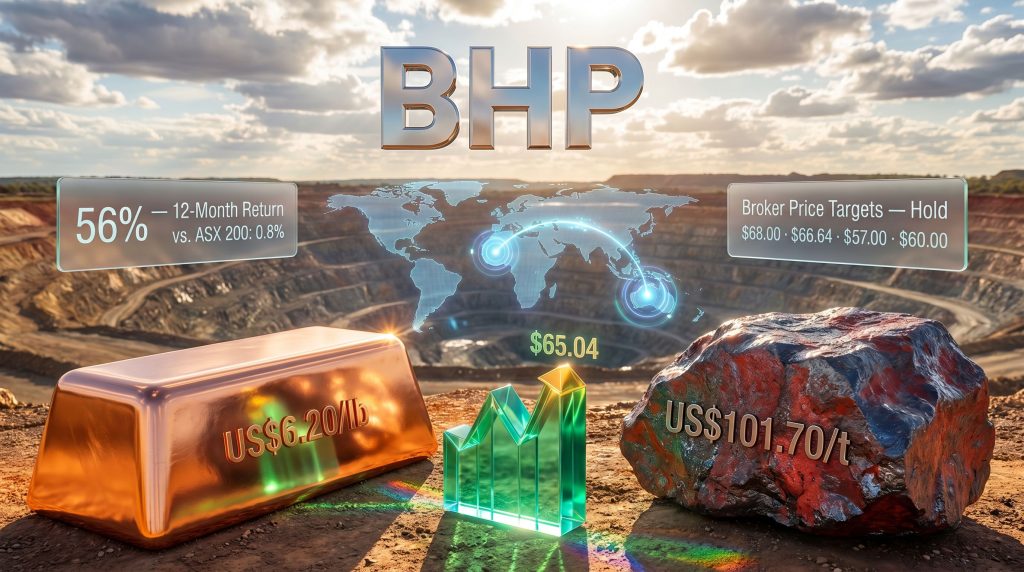
The copper price reached a record high of US$6.63 per pound in late May 2026, before retreating approximately 6.5% to around US$6.20 per pound. This pullback has compounded the iron ore headwinds, creating a dual-commodity drag that explains the intensity of BHP's share price correction from its record high of $65.04.
What Is Driving the Copper Price Cycle?
Copper's demand profile is structurally anchored to several of the most capital-intensive growth themes in the global economy. Understanding copper market trends in 2025, including supply crunches and strategic responses, provides essential context for interpreting BHP's earnings sensitivity. Furthermore, the key drivers behind copper price growth are boosting investment cases across the sector in 2025:
- Electric vehicle manufacturing requires substantially more copper per unit than a conventional internal combustion vehicle
- Grid infrastructure expansion to support renewable energy integration is highly copper-intensive at the transmission and distribution levels
- AI data centre construction requires significant copper for power delivery systems and cooling infrastructure
- General industrial electrification across manufacturing and transport sectors underpins a broad base of consumption growth
The recent price pullback from record levels reflects profit-taking and position unwinding following an exceptional rally rather than any fundamental deterioration in the demand outlook. The long-term copper supply deficit thesis, driven by years of underinvestment in new mine development and progressively declining ore grades at existing operations globally, remains broadly accepted among commodity specialists.
New copper discoveries are becoming increasingly rare, and the average grade of ore being processed at established mines continues to fall, meaning more rock must be processed to produce the same amount of metal. Tony Locantro from Alto Capital has suggested that elevated investor enthusiasm around electrification and AI-linked copper demand may have contributed to pricing that reflects future earnings expectations in an accelerated timeframe, making profit-taking a rational response at current levels for investors who participated in the rally.
The next major ASX story will hit our subscribers first
Broker Consensus: Rising Targets, Unchanged Hold Ratings
The analyst community's collective response to BHP's record high and subsequent pullback reveals a nuanced view that deserves careful interpretation. Following BHP reaching $65.04, four major brokers maintained hold ratings while three simultaneously revised their price targets upward:
| Broker | Previous Target | Revised Target | Rating |
|---|---|---|---|
| Jefferies | $57.00 | $68.00 | Hold |
| Citi | $55.21 | $66.64 | Hold |
| RBC Capital | $56.00 | $57.00 | Hold |
| UBS | N/A | $60.00 | Hold |
The divergence between rising price targets and unchanged hold ratings carries a specific meaning. It signals that analysts believe BHP's intrinsic value has genuinely improved, driven by the copper earnings uplift and the long-term structural demand narrative, but that the share price has already incorporated much of that improvement following its exceptional run.
"A cluster of hold ratings with rising price targets is not a bearish signal. It indicates that analysts see improved fundamental value but limited near-term upside from current price levels. For investors, this places greater emphasis on entry timing than was necessary twelve months ago."
For investors seeking an independent perspective on whether current valuations are justified, Morningstar's analysis of BHP shares following the recent fall offers a useful reference point on intrinsic value assessments.
BHP's 12-Month Performance in Context
Understanding the current volatility requires calibrating it against the magnitude of the preceding rally. BHP shares have delivered approximately a 56% total return over the twelve months preceding June 2026, compared to a gain of just 0.8% for the S&P/ASX 200 Index over the same period. A 9% retracement from the peak, while attention-grabbing in absolute terms, represents a modest consolidation within the context of that broader performance.
This outperformance reflects a combination of factors: copper price appreciation driven by electrification themes, improved operational performance, and a structural re-rating of diversified miners as energy transition commodity plays. The stock has essentially been repriced to reflect a future where copper demand is both larger and more durable than previously assumed.
Five Risk Variables to Monitor for BHP in 2026
Investors seeking to understand what determines BHP's share price trajectory from current levels should monitor these key variables:
- Simandou production ramp rate — Continued acceleration in Guinea's output will exert sustained downward pressure on iron ore prices and compress margins for Australian producers
- Chinese steel export volumes — Sustained export activity supports iron ore demand independent of domestic construction; trade barriers or tariff escalation targeting Chinese steel could erode this demand buffer
- Copper price trajectory — Whether the current pullback from record highs represents temporary consolidation or the beginning of a sustained reversal will materially shape BHP's EBITDA composition going forward
- India's seaborne iron ore transition — The pace and scale of India's shift from domestic to imported iron ore will define the long-term demand outlook for Australian miners over the next decade
- Global interest rate environment — Resource stocks are sensitive to real interest rate movements, and a sustained higher-for-longer rate environment increases the discount rate applied to long-duration commodity assets, which compresses valuations for stocks like BHP whose fundamental value case rests partly on multi-decade demand projections
FAQ: BHP Share Price Volatility Explained
Why did BHP shares fall after setting a record high?
BHP shares declined approximately 9% from their record high of $65.04 following news of significant production acceleration at the Simandou iron ore project in Guinea, combined with weaker-than-expected Chinese iron ore import data for May 2026. A simultaneous pullback in copper prices from record levels added additional downward pressure.
Does the volatility indicate a fundamental problem with BHP?
Not based on available information. BHP issued no negative operational updates during this period. The share price movement reflects external commodity market dynamics rather than company-specific deterioration. High-beta stocks with BHP's index weight and institutional ownership profile routinely exhibit amplified price swings when commodity benchmarks shift.
Is Simandou a long-term threat to BHP's iron ore business?
Simandou introduces a credible new source of high-grade supply into seaborne markets, which creates genuine long-term pricing pressure for Pilbara producers. However, BHP's scale of operations, established logistics infrastructure, and low-cost production profile provide meaningful competitive resilience against new entrants. The grade quality differential is the most significant variable to watch over time.
Why does copper now matter more to BHP than iron ore?
BHP has strategically expanded its copper portfolio over recent years. Combined with copper's price appreciation driven by electrification and energy transition demand, this has elevated copper's contribution to group EBITDA above that of iron ore. This shift makes BHP an increasingly relevant holding for investors seeking exposure to long-duration energy transition themes.
What is the current broker consensus on BHP?
As of early June 2026, the dominant broker view is a hold rating, with price targets ranging from approximately $57 to $68. The consensus reflects an assessment that BHP's long-term value has improved but that near-term upside is limited following its 56% twelve-month rally. Investors can also review live market data for BHP on the ASX company page to track current price movements and trading activity.
Short-Term Noise Versus Long-Term Structural Positioning
The question of why is the BHP share price so volatile this week resolves to a straightforward answer when viewed through the right analytical framework. Three macro forces have converged simultaneously: a supply-side disruption from Simandou's accelerating production, a demand-side disappointment from China's weaker-than-expected May import data, and a commodity price correction as copper retreats from record highs. None of these originated within BHP itself.
The stock's inherent sensitivity to these forces, amplified by its index weight, institutional ownership profile, and high trading liquidity, means that macro developments translate rapidly into price movements that can look alarming when viewed in isolation. Against the backdrop of a 56% twelve-month gain, the current pullback is better understood as a consolidation than a trend reversal.
For long-term investors, the structural investment case for BHP remains anchored in copper's energy transition demand profile, the resilience of China's steel export model despite property sector weakness, and the emerging India seaborne demand thesis. The broker consensus suggests that disciplined evaluation of entry points matters considerably more at current prices than it did when this rally began.
This article contains general information only and does not constitute financial advice. Past performance is not indicative of future returns. Investors should consider their own circumstances and seek professional advice before making investment decisions. All prices and figures referenced reflect data as of early June 2026.
Want To Spot the Next Major Mineral Discovery Before the Market Does?
While BHP's share price reflects the macro forces shaping global commodity markets, Discovery Alert's proprietary Discovery IQ model scans ASX announcements in real time, instantly identifying significant mineral discoveries across iron ore, copper, and more than 30 other commodities — explore historic discovery returns to understand what early positioning can mean for investors, or start your 14-day free trial today to gain an immediate market edge.