July 10, 2026
When Commodity Cycles Collide With Valuation Reality
Every few decades, a confluence of structural forces reshapes which industries generate the most compelling long-term returns. The current intersection of electrification infrastructure, artificial intelligence-driven power demand, and the global decarbonisation agenda has produced exactly this kind of cycle-defining moment for industrial metals. Copper, once a utilitarian industrial input, has been recast as a critical enabler of modern civilisation's energy architecture. Understanding the copper supply crunch is essential context for evaluating any company with major copper exposure on the ASX.
No company sitting on the ASX has greater exposure to this thesis than BHP Group Ltd (ASX: BHP). Yet exposure to a structural trend and share price performance are not the same thing. After one of the most exceptional single-year runs in BHP's modern history, investors searching for BHP shares broker ratings over the next 12 months will find a market that is simultaneously impressed by the miner's transformation and cautious about the price already embedded in its shares. Understanding that tension is essential before drawing any investment conclusions.
When big ASX news breaks, our subscribers know first
FY26 in Retrospect: A Year That Redefined BHP's Identity
The 62% Share Price Surge and What Actually Powered It
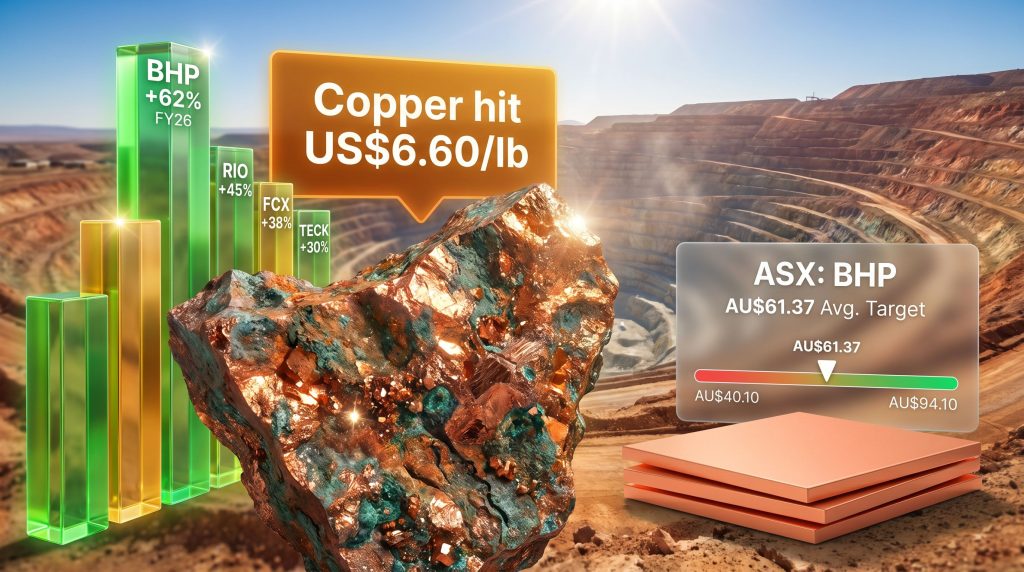
BHP shares closed the 2026 financial year at AU$59.40, representing a 62% gain over the twelve months to 30 June 2026. That places BHP among the strongest capital growth performers in the ASX 200's large-cap cohort for the period, a remarkable achievement for a company of its size.
Three distinct forces converged to produce this outcome. First, institutional capital rotated meaningfully into mining stocks as investors sought exposure to real assets with pricing power in an inflationary environment. Second, the copper price drivers behind the approximately 18% climb across FY26 culminated in a record high of US$6.60 per pound in May 2026, driven by accelerating demand from electrification infrastructure globally. Third, iron ore prices firmed by roughly 7%, providing a tailwind to BHP's most established division even as the company's commodity mix underwent a fundamental shift.
From Iron Ore Dependence to Copper Leadership
Perhaps the most consequential strategic development in BHP's recent history is its emergence as the world's largest copper producer. While the company's Pilbara iron ore operations remain a formidable cash generator, the commodity narrative has been rewritten. In the first half of FY26, copper accounted for more than half of BHP's underlying EBITDA (earnings before interest, taxes, depreciation, and amortisation), a composition that would have been unthinkable a decade ago.
This shift carries significant implications for how analysts model the company's earnings. Iron ore pricing is heavily influenced by China steel demand, which is subject to property sector cycles and government stimulus decisions. Copper demand, by contrast, is increasingly anchored by structural, multi-decade forces that are far less cyclical in nature.
Why Copper's Record Price Is Not a Speculative Spike
Copper reaching US$6.60 per pound in May 2026 was not a function of speculative positioning alone. Several supply and demand dynamics have fundamentally altered the metal's long-term price floor:
- Electric vehicles require approximately two to four times more copper than equivalent internal combustion engine vehicles
- Grid-scale renewable energy infrastructure, including wind and solar installations, is significantly more copper-intensive per megawatt than fossil fuel equivalents
- Data centres, which are expanding rapidly to support artificial intelligence workloads, require substantial copper wiring and cooling infrastructure
- Global copper supply growth has been constrained by underinvestment in new mines, grade depletion at existing operations, and permitting challenges in major producing regions
BHP's flagship Escondida operation in Chile and its Antamina joint venture in Peru are both positioned at the lower end of the global copper cost curve, meaning they generate strong margins even during price pullbacks.
What the Broker Community Is Saying About BHP Shares
A Hold-Dominated Consensus Across the Coverage Universe
The current BHP shares broker ratings over the next 12 months reveal a market that has reached a broadly cautious, but not pessimistic, consensus. Across multiple analytical platforms, the dominant recommendation is Hold/Neutral, reflecting a view that BHP's quality is unquestioned but its near-term valuation upside is constrained after such a powerful FY26 run.
| Metric | Detail |
|---|---|
| Consensus Rating (ASX, 17 analysts) | Neutral / Hold |
| Average 12-Month Price Target (AU) | ~AU$61.37 |
| Upside Implied (AU consensus) | ~+3.07% |
| Price Target Range (AU) | AU$40.10 to AU$94.10 |
| Consensus Rating (US, 6 analysts) | Hold (0 Buy, 5 Hold, 1 Sell) |
| Average 12-Month Price Target (US) | ~US$44.02 |
| Downside Implied (US consensus) | ~-21.78% |
| Most Bullish Major Target (AU) | AU$67.50 (Morgan Stanley) |
| Most Cautious Major Target (AU) | AU$40.10 (Barclays) |
On the TradingView platform, 20 analysts collectively produce a neutral consensus comprising 4 strong buy, 13 hold, 2 sell, and 1 strong sell ratings. On the CommSec platform, 19 analysts arrive at a similar hold consensus: 4 strong buy, 14 hold, and 1 strong sell. The Australian market-focused cohort of 17 analysts shows 12 hold, 4 buy, and 1 sell, with an average 12-month price target of approximately AU$61.37, representing modest upside of around 3% from the June 30 closing price.
The Price Target Spread Reveals Genuine Uncertainty
The breadth of BHP's 12-month broker price targets, spanning from AU$40.10 at the cautious end to AU$94.10 at the most optimistic, reflects substantive disagreement about commodity cycle timing, capital project execution risk, and the trajectory of Chinese industrial demand. A spread exceeding AU$54 across analyst estimates is itself a signal that BHP's forward earnings profile contains more uncertainty than its blue-chip status might suggest.
This divergence is not irrational. The variables that determine BHP's earnings in FY27 include copper prices (which can move 20% or more within a single quarter), iron ore pricing sensitive to Chinese policy decisions, capital expenditure discipline at Jansen, and production continuity at Pilbara. Each of these carries genuine uncertainty.
The Bull Case: Why Some Analysts Still Rate BHP a Buy
Morgan Stanley's Overweight Conviction at AU$67.50
Among major institutional brokers, Morgan Stanley carries the most constructive stance on BHP, maintaining a buy-equivalent overweight rating with a 12-month price target of AU$67.50. This implies upside of approximately 14% from the FY26 closing price, a meaningful premium to the consensus average. Morgan Stanley's thesis appears anchored in BHP's positioning as the world's largest copper producer at a moment when copper demand growth is structurally accelerating.
Deutsche Bank also rates BHP a buy, lifting its 12-month price target from AU$50.25 to AU$52.19 earlier in July 2026, reflecting updated modelling on copper volumes and balance sheet strength following the Wheaton Precious Metals silver streaming transaction.
Three Structural Pillars Underpinning the Bull Thesis
Analysts at Catapult Wealth have articulated why BHP's dominant positioning merits a buy rating for investors with a longer time horizon. Furthermore, their reasoning rests on three interconnected pillars:
- Pillar 1: BHP's status as the world's largest copper producer gives it unrivalled leverage to the energy transition supercycle, with copper demand structurally supported by EV adoption, grid upgrades, and data centre buildout
- Pillar 2: A robust balance sheet carrying low net debt provides flexibility to fund capital projects, sustain dividends, and withstand commodity price volatility without dilutive equity issuance
- Pillar 3: Production guidance for full-year FY26 tracking toward the upper end of targets, supported by strong output at both Escondida and Antamina, demonstrates operational reliability across BHP's most important copper assets
A dividend yield above 3% adds an income dimension to the investment case, which is particularly relevant for Australian superannuation funds and income-oriented long-term holders.
The Silver Streaming Agreement: Balance Sheet Catalyst
In February 2026, BHP completed a long-term silver streaming agreement with Wheaton Precious Metals Corp (NYSE: WPM). The structure of this deal saw BHP receive an upfront payment of US$4.3 billion in exchange for a share of silver production from the Antamina operation in Peru.
This transaction materially strengthened BHP's balance sheet heading into FY27 while preserving full copper production economics from Antamina. The ongoing royalty income from this arrangement also provides a secondary, relatively stable revenue stream that is less correlated with base metal price cycles.
Why the Majority Prefer to Wait: The Hold Thesis Examined
Valuation Compression After a 62% Rally
The single most cited reason for hold ratings across the broker community is straightforward: BHP's exceptional FY26 performance has already priced in much of the near-term upside. When a stock rises 62% in twelve months, forward earnings multiples expand, and the margin of safety available to new investors diminishes. Brokers who might have rated BHP a buy at AU$36 are largely unwilling to reiterate that recommendation at AU$59.
Hold-Rated Broker Targets at a Glance
| Broker | Rating | 12-Month Price Target | Movement |
|---|---|---|---|
| Morgans | Hold | AU$59.80 | Up from AU$54.90 |
| Bank of America | Hold | AU$65.00 | Down from AU$70.00 |
| Citi | Neutral | AU$63.00 | Down from AU$66.00 |
| Jefferies | Hold | AU$65.00 | Down from AU$68.00 |
| Macquarie | Neutral | AU$55.00 | Unchanged |
| UBS | Neutral | AU$60.00 | Unchanged |
| Barclays | Hold | AU$40.10 | Most cautious target |
Notably, several brokers that held optimistic targets earlier in FY26 have revised their figures downward. Bank of America trimmed from AU$70.00 to AU$65.00, Citi reduced from AU$66.00 to AU$63.00, and Jefferies moved from AU$68.00 to AU$65.00. These revisions do not represent bearish conviction but rather a recalibration of risk-reward following the share price appreciation. Analysts seeking broker views on BHP will find this pattern of modest downward revision consistent across much of the institutional coverage universe.
The Jansen Potash Cost Blowout: A Significant Risk Event
One of the most disruptive developments for BHP's investment case in FY26 was the revelation of a major capital cost overrun at the Jansen potash project in Saskatchewan, Canada. The Stage 2 estimate was revised from US$4.9 billion to US$6.9 billion, representing a cost increase of approximately US$2 billion or roughly 41%.
This type of capital escalation is particularly concerning for investors because it raises questions about project management discipline and the overall return profile of BHP's long-term growth pipeline. Jansen Stage 1 remains on schedule for first production in FY27, which provides some near-term positive signalling. However, the Stage 2 blowout has meaningfully reduced confidence in BHP's potash ambitions as a value-creation driver.
Analysts at Sanlam Private Wealth have indicated this capital cost escalation, combined with unresolved industrial relations risk at Pilbara, was sufficient justification to move BHP to a hold position despite a constructive long-term view on the copper thesis. The BHP strategic pivot toward growth commodities, however, remains broadly intact despite the Jansen setback.
Industrial Action at Pilbara: A Recurring Overhang
A potential industrial dispute at BHP's Western Australian iron ore operations was averted in June 2026, but analysts broadly agree this risk has not been permanently resolved. Iron ore production continuity at the Pilbara is critical to BHP's near-term cash generation, and any prolonged workforce dispute would directly impact both production volumes and earnings.
James Bills from Shaw and Partners notes that while BHP remains a cornerstone of the Australian sharemarket supported by disciplined capital management and strong cash generation, near-term commodity price volatility and global growth sensitivity warrant patience rather than aggressive accumulation at current levels.
Leadership Transition: New CEO, New Variables
Long-serving CEO Mike Henry stepped down on 1 July 2026 after six and a half years leading the company. His successor, Brandon Craig, brings 25 years of BHP experience and formerly served as President of the Americas division, overseeing the company's critical South American copper operations.
While Craig's deep familiarity with BHP's asset base is reassuring, any CEO transition introduces a period of strategic recalibration that markets typically price with a modest uncertainty premium. How Craig navigates the Jansen cost challenge and manages stakeholder relations in the Pilbara will be an early test of his leadership.
Key Risks and Catalysts Heading Into FY27
Downside Scenarios Investors Should Monitor
- Iron ore price deterioration: Chinese steel demand remains the primary variable. Any significant weakening driven by property sector stress or slowing fixed asset investment could compress margins at BHP's most cash-generative legacy division
- Jansen Stage 2 further escalation: Additional capital blowouts at the potash project could trigger impairment charges and force a reassessment of the growth pipeline's net present value
- Pilbara industrial action materialising: A prolonged workforce dispute would have immediate and direct consequences for production volumes and quarterly earnings
- Global growth deceleration: A deterioration in macroeconomic conditions, particularly in the United States or Europe, could suppress industrial metals demand broadly
Upside Catalysts That Could Drive a Re-Rating
- Copper price continuation above US$6.50/lb: Given copper now represents the majority of underlying EBITDA, even a modest sustained price increase translates into material earnings upside
- Escondida and Antamina production outperformance: Both assets are tracking toward the upper end of FY26 guidance, and continued operational strength would underpin analyst confidence into FY27
- Commodities supercycle acceleration: Market analysts have identified five structural drivers underpinning a new commodities supercycle including infrastructure spending, energy transition metals demand, chronic supply underinvestment, emerging market industrialisation, and AI-driven power infrastructure growth
- Wheaton streaming income: The ongoing royalty payments from the Wheaton Precious Metals silver streaming arrangement provide incremental, lower-volatility revenue that compounds over time
Scenario Modelling: Three Paths for BHP Over 12 Months
| Scenario | Key Assumption | Implied Price Range | Probability Signal |
|---|---|---|---|
| Bull Case | Copper sustains above US$6.50/lb; iron ore stable | AU$67 to AU$94 | Low to moderate |
| Base Case | Commodity prices range-bound; Jansen contained | AU$55 to AU$65 | Highest probability |
| Bear Case | Iron ore weakens; Jansen escalates further | AU$40 to AU$54 | Moderate tail risk |
The next major ASX story will hit our subscribers first
BHP's Strategic Position Within the ASX 200
Market Cap Leadership Reclaimed in May 2026
In May 2026, BHP reclaimed its position as the ASX 200's largest company by market capitalisation, surpassing Commonwealth Bank of Australia (ASX: CBA) in a development that reflected both BHP's commodity-driven rally and broader sector rotation dynamics favouring resources over financials. This milestone carries psychological significance for institutional investors whose mandates benchmark against the ASX 200 by weighting, as it requires rebalancing toward BHP as the index's lead constituent.
The Commodities Supercycle Framework: Is It Real?
Michael Gable of Fairmont Equities has taken the view that the broader commodities bull market is still in the early stages of its latest cycle, suggesting that the FY26 rally in BHP and its mining peers may represent momentum rather than exhaustion. This perspective is grounded in a supercycle framework that differs from shorter commodity price cycles in one critical way: it is demand-led rather than purely supply-constrained.
Historical commodities supercycles, such as those seen during post-WWII reconstruction and the Chinese industrialisation boom of the 2000s, lasted between ten and twenty years. Consequently, if the current electrification and AI infrastructure buildout follows a similar multi-decade arc, BHP's copper-weighted asset base could generate earnings well above current consensus modelling for a sustained period. The commodity price impact on BHP's earnings profile in this scenario would be substantial and prolonged.
This is a speculative scenario, not a consensus forecast. Commodity price cycles can reverse rapidly, and actual outcomes depend on a wide range of geopolitical, macroeconomic, and technological variables outside any single company's control.
Frequently Asked Questions: BHP Shares Broker Ratings
What Is the Current Broker Consensus Rating for BHP Shares?
The prevailing broker consensus across both Australian and international analysts is Hold/Neutral. Across 17 ASX-focused analysts, 12 rate BHP a hold, 4 a buy, and 1 a sell. The dominant view is that BHP is fairly to fully valued following its exceptional FY26 performance, with limited margin of safety at current prices.
What Is the Average 12-Month Price Target for BHP Shares?
Australian analyst consensus places the average 12-month price target at approximately AU$61.37, representing modest upside of around 3% from recent trading levels. US-based analyst consensus implies a more cautious average target of approximately US$44.02, which factors in currency translation risk and reflects a more conservative view on near-term commodity pricing.
Which Broker Has the Highest Price Target on BHP?
Among major institutional brokers, Morgan Stanley holds the most constructive view with a 12-month price target of AU$67.50 and an overweight (buy-equivalent) rating. Some broader analyst databases include individual targets reaching AU$93 to AU$94, though these represent outlier positions at the extreme optimistic end of the distribution.
Which Broker Has the Lowest Price Target on BHP?
Barclays holds the most cautious near-term view with a 12-month price target of AU$40.10, implying potential downside of approximately 30% from the FY26 closing price. This target reflects significant concern about either commodity price weakness, capital project risk, or both.
What Are the Main Risks to BHP's Share Price in FY27?
The primary risks include further capital cost escalation at Jansen Stage 2, potential industrial action at Pilbara iron ore operations, deterioration in Chinese steel demand affecting iron ore pricing, a new CEO navigating a complex operational and stakeholder environment, and broader commodity market volatility tied to global macroeconomic uncertainty.
How to Use Broker Ratings as an Investor: A Practical Framework
Understanding What a Hold Rating Actually Means
A hold rating in broker parlance is frequently misread by retail investors as a neutral position implying neither risk nor opportunity. In practice, a hold recommendation typically signals one of two things: either the analyst believes the stock is fairly valued with limited near-term upside, or they see a balance of risks and opportunities that does not justify a strong directional call. For BHP specifically, the dominant hold consensus reflects valuation discipline rather than any fundamental deterioration in the company's long-term outlook.
Why Price Targets Diverge So Widely
The AU$54 spread between the most bearish and most bullish major broker targets on BHP is not a sign of analytical confusion. It reflects the inherent difficulty of forecasting commodity prices, capital expenditure outcomes, and macroeconomic conditions twelve months in advance. Each broker uses different commodity price deck assumptions, discount rates, and production volume forecasts. Small differences in copper price assumptions, for instance, can produce dramatically different EBITDA estimates given copper's contribution to more than half of BHP's underlying earnings.
Broker ratings and price targets represent one analytical input among many. They are constructed on assumptions about commodity prices, production volumes, capital expenditure, and macroeconomic conditions, all of which can change rapidly. Investors should treat broker consensus as directional guidance rather than precise forecasts, and should always consider their own risk tolerance, investment time horizon, and financial circumstances before making any investment decision. This article contains general information only and does not constitute personal financial advice.
Key Takeaways: BHP Shares Broker Outlook at a Glance
-
BHP delivered a 62% share price gain in FY26, powered by copper price records, sector rotation into mining, and strong production performance at its flagship copper assets
-
The broker community is predominantly neutral to hold, reflecting valuation discipline after the strong run rather than any fundamental change in BHP's business quality
-
Morgan Stanley holds the most constructive major broker position at AU$67.50; Barclays carries the most cautious target at AU$40.10
-
Copper now accounts for more than half of BHP's underlying EBITDA, making it the primary earnings driver and the single most important variable to monitor heading into FY27
-
Near-term risks include the Jansen Stage 2 cost overrun of approximately US$2 billion, unresolved industrial relations risk at Pilbara, and commodity price volatility
-
Long-term structural tailwinds spanning electrification, EV adoption, data centre power demand, and AI infrastructure buildout remain firmly intact and support BHP's copper-leveraged investment thesis
-
The US$4.3 billion silver streaming deal with Wheaton Precious Metals has materially strengthened BHP's balance sheet, providing financial flexibility heading into a period of elevated capital demands
-
New CEO Brandon Craig takes the helm with strong operational credentials but faces an early test managing investor confidence around Jansen cost discipline and Pilbara labour relations
Want to Track the Next Major ASX Mineral Discovery Before the Market Moves?
Discovery Alert's proprietary Discovery IQ model scans ASX announcements in real time, instantly converting complex mineral data across more than 30 commodities into clear, actionable insights — so subscribers can identify high-potential opportunities the moment they emerge. Explore historic discoveries and the exceptional returns they generated, then start your 14-day free trial to position yourself ahead of the broader market.