July 15, 2026
When Momentum Meets Fundamentals: Reassessing a Mining Giant After a Monster Rally
Commodity markets move in long, uneven cycles. Periods of deep pessimism compress valuations to levels that bear little resemblance to underlying asset quality, while prolonged upcycles can create the opposite challenge: strong businesses trading at prices that already reflect a great deal of good news. Understanding where a company sits within that cycle, and whether its valuation still reflects genuine long-term opportunity, is one of the most useful questions an investor can ask.
That question is now squarely in front of anyone considering BHP Group Ltd (ASX: BHP). After one of the most significant re-ratings in its recent history, the mining giant is no longer the unloved, under-priced asset it was in the trough. So is it too late to buy BHP shares, or does the investment case remain intact at current levels?
When big ASX news breaks, our subscribers know first
Understanding What Actually Drove the Rally
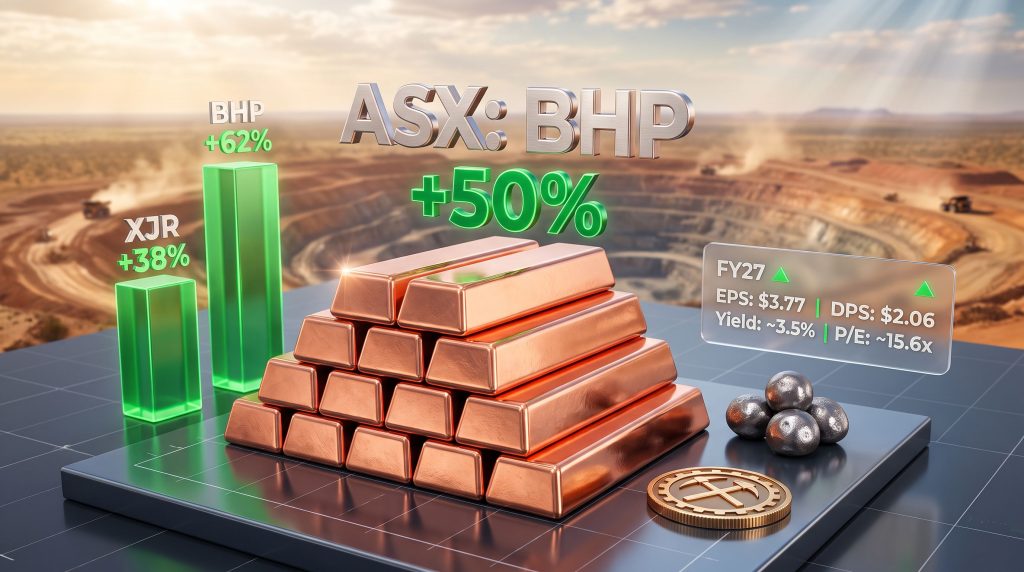
BHP shares have gained approximately 50% over the past 12 months, with the stock trading in the range of roughly $58 to $65 as of mid-2026. The financial year closed at approximately $59.40 on 30 June 2026, representing a 62% gain for the full FY26 period.
To appreciate the significance of that move, consider the context. The S&P/ASX 200 Resources Index (ASX: XJR) advanced approximately 38% over the same period, while the broader ASX 200 returned just 2.8%. The gap between resources and the wider market was not marginal; it was a defining feature of the Australian investment landscape in FY26.
However, a share price gain, regardless of its size, tells investors very little on its own. The more important question is whether the rally reflects a genuine reassessment of BHP's long-term earnings power, or whether it was primarily driven by short-term commodity price speculation and momentum-chasing capital.
The evidence points toward the former. Structural forces, including accelerating electrification investment, rising demand for data centre infrastructure, and ongoing industrial development across emerging economies, have fundamentally improved the long-term demand outlook for several of BHP's core commodities. Furthermore, BHP's strategic pivot away from its earlier portfolio composition has reinforced this shift. This is not a sentiment shift; it is a recalibration of forward earnings expectations grounded in real-world demand trends.
Valuation After a 50% Move: What the Numbers Actually Show
Breaking Down the Earnings Multiple Framework
Price-to-earnings ratios carry limited meaning in isolation. For resources companies in particular, multiples must be interpreted in the context of asset quality, commodity price assumptions, and balance sheet strength. With that framing in mind, BHP's current valuation warrants a closer look.
Based on CommSec consensus estimates, BHP is forecast to generate earnings per share of approximately $3.56 in FY26 and $3.77 in FY27. At a share price of around $58.71, that implies a forward P/E of approximately 16.5x FY26 earnings and 15.6x FY27 earnings.
For a mega-cap diversified miner with tier-one, long-life assets across multiple commodities and geographies, those multiples are not demanding by historical standards. This is not a speculative growth stock trading at triple-digit revenue multiples. It is a capital-intensive, cash-generative industrial business with decades of mine life ahead of it. The relationship between commodity prices and mining performance is a key consideration here for any investor assessing fair value.
Dividend Yield as a Valuation Anchor
| Metric | FY26 Estimate | FY27 Estimate |
|---|---|---|
| Earnings Per Share (EPS) | $3.56 | $3.77 |
| Dividends Per Share (DPS) | $2.10 | $2.06 |
| Forward Dividend Yield | ~3.6% | ~3.5% |
| Price-to-Earnings Ratio | ~16.5x | ~15.6x |
A forward dividend yield in the 3.5% to 3.6% range is a meaningful income contribution, particularly for investors who reinvest distributions over time. BHP's dividend reinvestment plan (DRP) allows shareholders to compound that yield through additional share accumulation, which over a 10 to 15-year horizon can meaningfully amplify total returns beyond what the share price alone suggests.
It is worth noting that dividend sustainability in the resources sector is never guaranteed. Payouts are ultimately a function of commodity prices, cash costs, and capital allocation priorities. Investors should, consequently, treat dividend forecasts as informed estimates rather than certainties.
"Reasonable valuation does not mean cheap valuation. BHP at current prices represents fair value for a world-class business, not the deep discount that existed 12 months ago. Investors entering now should calibrate their return expectations accordingly."
How Different Investor Profiles Should Approach BHP
| Investor Profile | Stance | Core Rationale |
|---|---|---|
| Long-term (10+ year horizon) | Buy | Tier-one asset quality, structural commodity demand, strong cash generation |
| Value-focused investors | Buy | Forward earnings multiples and dividend yield remain attractive post-rally |
| Short-term traders | Wait | Trading near 52-week highs; limited near-term re-rating catalyst |
| Cautious income investors | Hold | Dividend payout sustainability depends on commodity price stability |
The Structural Commodity Case: Why BHP Is More Than an Iron Ore Proxy
The Deliberate Portfolio Pivot Away from a Single Commodity
For much of its modern history, BHP's earnings narrative was, in practice, an iron ore narrative. China's extraordinary urbanisation and infrastructure build-out drove iron ore prices to levels that generated enormous cash flows, and BHP's Pilbara assets were central to that story.
That story has not ended. Iron ore will continue to contribute meaningfully to group earnings for the foreseeable future. However, what has changed is the addition of compelling structural growth narratives in other commodity categories. The China steel and iron ore outlook remains a critical input when assessing how BHP's earnings mix may evolve over the coming years.
Copper: The Metal at the Centre of the Electrification Era
Copper is widely understood to be an essential enabler of the energy transition, but the full scope of demand drivers is sometimes underappreciated. The emerging copper supply crunch makes this picture even more compelling for long-term investors. Consider the breadth of sectors that rely on increasing copper intensity:
- Electricity grid modernisation — transmission and distribution infrastructure upgrades require significant copper volumes
- Renewable energy installations — wind turbines, solar farms, and associated cabling are copper-intensive at both component and grid connection levels
- Electric vehicle manufacturing — battery electric vehicles require approximately three to four times more copper than equivalent internal combustion engine vehicles
- Data centre construction — the extraordinary power demands of AI-driven computing infrastructure require dense copper wiring and cooling systems
- Emerging market urbanisation — ongoing infrastructure build-out across South and Southeast Asia, Africa, and Latin America creates sustained baseline demand growth
What makes the copper supply-demand picture particularly interesting from an investment perspective is the geological constraint on new supply. Large-scale copper deposits of sufficient grade to justify major capital investment are increasingly scarce. Average ore grades at existing mines have been declining for decades as higher-grade portions of orebodies are exhausted first, a geological phenomenon known as grade depletion.
This means each tonne of copper produced requires processing more rock than it did historically, increasing unit costs and raising the incentive price needed to bring new supply to market. BHP already holds meaningful copper exposure through its existing operations, and this segment is positioned to grow as a proportion of group earnings over the coming decade.
The Jansen Potash Project: Agricultural Security as a Long-Term Commodity Theme
BHP's Jansen potash project in Saskatchewan, Canada, is often discussed in terms of capital commitment and timeline, but the strategic rationale deserves closer examination. Potash is a primary component of fertiliser, and fertiliser is non-negotiable for modern agricultural productivity. With global population continuing to grow and arable land per capita declining, the pressure on agricultural output is structurally increasing.
What is less commonly understood is the geography of potash production. The global potash market is highly concentrated, with a significant share of production historically controlled by a small number of countries and companies. This concentration creates supply security considerations that may ultimately support long-term price floors above what simple supply-demand models would suggest.
Jansen positions BHP as a future participant in a market with high barriers to entry, long project lead times, and structurally growing demand. It is a decade-plus investment with meaningful execution risk attached, but the strategic logic of adding a third major commodity pillar is sound.
"BHP's combination of copper exposure to the electrification transition and potash exposure to global food security represents a multi-decade commodity portfolio that very few mining companies of comparable scale can replicate."
Why Resources Exposure Has Portfolio-Level Value Beyond BHP Itself
The Diversification Premium of Resources Shares
The FY26 performance divergence between the ASX Resources Index and the broader ASX 200 illustrates a portfolio construction principle that is easy to overlook during extended periods of equity market calm. Resources shares can generate return streams that are largely uncorrelated with financials, healthcare, consumer discretionary, and technology sectors.
This diversification benefit is particularly valuable in environments characterised by elevated inflation, commodity supply disruption, or currency weakness. In each of those scenarios, resources companies tend to benefit from the same forces that create headwinds for other sectors. For investors seeking broader portfolio diversification strategies, resources allocation through a name like BHP offers a structurally sound starting point.
A Scenario Analysis for Perspective
Consider a hypothetical investor with a $100,000 ASX portfolio who allocated 15% to BHP 12 months ago. That $15,000 position would have grown to approximately $22,500, generating around $7,500 in capital gains before dividends. The same $15,000 allocated to the broader ASX 200 index would have grown to approximately $15,420.
The performance differential over a single year was more than $7,000 on a $15,000 allocation. This is not a trivial difference, and it illustrates why resources exposure is a genuine portfolio construction decision rather than merely a speculative one.
Addressing the Psychological Barrier of Buying Near Highs
Why the 52-Week High Hesitation Is Often Analytically Flawed
The instinct to avoid purchasing shares near their recent highs is psychologically understandable. It feels intuitive that a stock which has already gained 50% has less remaining upside than one which has not yet moved. This mental model, sometimes called anchoring bias, treats a recent price as a meaningful reference point for intrinsic value. It is not.
What matters is not the relationship between today's price and last year's price. What matters is the relationship between today's price and the present value of future cash flows. According to analyst consensus estimates, BHP at 15.6x forward earnings with a 3.5% dividend yield is a fundamentally different proposition from a speculative growth company trading at 50x revenue with no clear path to profitability.
A Practical Approach to Positioning: Step by Step
For investors who want to build or add to a BHP position but are uncertain about entry timing, the following framework provides a structured approach:
- Define your investment horizon — BHP is best suited to investors with a minimum five to ten-year view; the commodity cycle adds noise in shorter timeframes
- Assess your current resources exposure — if you hold no resources shares, BHP provides immediate sector diversification that may reduce overall portfolio volatility over time
- Determine your position size — given BHP's size and liquidity, it can anchor a resources allocation without creating concentration risk at the position level
- Consider dollar-cost averaging — splitting intended capital across three to six monthly tranches reduces sensitivity to short-term price movements and removes the burden of timing
- Monitor commodity price signals — copper and iron ore price trends are the most important leading indicators for BHP's earnings trajectory and should be tracked regularly
- Review dividend reinvestment — BHP's DRP can compound returns meaningfully over time, particularly for investors in the accumulation phase
The next major ASX story will hit our subscribers first
The Risk Framework: What Could Undermine the Thesis?
Balanced investment analysis requires honest engagement with downside scenarios. BHP's investment case carries several material risks that investors should weigh carefully:
- China demand deterioration — iron ore earnings remain highly sensitive to Chinese steel production volumes and property sector activity; a sustained structural slowdown would compress BHP's earnings materially
- Copper price correction — if the electrification-driven demand supercycle is slower or smaller than current forecasts suggest, copper price assumptions underpinning BHP's valuation may prove optimistic
- Project execution risk — large-scale mining developments, including Jansen, carry cost overrun potential, permitting complexity, and long lead times before generating meaningful returns
- Currency dynamics — a strengthening Australian dollar reduces the AUD value of commodity revenues priced in USD, creating an earnings headwind that is entirely outside BHP's operational control
- Cyclical timing risk — resources sectors remain inherently cyclical; investors entering near recent peaks accept a wider range of near-term outcomes than those who entered during periods of pessimism
Warning: The margin of safety available to investors 12 months ago has narrowed considerably following BHP's 50%+ rally. While the long-term structural thesis remains intact, investors should size positions according to their risk tolerance and maintain realistic return expectations from current levels.
Frequently Asked Questions: BHP Shares in 2026
Is it too late to buy BHP shares after a 50% rally?
Not necessarily. The deep-value entry point available 12 months ago has passed, but a forward P/E of approximately 15.6x FY27 earnings and a dividend yield of around 3.5% suggest BHP remains reasonably priced for a world-class diversified miner with structural commodity tailwinds. The investment case has shifted from deep value to quality at fair value. Readers weighing up this question can find additional perspectives on BHP's outlook from expert commentary in the financial press.
What is BHP's forecast dividend yield for FY27?
Based on CommSec consensus estimates, BHP is forecast to pay approximately $2.06 per share in dividends for FY27, implying a forward yield of approximately 3.5% at current prices.
What commodities does BHP produce beyond iron ore?
BHP's portfolio includes copper, metallurgical coal, and nickel (subject to ongoing operational review), with the Jansen potash project in Saskatchewan, Canada representing a major long-term growth commitment.
What is the biggest long-term growth driver for BHP?
Copper is widely regarded as the most structurally compelling long-term growth driver, underpinned by electrification infrastructure, renewable energy, electric vehicles, and data centre construction demand.
Should I use dollar-cost averaging to buy BHP?
For investors concerned about entering near recent highs, deploying capital in regular tranches across three to six months is a prudent strategy that reduces sensitivity to short-term price fluctuations without forfeiting long-term exposure.
The Verdict: Assessing BHP's Investment Case at Current Levels
Summary Scorecard
| Assessment Dimension | Rating | Key Observation |
|---|---|---|
| Valuation (P/E) | Reasonable | 15.6 to 16.5x forward earnings; not demanding for this asset quality |
| Dividend Yield | Attractive | 3.5 to 3.6% forward yield; solid income component |
| Commodity Diversification | Strong | Copper and potash add structural growth beyond iron ore |
| Entry Point Comfort | Moderate | Trading near 52-week highs; margin of safety has narrowed |
| China Demand Risk | Elevated | Iron ore earnings remain sensitive to Chinese economic conditions |
| Long-Term Structural Case | Compelling | Electrification, food security, and infrastructure megatrends align with BHP's portfolio |
The investment case for BHP in mid-2026 is materially different from what existed twelve months ago, and investors should not expect the same magnitude of returns from current levels. The easy money has been made. What remains is a world-class business with diversified commodity exposure, a reasonable earnings multiple, a solid dividend yield, and genuine structural growth optionality through copper and potash.
For long-term investors asking whether it is too late to buy BHP shares, the honest answer is that it depends on what you are expecting. If the expectation is another 50% gain in the next 12 months, the setup is less compelling than it was. If, however, the question is whether BHP represents a credible core holding for a diversified ASX portfolio over a ten-plus year horizon, the evidence suggests the answer remains yes.
This article contains general financial information only and does not constitute personal financial advice. Past performance is not indicative of future results. Investors should consider their own circumstances and seek independent professional advice before making investment decisions. All financial estimates referenced are based on consensus data available at time of writing and are subject to change.
Want to Discover the Next Major ASX Mining Opportunity Before the Broader Market?
While BHP offers long-term structural appeal through copper and potash, the most significant returns in resources investing have historically come from identifying transformative mineral discoveries early — Discovery Alert's proprietary Discovery IQ model scans ASX announcements in real time, delivering instant alerts on high-potential discoveries across 30+ commodities, as illustrated by historic outcomes on the discoveries page. Begin your 14-day free trial at Discovery Alert and position yourself ahead of the market on the next major find.