
July 15, 2026
The Strait of Hormuz: Why One Waterway Can Hold the Global Economy Hostage
Few geographic features on Earth carry the economic weight of a narrow stretch of water barely 21 miles across at its navigable minimum. US strikes Iran before Hormuz Strait blockade restarts has thrust this corridor back into global headlines, exposing structural vulnerabilities in energy supply chains that markets had long underestimated. The Strait of Hormuz sits at the intersection of Persian Gulf oil wealth and global energy demand, functioning as the single most consequential maritime chokepoint in existence.
When this corridor operates normally, the world barely notices it. When it does not, however, the consequences ripple through oil markets, shipping networks, insurance premiums, and consumer prices across every continent.
Understanding why this waterway commands such outsized importance, and what the escalating U.S.-Iran confrontation means for energy markets and global stability, requires looking beyond the immediate military exchange and examining the structural vulnerabilities it exposes.
When big ASX news breaks, our subscribers know first
Why Hormuz Concentration Risk Is Unlike Any Other Maritime Chokepoint
The Numbers Behind the Dependency
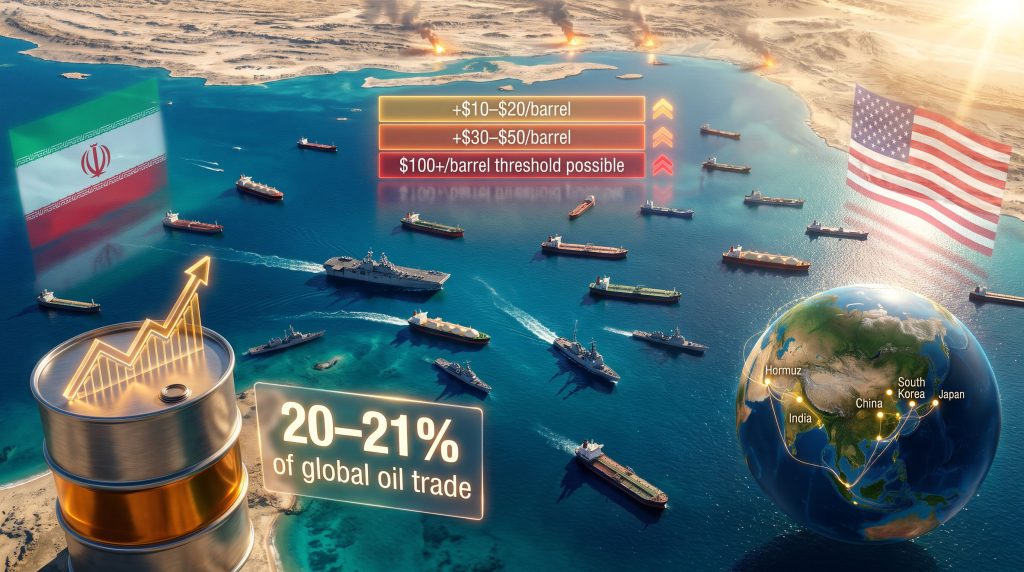
Roughly 20 to 21% of global oil trade transits the Strait of Hormuz every year. Alongside crude oil, approximately 17% of the world's liquefied natural gas exports pass through the same corridor, predominantly originating from Qatar, the world's largest LNG supplier. No other single maritime passage concentrates this volume of energy trade. Monitoring crude oil price trends has consequently become essential for any investor with exposure to global energy markets.
The nations most acutely exposed to any disruption include:
- China, the world's largest oil importer, with substantial Gulf crude dependency
- Japan and South Korea, whose import structures leave minimal flexibility for rapid diversification
- India, whose refinery complex is calibrated around Gulf crude grades
- European importers, who have already restructured supply chains following the Russia-Ukraine conflict and face compounding disruption risk
The alternative routing option, diverting around the Cape of Good Hope, adds approximately 10 to 15 extra days of transit time per voyage. At scale, this creates cascading cost pressures across freight, insurance, and feedstock pricing simultaneously.
From Ceasefire to Conflict: The Escalation Timeline
A Truce That Did Not Hold
On June 17, 2026, a temporary ceasefire between the United States and Iran brought a brief halt to hostilities and reopened Hormuz to commercial traffic. The respite was short-lived. In the weeks that followed, both governments traded accusations of ceasefire violations, with incidents multiplying through late June and early July.
By the evening of July 13, 2026, U.S. forces launched the first in a new series of airstrikes against Iranian military infrastructure, marking the third consecutive night of strikes. The following day brought a formal and decisive escalation:
- At 3:00 p.m. ET on July 14, 2026, U.S. Central Command confirmed fresh strikes targeting Iranian capabilities used to threaten commercial shipping operations
- At 4:00 p.m. ET (20:00 GMT), the U.S. Navy-led naval blockade of Iranian ports, oil terminals, and coastal maritime zones officially restarted
President Trump had formally declared the ceasefire void in the days prior, citing sustained violations by Iran and renewed regional hostilities as justification for returning to active military operations.
What U.S. Forces Struck, and Why It Matters
310 Strikes, 140 Targets: The Scale of Degradation Operations
Over approximately one week of operations, U.S. forces conducted an estimated 310 airstrikes against roughly 140 Iranian military facilities. The targeting philosophy was deliberate: rather than striking Iran's nuclear infrastructure or civilian assets, the campaign concentrated on degrading the military apparatus used to conduct asymmetric maritime warfare.
Target categories included:
- Air defense and radar installations limiting U.S. operational freedom
- Missile and drone storage facilities capable of threatening commercial vessels
- Small attack boat staging areas used by Iran's Islamic Revolutionary Guard Corps (IRGC) Navy
- Surveillance and command infrastructure linked to strait interdiction operations
The stated CENTCOM objective was precise and operationally bounded: degrading Iranian capabilities used to attack commercial shipping. This framing is significant because it signals a campaign designed to restore transit security rather than pursue regime change or comprehensive military defeat.
What Triggered the Renewed Campaign
The proximate cause of the blockade restart was a two-part Iranian action. Iran's Navy fired on a vessel transiting the strait, and simultaneously, Iranian authorities announced formal intentions to close the waterway entirely. This combination of physical aggression and political declaration provided the trigger for U.S. reengagement.
Iran's retaliatory strikes extended well beyond the strait itself. This broader this oil market disruption has consequently drawn comparisons to some of the most severe energy crises of the past four decades:
| Target Location | Claimed Iranian Action |
|---|---|
| Bahrain and Kuwait | IRGC claimed strikes against U.S. military facilities |
| Oman | Radar infrastructure reportedly destroyed |
| Jordan (Prince Hassan Airbase) | Fuel and ammunition depots reportedly targeted |
The geographic dispersion of these counter-strikes across four countries reflects a calculated effort to regionalise the conflict, raising the political and logistical cost of sustained U.S. military engagement by involving allied host nations.
How the Naval Blockade Actually Functions
Maritime Interdiction at an Unprecedented Scale
The reimposed blockade operates through the U.S. Navy-led Joint Maritime Information Centre and covers all Iranian ports, oil export terminals, and adjacent coastal maritime zones. Critically, enforcement is flag-neutral: vessels of any national registration are subject to interdiction, creating immediate uncertainty for shipping operators worldwide regardless of their cargo or origin.
The USS Tripoli (LHA 7) was confirmed operational in the region as of May 2026, serving as a key amphibious assault asset supporting strike and maritime interdiction operations. Coalition partner roles and their participation levels remain a fluid diplomatic variable.
The human dimension of the blockade is substantial. An estimated 6,000 seafarers aboard hundreds of vessels are currently reported stranded in or near the strait as traffic has fallen to near-standstill conditions. For shipping operators, the implications extend well beyond routing delays:
- Lloyd's of London war risk premiums for Gulf-transiting vessels can multiply 10 to 20 times during active conflict periods
- Rerouting via Cape of Good Hope adds significant fuel costs and ties up vessel capacity for weeks longer per voyage
- Cargo insurance underwriters face acute difficulty pricing exposure with no clear resolution timeline
The 1987-1988 Operation Earnest Will, conducted during the Iran-Iraq tanker war, provides a historical structural parallel. However, the current blockade is considerably broader in scope, targeting all Iranian coastal zones rather than focusing on convoy escort operations.
Oil Market Scenarios: Three Price Trajectories Investors Should Understand
Modelling the Range of Outcomes
The oil price impact of a sustained Hormuz disruption depends almost entirely on duration and diplomatic trajectory. Furthermore, OPEC market influence over production decisions will play a defining role in whether supply-side responses can meaningfully offset the disruption. Three distinct scenarios frame the range of possible outcomes:
| Scenario | Conditions | Estimated Brent Crude Impact |
|---|---|---|
| Short-Term Disruption (1-2 weeks) | Blockade enforced but quickly resolved through back-channel negotiation | +$10 to $20 per barrel spike |
| Sustained Blockade (1-3 months) | No diplomatic resolution; full enforcement maintained | +$30 to $50 per barrel sustained elevation |
| Full Regional Escalation | Multi-country conflict; strait effectively closed | $100+ per barrel threshold becomes realistic |
Investor Note: The primary near-term price suppression mechanisms available to Western governments are Strategic Petroleum Reserve (SPR) releases by the United States and coordinated emergency stock drawdowns through the International Energy Agency. Previous SPR deployments, including the 2022 Russia-Ukraine response, demonstrated meaningful but time-limited price relief lasting weeks rather than months.
LNG and Natural Gas: The Secondary Shock
Qatar routes a substantial portion of its LNG exports through or adjacent to the Strait of Hormuz. Consequently, the LNG supply outlook for Asian markets has deteriorated sharply, given the limited short-term supply-side flexibility available to major buyers. Asian buyers cannot rapidly substitute Qatari LNG volumes with North American or Australian supply on contracted terms.
European energy security compounds this vulnerability. Having restructured supply chains following Russia's 2022 actions in Ukraine, European buyers now face the prospect of concurrent disruption across two of their major alternative supply corridors.
The next major ASX story will hit our subscribers first
Three Scenarios for Resolution: What Investors Need to Watch
Scenario A: Rapid De-escalation Within 30 to 60 Days
Back-channel diplomatic engagement through Oman or Qatar, historically the most reliable intermediaries in U.S.-Iran communications, could produce a rapid de-escalation pathway. Iranian domestic economic pain from oil export disruption, given that Iran's own exports also transit Hormuz, creates internal pressure for pragmatism. Probability is moderate but requires neither side to suffer a politically unacceptable military loss before negotiations begin.
Scenario B: Frozen Conflict With Managed Blockade (3 to 12 Months)
This scenario most closely mirrors the structural dynamics of the 1980s tanker war. The blockade remains in place but is selectively enforced, with some humanitarian and non-oil cargo permitted through. Iran conducts continued asymmetric harassment without triggering full escalation. Global oil markets adapt gradually through rerouting, SPR releases, and accelerated non-OPEC production increases.
This is arguably the most likely medium-term outcome and carries significant implications for shipping equities and oil producer valuations.
Scenario C: Regional War Expansion
A major casualty event involving U.S. or Iranian forces, combined with domestic political hardening in Tehran, could trigger broader Axis of Resistance activation. This scenario involves:
- Israeli military engagement escalation
- Houthi reactivation of Red Sea interdiction operations
- Hezbollah escalation in Lebanon
- Simultaneous disruption of both the Strait of Hormuz and the Bab-el-Mandeb strait
The combined closure of both chokepoints would affect approximately 30% of global seaborne oil trade, a shock without modern precedent in scale or speed.
What This Means for Investors: Sectors, Assets, and Strategy
Commodities and Equities Most Directly Exposed
The conflict creates a divergent exposure landscape across sectors:
- Non-Gulf crude oil producers stand to benefit most directly from sustained price elevation without operational disruption risk
- U.S. LNG exporters face a complex profile: elevated spot prices benefit revenue, but if broader conflict disrupts buyer economies, demand signals weaken
- Tanker operators face margin compression from war risk surcharges even as headline freight rates rise, creating a complex net exposure calculation
- Asian refinery complexes face feedstock cost volatility that compresses margins, particularly for operations calibrated around Gulf sour crude grades
- Petrochemical, fertilizer, and plastics manufacturers face upstream cost pressure through oil-derived feedstock pricing
Safe Haven Dynamics During Gulf Escalation
Historical patterns during sustained Middle East military operations show consistent behaviour across safe haven assets. In addition, gold safe-haven demand has historically surged during protracted Gulf conflicts as institutional investors seek to hedge geopolitical tail risk.
- Gold and U.S. Treasuries attract risk-off flows as geopolitical uncertainty mounts
- The U.S. dollar tends to strengthen during Gulf conflict escalation given its reserve currency role in oil transactions
- Defence sector equities have historically outperformed broader market indices during sustained military operations in the region
- Energy-focused ETFs and commodity funds see elevated institutional inflows during blockade scenarios
Iran's Strategic Paradox: The Deterrence Trap
One aspect of the Hormuz standoff that receives insufficient analytical attention is the self-defeating dimension of Iran's closure strategy. Approximately 80 to 90% of Iran's own oil export revenue depends on ships transiting the very waterway Tehran threatens to close. This creates a deterrence paradox: the threat of closure carries maximum coercive value precisely because it is so economically devastating, but executing the closure inflicts enormous self-harm on Iran simultaneously.
This dynamic explains why the IRGC tends to favour asymmetric harassment operations, mining, drone strikes, and small-boat tactics over outright closure. Maintaining ambiguity preserves leverage while avoiding complete economic self-destruction.
The wildcard in this calculation is IRGC institutional independence from Iran's political leadership. Escalation decisions are not always made through a unified command structure, creating genuine risk of uncoordinated actions that exceed what Tehran's political leadership intends or can control. This reality is precisely why US strikes Iran before Hormuz Strait blockade restarts carries such profound significance for global energy security planning.
Frequently Asked Questions
What triggered the U.S. decision to restart the Hormuz blockade?
The restart followed Iran's Navy firing on a vessel in the strait combined with Tehran's formal announcement of its intention to close the waterway. These actions, alongside what the U.S. described as repeated ceasefire violations, led President Trump to declare the prior truce void and authorise both renewed strikes and blockade reimposition effective July 14, 2026.
How many Iranian targets has the U.S. struck?
U.S. forces conducted an estimated 310 airstrikes targeting approximately 140 Iranian military facilities over roughly one week, focusing on air defense systems, radar infrastructure, and maritime warfare capabilities.
What percentage of global oil passes through Hormuz?
Approximately 20 to 21% of global oil trade and roughly 17% of global LNG exports transit the Strait of Hormuz annually.
How many seafarers are currently stranded?
Approximately 6,000 seafarers aboard hundreds of vessels are reported stranded in or near the strait as traffic has reached near-standstill conditions.
This article contains forward-looking analysis, scenario modelling, and market projections based on information available at time of writing. Geopolitical situations evolve rapidly, and no content herein constitutes financial or investment advice. Readers should conduct independent research and consult qualified financial advisors before making investment decisions.
Want to Stay Ahead of Commodity Discoveries Driven by Global Energy Disruptions?
When geopolitical shocks like the Hormuz blockade send commodity markets into turmoil, the investors who act fastest on emerging mineral opportunities gain the greatest advantage — Discovery Alert's proprietary Discovery IQ model delivers real-time ASX mineral discovery alerts, turning market volatility into actionable investment opportunities the moment they emerge. Start your 14-day free trial at Discovery Alert and position yourself ahead of the market before the next major discovery is priced in.