July 16, 2026
The Case for Patient Capital in a Commodity-Driven World
Commodity markets operate on cycles that span decades, not quarters. Investors who grasp this fundamental reality tend to approach large-cap miners with a very different mindset than those chasing short-term momentum. The decision to buy and hold BHP shares is not simply a question of whether today’s price looks attractive on a screen. It is a deeper question about how a portfolio should be positioned across commodity cycles, energy transition tailwinds, and the structural evolution of global infrastructure demand over the next ten to twenty years.
Understanding what BHP actually is, how it generates value, and what risks are genuinely embedded in the thesis is the starting point for any serious long-term assessment.
When big ASX news breaks, our subscribers know first
BHP’s Place in the ASX Landscape
BHP Group Ltd (ASX: BHP) is consistently ranked among the five largest companies by market capitalisation on the ASX 200. It functions as a foundational holding across institutional portfolios, self-managed super funds (SMSFs), and retail accounts seeking meaningful exposure to global commodity markets. Its dual listing across the ASX, the London Stock Exchange, and as a NYSE ADR means it attracts capital from a genuinely diverse global investor base.
Within the Australian resources sector, BHP is frequently benchmarked alongside Rio Tinto (ASX: RIO) and South32 (ASX: S32). However, the company’s commodity mix and strategic trajectory are increasingly distinct from both peers. This distinction matters enormously for investors who are thinking in terms of five to ten year holding periods rather than a single commodity cycle. The BHP strategic pivot away from coal and toward future-facing commodities is central to understanding this divergence.
Iron Ore: The Earnings Engine and Its Structural Dependencies
The Pilbara iron ore operations in Western Australia remain the commercial heartbeat of BHP’s business. These assets benefit from entrenched cost advantages: dedicated rail and port infrastructure built over generations, high ore grades relative to many global peers, and scale economies that make cost replication by competitors exceptionally difficult.
Iron ore’s 62% Fe (iron content) benchmark price, typically quoted as CFR China in US dollars per tonne, is the single most important external variable for BHP’s near-term earnings and dividend capacity. Historically, BHP’s Pilbara operations have remained cash-generative even at iron ore prices well below current spot levels, which provides some margin of safety during cyclical downturns.
What Are the Structural Risks to Iron Ore Demand?
However, the key risk is both structural and cyclical. China’s property sector, which has long driven demand for steel and by extension iron ore, has been undergoing a prolonged contraction. Steel-intensive construction activity linked to residential property development has declined materially from its peak. The iron ore demand outlook remains closely watched among commodity analysts, as government-directed infrastructure investment only partially offsets the broader weakness in Chinese property.
Iron ore pricing remains BHP’s most significant near-term earnings risk. A sustained move below US$90 per tonne would compress cash flows and dividend capacity meaningfully. Investors should monitor 62% Fe CFR China prices as a leading indicator of BHP’s earnings trajectory.
Copper: Why This Metal Changes the Long-Term Equation
Copper is the commodity that transforms BHP’s long-term investment thesis from a simple income play into something more structurally compelling. The metal sits at the intersection of nearly every major electrification trend shaping the global economy: electric vehicle manufacturing, renewable energy grid buildout, data centre power infrastructure, and industrial automation.
What makes copper’s supply dynamics particularly interesting is a characteristic that is often underappreciated by investors outside the mining sector. Copper ore grades at existing mines have been declining for decades. The average grade of copper ore processed globally has fallen from roughly 1.8% copper in the 1930s to below 0.6% in many major producing regions today. This means miners must process dramatically larger volumes of rock to extract the same quantity of refined copper, which increases energy consumption, water usage, and costs per unit of output.
This grade decline creates a compounding supply constraint. Furthermore, new greenfield copper deposits are becoming harder to find, more expensive to develop, and face longer regulatory approval timelines. Discovery-to-production cycles for major new copper mines routinely span fifteen to twenty years, meaning supply responses to higher prices are inherently slow. The emerging copper supply crunch is consequently one of the most compelling structural narratives in the resources sector today.
BHP’s existing copper portfolio, anchored by Escondida in northern Chile — the world’s single largest copper mine by annual output — positions the company as one of the primary beneficiaries of any structural supply shortfall. Escondida alone produces roughly one million tonnes of copper annually, representing approximately five to six percent of global mine supply.
The Water Constraint Dimension
A less commonly discussed risk to copper supply is water scarcity in the Atacama Desert region of northern Chile, where Escondida and many of the world’s largest copper operations are located. The Atacama is one of the driest places on earth, and copper processing is extremely water-intensive. BHP has invested significantly in desalination infrastructure at Escondida to reduce reliance on freshwater aquifers, but desalinated water involves higher operating costs and energy consumption. This is a structural cost pressure that applies across the Chilean copper industry and is one reason why supply expansion in this region is more constrained than simple geological reserves would suggest.
Potash: The Agricultural Diversification That Most Investors Overlook
BHP’s Jansen potash project in Saskatchewan, Canada, represents a genuinely different type of commodity exposure. Potash is a primary component of agricultural fertilisers, particularly for crops that require high potassium levels including cereals, soybeans, and sugarcane. Global demand for potash is linked to population growth, dietary shifts toward protein-intensive foods in emerging markets, and the need to maintain soil productivity on existing farmland.
What makes potash strategically interesting from a portfolio construction perspective is its low correlation with iron ore and copper demand cycles. Potash demand is driven by agricultural output requirements, which are relatively stable across economic cycles. This gives BHP a commodity exposure that does not move in lockstep with its existing earnings streams. Jansen is not expected to contribute meaningfully to BHP’s earnings in the near term, with the timeline to significant production volumes extending into the late 2020s at earliest.
Valuation Context: What the Numbers Say Right Now
| Metric | Detail |
|---|---|
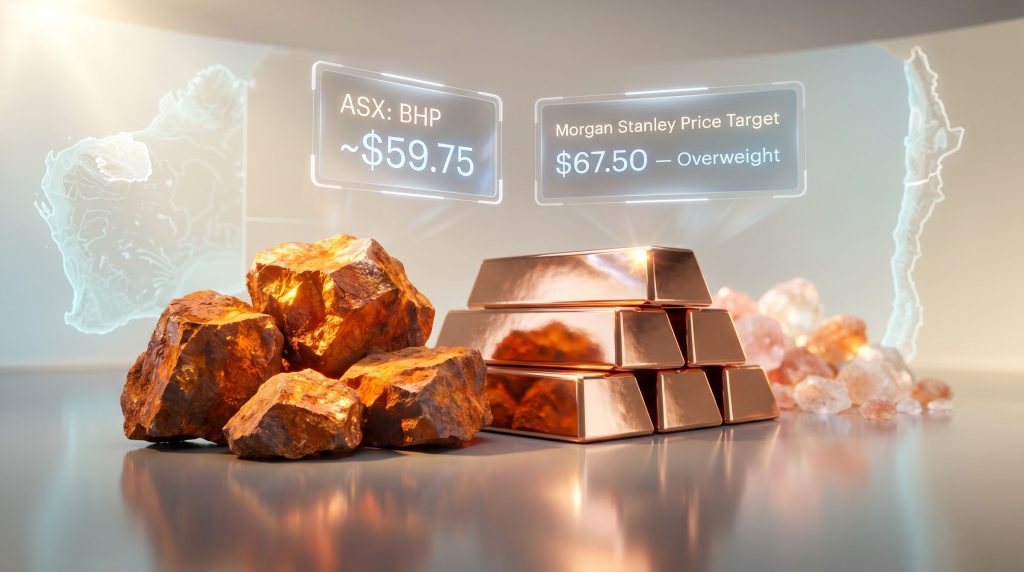
| Recent Share Price (ASX: BHP) | ~$59.75 |
| Morgan Stanley Price Target | $67.50 |
| Morgan Stanley Recommendation | Overweight |
| Implied Upside to Price Target | ~13% |
| Goldman Sachs Stance | Constructive / Buy-aligned |
| Zacks ADR Rating (NYSE) | Hold (mixed near-term signals) |
At approximately $59.75, BHP shares have recovered substantially from their earlier 2025 lows. This rally has meaningfully compressed the margin of safety that existed when the stock was trading at more depressed levels. The current price is not one that represents an obvious deep-value entry, and investors should be clear-eyed about that reality.
Institutional coverage from Morgan Stanley remains constructive, with a price target of $67.50 implying approximately 13% upside from current levels, before accounting for dividend income. Goldman Sachs has maintained a broadly positive stance, citing medium-term commodity fundamentals and the quality of BHP’s asset base as justifications.
BHP’s chairman Ross McEwan has reportedly been purchasing shares on-market, which signals that those closest to the business retain confidence in its long-term trajectory. While insider buying is never a guarantee of near-term price performance, it is a data point worth noting in the broader valuation assessment.
For long-term investors, the more useful valuation question is not whether BHP looks cheap in isolation, but whether its current price adequately compensates for the commodity risk being accepted over a five to ten year holding period. At $59.75, the answer depends heavily on your assumptions for iron ore, copper, and the AUD/USD exchange rate over the medium term.
The next major ASX story will hit our subscribers first
Understanding the Currency Dimension
A nuance that Australian investors frequently underestimate is the AUD/USD currency dynamic embedded in a BHP position. Commodity prices are globally benchmarked in US dollars. BHP’s revenues are predominantly earned in USD. However, Australian investors hold ASX-listed BHP shares priced in Australian dollars.
This creates a natural translation effect. When the Australian dollar strengthens against the US dollar, BHP’s USD-denominated earnings translate into fewer AUD when reported and distributed as dividends. Conversely, a weaker AUD amplifies the AUD value of BHP’s earnings for Australian shareholders. In periods of AUD strength, the earnings translation effect can act as a headwind even when underlying commodity prices are holding firm.
Risks That Demand Respect
Long-term investors in BHP need to account for several categories of risk that go beyond simple commodity price movements:
- Geopolitical and regulatory risk in Chile: Evolving royalty and taxation frameworks, water access legislation, and community relations challenges at Escondida and other Chilean operations can materially affect production costs and volumes.
- Jansen execution risk: As a greenfield potash development, Jansen carries capital cost overrun and timeline risk inherent to large-scale mining construction projects.
- ESG and regulatory pressure: Global regulatory frameworks around carbon emissions, land disturbance, and indigenous land rights are tightening across all major mining jurisdictions, introducing compliance costs that are difficult to quantify precisely.
- Dividend variability: BHP operates a variable dividend policy linked directly to earnings rather than a fixed payout commitment. In commodity downturns, both dividend per share and payout yields can decline sharply.
- Portfolio concentration: Investors who already hold Rio Tinto, Fortescue Metals, or South32 alongside BHP should assess their aggregate resources sector exposure carefully to avoid compounding commodity cycle concentration.
Peer Comparison: How BHP Stacks Up
| Factor | BHP (ASX: BHP) | Rio Tinto (ASX: RIO) | South32 (ASX: S32) |
|---|---|---|---|
| Primary Commodity Exposure | Iron ore, copper, potash | Iron ore, aluminium, copper | Aluminium, manganese, coal |
| Copper Growth Exposure | High (Escondida + pipeline) | Moderate (Oyu Tolgoi) | Low |
| Dividend Track Record | Strong, variable payout | Strong, variable payout | Moderate |
| Market Capitalisation | Large-cap (ASX Top 5) | Large-cap (ASX Top 5) | Mid-large cap |
| Energy Transition Positioning | Strong (copper + potash) | Moderate | Moderate |
| Analyst Sentiment (2025-2026) | Broadly constructive | Broadly constructive | Mixed |
For investors specifically seeking energy transition commodity exposure within the ASX large-cap resources space, BHP’s copper portfolio depth gives it a structural advantage over South32, while its potash optionality introduces a demand driver that currently differentiates it from Rio Tinto’s commodity mix.
A Practical Guide to Building a BHP Position
Step 1: Select Your Listing and Brokerage
- ASX listing (BHP): The most appropriate structure for Australian retail investors and SMSF holders. Traded in AUD during ASX market hours and eligible for franking credits on dividends.
- LSE listing (BHP): Relevant primarily for UK-based investors accessing the stock through British platforms.
- NYSE ADR (BHP): Available for US-based investors or Australians using international brokerage platforms, though currency conversion costs apply.
For Australian investors, CHESS-sponsored brokers provide direct legal ownership of shares rather than a custodial arrangement, which is generally preferred for SMSF and estate planning purposes.
Step 2: Define Your Investment Objective
Before sizing a BHP position, clarify whether it is serving primarily as an income vehicle (dividend yield and franking credits), a growth position (copper and potash upside), or a portfolio diversifier (commodity cycle hedge against other asset classes). Each objective implies a different position size and acceptable volatility threshold.
Step 3: Choose an Entry Strategy
Given that BHP has already experienced a significant price recovery from 2025 lows, a staged entry approach across three to six months is generally more prudent than a single lump-sum purchase. Dollar-cost averaging reduces timing risk and avoids the psychological burden of committing a large sum at what may prove to be a near-term price peak.
Using limit orders rather than market orders during entry can also reduce slippage costs, particularly during periods of high intraday volatility following commodity price movements or significant data releases.
Step 4: Establish a Monitoring Framework
- Set calendar reminders for BHP’s half-year results (typically February) and full-year results (typically August).
- Track 62% Fe CFR China iron ore prices and LME copper spot prices as leading earnings indicators.
- Monitor dividend announcements and pay attention to the franking credit percentage attached to each payment.
- Watch AUD/USD movements, particularly during periods of commodity price volatility.
Step 5: Reassess Without Overreacting
A long-term buy and hold BHP shares approach requires discipline across commodity cycles. Thesis-breaking events that would justify a fundamental reassessment include a structural and permanent collapse in iron ore demand, sustained copper price weakness driven by EV demand disappointment, or major capital destruction at Jansen. Routine commodity price fluctuations and short-term earnings volatility do not constitute thesis breakers for investors with a genuine decade-plus time horizon.
The Bull and Bear Case in Plain Terms
Bull Case Assumptions:
- Copper demand accelerates through the late 2020s and into the 2030s as EV adoption, grid investment, and data centre construction compound simultaneously.
- Iron ore prices hold above US$90 per tonne as Chinese infrastructure investment partially offsets property sector weakness.
- Jansen reaches commercial production on schedule with manageable capital costs.
- The USD weakens over the medium term, providing broad support to commodity prices globally.
Bear Case Assumptions:
- Chinese steel demand enters structural decline faster than anticipated, pushing iron ore below US$80 per tonne on a sustained basis.
- Copper demand disappoints relative to current forecasts due to slower-than-expected EV adoption rates or grid investment delays.
- Jansen faces material cost overruns or timeline extensions, destroying capital allocated to the project.
- The AUD strengthens significantly against the USD, compressing the domestic value of BHP’s earnings.
Frequently Asked Questions
Is BHP Suitable for an SMSF Portfolio?
BHP is one of the most widely held ASX shares within self-managed super funds. Its franked dividend history, balance sheet strength, and market liquidity make it a logical consideration for income-focused SMSF strategies. Trustees should ensure BHP aligns with their fund’s documented investment strategy and assess whether existing resources sector exposure creates concentration risk at the fund level.
How Does BHP’s Dividend Policy Work?
BHP operates a variable dividend policy, meaning the payout is determined by earnings performance each period rather than a fixed commitment. This approach delivers substantial dividends in strong commodity years and reduced payouts during downturns. For Australian investors, dividends paid on ASX-listed BHP shares typically carry franking credits, which can meaningfully enhance after-tax returns for investors in lower marginal tax brackets, including superannuation funds in pension phase.
What Is the Significance of Insider Buying by BHP’s Chairman?
When a company’s most senior directors purchase shares on-market using their own capital, it is generally interpreted as a signal of confidence in the company’s prospects at the prevailing price. BHP’s chairman Ross McEwan’s on-market purchases represent a meaningful data point, though they should be considered alongside broader fundamental analysis rather than treated as a standalone investment signal.
How Does a Weak US Dollar Environment Affect BHP?
A weaker USD typically supports higher commodity prices in USD terms, as commodities become relatively cheaper for buyers holding other currencies. For Australian investors, this dynamic is partially filtered through the AUD/USD exchange rate. If the AUD strengthens in tandem with a weaker USD, some of the commodity price benefit is absorbed in the currency translation, limiting the net earnings uplift experienced by Australian shareholders.
Furthermore, understanding cut-off grade economics helps investors appreciate why declining ore grades globally reinforce the long-term supply constraints underpinning BHP’s copper thesis.
Key Takeaways for Long-Term Investors
- BHP at approximately $59.75 is not a distressed-valuation entry, but it is not priced for perfection either. The risk-reward is reasonable for investors with a genuine multi-year time horizon.
- The iron ore business remains the primary earnings and dividend engine, with world-class cost competitiveness providing resilience across the commodity cycle.
- Copper is BHP’s most compelling long-term growth story, underpinned by declining ore grades globally, rising electrification demand, and structurally slow supply response timelines.
- Potash via the Jansen project introduces a demand driver fundamentally uncorrelated with industrial metals cycles, strengthening BHP’s long-term diversification narrative.
- Analyst sentiment from major institutional houses remains broadly constructive, with Morgan Stanley’s $67.50 price target implying meaningful upside before dividend income is included.
- Those who choose to buy and hold BHP shares via a staged entry approach will generally manage timing risk more effectively than those committing a full position at once.
- Currency dynamics, dividend variability, and geopolitical risk in copper-producing regions are embedded risks that investors must price into any long-term position sizing decision.
This article contains general financial information only and does not constitute personalised financial advice. Past performance is not indicative of future returns. Investors should consider their own circumstances and consult a licensed financial adviser before making investment decisions. All figures cited are based on publicly available data at the time of writing and are subject to change.
Want to Catch the Next Major Mineral Discovery Before the Market Does?
While BHP offers exposure to established commodity cycles, significant wealth in the resources sector has historically been built by investors who identified transformative discoveries early — Discovery Alert’s proprietary Discovery IQ model delivers real-time ASX mineral discovery alerts, turning complex geological data into actionable opportunities the moment they are announced. Explore historic discoveries and the returns they generated, then begin a 14-day free trial to position yourself ahead of the broader market.