July 16, 2026
When Two Shocks Collide: The Case for Selective Energy Equity Exposure in 2026
Energy markets have a long memory for convergence events. The episodes that define investor cycles are rarely caused by a single force acting in isolation. They emerge when independent systems collide simultaneously, compressing reaction time and bifurcating returns between those positioned correctly and those caught in the crossfire. The current environment carries the fingerprints of exactly this kind of convergence, and understanding the mechanics of each shock, and how they interact, is the starting point for identifying which oil and gas stocks are genuinely ready for a Hormuz spike and a hawkish Fed.
When big ASX news breaks, our subscribers know first
Two Shocks, One Market: Understanding the Structural Setup
The first shock is geophysical and geopolitical. The Strait of Hormuz, a navigable channel barely 33 kilometres wide at its narrowest point between Iran and Oman, functions as the world's single most consequential energy transit corridor. Approximately one-fifth of all seaborne crude oil trade passes through this passage, representing the combined export capacity of Saudi Arabia, Iraq, Kuwait, the UAE, and Qatar. There is no physical alternative that can absorb that volume quickly.
The Suez Canal, the Cape of Good Hope routing, and existing overland pipeline infrastructure cannot collectively compensate for a sustained Strait closure without significant price consequences. Furthermore, the oil prices and trade war dynamics currently shaping global markets add another layer of complexity to an already pressured supply environment.
Iran's Revolutionary Guard declared the Strait closed to commercial traffic on July 11, 2026. Three consecutive nights of U.S. military strikes followed, yet repeated military action has not restored full transit freedom. Tensions in the Strait of Hormuz sent tanker traffic to multi-week lows, the International Maritime Organization urged carriers to avoid transits, and Japan's trade leadership formally declared the passage off-limits for its carriers. Pakistan launched emergency LNG procurement, and Asian importers began pivoting toward U.S. barrels as Gulf supply became operationally unreliable.
The second shock originates in monetary policy. Elevated crude prices transmit directly into headline and core inflation metrics through transportation costs, manufacturing input prices, and consumer fuel expenditure. That inflation persistence reduces the Federal Reserve's flexibility to ease financial conditions. The 2-year yield outlook has become increasingly relevant here, with the 2-year U.S. Treasury yield climbing to a 16-month high as energy-driven inflation expectations repriced the forward rate path.
Fed Chair Kevin Warsh has signalled a commitment to eliminating the inflation experience of the prior half-decade, which markets interpret as a determination to maintain restrictive policy until price pressures are demonstrably extinguished. A cooler June CPI reading reduced the probability of an immediate July hike, but at least one additional rate increase before year-end remains the market's baseline expectation.
These two forces, a supply-side geopolitical shock and demand-side monetary restriction, typically pull markets in opposite directions. In 2026, they are paradoxically converging to strengthen the case for a specific subset of energy equities: those with maximum commodity price exposure and minimum financial leverage.
The Hormuz Price Transmission: What the Numbers Actually Show
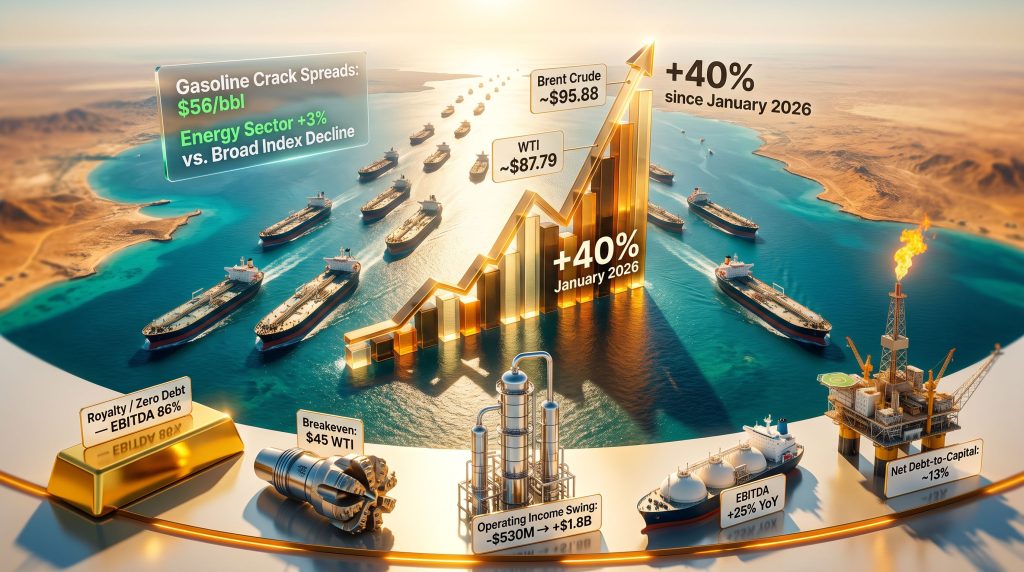
Brent crude climbed back above $86 per barrel following the July escalation, a one-month high, with crude up approximately 40% since January 2026. Some trading sessions saw Brent futures reach $95.88 and WTI touch $87.79, with analyst scenarios modelling $100+ per barrel if the closure extends materially beyond initial projections. U.S. gasoline prices approached $4 per gallon, with retail fuel markets absorbing upstream disruption with a characteristic lag.
Monitoring crude oil price trends closely is essential during this period, as the forward curve itself is sending clear structural signals. Brent futures flipped into backwardation, where near-term contracts trade at a premium to longer-dated ones. This is a reliable signal that physical supply tightness is being priced into immediate delivery markets rather than speculative positioning. Backwardation is not a prediction; it is a measurement of current physical scarcity.
| Crude Benchmark | Recent Price Range | Move Since January 2026 |
|---|---|---|
| Brent Crude | $86–$95.88 | ~+40% |
| WTI Crude | $80–$87.79 | Significant uplift |
| Natural Gas (U.S.) | ~$2.92 | Modest positive |
| Gasoline (U.S.) | ~$3.31–approaching $4.00 | Elevated |
| European Natural Gas | Elevated | Hormuz escalation premium |
The trade flow consequences are already reshaping global procurement patterns. Asian importers are redirecting purchases toward U.S. crude and LNG as Gulf supply becomes hazardous. China has cut Saudi crude orders as Hormuz risk premiums and discount structures alter the economics of long-haul Middle Eastern supply.
China's refinery runs fell to pandemic-era lows and crude imports dropped to decade lows as the crisis simultaneously disrupted supply and compressed Asian industrial activity. Nigeria's oil production hit a six-year high as non-Gulf producers captured market share from disrupted Middle Eastern flows.
The Fed Dimension: Why Rate Sensitivity Is Now a Primary Differentiator
The monetary policy overlay fundamentally changes how energy company quality should be assessed. In a zero-rate environment, leverage was a tool for amplifying returns. In a structurally higher-rate environment, however, leverage is a liability that can consume the commodity upside it was supposed to amplify.
Companies that expanded aggressively during the era of near-zero borrowing costs now face refinancing risk in a world where credit is meaningfully more expensive. The selection principle for this cycle is straightforward: maximum commodity price leverage combined with minimum financial leverage. Debt-soaked exploration and production companies remain structurally disadvantaged even as oil prices surge, because every rate hike redirects cash flow from shareholders toward creditors.
A rate hike that costs a heavily leveraged driller tens of millions in refinancing expense costs a zero-debt royalty company precisely nothing. Balance sheet quality has become as important a variable as commodity price exposure in 2026.
The Investment Framework: Four Screening Criteria for the Current Cycle
Identifying oil and gas stocks ready for a Hormuz spike and a hawkish Fed requires applying a consistent analytical filter across business models. Understanding the commodity price impact on different company structures is essential context here. The four criteria that matter most in this environment are:
- Commodity price leverage – Does unhedged or minimally hedged production exposure translate directly into earnings upside as crude climbs?
- Balance sheet resilience – Is net-debt-to-capital low enough to remain indifferent to rate hike cycles?
- Free cash flow generation – Can shareholder returns be sustained without accessing debt markets?
- Strategic positioning – Does the company benefit from secondary Hormuz effects, including refining margin expansion, LNG demand redirection, and U.S. export market share gains?
| Company Type | Commodity Leverage | Balance Sheet Strength | Rate Hike Sensitivity | Hormuz Beneficiary |
|---|---|---|---|---|
| Integrated Supermajor | Moderate-High | Very High | Very Low | Yes (upstream + downstream) |
| Unhedged Shale Producer | Very High | High | Low | Yes (direct crude price) |
| Independent Refiner | High (crack spread) | Moderate-High | Low-Moderate | Yes (product shortage) |
| LNG Exporter | High (gas rerouting) | Moderate | Moderate | Yes (Qatar displacement) |
| Royalty / Mineral Rights | Very High | Extremely High | None | Yes (unhedged royalties) |
How Each Energy Business Model Performs Under Simultaneous Pressure
Integrated Supermajors: Fortress Balance Sheets That Win on Both Ends
Vertically integrated energy companies carry a structural advantage during supply shocks because they benefit simultaneously from upstream crude price uplift and downstream refining margin expansion. ExxonMobil (NYSE: XOM) exemplifies this profile, carrying a net-debt-to-capital ratio of approximately 13% alongside $8.4 billion in cash, 43 consecutive years of dividend growth, and a $20 billion buyback programme in 2026 that requires no capital markets access to sustain.
First-quarter net income fell to $4.2 billion from $7.7 billion a year earlier, partly because the fuels segment recorded a $1.3 billion loss when Hormuz disruption blocked physical shipments tied to existing hedges. This created headline alarm, but the underlying dynamic is a timing mismatch rather than a structural impairment. The upstream engine, powered by record production from Guyana and continued Permian Basin growth, generated $5.7 billion in cash flow. When physical hedge mismatches normalise, both segments contribute simultaneously.
The primary risk for supermajors in this environment is not financial. It is political. War-related profit surges historically attract windfall tax proposals within 60 to 90 days of earnings beats becoming public knowledge, and both Washington and Brussels are already revisiting that conversation.
Unhedged Shale Producers: Full Upside, Conservative Capital Structure
EOG Resources (NYSE: EOG) entered 2026 without commodity hedges, a deliberate strategic decision that gives shareholders full, unfiltered exposure to crude price movements. This approach is only viable for operators with ultra-low corporate breakevens. EOG's model is stress-tested to remain profitable at $45 WTI and $2.50 natural gas, breakeven economics that make the current price environment look extraordinarily generous.
The company ended the first quarter with $3.8 billion in cash and a net-debt-to-capital ratio of 11.7%, alongside an untouched $3 billion credit facility maintained as insurance rather than operational necessity. At current strip prices, management projects record annual free cash flow of $8.5 billion, with a commitment to return at least 70% to shareholders through dividends and buybacks. A Fed rate hike is arithmetically irrelevant to a company that built its financial model around $45 oil rather than cheap debt.
Independent Refiners: The Spread Play That Outperforms the Barrel
The counterintuitive insight of supply shock economics is that refining margins can outperform crude price gains because product shortages are structurally independent of barrel pricing. When physical crude supply is disrupted, refined product scarcity develops on its own timeline, often faster and more severely than the crude market itself adjusts.
Gasoline crack spreads exceeded $56 per barrel, approaching levels last recorded following the 2022 Russia-Ukraine conflict. Diesel dynamics were even more acute: Ukrainian drone strikes on Russian refinery infrastructure triggered Russian export restrictions, sending European diesel cracks to 15-year highs.
Valero (NYSE: VLO) captured this environment directly. Refining operating income swung from a $530 million loss to $1.8 billion in a single year. Management indicated that second-quarter Gulf Coast margin indicators were running near $30 per barrel versus $18 in the prior quarter. The company issued $850 million of 10-year notes in March at a 5.15% coupon, reportedly the tightest spread a refiner had achieved over Treasuries, specifically structured to clear near-term maturities before the rate environment deteriorated further.
The share count has been reduced from approximately 400 million in 2022 to near 300 million, amplifying per-share earnings through sustained buybacks. Risk factors are real and should not be minimised. A March explosion and fire disrupted units at the Port Arthur refinery in Texas. The wind-down of the Benicia facility in California creates an ongoing earnings drag. And a stock trading at record highs carries less margin for error if crack spreads normalise.
LNG Exporters: The Second-Order Hormuz Trade
The Hormuz trade that fewer market participants are actively pricing involves natural gas, not crude. Qatar, one of the world's largest LNG suppliers, paused maritime activity and diverted carriers when the Strait became operationally hazardous. European natural gas prices spiked on Middle Eastern LNG supply interruption. When Gulf gas cannot move, the structural beneficiary is the United States, which became the world's largest LNG exporter after the first American cargo departed Sabine Pass in 2016.
Cheniere Energy (NYSE: LNG) reported consolidated adjusted EBITDA growth of 25% year-over-year in the first quarter, set a cargo export record, commissioned a new liquefaction train, and raised full-year guidance. The chief executive indicated publicly on the Q1 2026 earnings call that disruption of Middle Eastern LNG volumes was directly exacerbating the supply shortage and pushing prices higher. In addition, that framing from the operator of the largest U.S. export terminal carries meaningful market intelligence.
The balance sheet warrants careful reading. Cheniere carries more leverage than the other categories, a structural legacy of the capital intensity required to build LNG export terminals at scale. However, the trajectory is constructive: $1.75 billion of notes were refinanced into cheaper structures last quarter, interest coverage runs above 6x, and $537 million in stock was repurchased in a single quarter.
The headline $3.5 billion net loss is a non-cash mark-to-market movement on long-dated gas contracts, not a cash outflow. The genuine capital risk is Trains 8 and 9, which are approximately one-third complete, representing a substantial remaining cash commitment before full free cash flow generation is achievable.
Royalty and Mineral Rights Companies: Zero Debt, Pure Commodity Exposure
The royalty business model is structurally distinct from every other category in energy. Companies operating in this space own subsurface or surface acreage rights across producing basins and collect a contractual percentage of all production revenue without incurring any drilling, completion, or operating costs. Capital expenditure is minimal or nonexistent. There are no rigs, no crews, and no exposure to cost inflation.
Texas Pacific Land (NYSE: TPL) owns approximately 881,000 surface acres and 28,000 net royalty acres across the Permian Basin, generating EBITDA margins near 86% as a direct function of the zero-capital-intensity model. The rate hike question is resolved by a single data point: TPL carries zero debt. It holds $248 million in cash alongside an undrawn $500 million credit facility. The company has no refinancing exposure regardless of where the Fed takes the overnight rate.
Because its royalty streams are entirely unhedged, TPL translates Hormuz-driven crude price gains almost immediately into revenue. Record first-quarter revenue of $237 million was reported alongside earnings estimate beats, with royalty production volumes up approximately 19% year-over-year.
An emerging optionality layer is developing outside the hydrocarbon business. TPL's surface acreage in West Texas is being monetised for data centre and AI infrastructure power projects, creating a non-hydrocarbon revenue stream tied to technology sector energy demand growth. This is a genuinely novel value dimension for a mineral rights company that most energy-focused investors have not yet fully incorporated into valuation frameworks.
Concentration risk is the primary structural concern. All assets sit within a single basin, creating correlated downside if Permian-specific regulatory, geological, or infrastructure conditions deteriorate. Governance uncertainty following the departure of a highly influential long-term shareholder created additional uncertainty about strategic direction. And a market capitalisation near $30 billion for a zero-debt royalty business reflects both scarcity value and a full commodity cycle premium that compresses the margin of safety at current prices.
The next major ASX story will hit our subscribers first
Risks the Market May Be Underpricing
The De-Escalation Risk Premium
The asymmetric risk profile of a Hormuz-driven energy trade is that the upside scenario requires sustained disruption while the downside is a diplomatic resolution that rapidly deflates the geopolitical risk premium embedded in crude prices. Experts warn of dire risks from draining strategic reserves as a stop-gap measure, with historical precedent consistently demonstrating sharp price reversals following geopolitical de-escalation, often within days rather than weeks. The highest-volatility window is typically the first 72 hours following any escalation or de-escalation event, when positioning adjustments are most aggressive and price discovery is least reliable.
The Demand Destruction Paradox
The Federal Reserve's monetary tightening creates a paradox within the energy trade. Higher rates slow economic activity, which eventually reduces oil demand, which undermines the very price spike that justified the hawkish policy stance. China's refinery runs falling to pandemic-era lows and crude imports collapsing to decade lows illustrates that the Hormuz crisis is simultaneously disrupting supply and suppressing Asian industrial demand.
Consequently, OPEC's market influence is being tested as never before. OPEC has cut its demand forecast again, a signal that the cartel itself is pricing in demand-side headwinds even as supply tightens on the other side of the equation.
The Russia Parallel Disruption
A second simultaneous maritime supply disruption is developing in the Black Sea as Ukraine intensifies attacks on Russian tankers. Russia's oil export surge is running into what analysts describe as a 135-million-barrel traffic jam as tanker routing complications, insurance market withdrawals, and physical logistics challenges compound. The IEA has cut Russia's oil production forecast in response to sustained Ukrainian infrastructure targeting. Two simultaneous maritime chokepoint crises create compounding supply uncertainty that is historically unusual and analytically challenging to model with confidence.
Alternative Supply Routes and the Long-Term Bypass Question
The Hormuz crisis is accelerating infrastructure planning that has existed in conceptual form for years. U.S. backing for an Iraq-Syria oil pipeline represents a potential long-term bypass route for Hormuz-dependent Iraqi crude, though pipeline construction timelines measured in years make this irrelevant to the current price cycle.
Dubai is advancing strategic planning for post-Hormuz infrastructure resilience, including pipeline capacity expansions designed to route Gulf crude to non-Strait export terminals. These initiatives reflect a recognition within the Gulf that structural dependence on a single maritime chokepoint creates unacceptable sovereign risk. For investors tracking oil and gas stocks ready for a Hormuz spike and a hawkish Fed, these longer-term developments remain worth monitoring as potential structural shifts in the global energy supply architecture.
Disclaimer: This article is intended for informational and educational purposes only and does not constitute financial, investment, tax, or legal advice. All figures, price levels, company metrics, and market data referenced are based on publicly available information current to the time of writing and are subject to change. Forecasts, analyst projections, and scenario modelling involve inherent uncertainty and should not be relied upon as predictions of future outcomes. Readers should conduct their own independent research and consult qualified financial advisers before making any investment decisions. Past performance of energy equities during prior geopolitical or monetary cycles does not guarantee comparable results in the current environment.
Want to Track the Next Major Resource Discovery Before the Market Does?
While geopolitical shocks and monetary policy cycles reshape energy equity returns, significant mineral discoveries on the ASX can generate equally transformative opportunities — and timing is everything. Discovery Alert's proprietary Discovery IQ model delivers real-time alerts the moment significant ASX mineral discoveries are announced, cutting through market noise to surface actionable opportunities for both traders and long-term investors — explore historic discovery returns to see what early positioning has meant in practice, and begin your 14-day free trial today to ensure you are never caught on the wrong side of a major announcement.