July 16, 2026
The Technology Cost Curve That Is Rewriting Australia's Energy Playbook
Energy systems rarely transform through single dramatic events. They shift through the slow, compounding pressure of economics, and when two opposing cost curves finally intersect, the consequences ripple through investment decisions, grid planning, and long-term infrastructure strategy for decades. That moment has now arrived in Australia's National Electricity Market, where GenCost cheaper batteries challenge gas generation in ways that even the most optimistic renewable energy forecasters did not anticipate this early.
Understanding why this crossover matters, and what it means for the future of flexible generation capacity, requires looking beyond the headline numbers and examining the structural forces driving both curves simultaneously.
When big ASX news breaks, our subscribers know first
What the CSIRO GenCost Framework Actually Measures
The CSIRO GenCost report is Australia's most authoritative annual benchmarking exercise for electricity generation costs. Published by the Commonwealth Scientific and Industrial Research Organisation, it applies Levelised Cost of Energy (LCOE) analysis across technology types, incorporating global supply chain data, technology learning rates, and projected capital expenditure trajectories to produce comparable cost estimates across generation and storage technologies.
LCOE is a useful but imperfect tool. It calculates the lifetime average cost of generating one unit of electricity by spreading all capital, operating, and fuel costs across projected output. What it cannot fully capture is the system value of dispatchability, the premium placed on electricity delivered at specific times of peak demand rather than whenever the resource is available.
This distinction matters enormously when comparing batteries and gas turbines, because the economic battleground between them is not baseload generation — it is the evening demand peak, where the price of electricity and the cost of supplying it diverge most sharply from average conditions.
The Economics Behind the Battery-vs-Gas Cost Crossover
How Battery Capital Costs Have Fallen Faster Than Most Forecasts Predicted
The speed of lithium-ion battery cost reduction has repeatedly outpaced industry forecasts, and the most recent data reinforces this pattern dramatically. Large-scale battery capital costs declined approximately 20% in 2024-25, with GenCost modelling projecting a further 15% year-on-year reduction for 2025-26. Globally, lithium-ion battery costs fell roughly 35% in under a year, a compression that has fundamentally altered the competitive landscape for flexible generation capacity.
The driving forces behind this cost collapse are interconnected:
- Massive expansion of Chinese battery manufacturing capacity has created persistent oversupply conditions in global cell markets
- Improvements in cell chemistry and manufacturing process efficiency continue to reduce per-unit production costs
- Increased competition among battery system integrators is compressing margins at every stage of the supply chain
- Falling raw material costs for lithium carbonate following the 2022-23 price peak have fed through to cell production economics
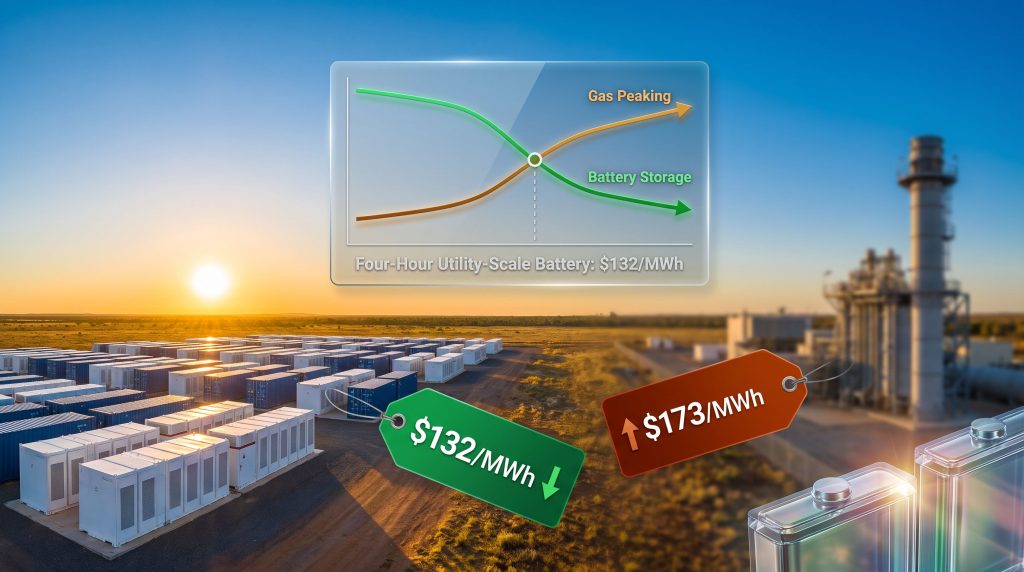
The battery raw materials market has, furthermore, seen significant shifts in the lithium carbonate market dynamics that continue to influence global battery pricing. The result is a cost structure that now places four-hour utility-scale batteries at approximately $132/MWh, compared to gas peaking plants (open cycle gas turbines) at approximately $173/MWh for equivalent evening peak supply. By 2030, battery capital costs are projected to reach approximately $922/kW, continuing the downward trajectory that has characterised the past decade.
| Technology | Cost per MWh (Approx.) | Cost Trajectory |
|---|---|---|
| Four-Hour Utility-Scale Battery | $132/MWh | Declining |
| Gas Peaking Plant (Open Cycle) | $173/MWh | Rising |
| Large-Scale Battery (2030 Projection) | ~$922/kW capital cost | Declining |
Why Gas Turbine Costs Are Moving in the Opposite Direction
While battery costs compress, gas generation economics are deteriorating from multiple directions simultaneously. Fuel price exposure remains a structural vulnerability, but the more immediate pressure comes from equipment procurement costs. Global gas turbine manufacturing capacity is a concentrated market dominated by a small number of major suppliers, and when demand for turbines spikes, lead times and prices respond sharply.
The Unexpected Catalyst: US Data Centre Demand and Global Turbine Scarcity
One of the least-discussed but most consequential factors currently reshaping Australian electricity economics originates thousands of kilometres away. The explosion of artificial intelligence infrastructure investment across the United States has generated enormous demand for reliable, high-capacity power. Data centre developers, facing constraints on renewable energy availability and grid connection queues, have turned to gas-fired generation as a near-term solution, creating intense competition for gas turbines globally.
This surge in AI-driven power demand has pushed gas turbine procurement costs well above historical norms, with delivery queues extending years into the future. The consequence for markets like Australia is that new gas peaking capacity has become significantly more expensive to build, inadvertently accelerating battery storage's cost advantage precisely when the NEM needs new flexible capacity most.
Indeed, the US data centre boom is directly shaking up Australia's energy grid in ways few anticipated. This is a genuinely underappreciated dynamic — the infrastructure build-out for artificial intelligence computing is directly influencing the relative economics of gas versus battery storage in the Australian grid.
What Evening Peak Displacement Actually Means for the NEM
The 5pm-9pm Window: Where Grid Economics Are Decided
Australia's National Electricity Market does not price electricity uniformly across the day. The 5pm to 9pm window represents the period of maximum residential and commercial demand, when solar generation has ceased and household consumption peaks. This four-hour window has historically been the defining economic opportunity for gas peaking plants, which could charge low during off-peak periods and dispatch at high prices during the evening surge.
Four-hour battery systems are now specifically engineered to target exactly this window. They charge during daylight hours when solar generation is abundant and wholesale prices are frequently negative or near zero, then discharge during the evening peak to capture the premium between daytime and nighttime pricing. The economic logic is precise and self-reinforcing.
Solar Absorption and the Daytime Charging Advantage
A less obvious dimension of the battery economics story is the relationship between solar penetration and charging costs. As rooftop and utility-scale solar capacity continues expanding across the NEM, midday wholesale prices have been driven progressively lower, sometimes into deeply negative territory. For battery operators, this represents a structural subsidy — a recurring opportunity to acquire energy at minimal or zero cost before reselling it during the high-value evening window.
The higher the solar penetration, the more pronounced this midday price depression becomes, and the stronger the economic case for battery storage grows. Renewables now account for a record 52.4% of total NEM energy supply, having pushed coal-fired generation to an all-time quarterly low, down 4.6% year-on-year as of Q4 CY25. This dynamic compounds the battery advantage with every additional solar installation connected to the grid.
The structural relationship between solar penetration and battery economics is self-reinforcing: more solar creates lower midday prices, which reduces battery charging costs, which improves battery margins, which attracts more battery investment, which absorbs more solar, which reduces curtailment.
How the Evening Peak Crossover Reshapes Price Formation
When battery storage consistently undercuts gas peakers during the evening demand window, it fundamentally alters how electricity prices are formed during that period. Gas peaking plants have historically set the marginal price during peak demand, meaning their relatively high operating costs flowed through to wholesale electricity prices across the entire market. As batteries displace gas peakers from the merit order, this price-setting mechanism shifts, with potentially significant implications for both wholesale market prices and long-term contract economics.
Is Gas Generation Becoming Commercially Obsolete?
The Case for Gas Retaining a Residual System Role
Despite the dramatic cost crossover, a complete and rapid exit of gas generation from the NEM is neither likely nor, from a system stability perspective, currently desirable. GenCost modelling projects gas generation retaining a 3% to 7% share of NEM electricity supply through to 2050, reflecting its continued utility in specific system contexts that battery storage cannot yet address economically.
For gas generation to remain a commercially rational investment as battery costs continue their downward trajectory, modelling suggests gas commodity prices would need to remain as low as $4/GJ over the long term, combined with persistently elevated battery charging costs. The simultaneous, permanent achievement of both conditions is considered unlikely under current market trajectories.
Where Batteries Still Face Functional Limitations
The distinction between dispatchability and cost competitiveness is critical to understanding why gas does not disappear overnight. Consider the capability comparison across key grid services:
| Capability | Battery Storage | Gas Generation |
|---|---|---|
| Evening Peak Supply | Cost-competitive | Higher cost |
| Rapid Dispatch | Sub-second response | Minutes-scale |
| Synchronous Inertia | Requires inverter solutions | Native capability |
| Long-Duration Firming (>8 hrs) | Limited at scale | Capable |
| Carbon Emissions | Zero operational | Significant |
| Cost Trajectory | Declining | Rising |
Synchronous inertia represents perhaps the most technically significant gap. Conventional rotating generators, including gas turbines, contribute inertia to the grid through their physical mass. This inertia acts as a buffer against sudden frequency deviations, giving the system time to respond to generation or load imbalances. Battery inverters do not provide this naturally and require sophisticated control systems, synthetic inertia technologies, or complementary grid services to replicate the stabilising function.
Long-duration firming beyond eight hours also remains a challenge for lithium-ion battery systems at scale, a limitation that becomes increasingly relevant during extended low-renewable-generation periods such as prolonged cloudy or windless conditions.
GenCost Methodology: Learning Rates and the Technology Projection Problem
How Technology Learning Rates Work in Practice
The GenCost model applies technology learning rates — a concept borrowed from manufacturing economics — to project future generation costs. Learning rates describe the percentage reduction in cost achieved for each doubling of cumulative installed capacity. Historically, lithium-ion batteries have demonstrated learning rates of approximately 18-20%, meaning costs fall by that proportion every time global installed capacity doubles.
Given the pace of global battery deployment driven by both stationary storage and electric vehicle manufacturing, cumulative capacity is doubling relatively rapidly, which is why observed cost reductions have persistently exceeded point-in-time projections. The challenge for modellers is that learning rates are not constant — they tend to slow as technologies mature and the easiest manufacturing improvements are exhausted.
The Role of Global Supply Chain Data
GenCost incorporates international supply chain pricing data rather than relying solely on Australian project cost observations, which is methodologically important. Local project costs often include significant non-hardware components — grid connection, civil works, and financing costs — that can obscure the underlying technology cost trajectory. By anchoring projections to global manufacturing costs and adjusting for local conditions, the framework provides a more reliable forward-looking benchmark.
The next major ASX story will hit our subscribers first
Strategic Implications for Energy Investment and Grid Planning
What the Cost Crossover Means for New Gas Infrastructure
For investors and infrastructure planners evaluating new flexible generation capacity, the GenCost data presents a stark message. A new open cycle gas turbine committed today faces an extended operating life during which battery alternatives will continue to become cheaper, gas fuel costs remain uncertain, and the window of economic viability for peaking generation narrows progressively. The risk profile of new gas peaking investment has, consequently, deteriorated materially.
Battery storage, by contrast, benefits from a virtuous cycle of falling capital costs, improving operational performance, and a market structure that increasingly rewards the specific service batteries are optimised to deliver. The Chinese battery recycling breakthrough of recent years has further strengthened supply chain resilience, contributing to the sustained downward cost pressure observed in global battery markets.
Three Structural Forces Sustaining the Battery Advantage
- Manufacturing scale: Global battery production capacity continues expanding, sustaining downward pressure on cell and system costs regardless of local policy settings
- Solar synergy: Continued growth in NEM solar penetration persistently depresses midday charging costs, improving battery revenue economics
- Gas turbine supply constraints: AI infrastructure demand in the United States is creating sustained upward pressure on turbine procurement costs, widening the cost gap from the gas side simultaneously
What Regulators and Planners Need to Address
Regulatory frameworks designed around a gas-dominated flexible capacity market require adaptation. Inertia and frequency control obligations, ancillary service markets, and long-duration firming procurement mechanisms all need to evolve to reflect a battery-dominant flexible capacity environment. The technical limitations of battery storage are real but not insurmountable, and most have workable engineering solutions that become more economical as deployment scales.
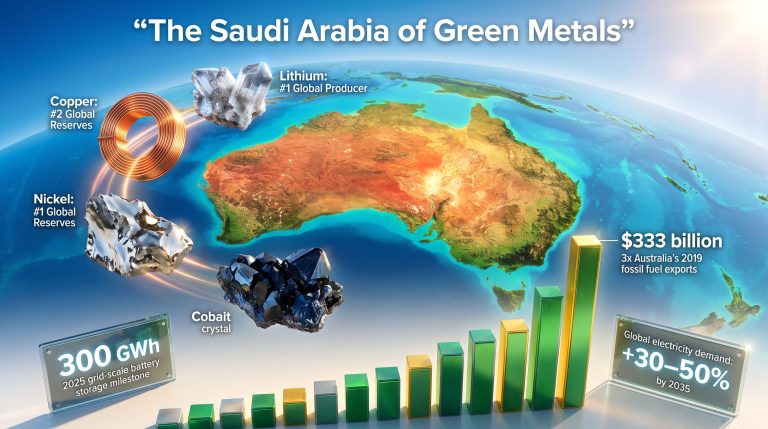
Furthermore, the broader context of critical minerals demand driven by the energy transition will continue to shape both battery input costs and the geopolitical dimensions of supply chain security for years to come. In addition, renewable energy solutions are transforming the mining sector itself, creating further synergies across the clean energy economy.
Energy planners and market regulators face the challenge of designing markets that can extract the full economic benefit of battery storage's cost advantage while ensuring the grid services that batteries cannot yet provide are procured through other means — whether through retained gas capacity, pumped hydro, demand response, or emerging long-duration storage technologies.
The CSIRO's finding that batteries are now cheaper than gas as AI drives turbine costs higher marks a genuine turning point for Australia's electricity sector. The NEM is at an inflection point where GenCost cheaper batteries challenge gas generation in a manner that is structural, not cyclical, and unlikely to reverse. What comes next depends on how quickly planning frameworks, investment signals, and grid service markets adapt to a cost reality that the data is now making impossible to ignore.
For additional reporting on Australia's electricity generation economics and NEM generation trends, visit australianminingreview.com.au.
This article contains forward-looking cost projections and modelling outputs. All forecasts are inherently uncertain and subject to change based on evolving market conditions, supply chain dynamics, technology development, and regulatory settings. This content does not constitute financial or investment advice.
Want to Catch the Next Major Mineral Discovery Before the Broader Market Does?
The energy transition reshaping Australia's electricity grid is driving unprecedented demand for critical minerals — and Discovery Alert's proprietary Discovery IQ model scans every ASX announcement in real time, instantly identifying significant new discoveries across battery metals and the full spectrum of commodities fuelling this shift. Explore historic examples of what major mineral discoveries can return and begin your 14-day free trial at Discovery Alert to position yourself ahead of the market.