August 2, 2026
Why the Case to Buy BHP Shares Now and Hold for the Next Decade Deserves Serious Scrutiny
Few investment decisions carry more weight than committing capital to a large-cap miner across a full decade. Commodity markets are notoriously humbling, punishing investors who enter at cycle peaks and rewarding those who understand that today's pricing environment rarely reflects tomorrow's structural reality. The decision to buy BHP shares now and hold for the next decade is not simply a bet on commodity prices remaining elevated. It is a thesis built around operational scale, capital discipline, and positioning across three distinct commodity pillars that each carry meaningful long-term demand drivers.
Understanding this distinction matters because it separates genuine long-term conviction from momentum-driven enthusiasm. The global energy transition, shifting agricultural demand, and infrastructure development across emerging economies are not abstract forces. They have measurable implications for the specific materials BHP extracts, processes, and sells. Whether those forces translate into sustained shareholder returns depends on execution, valuation at entry, and the investor's ability to endure cyclical drawdowns without abandoning the position.
When big ASX news breaks, our subscribers know first
How Has BHP Actually Performed Over the Past Decade?
A Decade of Returns: BHP vs. the Broader Market
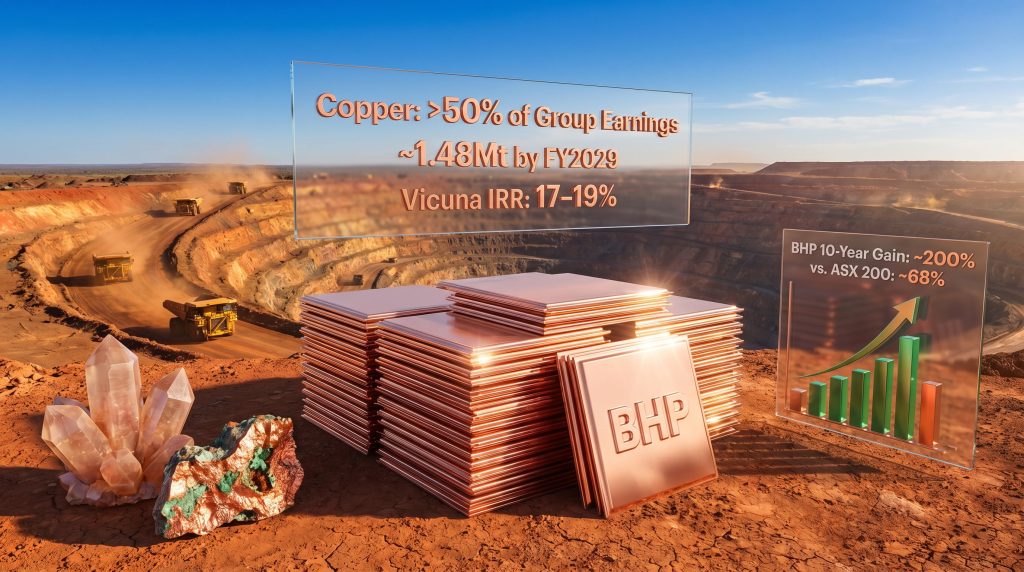
The historical return profile of BHP Group Ltd (ASX: BHP) provides essential grounding before any forward-looking analysis can be credible. Over the past decade, BHP shares have gained approximately 200%, while the S&P/ASX 200 Index has risen roughly 68% over the same period. In the 12 months to April 2026 alone, BHP shares climbed approximately 47%, compared to the broader index's return of around 11%.
| Performance Metric | BHP (ASX: BHP) | S&P/ASX 200 Index |
|---|---|---|
| 10-Year Share Price Gain | ~200% | ~68% |
| 12-Month Share Price Gain | ~47% | ~11% |
| Forward P/E Ratio (post-recovery) | ~14x | Market average |
| Forecast Earnings Growth (p.a.) | 4.6% | N/A |
| Forecast Revenue Growth (p.a.) | 0.5% | N/A |
| Projected ROE (3-year horizon) | 19.4% | N/A |
The roughly 132 percentage point outperformance relative to the ASX 200 over a decade reflects the compounding effect of commodity exposure paired with disciplined capital management. Critically, that journey was anything but smooth. Large drawdowns of 20% to 40% are characteristic of commodity-linked equities during pricing troughs, and BHP is no exception.
"Outperformance across a commodity cycle is not achieved through passive observation. It requires the capacity to hold through significant interim losses without forced selling, a psychological and financial requirement that many retail investors underestimate."
Why Commodity Cycles Create Entry Point Opportunities
Investors who view commodity cycle drawdowns as threats rather than opportunities systematically underperform over multi-decade time horizons. BHP shares pulled back approximately 13% between March 2026 highs and the point of analysis in late April 2026, creating a more attractive entry point relative to recent peak pricing. Furthermore, this kind of volatility is well within the normal range for world-class mining operators.
- Commodity-linked equities routinely experience drawdowns of 20% to 40% during pricing troughs
- Short-term price weakness rarely reflects long-term operational deterioration in world-class mining assets
- Investors who systematically add capital during drawdown periods benefit from lower average cost bases and higher effective yields on new capital deployed
- Historical evidence across multiple BHP commodity cycles demonstrates that patient holders have consistently been rewarded, though always on timeframes measured in years rather than quarters
What Are the Core Operational Drivers Supporting BHP's Investment Case?
Iron Ore: Record Western Australian Output and What It Means for Cash Flow
BHP's Western Australian iron ore operations have achieved record production levels, with full-year guidance tracking toward approximately 270 million tonnes attributable by FY2029. This operational consistency is not incidental. It reflects years of investment in mine sequencing, infrastructure, and logistics that allow BHP to maintain throughput across varying market conditions. However, the iron ore demand outlook adds important nuance to this picture.
The strategic value of consistent iron ore production lies in its cash flow predictability. Even during periods of commodity price softness, a low-cost operational base protects margins and sustains the free cash flow pipeline that funds both shareholder returns and growth capital allocation.
However, the structural demand picture for iron ore is less straightforward than for copper. Analysts project midcycle EBITDA of approximately US$22 billion by FY2029, which represents roughly 25% below FY2024 levels. This compression reflects the ongoing adjustment in Chinese steel demand driven by the country's property sector dynamics.
"China accounts for a disproportionate share of global seaborne iron ore consumption. Policy shifts affecting Chinese property construction activity, steel export volumes, or domestic production capacity directly influence BHP's iron ore revenue trajectory in ways that are difficult to model with precision over multi-year horizons."
Copper: The Energy Transition Commodity Driving BHP's Next Growth Chapter
Copper has now surpassed iron ore as the dominant earnings contributor to BHP's group result, accounting for more than half of total group earnings. This structural shift in earnings composition is arguably the most important development in BHP's investment thesis over the past five years. In addition, the emerging copper supply crunch adds further urgency to understanding this dynamic.
Why copper demand is structurally supported across multiple vectors:
- Electric vehicles require approximately 3 to 4 times more copper than conventional internal combustion engine vehicles, driven by battery management systems, electric motors, wiring harnesses, and onboard charging components
- Grid-scale renewable energy generation, including wind turbines and solar arrays, requires substantially more copper per megawatt of capacity than fossil fuel generation equivalents
- High-voltage direct current (HVDC) transmission infrastructure, which is increasingly necessary to move renewable power from generation sites to consumption centres, is intensely copper-dependent
- Data centre construction, driven by artificial intelligence workloads and cloud computing expansion, represents an emerging and rapidly growing copper demand vector that is not yet fully reflected in conventional energy transition demand models
BHP's copper production trajectory:
| Metric | Current Status | FY2029 Target |
|---|---|---|
| Copper Production Volume | Upper half of guidance range | ~1.48 million tonnes |
| Key Growth Asset | Vicuna Project (50% BHP-owned) | 700kt annual production target from ~2030 |
| Vicuna Project IRR | Under development | 17-19% projected |
The Vicuna copper project, in which BHP holds a 50% interest, is increasingly regarded as one of the highest-quality undeveloped copper deposits globally. A projected internal rate of return of 17% to 19% compares favourably to most large-scale mining developments currently in execution globally, where typical greenfield projects target IRRs in the 15% to 25% range depending on jurisdiction and commodity.
"Large undeveloped copper deposits of Vicuna's calibre are genuinely rare in the global pipeline. The combination of grade, scale, and projected project economics positions this asset as potentially multi-generational in its earnings contribution to BHP's copper division from the 2030s onward."
One dimension of copper's investment case that receives insufficient attention in mainstream analysis is the supply side constraint. Global copper mine supply has grown at a declining rate for over a decade, with grades at many producing mines gradually declining as higher-quality ore zones are depleted. New large-scale copper discoveries are becoming progressively harder to bring to production given permitting timelines, jurisdictional complexity, and the capital intensity of modern mine construction. This structural supply challenge strengthens the long-term pricing case for copper beyond the demand arguments alone.
Is BHP a Reliable Dividend Stock for Australian Income Investors?
Understanding BHP's Dividend Policy and Franking Structure
For Australian investors, the income characteristics of BHP shares represent a material component of total return calculation that is frequently underweighted in simple share price analysis. BHP maintains a formal policy of distributing a minimum of 50% of underlying attributable earnings as dividends, with yields historically ranging between 4% and 6%, typically delivered as fully franked distributions. You can review BHP's official dividend history directly to assess the track record in detail.
The franking advantage is substantial and mechanically precise. For Australian investors subject to a 30% marginal tax rate, a fully franked dividend carries an effective gross yield that exceeds the headline cash yield by approximately 43%. For superannuation funds operating in pension phase under a nil tax rate, franking credits generate direct cash refunds from the Australian Taxation Office, further amplifying the effective income return.
Illustrative franking benefit for different investor types:
| Investor Type | Effective Tax Rate | Franking Benefit | Gross Yield Uplift |
|---|---|---|---|
| Individual (37% marginal rate + Medicare) | 47% total | Partial offset | Moderate |
| Individual (30% marginal rate) | 30% | Full credit offset | ~43% uplift |
| SMSF in accumulation phase | 15% | Credit offset + partial refund | High |
| SMSF in pension phase | 0% | Full cash refund of credits | Maximum |
Dividend Sustainability: What the Forecasts Suggest
UBS forecasts for BHP project net profit of approximately US$12.5 billion in FY2026 growing to approximately US$14.3 billion by FY2030, implying a compound annual growth rate of roughly 3.3% over four years. Applied against BHP's 50% minimum payout policy, this trajectory supports a gradually rising dividend stream in absolute terms, though yield expressed as a percentage of share price will fluctuate with market pricing.
| Dividend Metric | Detail |
|---|---|
| Minimum Payout Ratio Target | 50% of underlying attributable profit |
| Typical Yield Range | 4% to 6% (fully franked) |
| UBS FY2026 Net Profit Forecast | US$12.5 billion |
| UBS FY2030 Net Profit Forecast | US$14.3 billion |
| Implied Dividend CAGR | ~3.3% over 4 years |
| Key Risk | Dividends have been cut during prior commodity downturns |
"BHP's dividend history includes meaningful reductions during commodity price troughs. Investors building income-reliant portfolios should stress-test their models against scenarios where distributions decline 30% to 50% during cyclical downturns before recovering. The 2015-2016 commodity cycle, when iron ore prices fell below US$40 per tonne, demonstrated that even structurally sound miners reduce distributions when cash generation contracts sharply."
What Is BHP's Strategic Growth Pipeline Beyond Iron Ore and Copper?
The Jansen Potash Project: Commodity Diversification Into Agricultural Inputs
The Jansen potash project in Saskatchewan, Canada, is among the most underappreciated elements of the decade-long BHP investment thesis. With first production targeted for approximately mid-2027, Jansen represents BHP's largest single greenfield development commitment and introduces a fundamentally different commodity dynamic to the earnings mix. Furthermore, the BHP strategic pivot toward growth commodities provides essential context for understanding why Jansen fits so centrally into the company's long-term direction.
Why potash diversification adds structural value:
- Potash is the potassium component of NPK (nitrogen-phosphorus-potassium) fertiliser blends, which are essential inputs for most agricultural crop production globally
- Agricultural commodity demand cycles tend to be less correlated with industrial metal cycles, providing genuine earnings diversification rather than simply adding another economically-linked exposure
- Global population growth projections and the gradual reduction in arable land per capita create a structural demand backdrop that operates independently of manufacturing and construction cycles
- Major potash production is geographically concentrated in Canada, Russia, and Belarus, creating potential supply disruption scenarios that could benefit new producers with stable jurisdictional profiles
"Some commodity analysts argue that potash represents one of the most undervalued agricultural inputs relative to its fundamental necessity. Unlike copper or iron ore, potash cannot be substituted in crop nutrition applications without meaningful yield penalties, making its demand profile unusually inelastic compared to most industrial commodities. This characteristic could make Jansen's earnings contribution more resilient across economic cycles than BHP's existing commodity exposures."
Balance Sheet Strength and Capital Allocation Discipline
BHP's financial architecture provides the operational foundation for executing its growth agenda without compromising shareholder returns. A major silver streaming transaction completed in recent periods generated significant liquidity and reinforced an already robust balance sheet position.
BHP's capital allocation hierarchy follows a clearly defined priority sequence:
- Balance sheet maintenance: Net debt managed conservatively relative to EBITDA, preserving financial flexibility through commodity cycles
- Growth investment: Capital directed toward high-return projects including Vicuna copper and Jansen potash with disciplined IRR thresholds
- Shareholder returns: Dividends meeting the minimum 50% payout policy, with buybacks deployed when balance sheet capacity permits
This structured approach to capital allocation is a distinguishing characteristic of BHP relative to smaller mining peers, many of which lack the earnings diversity to maintain investment-grade balance sheets through commodity downturns.
What Do Analysts Actually Think About BHP Shares Right Now?
Analyst Consensus: A Balanced but Cautious Outlook
The analyst community's current stance on BHP reflects a market that acknowledges long-term quality while remaining uncertain about near-term catalysts. With the consensus weighted toward neutral ratings, the implication is that most analysts view BHP as fairly valued relative to current commodity price assumptions rather than materially mispriced in either direction.
| Analyst Metric | Detail |
|---|---|
| Average 12-Month Price Target | ~A$51.79 |
| Bull Case Target | ~A$68.05 (approximately +33% upside) |
| Bear Case Scenario | Approximately -33% downside |
| Buy Ratings | 7 |
| Hold Ratings | 11 |
| Sell Ratings | 2 |
| Medium-Term Projection (end-2026) | ~A$71.45 |
| Medium-Term Projection (end-2029) | ~A$53.03 |
"The approximately 66 percentage point spread between bull and bear analyst price targets is not a sign of analytical weakness. It accurately reflects the genuine uncertainty inherent in forecasting commodity prices over multi-year horizons. Investors who expect analysts to provide precise price targets for commodity stocks fundamentally misunderstand the limits of financial modelling applied to cyclical businesses."
How BHP's Growth Forecasts Compare to Sector Benchmarks
| Growth Metric | BHP Forecast | Metals and Mining Sector Average |
|---|---|---|
| Earnings Growth (p.a.) | 4.6% | 16.1% |
| Revenue Growth (p.a.) | 0.5% | N/A |
| ROE (3-year projection) | 19.4% | N/A |
BHP's earnings growth forecast of 4.6% per annum lags the broader metals and mining sector average of 16.1% by a significant margin. This gap is not necessarily a weakness. Large-cap, world-class mining operators grow earnings more slowly than the sector average precisely because they have less operational upside from development projects reaching production and more earnings stability from mature producing assets. The projected 19.4% return on equity over three years reflects the capital efficiency of BHP's existing portfolio rather than speculative growth. Consequently, for investors comparing options across the ASX mining stocks guide, BHP's profile sits firmly in the quality-over-growth category.
The next major ASX story will hit our subscribers first
What Are the Key Risks of Holding BHP Shares for a Decade?
Commodity Price Volatility: The Unavoidable Structural Risk
No analysis of BHP as a decade-long holding is complete without confronting the commodity price risk directly. Prices for iron ore, copper, and potash are determined by global supply and demand forces that no individual company can control, predict with reliability, or hedge economically at meaningful scale.
- Iron ore prices are acutely sensitive to Chinese steel production activity, property sector policies, and any shift in China's infrastructure investment trajectory
- Copper prices can experience substantial drawdowns during global economic slowdowns, as manufacturing and construction activity contracts
- Potash pricing is influenced by geopolitical factors, particularly given the dominant production positions held by Russia and Belarus, whose access to global markets has been intermittently disrupted
Execution Risk Across Major Capital Projects
Large-scale mining developments carry inherent execution risks that even the most experienced operators cannot fully eliminate. Furthermore, the commodity price impact on project economics can shift materially during multi-year construction timelines.
- Construction cost inflation has been a persistent challenge across global mining projects over the past five years, with many developments experiencing budget overruns of 15% to 30% or more
- The Vicuna copper project will require sustained capital commitment through the late 2020s, creating multi-year exposure to both construction risk and copper price uncertainty simultaneously
- Jansen potash introduces operational complexity in a commodity segment where BHP has no existing production experience, creating a meaningful learning curve risk during the ramp-up phase
Macro and Geopolitical Headwinds
- Currency movements between the Australian dollar and US dollar materially affect reported earnings for Australian investors, since BHP's revenues are predominantly denominated in US dollars
- Global trade policy shifts, including tariffs on steel, aluminium, or manufactured goods, can affect downstream demand for BHP's commodities in ways that are difficult to anticipate
- Energy transition timelines remain subject to policy risk, technological disruption, and the political cycle in major economies, all of which could compress or extend copper's demand growth trajectory
"A genuine decade-long holding period absorbs multiple commodity cycles by definition. The historical record demonstrates that patient holders of BHP have typically been rewarded across full cycles, but only when those holders possessed sufficient capital resilience to avoid forced selling during the inevitable drawdown periods. Position sizing relative to total portfolio value is therefore as important as stock selection itself."
Is Now a Strategically Sound Time to Consider BHP for a Long-Term Portfolio?
Evaluating Entry Conditions: Valuation, Cycle Position, and Portfolio Role
The current entry environment presents a mixed but not unfavourable picture for investors considering whether to buy BHP shares now and hold for the next decade. Shares are trading at approximately 14 times forward earnings following recovery from the March 2026 pullback, a moderate valuation relative to historical mining sector ranges rather than an extended premium that would significantly limit forward returns. For additional perspective, 3 reasons to buy BHP shares now and hold long term provides a useful complementary view.
Factors supporting current entry consideration:
- The approximately 13% pullback from March 2026 highs creates a more attractive cost base than peak pricing would have allowed
- Copper production trajectory toward 1.48 million tonnes by FY2029 represents a meaningful and funded earnings growth vector
- Jansen potash adds a growth optionality layer that is not yet fully reflected in consensus valuations
- The forward P/E of ~14x does not embed an aggressive growth premium, limiting the downside from multiple compression
Factors warranting caution:
- Analyst consensus weighted toward hold (11 of 20 analysts), suggesting limited near-term re-rating catalyst absent a commodity price surprise
- Revenue growth forecast of just 0.5% per annum indicates modest top-line expansion from current levels
- Iron ore pricing headwinds could compress EBITDA by as much as 25% from FY2024 levels by FY2029
Hypothetical Scenario: A$10,000 Invested in BHP for 10 Years
| Scenario | Assumed Annual Total Return | Projected Value at Year 10 |
|---|---|---|
| Bear Case | 3% p.a. (dividends only, flat price) | ~A$13,440 |
| Base Case | 7% p.a. (dividends + moderate price growth) | ~A$19,670 |
| Bull Case | 12% p.a. (strong copper cycle + potash ramp) | ~A$31,060 |
These are illustrative projections only and do not constitute financial advice. Actual returns will vary based on commodity prices, dividend decisions, currency movements, and broader macroeconomic conditions.
Frequently Asked Questions: BHP Shares as a Long-Term Investment
Is BHP a good dividend stock for Australian investors?
BHP maintains a policy of distributing at least 50% of underlying earnings as dividends, with yields typically ranging between 4% and 6%, fully franked. The franking credit mechanism provides a meaningful tax efficiency advantage for eligible Australian investors, particularly self-managed superannuation funds in pension phase. However, dividends have been reduced materially during prior commodity downturns, and income-reliant investors should model cyclical reduction scenarios before relying on BHP distributions as a primary income source.
What is BHP's biggest growth opportunity over the next decade?
Copper represents BHP's most significant earnings growth lever, with production targeted at approximately 1.48 million tonnes by FY2029. The Vicuna project, targeting 700,000 tonnes annually from approximately 2030, is the flagship undeveloped asset underpinning this trajectory. The Jansen potash project adds a second major growth pillar with first production expected around mid-2027.
How does BHP compare to other ASX mining stocks for long-term investors?
BHP's projected earnings growth of 4.6% per annum trails the broader metals and mining sector average of 16.1%, reflecting its maturity as a large-cap operator. However, BHP provides greater operational scale, balance sheet resilience, and commodity diversification than most ASX mining peers. The 19.4% projected return on equity over three years demonstrates capital efficiency that smaller explorers and developers typically cannot match on a sustained basis. For broader context on how to evaluate BHP alongside peers, how BHP shares compare over a five-year investment horizon offers additional historical grounding.
What are the main risks of holding BHP for 10 years?
The primary risks include iron ore price deterioration driven by Chinese demand shifts, copper price cyclicality, capital project execution risk across Vicuna and Jansen, and AUD/USD currency movements affecting reported earnings. A decade-long holding period absorbs multiple commodity cycles but demands tolerance for significant interim drawdowns and potential dividend reductions during pricing troughs.
What is BHP's current analyst price target?
The average 12-month analyst price target sits at approximately A$51.79, with the bull case reaching A$68.05 and bear case scenarios implying meaningful downside. Of 20 analysts covering the stock, 7 recommend buying, 11 hold neutral ratings, and 2 recommend selling. Medium-term projections suggest a range of A$53.03 to A$71.45 depending on commodity cycle outcomes.
The Decade-Long Investment Verdict on BHP Shares
Synthesising the Bull and Bear Cases
Investors who approach the decision to buy BHP shares now and hold for the next decade need to reconcile two competing realities. On one side sits a genuinely compelling structural thesis: world-class assets in copper, iron ore, and potash, operated at competitive cost positions, backed by a robust balance sheet, and positioned across commodities with credible long-term demand drivers. On the other side sits the mathematical reality of moderate near-term growth, iron ore pricing headwinds, and the ever-present uncertainty of commodity cycle timing.
The decade-long investment case for BHP rests on three structural pillars that are unlikely to be invalidated by short-term market noise:
- Operational consistency: World-class assets delivering record production across multiple divisions simultaneously provides a foundation that speculative junior miners cannot replicate
- Copper positioning: The Vicuna project's economics and BHP's existing copper production trajectory place the company at the centre of the energy transition's most critical material requirement
- Potash diversification: Jansen introduces earnings exposure to agricultural demand cycles that operate on fundamentally different drivers to industrial metals, genuinely reducing rather than simply redistributing portfolio risk
Investors must enter with calibrated expectations rather than optimistic assumptions:
- Earnings growth will be moderate at approximately 4.6% per annum, not explosive
- Volatility is structural rather than temporary, with commodity cycles guaranteed to create multi-year drawdown periods
- Income will fluctuate, with yields between 4% and 6% attractive in context but not guaranteed during pricing troughs
- Patience is the primary edge, as the decade-long thesis only delivers its potential for investors who hold through cyclical adversity rather than selling into weakness
"BHP is not a technology growth investment or a speculative commodity play. It is one of the world's most capable industrial asset operators, with meaningful and funded exposure to the materials that will define the next phase of global economic and energy development. For patient investors with a genuine ten-year time horizon, the current valuation and entry conditions following recent price weakness represent a considered starting point, not a reckless one. The central question is not whether BHP is a quality business. It demonstrably is. The question is whether the investor has the temperament and financial resilience to stay invested across the full cycle duration the thesis requires."
This article contains general information only and does not constitute financial advice. Past performance is not necessarily indicative of future returns. Investors should consult a licensed financial adviser before making investment decisions. Commodity prices, dividend levels, and share prices may fluctuate materially from projections discussed in this article.
Want to Discover the Next Major ASX Mining Stock Before the Market Does?
While BHP offers compelling long-term exposure to copper, iron ore, and potash, significant returns in the mining sector have historically been generated by identifying transformative mineral discoveries early — exactly what Discovery Alert's proprietary Discovery IQ model is designed to deliver, providing real-time ASX alerts that turn complex discovery data into actionable opportunities the moment they are announced. Explore how historic mineral discoveries have generated extraordinary returns and begin your 14-day free trial today to position yourself ahead of the broader market.