July 31, 2026
Understanding BHP's Strategic Shift into Agricultural Commodities
The global mining industry stands at a crossroads where traditional commodity strategies join transformative demographic realities. Accelerating population growth to 9.7 billion by 2050 intensifies agricultural demands. The BHP Jansen potash project stage 1 investment signals a pivotal move for major mining corporations as they embrace the mining industry evolution while addressing fundamental food security challenges.
BHP's Historic Capital Commitment to Saskatchewan Potash
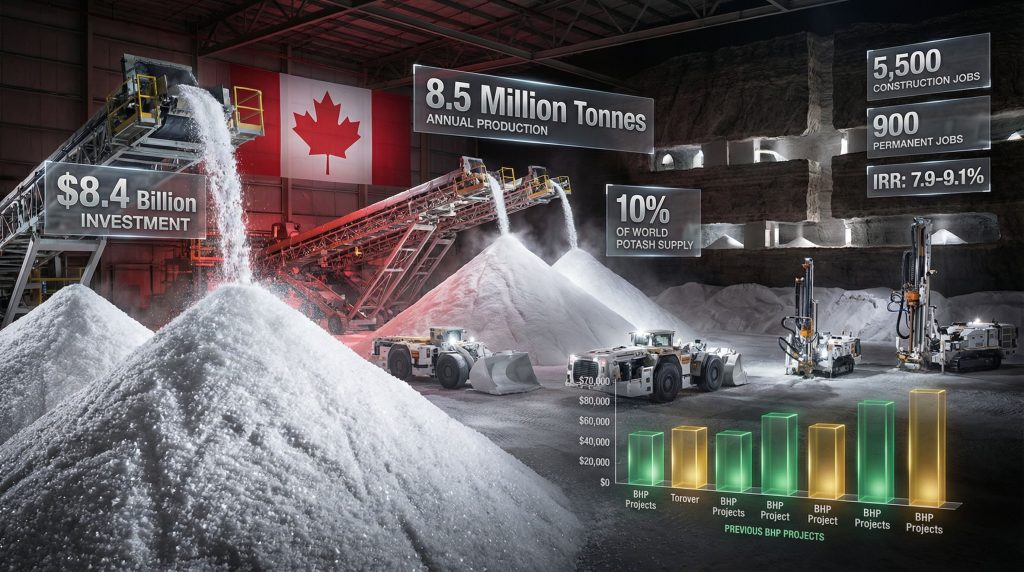
The BHP Jansen potash project stage 1 investment has reached $8.4 billion, marking the largest single greenfield investment in BHP’s history. This figure represents a 47.4% increase from the original $5.7 billion estimate approved in August 2021. Historical projects like the Escondida, Spence, and South Flank expansions were considerably smaller.
Historical context underscores a real transformation. BHP now positions itself to tap into sustained agricultural demand while recalibrating its portfolio towards long-term stability.
Strategic Rationale Behind Potash Selection
BHP’s pivot towards potash reflects calculated exposure to agricultural commodity fundamentals rather than speculative diversification. For instance, demographic tailwinds and more predictable demand compared to iron ore or copper create attractive prospects. Furthermore, long operational life ensures stable returns. Investors are exploring diversification investment strategies to reduce exposure.
Cost Escalation Analysis and Productivity Challenges
Cost escalation from $5.7 billion to $8.4 billion reflects broader industry pressures. Inflation, design complexity, and productivity challenges in remote Saskatchewan contributed to budget revisions. Transitioning from traditional methods, modern techniques such as AI in mining technology are increasingly important for enhancing efficiency.
Key cost pressures include:
• Steel prices rising by 35–40%
• Supply chain constraints affecting specialised mining equipment
• Premium wages required to attract skilled labour in remote regions
Economic Impact Analysis for Saskatchewan
Combined Stage 1 and Stage 2 investments total CAD $14 billion, representing 11.8% of Saskatchewan’s annual provincial GDP. This investment creates substantial local multiplier effects and bolsters infrastructure improvements throughout the region.
Employment Generation and Workforce Development
Jansen’s impact extends beyond direct hiring, promoting skill development and technology transfer in Saskatchewan’s mining sector. For instance, 5,500 construction jobs will be created at peak development, alongside 900 permanent operational positions for Stage 1. Moreover, mining sustainability trends now influence modern workforce planning.
| Employment Category | Stage 1 | Combined Stages 1 & 2 |
|---|---|---|
| Construction (Peak) | 5,500 | 7,000+ |
| Permanent Operations | 900 | 1,500+ |
| Indirect Support | 1,800 | 3,000+ |
| Total Economic Impact | 8,200 | 11,500+ |
Indigenous Economic Partnership Framework
BHP has committed CAD $850 million in Indigenous contracts for Stage 1, expanding to CAD $1.2+ billion across combined stages. This initiative benefits Saskatchewan’s Indigenous communities by creating opportunities in construction, environmental monitoring, and logistics services.
Regional Infrastructure Development Spillovers
Jansen’s infrastructure requirements generate significant spillover benefits. Rail corridor improvements estimated between CAD $500–800 million support potash logistics while enhancing transportation for agricultural goods. For example, a latest project update highlights these developments.
Power grid enhancements and advanced water management systems further stimulate local economic growth.
Production Capacity Analysis and Global Market Impact
Planned capacity of 8.5 million tonnes per annum from Stages 1 and 2 represents roughly 10% of the global potash supply. Consequently, BHP is positioned as one of the world’s top potash producers. This shift reinforces the firm’s competitive approach as seen in recent industry consolidation insights.
Global Supply Dynamics and Market Positioning
Global potash production totals 85–90 million tonnes annually, with a concentrated market among key players. Enhanced production capacities enable BHP to influence pricing dynamics. Moreover, strategic geographic advantages boost export potential to major agricultural regions.
Geopolitical Supply Rebalancing
Following sanctions that affected Russian and Belarusian exports, Jansen’s capacity addition helps bridge supply gaps. This improvement reduces reliance on politically unstable sources while enhancing supply security across North America.
Demand Growth Fundamentals
Global potash demand is growing at a 2.5–3.5% compound annual rate, driven by increased agricultural productivity and improved dietary standards. Furthermore, precision agriculture techniques boost application efficiency, ensuring sustainable long-term demand.
Investment Returns Analysis and Financial Modeling
The BHP Jansen potash project stage 1 investment generates projected internal rates of return between 7.9–9.1% and offers payback periods of 11–15 years from first production. These returns are notably favourable when compared with alternative investments in traditional commodities.
Financial Performance Metrics
Jansen’s performance includes EBITDA margins of 63–64% and breakeven prices in the range of $280–320 per tonne. Such metrics provide strong resilience against market downturns and underpin robust profitability. Furthermore, the integration of modern technology helps optimise these outcomes.
Key Financial Indicators:
- Internal Rate of Return: 7.9%–9.1%
- Payback Period: 11–15 years
- EBITDA Margins: 63–64%
- Break-even Price: $280–320/tonne
Scenario Analysis and Return Optimisation
Several scenarios could further enhance project economics. For instance, sustained potash price appreciation above $350 per tonne and operational efficiency gains through advanced technologies could boost returns. Additionally, a significant investment in supportive projects reinforces long-term value.
Risk Factors and Downside Protection
Risks include construction delays, weather-related interruptions, and shortages of skilled labour. Market volatility remains a factor, yet Jansen’s low-cost operating model provides vital downside protection. Moreover, comprehensive scenario planning helps mitigate these potential setbacks.
Technology Integration and Operational Excellence
Advanced mining technologies underpin operational excellence at Jansen. The integration of automation and digital twin modelling enhances both safety and productivity. Consequently, these innovations set a benchmark for future potash projects. In addition, ongoing mining industry evolution initiatives further drive modernisation.
Underground Mining Innovation
Modern automated systems reduce labour requirements while improving safety. Digital twin modelling provides real-time optimisation and predictive maintenance advantages. This seamless integration is a key competitive edge. In addition, employing AI in mining technology supports critical efficiency gains.
Sustainability and Environmental Stewardship
Sustainability measures at Jansen exceed regulatory standards. Advanced equipment improves energy efficiency, while closed-loop water recycling minimises freshwater consumption. Moreover, comprehensive carbon footprint reduction initiatives underscore BHP’s commitment to environmental stewardship and responsible resource management.
Strategic Portfolio Transformation
BHP is reshaping its portfolio by shifting towards long-life agricultural commodities. Diversification now reduces exposure to volatile industrial cycles and bolsters dividend sustainability. Robust returns are further supported by emerging global trends and evolving diversification investment strategies.
Diversification Benefits and Risk Reduction
Potash offers stability with non-cyclical demand drivers. Key benefits include:
• Reduced exposure to volatile commodity cycles
• Enhanced supply security
• Geographic and sector diversification
• Stable long-term returns
Future Expansion and Growth Platform
The successful execution of Stage 1 demonstrates BHP’s capabilities for further expansion. Potential future stages could boost capacity to 16–17 million tonnes annually, setting a global benchmark. Strategic partnerships and market share gains further underscore growth prospects.
Investment Outlook and Market Positioning
The BHP Jansen potash project stage 1 investment positions BHP to capitalise on long-term agricultural trends while maintaining a low-cost production profile. Sustained premium pricing, operational execution, and competitive market share gains all validate the investment thesis. This strategic framework enhances long-term value creation for stakeholders.
Market Validation Scenarios
Market validation depends on sustained premium pricing, successful operational execution, and competitive market share development. Meeting production targets and cost efficiencies will further support BHP’s global competitiveness.
Long-Term Value Creation Framework
Value creation is underpinned by production ramp-up, cost management, and market share expansion. Robust technology integration and infrastructure investments ensure that stakeholders realise sustainable long-term gains.
Conclusion
BHP’s strategic shift into agricultural commodities marks a new era in mining. This calculated move redefines portfolio strategy and industry dynamics. Operational excellence, technological innovations, and sustainable practices set a precedent for future projects. Furthermore, investors benefit from exposure to essential global food security trends.
Disclaimer: This analysis is based on publicly available information and does not constitute investment advice. Commodity investments involve significant risks, including price volatility, operational challenges, and regulatory changes. Investors should conduct their own research and consider their risk tolerance before making any decisions.
Ready to Capitalise on the Next Major Mining Investment?
Discovery Alert's proprietary Discovery IQ model delivers real-time notifications on significant ASX mineral discoveries, empowering subscribers to identify actionable trading opportunities as they emerge. Begin your 30-day free trial today to stay ahead of the market and position yourself for the next transformative discovery in the mining sector.