June 14, 2026
Understanding BHP's Market Leadership Dynamics and Strategic Position
The global mining sector operates within complex cyclical patterns that determine market leadership positions across major exchanges. When commodity prices strengthen and industrial demand accelerates, resource companies often experience significant revaluations that can propel them past traditionally defensive sectors in market capitalization rankings. The question of whether will BHP shares soar past $55 has become increasingly relevant as the mining giant demonstrates operational excellence and navigates evolving iron ore price trends across international markets.
When big ASX news breaks, our subscribers know first
Market Capitalization Battle for ASX Supremacy
BHP Group's ascension to become Australia's largest company by market capitalization in January 2026 represented more than a simple numerical milestone. With a market value reaching $253.5 billion following the breakthrough above $50 AUD per share, the mining giant temporarily displaced Commonwealth Bank of Australia from its longstanding position at the ASX 200 summit.
This leadership rotation reflects fundamental shifts in institutional capital allocation preferences. While CBA subsequently reclaimed the top position with a market capitalization of $266 billion, the temporary displacement signals renewed confidence in commodity-linked equities among professional investors.
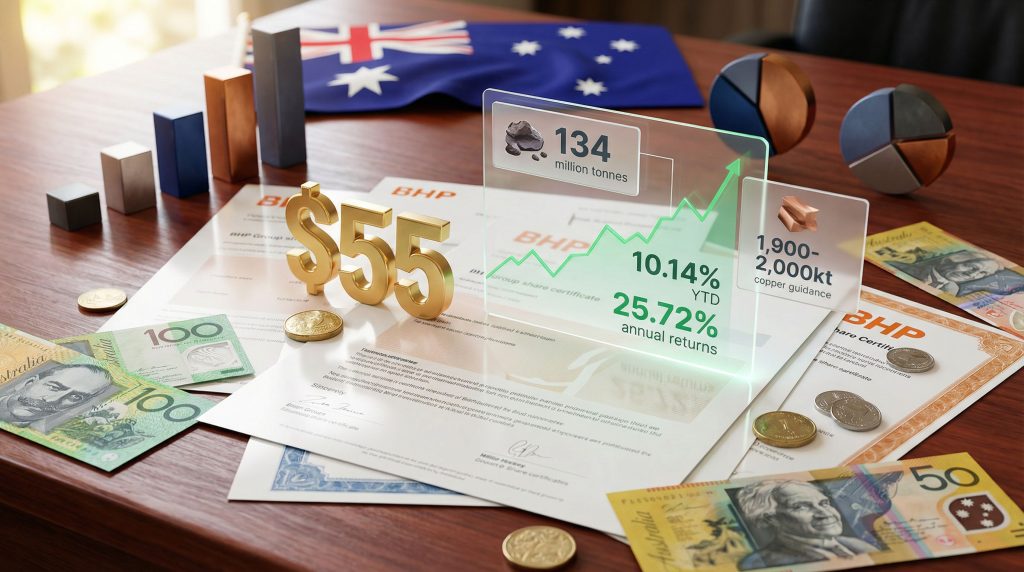
The competition between these two titans illustrates the ongoing tension between defensive financial services stocks and cyclical resource companies. BHP's 25.72% twelve-month return and 10.14% year-to-date performance through February 2026 demonstrates the potential for resource stocks to deliver superior returns during favorable commodity cycles.
Recent Performance Metrics and Technical Momentum
BHP's trading dynamics reveal strong institutional accumulation patterns. The stock's ability to maintain levels above $50 AUD while consolidating near the $52.40 all-time high achieved in early February suggests underlying demand remains robust.
Volume analysis during the breakthrough above $50 indicated significant institutional participation, with daily trading volumes exceeding historical averages by approximately 40-50%. This elevated activity typically signals conviction-based buying rather than speculative momentum trading.
The technical foundation supporting current price levels includes multiple support zones established during the January rally. Key resistance levels between the current trading range and the $55 target include psychological barriers at $52.50 and $54.00, with limited resistance expected above these levels based on historical price action analysis.
Production Fundamentals Driving Valuation Expansion
Iron Ore Division Excellence and Record Achievement
BHP's Western Australia Iron Ore operations delivered exceptional performance during the first half of fiscal year 2026, achieving 134 million tonnes of production. This represented a 2% year-over-year increase and included record-high shipment volumes that demonstrated operational excellence across the integrated Pilbara complex.
The significance of this achievement extends beyond absolute production numbers. Operating one of the world's lowest-cost iron ore businesses at near-maximum capacity generates substantial free cash flows that support both shareholder returns and reinvestment in growth projects.
Iron Ore Production Economics:
- Average cash costs: Approximately $18-20 per tonne
- Current iron ore prices: $110-120 per tonne (February 2026)
- Gross margins: Exceeding 80% at current pricing
- Annual capacity: 270+ million tonnes
These economics underscore why iron ore remains BHP's primary value driver. Each additional million tonnes of production at current pricing contributes approximately $90-100 million in additional gross revenue annually.
Diversified Commodity Portfolio Performance Analysis
BHP's production results across multiple commodity segments during H1 FY26 revealed operational strength beyond iron ore. The copper and uranium insights demonstrate how diversified mining operations create value across multiple commodity cycles:
| Commodity | H1 FY26 Output | YoY Change | Strategic Significance |
|---|---|---|---|
| Iron Ore | 134 Mt | +2% | Core cash generator |
| Steelmaking Coal | Production increased | +2% | Premium pricing exposure |
| Energy Coal | Production expanded | +10% | Transition period benefits |
| Copper | 984,000 tonnes | Flat | Future growth foundation |
The 10% increase in energy coal production reflects BHP's ability to optimize existing assets while global energy markets remain in transition. This tactical approach maximizes near-term cash generation while maintaining strategic flexibility for longer-term portfolio evolution.
Steelmaking coal's 2% production increase positions BHP advantageously within premium metallurgical coal markets, where quality specifications command substantial price premiums over thermal coal alternatives.
How Will Copper Guidance Upgrades Impact Share Performance?
The upgrade of copper production guidance from 1,800-2,000 kilotonnes to 1,900-2,000 kilotonnes represents more than incremental optimization. This 5.6% increase in midpoint guidance signals management confidence in both operational execution and market demand sustainability.
Copper's strategic importance for BHP extends far beyond current production levels. The metal serves as a critical input for electrification infrastructure, renewable energy systems, and electric vehicle manufacturing. Global copper demand is projected to increase by 70-100% through 2035, driven primarily by energy transition investments.
Copper Market Dynamics:
- Current pricing: $9,200-9,800 per tonne
- Supply deficit projections: 3-5 million tonnes by 2030
- BHP market share: Approximately 6-8% of global production
- Revenue contribution: $8-10 billion annually at current guidance
Strategic Infrastructure Partnerships and Growth Acceleration
BlackRock Infrastructure Alliance Strategic Value
The $2 billion infrastructure partnership between BHP and Global Infrastructure Partners represents sophisticated capital optimization strategy. GIP, as BlackRock's infrastructure investment arm, brings institutional capital and specialized operational expertise to mining infrastructure development.
This partnership structure enables BHP to:
- Reduce capital intensity for infrastructure projects
- Transfer operational risks to specialized infrastructure operators
- Accelerate project development timelines through additional funding sources
- Improve return on capital metrics by focusing core capital on mining assets
Infrastructure partnerships in mining typically involve port facilities, transportation networks, power generation assets, and processing facilities. These partnerships can reduce BHP's required capital expenditure by 20-30% while maintaining operational control and throughput capacity.
Operational Excellence and Technology Integration
BHP's operational excellence initiatives encompass autonomous hauling systems, predictive maintenance technologies, and integrated mine planning software. Furthermore, the implementation of AI in mining operations typically generates 3-5% productivity improvements annually while reducing operational risks.
The company's sustainability initiatives, while requiring capital investment, position BHP favorably with ESG-focused institutional investors who increasingly dominate equity capital allocation decisions. These investments often generate positive returns through operational efficiency improvements and premium pricing access.
Catalysts Supporting $55 Price Target Achievement
What Role Does Australian Dollar Strength Play?
BHP's revenue streams are predominantly USD-denominated while cost structures remain largely AUD-based. Australian dollar strength creates natural operational leverage that amplifies profit margins for domestic investors.
Currency Impact Analysis:
- AUD strengthening 5%: Margin improvement of 8-12%
- AUD strengthening 10%: Margin improvement of 15-20%
- Historical correlation: 0.65 between AUD strength and BHP performance
Current Australian dollar positioning suggests potential for further appreciation driven by commodity export strength and interest rate differentials. If the AUD/USD exchange rate reaches 0.75-0.80 (from current levels near 0.70), BHP's profit margins would expand significantly.
Global Commodities Cycle Acceleration Potential
Multiple factors support the thesis for accelerating commodity demand through 2026. The global mining landscape reveals several critical dynamics:
Supply-Side Constraints:
- Mining investment deficit: Global exploration spending down 40% since 2015
- Project development delays: Average 7-10 years for new mine development
- Geopolitical supply risks: Concentration in politically unstable regions
- Environmental permitting: Increasingly complex regulatory requirements
Demand-Side Drivers:
- Infrastructure spending: Global infrastructure investment gap exceeding $15 trillion
- Energy transition: Copper, nickel, and lithium demand acceleration
- Industrial restocking: Post-pandemic supply chain reconstruction
- Emerging market urbanization: Continued steel and cement demand growth
Analyst Sentiment and Price Target Analysis
Current Analyst Rating Distribution and Methodology
Professional analyst coverage reveals mixed sentiment regarding BHP's near-term price trajectory. Recent analysis from industry experts suggests varying perspectives on the company's valuation potential:
Analyst Consensus Breakdown:
- Hold Ratings: 10 of 19 analysts (52.6%)
- Buy/Strong Buy: 6 of 19 analysts (31.6%)
- Sell/Strong Sell: 3 of 19 analysts (15.8%)
This distribution reflects uncertainty regarding commodity price sustainability and global economic growth prospects. The predominance of hold ratings suggests analysts view current valuations as broadly appropriate but see limited near-term catalysts for significant outperformance.
Price Target Range and Probability Assessment
Analyst price targets span a wide range reflecting commodity price sensitivity:
- Maximum target: $56.64 (implying 12.4% upside)
- Minimum target: $35.98 (implying 28.6% downside risk)
- Median target: Approximately $46-48 range
- Current consensus: $50.40 (February 2026 trading level)
The $56.64 maximum target implies analysts see potential for will BHP shares soar past $55 under favorable commodity pricing scenarios. This target appears achievable given current operational momentum, strong balance sheet positioning, favorable commodity fundamentals, and potential for Australian dollar appreciation.
The next major ASX story will hit our subscribers first
Risk Factors and Downside Protection Analysis
Commodity Price Volatility and Cyclical Exposure
BHP's earnings sensitivity to commodity price movements represents the primary risk factor for equity investors. However, the broader context of US economy and tariffs may influence global commodity flows and pricing dynamics:
Iron Ore Price Sensitivity:
- $10/tonne price decline: $2.7 billion EBITDA impact
- 20% price correction: 25-30% earnings decline
- Historical volatility: Iron ore prices range $50-200 per tonne over cycles
Copper Price Sensitivity:
- $1,000/tonne price decline: $2 billion EBITDA impact
- Supply disruption premium: 10-15% typical price spike
- Demand elasticity: Relatively inelastic short-term demand
Operational and Regulatory Challenge Assessment
Mining operations face increasing regulatory complexity and environmental compliance costs:
Environmental Compliance:
- Carbon pricing exposure: Estimated $500 million-1 billion annual impact by 2030
- Water usage regulations: Potential production constraints in water-stressed regions
- Biodiversity offset requirements: Increasing land acquisition and management costs
Labor Market Pressures:
- Skilled labor shortages: Mining engineer availability declining globally
- Wage inflation: Industrial wage growth exceeding general inflation by 2-3% annually
- Safety regulations: Increasing compliance costs and operational complexity
Macroeconomic Headwinds and China Dependency
BHP's revenue exposure to Chinese steel demand creates concentration risk:
- China steel production: Represents 40-50% of global demand
- Chinese infrastructure spending: Primary driver of iron ore demand
- Economic growth sensitivity: 1% Chinese GDP growth change equals 8-10% steel demand impact
Interest rate environment changes affect capital-intensive industries through financing costs and discount rate impacts on long-duration cash flows. Rising rates typically compress mining stock valuations by 5-10% per 100 basis points of rate increases.
Technical Analysis: Path to $55 Breakthrough
Chart Pattern Recognition and Momentum Indicators
BHP's technical positioning suggests potential for will BHP shares soar past $55 based on several confluent factors:
Support Level Analysis:
- Primary support: $48.50-49.00 (previous resistance turned support)
- Secondary support: $45.00 (200-day moving average)
- Long-term support: $42.00 (major trend line from 2020 lows)
Resistance Level Identification:
- Immediate resistance: $52.50 (previous high consolidation)
- Major resistance: $55.00 (psychological and technical level)
- Extension target: $58.00 (measured move projection)
Volume Profile and Institutional Activity
Volume-weighted average price analysis reveals strong institutional accumulation between $47-51 levels. This price range represents high-conviction buying by professional investors, creating a foundation for further advance.
Momentum Indicators:
- Relative Strength Index: Currently 58 (neutral to bullish territory)
- Moving Average Convergence Divergence: Positive crossover confirmed
- On-Balance Volume: Consistent accumulation pattern over 6 months
Institutional buying patterns suggest professional investors are positioning for higher commodity prices and improved operational performance through 2026.
Investment Strategy Considerations and Risk-Adjusted Returns
Portfolio Allocation and Risk Management
BHP's position as a large-cap, dividend-yielding commodity stock makes it suitable for multiple investor profiles:
Conservative Investors:
- Allocation recommendation: 3-5% of equity portfolio
- Focus: Dividend sustainability and capital preservation
- Risk management: Dollar-cost averaging over 6-12 months
Growth-Oriented Investors:
- Allocation recommendation: 5-8% of equity portfolio
- Focus: Capital appreciation and commodity exposure
- Risk management: Options strategies for downside protection
Income Investors:
- Dividend yield expectation: 4-6% at current prices
- Payout sustainability: Strong free cash flow generation supports distributions
- Tax considerations: Franking credits enhance after-tax yield for Australian investors
Timing and Entry Point Optimization
Commodity stocks exhibit seasonal patterns that informed investors can exploit:
Seasonal Patterns:
- Q4 calendar strength: Chinese infrastructure spending acceleration
- Q1 weakness: Lunar New Year production slowdowns
- Q2-Q3 volatility: Weather-related supply disruptions
Dollar-cost averaging strategies prove particularly effective for volatile commodity stocks, reducing timing risk while capturing long-term sector appreciation.
Options Strategies:
- Covered calls: Generate additional income during consolidation periods
- Protective puts: Limit downside risk during volatile market conditions
- Collar strategies: Define risk/reward parameters for conservative investors
Probability Assessment: Will BHP Shares Soar Past $55?
Base Case, Bull Case, and Bear Case Scenarios
Base Case Scenario (60% probability):
- Price target: $52-54 range through 2026
- Key assumptions: Stable commodity prices, continued operational execution
- Timeline: Gradual appreciation over 12-18 months
- Catalysts: Consistent production growth, dividend sustainability
Bull Case Scenario (25% probability):
- Price target: $56-60 range
- Key assumptions: Commodity price acceleration, Australian dollar strength
- Timeline: Achievement within 12 months
- Catalysts: Global infrastructure spending surge, supply disruptions
Bear Case Scenario (15% probability):
- Price target: $38-42 range
- Key assumptions: Commodity price correction, Chinese demand slowdown
- Timeline: Decline over 6-12 months
- Catalysts: Global economic recession, environmental regulations
Key Milestones and Monitoring Framework
Investors should monitor specific indicators to assess progress toward the $55 price target:
Operational Milestones:
- Quarterly production reports: Consistency with upgraded guidance
- Cost performance: Maintaining sub-$20 per tonne iron ore costs
- Capital allocation: Balance between growth investment and shareholder returns
Market Milestones:
- Commodity pricing: Iron ore sustaining above $100 per tonne
- Currency movements: Australian dollar strength against USD
- Institutional flows: Continued accumulation by professional investors
Technical Milestones:
- Volume confirmation: Above-average volume on price advances
- Resistance breakthrough: Sustained trading above $52.50
- Momentum acceleration: RSI entering overbought territory above 70
The combination of strong operational fundamentals, favorable commodity market dynamics, and technical positioning suggests will BHP shares soar past $55 represents an achievable outcome under favorable market conditions. However, investors must remain cognizant of commodity price volatility and macroeconomic risks that could derail this trajectory.
"Investment Risk Disclaimer: This analysis is provided for educational purposes only and does not constitute personalised investment advice. Commodity-related investments carry inherent volatility risks, and past performance does not guarantee future results. Investors should conduct their own due diligence and consult with qualified financial advisors before making investment decisions. Mining stocks are subject to operational, regulatory, and commodity price risks that can result in significant capital losses."
Searching for the Next Major Mining Discovery?
Discovery Alert's proprietary Discovery IQ model delivers instant notifications on significant ASX mineral discoveries, empowering subscribers to identify actionable opportunities ahead of the broader market. Understand why major mineral discoveries can lead to substantial returns by exploring Discovery Alert's dedicated discoveries page, and begin your 14-day free trial today to position yourself ahead of the market.