May 22, 2026
The Hidden Waste Stream Sitting Between Banana Farms and Blast Sites
Most people picture agricultural waste ending up as compost or simply rotting in a paddock. Few would imagine it becoming a precision-engineered component inside an Australian open-cut mine. Yet that is precisely the commercial reality taking shape as lignocellulosic biomass science collides with the mining sector's mounting pressure to eliminate synthetic plastic from its operations.
The concept of converting plant-based agricultural residue into structural industrial products is not new to materials science. Researchers have studied fibres from sugarcane bagasse, bamboo, hemp, and rice straw for decades. What is different now is the combination of commercial urgency, ESG-driven procurement shifts, and proprietary processing technology capable of turning that science into a supply-chain-ready product at scale.
Biodegradable blast collars manufactured from banana plantation waste represent exactly this convergence point, and the commercial architecture surrounding their development offers a revealing case study in waste-to-value innovation.
When big ASX news breaks, our subscribers know first
Why Open-Cut Mining Still Has a Plastic Problem
The Consumable Blind Spot in Mining's ESG Story
Large-scale mining operations attract considerable attention for their land disturbance footprint, water usage, and carbon emissions. What receives far less scrutiny is the sheer volume of synthetic consumables that enter the blast zone and never leave it. Furthermore, this blind spot sits uncomfortably against the formal commitments most major operators now publish annually.
Drill-and-blast operations in open-cut mining rely on a range of single-use components inserted into blastholes before detonation. These include stemming materials, initiation components, and collar devices. Many are manufactured from synthetic polymers that, once blasted and buried in overburden spoil, remain in the ground indefinitely. They do not degrade. They fragment. Over time, they contribute to microplastic contamination within the post-blast material profile.
This is a gap that sits uncomfortably against the formal sustainability commitments most major Australian mining operators now publish annually. Procurement teams have historically prioritised performance reliability and unit cost over end-of-life environmental outcomes. The result is a structural contradiction between corporate ESG narratives and the actual chemical composition of what gets buried at the blast face every single day. Mining sustainability transformation efforts are increasingly being directed toward addressing exactly these kinds of embedded contradictions.
Emerging regulatory frameworks in extractive industries are beginning to close this gap, and procurement managers are increasingly required to demonstrate certified biodegradable alternatives are at least being evaluated. The market for such alternatives is still in early formation, which is precisely what makes first-mover positioning in this segment commercially significant.
What a Blast Collar Actually Does and Why Material Choice Matters
The Mechanics of Blasthole Integrity
A blast collar, sometimes referred to as a collar keeper, serves a deceptively simple function. It is inserted into the top section of a drilled blasthole with a lip protruding above ground level. Its purpose is to prevent excavated material, loosened by drilling vibrations or environmental disturbance, from falling back into the hole and displacing the explosive charge.
This matters because the entire outcome of a blast, including fragmentation uniformity, ore recovery efficiency, and wall stability, depends on the explosive detonating at a precise, consistent depth. When material collapses back into the hole, the charge detonates higher than intended. This produces uneven fragmentation, harder digging conditions for downstream loading equipment, and in some cases, misfires that create safety hazards requiring secondary blasting.
In blasting engineering, this concept is integral to what practitioners describe as responsible blasthole quality management. Aquirian's commercial framework around its Bootless Bench methodology places blasthole stabilisation at the centre of blast efficiency optimisation, and the collar keeper is a core component of that system.
The Post-Blast Environmental Calculus
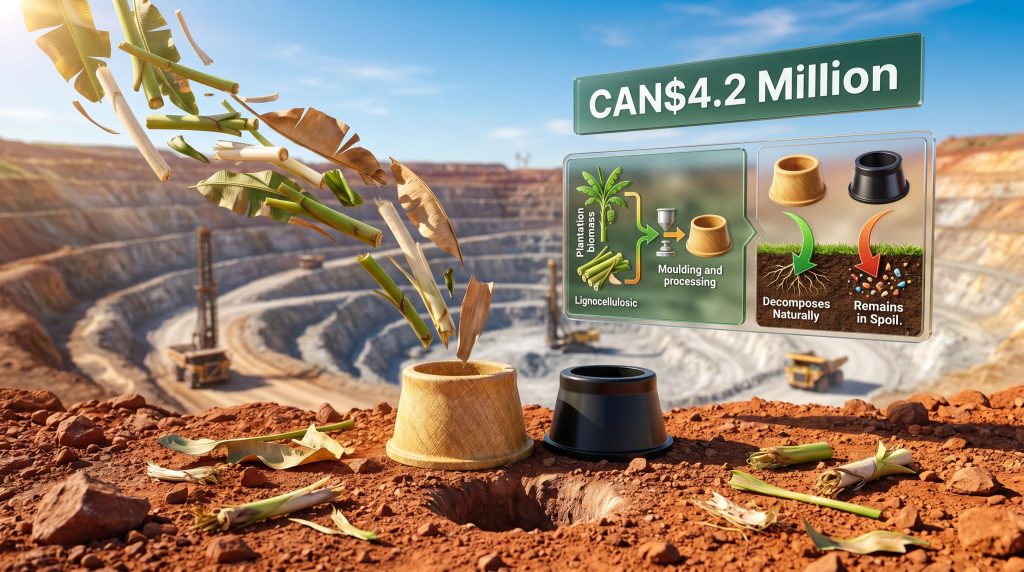
The performance function of a collar ends at detonation. What happens to the material after that point has historically been nobody's problem. With synthetic polymer collars, post-blast fate means indefinite persistence in the overburden profile. With a banana fibre collar, it means natural decomposition into organic matter.
The environmental distinction between these two outcomes is substantial, as illustrated below:
| Collar Type | Base Material | Post-Blast Behaviour | Biodegradable | Environmental Risk Profile |
|---|---|---|---|---|
| Conventional synthetic collar | Polymer plastic | Fragments, persists in spoil | No | Microplastic contamination risk |
| Banana fibre collar | Processed lignocellulosic biomass | Decomposes into organic matter | Yes | Minimal to negligible |
At volume, across hundreds of blast operations per year at a single large mine site, this difference in material fate accumulates into a meaningful environmental outcome. Consequently, the case for adopting biodegradable blast collars from banana plantation waste becomes increasingly difficult for procurement teams to dismiss.
From Plantation Waste to Precision Component: The Technical Pathway
What Makes Banana Biomass Structurally Viable
Banana plants produce significant volumes of non-fruit biomass throughout their growth cycle. Stems, stalks, and leaves are discarded after each harvest and typically left to decompose in the field. This decomposition process releases methane, a greenhouse gas with a warming potential significantly higher than carbon dioxide over a 20-year timeframe.
The organic material left behind is not simply agricultural debris. Banana plant tissue contains lignocellulosic compounds, the same class of structural polymers found in wood and other plant cell walls, that give processed fibre products their mechanical rigidity. When properly extracted and formed, this material can achieve the dimensional consistency and load-bearing characteristics required for precision industrial components.
Compared to other agricultural waste feedstocks:
- Sugarcane bagasse is widely used in paper and board products but contains higher sugar residues that complicate fibre purification
- Hemp fibre offers excellent tensile properties but faces crop availability constraints in some regions
- Bamboo is structurally strong but requires more intensive processing to achieve consistent fibre separation
- Banana biomass offers a combination of wide domestic availability, low feedstock cost, and structural properties suited to moulded product applications
Low-Impact Conversion as a Differentiating Factor
Papyrus Australia's proprietary processing technology is specifically designed to convert plantation waste into a usable fibre resource using a low-impact methodology. This is a meaningful distinction from conventional industrial biomaterial processing, which often relies on chemical-intensive pulping or high-temperature thermal treatment. In addition, this approach aligns closely with the broader push toward natural capital in mining as operators seek to quantify and reduce environmental liabilities across their supply chains.
The conversion pathway moves through several stages:
- Raw material collection from banana growing regions, primarily stems, stalks, and leaves post-harvest
- Fibre extraction using proprietary low-impact separation methods that preserve structural integrity
- Forming and moulding into dimensionally consistent blast collar geometry
- Quality validation through laboratory testing against performance benchmarks matching synthetic collar specifications
- Field acceptance testing under real operational conditions before commercial volume supply
The Adelaide University Rapid Prototyping and R&D Facility plays a central role in stages three through five, functioning as a development and testing hub that connects growers, manufacturers, and technology stakeholders across the product development cycle.
The Commercial Framework: Supply Agreements and Co-Investment
Structure of the CAN$4.2 Million Supply Agreement
In November 2025, Papyrus Australia entered a supply agreement with TBS Mining Solutions Pty Ltd, a company operating within the Aquirian Limited corporate structure, for the provision of biodegradable blast collars. The agreement is valued at CAN$4.2 million and represents the commercial endpoint of a collaborative laboratory and field-testing programme conducted between the two companies.
Several hundred collar units have already been produced as an initial shipment and made available to TBS Mining Solutions for large-scale field acceptance testing. The progression to full commercial supply volumes is contingent on successful outcomes from this acceptance testing phase.
Key features of the commercial structure include:
- A defined supply term supporting forward production planning for both parties
- TBS Mining Solutions as the end-user distribution channel within an established mining services business
- An initial production batch serving as both a proof-of-manufacturing-capability and a field performance validation exercise
- Volume commitment milestones tied to acceptance testing outcomes rather than speculative forecasts
The Role of Matched Funding in Bridging the Commercialisation Gap
Papyrus Australia was awarded a CAN$250,000 matched funding grant through the Australian Government Industry Growth Programme. This grant specifically supports early-stage commercialisation of the banana fibre processing technology, covering the transition from concept validation through to commercial-scale manufacturing capability.
Matched funding mechanisms work by requiring the recipient company to invest equivalent capital alongside the government contribution, effectively doubling the available commercialisation resources while aligning private and public risk. For early-stage biomaterial companies, this structure is particularly valuable because it funds infrastructure and testing costs that would otherwise require significant equity dilution or debt financing.
The grant provides direct access to the Rapid Prototyping and R&D Facility at Adelaide University, giving Papyrus Australia access to specialised equipment and collaborative research infrastructure without carrying the full capital cost of that capability independently.
Exclusivity and First-Mover Positioning
Papyrus Australia holds the position of exclusive global producer of this specific biodegradable blast collar variant. In niche industrial consumable markets, exclusivity of this nature creates a defensible commercial position that is difficult for competitors to replicate quickly, given the combination of proprietary processing technology, feedstock supply relationships, and customer acceptance testing already completed. This kind of mining industry innovation rarely emerges from large incumbents; it typically originates at the intersection of agricultural science and industrial materials chemistry.
First-mover advantage in specialised industrial biomaterial segments tends to be more durable than in commodity markets because switching costs for mining operators, once acceptance testing is complete and the product is integrated into blast design protocols, are relatively high.
Australia's Banana Industry Waste: A Problem Worth Solving
The Scale of the Agricultural Waste Challenge
Australia's banana industry generates many thousands of tonnes of organic waste annually, predominantly from post-harvest stems, stalks, and leaves. The vast majority of this material currently decomposes in the field, a process that releases methane into the atmosphere at a scale equivalent to many thousands of tonnes of carbon dioxide.
This represents a dual inefficiency: a waste management burden for growers and an unnecessary source of agricultural greenhouse gas emissions. The circular economy opportunity embedded in this waste stream has been recognised but largely untapped, primarily because converting soft plant tissue into rigid industrial products requires specialised processing capability that most agricultural operators do not possess.
The Double Environmental Dividend
Redirecting banana plantation biomass from field decomposition to fibre product manufacturing creates what can be described as a double environmental dividend:
| Scenario | Greenhouse Gas Outcome | Waste Outcome |
|---|---|---|
| Biomass decomposes in field | Methane released, high CO2-equivalent impact | Waste remains, no value captured |
| Biomass converted to fibre product | Methane avoided, carbon partially retained in product | Waste eliminated, value generated |
| Fibre product biodegrades post-use | Controlled breakdown, minimal residual impact | No persistent contamination |
The emissions reduction potential scales directly with the volume of plantation waste redirected into industrial fibre production. As commercial supply volumes increase under the TBS Mining Solutions agreement, the upstream environmental benefit to banana-growing regions increases proportionally. Furthermore, these renewable mining solutions demonstrate that decarbonisation pathways in the sector extend well beyond energy sources into the consumable materials embedded in everyday operations.
The next major ASX story will hit our subscribers first
The Broader Biomaterials Landscape and What It Signals
Agricultural Waste as an Industrial Feedstock Class
Global research interest in banana biomass applications has expanded considerably over the past decade. Published studies have explored its use across activated carbon production, biofilter media, biodegradable packaging, bioplastic composites, and pulp and board manufacturing. The material's combination of availability, low cost, and workable structural properties places it in an attractive position within the broader lignocellulosic biomass category.
What distinguishes the blast collar application is its specificity. Rather than competing in high-volume commodity biomaterial markets where margins are thin and competition is intense, the collar application targets a defined niche within mining consumables where performance validation, supply reliability, and ESG certification carry premium value. The broader push toward mining decarbonisation is creating sustained commercial demand for precisely these kinds of certified, low-impact alternatives to synthetic industrial inputs.
Is the Model Replicable Across Other Waste Streams?
The principles underlying banana fibre blast collar production are not inherently specific to banana biomass. The conditions required for agricultural waste to become a viable industrial biomaterial feedstock are:
- Sufficient volume and geographic concentration to support consistent supply
- Lignocellulosic fibre composition with adequate structural properties for the target application
- A processing methodology capable of producing consistent, dimensionally stable output
- A defined industrial end-use with performance requirements the material can credibly meet
- An economic model in which the value of the finished product justifies processing costs
Cotton gin waste, rice straw, and certain sugarcane residues could theoretically meet several of these conditions for selected industrial applications. Whether those applications exist at commercially viable scale is a separate question, and one that requires the same patient laboratory-to-field development pathway that the blast collar has undergone. Banana plantation waste transformed into precision mining components illustrates just how far that pathway can extend when the technical and commercial conditions align.
Frequently Asked Questions: Biodegradable Blast Collars from Banana Plantation Waste
What exactly is a blast collar and what does it do?
A blast collar, also known as a collar keeper, is a device placed in the uppermost section of a drilled blasthole in open-cut mining. It sits with its upper edge above ground level and physically prevents loose excavated material from falling back into the hole. This matters because any material that collapses into the hole displaces the explosive charge upward, causing it to detonate at the wrong depth and producing inconsistent fragmentation across the blast pattern.
Why is banana fibre specifically suited to this application?
Banana plant tissue is rich in lignocellulosic compounds that, when properly processed and formed, produce a material with sufficient rigidity and dimensional stability to function as a precision-fit industrial component. The fibre is also widely available as a post-harvest waste product across Australian banana-growing regions, meaning the feedstock supply chain does not require new agricultural land or crop diversion.
How does performance compare to a conventional synthetic collar?
Laboratory and field-testing trials conducted collaboratively between Papyrus Australia and TBS Mining Solutions validated that the biodegradable collar meets the same blasthole stabilisation standards as its synthetic counterpart. The key difference is post-blast fate: synthetic polymer collars persist in overburden spoil indefinitely, while banana fibre collars decompose into organic matter without leaving persistent chemical residues.
What is the current status of commercial deployment?
An initial production batch of several hundred units has been completed and delivered to TBS Mining Solutions for large-scale field acceptance testing. Full commercial supply volumes under the CAN$4.2 million agreement are contingent on the outcomes of that testing phase.
Could this technology expand beyond the Australian market?
The current commercial focus is the Australian mining sector through the TBS Mining Solutions supply agreement. However, the underlying technology and the growing global demand for certified biodegradable alternatives to synthetic mining consumables create a logical pathway for international market expansion over the medium term. Open-cut mining operations exist across every major mining jurisdiction globally, and ESG-driven procurement pressure is not unique to Australia.
Disclaimer: This article contains forward-looking statements, projections, and speculative analysis based on publicly available information. It does not constitute financial advice. Readers should conduct independent research and seek professional advice before making any investment decisions. All commercial figures referenced are sourced from public announcements and third-party publications.
Want To Stay Ahead of the Next Major ASX Mining Discovery?
Discovery Alert's proprietary Discovery IQ model delivers real-time alerts on significant ASX mineral discoveries, instantly turning complex data across more than 30 commodities into clear, actionable insights for traders and investors at every experience level. Start your 14-day free trial today and explore Discovery Alert's discoveries page to understand why being first to a major discovery has historically generated extraordinary returns.