July 22, 2026
When the Waterway Goes Dark: Understanding the Mechanics of Black Sea Freight Prices Suspension
Commodity markets operate on a deceptively simple premise: prices only mean something when the transactions underpinning them are real, verifiable, and sufficient in number. Strip away those conditions, and what remains is not a price but a guess. This distinction sits at the heart of one of the most consequential developments in global agricultural trade infrastructure during mid-2026, when a series of Black Sea freight prices suspension decisions began cascading through benchmark systems that govern how billions of dollars worth of grain, fertilizer, and agricultural commodities are bought and sold across the Eastern Mediterranean.
The suspension of freight benchmarks linked to the Azov Sea is not simply an administrative footnote. It represents a structural fracture in the pricing architecture that importers in Turkey, Lebanon, and across the Eastern Mediterranean have relied upon for decades. Furthermore, the evolving geopolitical landscape in this region has amplified the scale and complexity of these disruptions considerably.
When big ASX news breaks, our subscribers know first
The Azov Sea as a Chokepoint: Geography, Commerce, and Control
To understand why a freight price suspension in this region carries such outsized consequences, it helps to appreciate the peculiar geography of the Azov Sea itself. Unlike most maritime export corridors, every vessel entering or leaving the Sea of Azov must pass through a single narrow passage: the Kerch Strait, a waterway roughly 4.5 kilometres wide at its narrowest point. Russia exercises physical sovereignty over this strait, having controlled the Kerch Peninsula since 2014.
This geography means that any decision to restrict or close the Kerch Strait does not merely inconvenience individual ports. It simultaneously severs all five primary freight corridors linking Azov Sea ports to Turkish and Eastern Mediterranean import markets. There is no alternative maritime exit. The closure of the strait is, functionally, the closure of the entire Azov Sea for commercial shipping purposes.
Following reported escalation in strikes between Russia and Ukraine in July 2026, Russia reportedly closed the Azov Sea ports and the Kerch Strait to commercial shipping. The consequences for benchmark pricing were immediate and unavoidable. For further context on how global trade disruptions of this nature ripple through interconnected commodity systems, the pattern is well established.
Five Routes, One Decision: The Suspended Freight Assessments
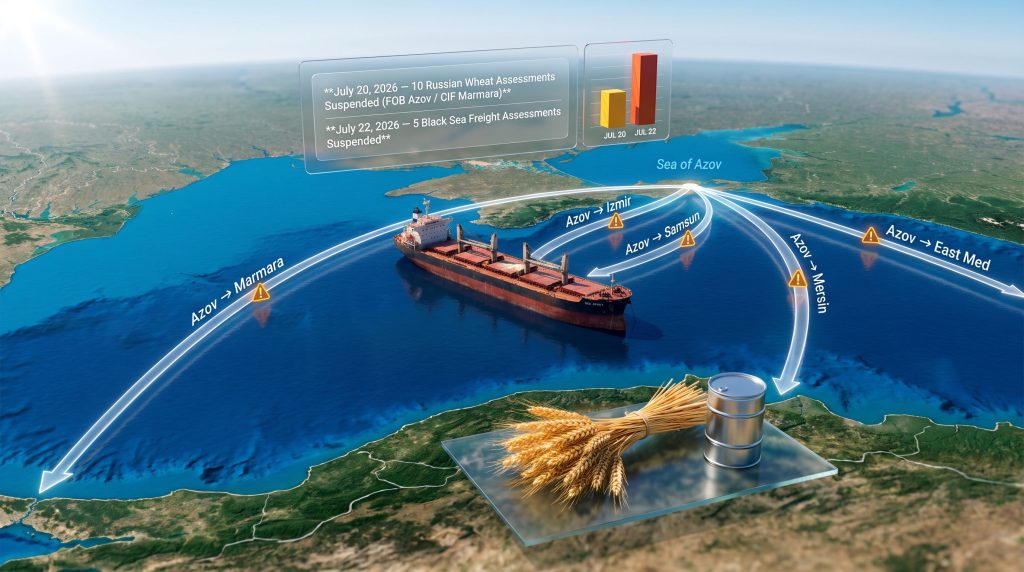
On July 22, 2026, five freight price assessments covering all major Azov-origin trade corridors were formally suspended by Fastmarkets, one of the leading price reporting agencies (PRAs) operating in global agriculture and commodities markets. The suspended assessments and their respective trade corridors are as follows:
| Price Code | Route | Unit |
|---|---|---|
| FM-FRT-0018 | Azov to Marmara | $/mt |
| FM-FRT-0019 | Azov to Izmir | $/mt |
| FM-FRT-0020 | Azov to Samsun | $/mt |
| FM-FRT-0021 | Azov to Mersin | $/mt |
| FM-FRT-0022 | Azov to East Med | $/mt |
Each of these routes connects Russian Azov Sea export terminals to Turkish receiving ports or broader Eastern Mediterranean destinations. Izmir, Samsun, and Mersin are significant import hubs for wheat and other agricultural commodities arriving from the Black Sea basin. The loss of reliable pricing data across all five corridors simultaneously creates a vacuum that traders, millers, and logistics operators cannot simply ignore.
This suspension did not occur in isolation. Two days earlier, on July 20, 2026, ten FOB Azov and CIF Marmara Russian wheat price assessments had already been suspended for the same underlying reason. The sequencing reveals how commodity price disruptions and freight benchmark disruptions are structurally interdependent: when cargo cannot move, freight pricing loses its transactional foundation.
| Suspension Date | Assessment Type | Number Suspended |
|---|---|---|
| July 20, 2026 | Russian wheat (FOB Azov / CIF Marmara) | 10 |
| July 22, 2026 | Black Sea freight (Azov origin routes) | 5 |
What a Freight Price Suspension Actually Means
A common misconception among non-specialist observers is that a freight price suspension signals the permanent closure of a trade route. In practice, the decision reflects something more precise and, in some ways, more consequential: the benchmark administrator can no longer source sufficient, verifiable market data to produce a credible price assessment.
Price reporting agencies like Fastmarkets operate under internationally recognised standards, including the IOSCO Principles for Financial Benchmarks, which require that assessments be suspended rather than estimated when market data falls below defined reliability thresholds. Publishing a price derived from thin, unrepresentative, or unverifiable data would expose downstream users — including traders, grain merchants, export financiers, and commodity funds — to the risk of acting on a fabricated signal.
A suspension protects the integrity of the entire pricing ecosystem. It is a methodologically disciplined response to market failure, not an administrative convenience.
The specific conditions that typically trigger a formal suspension include:
- Physical inaccessibility of the route due to conflict, closure, or force majeure conditions
- Insufficient transactional volume to derive a statistically valid and representative price
- Benchmark integrity risk, where publishing on thin data could actively mislead contract counterparties
Understanding this distinction matters because it shapes how market participants should interpret and respond to the suspension. Contracts referencing suspended benchmarks do not automatically become void, but they do require active management. In addition, understanding commodity hedging strategies becomes especially critical when primary benchmarks are no longer accessible.
Cascading Consequences for Agricultural Trade
The Azov Sea corridor handles a meaningful share of Russian agricultural export volumes, including wheat, barley, sunflower products, and fertilizers. The ports of Rostov-on-Don and Taganrog, both Azov-facing, have historically been significant throughput points for grain destined for Turkish and North African markets.
With freight benchmarks suspended, buyers operating on Azov-origin contracts face a specific and uncomfortable challenge: pricing opacity. Without a published benchmark, the reference rate embedded in their supply agreements is either unavailable or must be substituted through negotiation, proxy pricing, or basis adjustment from active Black Sea routes.
Before the suspension, spot freight rates for Black Sea grain routes were already reflecting the elevated risk environment. Rates for wheat movements from Odesa to Lebanese and Turkish ports such as Mersin were reported at approximately $27 per tonne in July 2026. Earlier in 2023, rates had settled in the high $20s per tonne for Eastern Mediterranean destinations and the low $30s per tonne for longer-haul routes toward Spain, where stagnation rather than growth characterised the market.
The transition from stagnant freight rates to formally suspended benchmarks represents a qualitative deterioration, not merely a quantitative one. Stagnation implies a flat but functional market. Suspension implies a market that has ceased to be assessable.
How the Market Adapts: Rerouting, Proxy Pricing, and OTC Negotiation
When primary benchmarks become unavailable, experienced market participants shift to a structured set of alternatives. Understanding these mechanisms is critical for anyone managing exposure to Black Sea commodity flows.
Alternative routing benchmarks become the most immediate reference point. Romanian Black Sea ports, particularly Constanta, operate outside the Azov-Kerch system and have historically served as a natural alternative origin for Eastern Mediterranean buyers. Danube river routes also provide a partial substitute for bulk agricultural flows, though with capacity and cost constraints.
Proxy pricing and basis adjustments allow traders to estimate Azov corridor values by referencing active Black Sea routes and applying a differential to account for distance, port costs, and risk. This approach is imprecise but operationally necessary during benchmark suspensions.
Over-the-counter (OTC) negotiated rates become more prevalent as published benchmarks disappear. This shift reduces price transparency across the market and concentrates pricing power in the hands of counterparties with superior information access, typically larger trading houses and major carriers.
Force majeure clauses in freight and commodity contracts become highly relevant. Many long-term supply agreements include provisions that allow contract modification or suspension when benchmark prices are unavailable due to circumstances beyond the control of either party.
The next major ASX story will hit our subscribers first
War-Risk Insurance and the Hidden Cost Multiplier
One dimension of Black Sea freight disruption that often receives insufficient attention is the compounding effect of war-risk insurance premiums. Even on routes not formally suspended, carriers operating anywhere in the Black Sea basin have faced sharply elevated hull and cargo insurance costs since the onset of full-scale conflict in 2022. These represent some of the hidden costs in sea freight that many buyers fail to fully account for when negotiating supply terms.
War-risk premiums are charged as an additional percentage of vessel value, assessed on a per-voyage basis. When geopolitical conditions deteriorate, underwriters reprice this exposure rapidly and sometimes dramatically. The practical effect is that the all-in cost of freight on nominally active Black Sea routes may be substantially higher than the published benchmark rate suggests, because war-risk surcharges sit outside the standard freight rate assessment framework.
This creates a structural distortion: published freight benchmarks may understate the true cost of moving cargo in the region, particularly during periods of elevated conflict risk. Buyers negotiating based on benchmark rates alone may find that actual shipping offers come in materially higher once insurance costs are incorporated. Consequently, the influence of commodity market tariffs on overall landed costs adds yet another layer of complexity for importers managing exposure to this region.
The Historical Arc of Black Sea Shipping Disruption
The July 2026 suspension did not arrive without precedent. The trajectory of disruption across the Black Sea freight market over the preceding four years provides important context:
- 2022: Full-scale conflict onset triggered near-total paralysis across Ukrainian Black Sea ports and severe disruption to Russian export flows, with insurance markets initially refusing cover for the region entirely
- 2023: A grain corridor arrangement allowed limited Ukrainian agricultural exports to resume, though persistent inspection delays led to extended voyage times and cost inflation. Russian Azov corridor freight rates settled into stagnation in the high $20s to low $30s per tonne range for Mediterranean destinations
- 2024–2025: Episodic escalations continued to generate insurance surcharges and periodic shipping disruptions, but formal benchmark suspensions were avoided as transactional data remained sufficient
- 2026: Reported Azov Sea port closures and Kerch Strait restrictions finally crossed the threshold at which reliable pricing data became unavailable, triggering formal suspension of both commodity and freight benchmarks
Conditions for Resumption and the Long-Term Risk
Fastmarkets has indicated it is actively monitoring conditions in the Sea of Azov and the Kerch Strait and reviewing the circumstances under which pricing assessments could be reinstated. The agency is also soliciting market feedback on alternative price references for the affected corridors.
Resumption of the suspended Black Sea freight prices assessments is contingent on three overlapping conditions being met:
- Geopolitical stabilisation sufficient to allow commercial shipping to resume through the Kerch Strait
- Recovery of transactional volume on the affected routes to levels that support credible price assessment
- Completion of stakeholder consultation on any revised pricing methodology or alternative reference structures
The longer the suspension persists, the greater the risk that it transitions from a temporary disruption to a structural realignment. If Azov Sea freight routes remain commercially unavailable for an extended period, market participants may permanently redirect trade flows through alternative corridors, reducing the eventual relevance of reinstated benchmarks even after the physical route reopens. Understanding the broader commodity price impacts on producers and traders downstream remains essential during this period of uncertainty.
If the closure extends significantly, the suspended benchmarks risk becoming structurally irrelevant rather than temporarily unavailable, accelerating demand for new pricing frameworks that reflect the post-conflict geography of Black Sea commodity trade.
Quick Reference: Black Sea Freight Suspension at a Glance
| Factor | Detail |
|---|---|
| Suspension effective date | July 22, 2026 |
| Freight assessments suspended | 5 |
| Affected origin | Azov Sea ports |
| Destinations affected | Marmara, Izmir, Samsun, Mersin, East Med |
| Trigger | Azov Sea and Kerch Strait closure to commercial shipping |
| Underlying cause | Russia-Ukraine conflict escalation |
| Related commodity suspensions | 10 Russian wheat assessments (July 20, 2026) |
| Market consultation | Underway, alternative price references being evaluated |
| Resumption conditions | Geopolitical stabilisation and transactional data recovery |
This article contains forward-looking analysis and scenario projections based on publicly available information as of the date of publication. Commodity markets, geopolitical conditions, and freight pricing frameworks are subject to rapid change. Nothing in this article constitutes financial or trading advice. Readers should conduct independent due diligence before making any commercial or investment decisions.
Want to Stay Ahead of Commodity Market Shifts Driven by Major Discoveries?
When freight disruptions and geopolitical shocks reshape global commodity flows, identifying where capital moves next becomes critical — Discovery Alert's proprietary Discovery IQ model delivers real-time alerts on significant ASX mineral discoveries, instantly translating complex market data into actionable investment opportunities for traders and investors at every level. Explore how historic mineral discoveries have generated substantial returns and begin your 14-day free trial today to position yourself ahead of the broader market.