July 22, 2026
When Geography Becomes a Price Signal: The Bab el-Mandeb Strait and Naphtha Market Risk
Global commodity markets have long understood that physical geography is not merely a logistical detail but a fundamental pricing variable. When a critical maritime chokepoint comes under threat, price signals travel faster than any cargo ship. The Bab el-Mandeb strait, connecting the Red Sea to the Gulf of Aden, sits at the intersection of European supply and Asian demand in ways that make it one of the most consequential 29-kilometre stretches of water on earth for petrochemical feedstock markets. Understanding how and why European naphtha pricing in Red Sea disruption risk scenarios behaves the way it does requires looking beyond headlines and into the transmission architecture of global commodity flows.
When big ASX news breaks, our subscribers know first
The Strait That Connects Europe's Supply to Asia's Demand
Naphtha, the primary feedstock for ethylene production in Asia's steam crackers, does not come predominantly from within the Asia-Pacific region. A substantial portion flows westward from European refining hubs, traversing the Mediterranean, through the Suez Canal, and across the Gulf of Aden before reaching destination markets in Japan, South Korea, and China. The Bab el-Mandeb strait is the unavoidable gateway on this route.
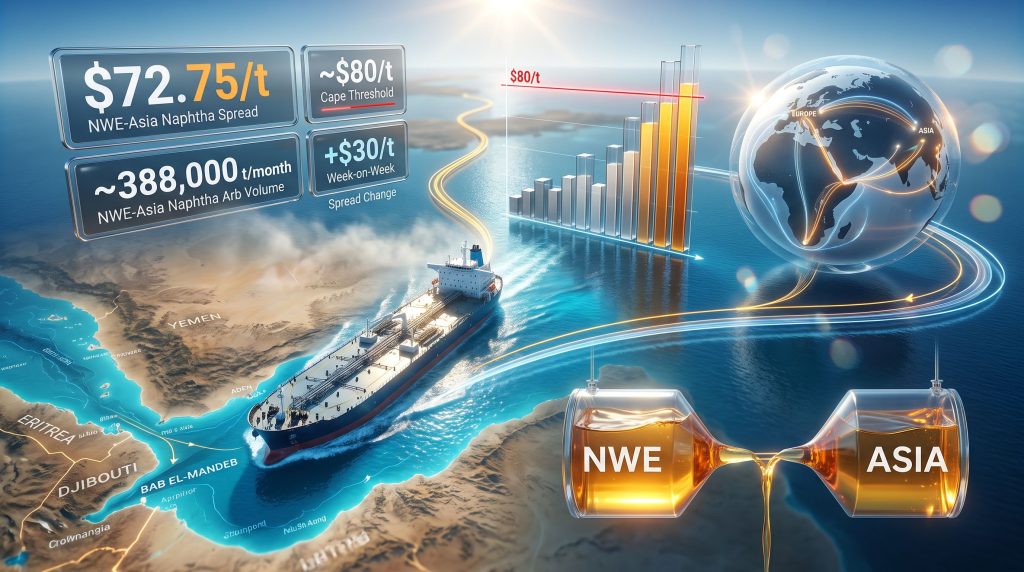
Transit data underscores just how elevated this exposure has become. Naphtha volumes passing through Bab el-Mandeb averaged approximately 388,000 tonnes per month in the two months leading up to July 2026, a figure that represents roughly double the monthly average recorded across all of 2025, according to Argus Media. This surge in baseline transit volume means any disruption carries proportionally higher market consequences than it would have a year earlier.
The alternative, rerouting around the Cape of Good Hope, is commercially viable only under specific spread conditions. An LR2 tanker redirected from the Mediterranean to Japan via South Africa travels approximately 3,500 to 4,000 additional nautical miles, adding roughly 19 days to voyage duration and nearly $600,000 in additional fuel costs at prevailing bunker prices. This is not a trivial burden for traders working on margin-sensitive arbitrage. Furthermore, as global trade disruptions in the Red Sea have demonstrated repeatedly, the ripple effects extend well beyond immediate freight costs.
Four Channels Through Which Disruption Risk Moves Prices
A common misconception is that geopolitical risk in shipping corridors translates directly and proportionally into commodity price increases. In practice, the relationship is far more complex, operating through multiple simultaneous channels that can amplify or counteract each other depending on prevailing market conditions.
Channel One: Freight Cost Escalation
The most visible mechanism is freight. When cargo owners divert tankers to longer routes or when war risk insurance premiums rise during periods of active conflict exposure, the cost of delivering a tonne of naphtha to an Asian buyer increases materially. These additional costs do not sit with the shipowner alone; they feed directly into delivered price negotiations with petrochemical producers in Japan, South Korea, and China.
During periods of elevated Red Sea risk, LR2 tanker rates on the Mediterranean-to-Asia route tend to reflect a risk premium layered on top of standard market rates. This premium effectively functions as a floor-raising mechanism for Asian delivered naphtha prices. For a broader view of how this plays into oil price movements, the interaction between freight risk and energy benchmarks is equally important to monitor.
Channel Two: East-West Arbitrage Spread Dynamics
The east-west naphtha swap spread is the market's primary barometer for the economic viability of cross-regional arbitrage trade. It measures the price differential between Asian and European naphtha benchmarks. When Asian buyers are willing to pay a sufficiently large premium over European prices, cargoes flow eastward. When the spread narrows, the economics of that trade deteriorate.
On 21 July 2026, this spread reached $72.75 per tonne, widening by $18 per tonne in a single trading session and by $30 per tonne over the preceding week, as reported by Argus Media. Market participants estimate the spread would need to approach approximately $80 per tonne before Cape of Good Hope routing becomes routinely economic for most long-haul cargoes. At the time of writing, the market was positioned less than $8 below that threshold.
| Market Indicator | Value (July 2026) | Change |
|---|---|---|
| East-West Naphtha Swap Spread | $72.75/t | +$30/t week-on-week |
| Single-Session Spread Widening | $72.75/t | +$18/t on the day |
| Estimated Cape Routing Threshold | ~$80/t | Reference level |
| LR2 Additional Fuel Cost (Cape Route) | ~$600,000/voyage | Versus Suez route |
| Additional Voyage Duration (Cape Route) | ~19 days | Versus Suez route |
| Bab el-Mandeb Monthly Transit Volume | ~388,000 t/month | ~2x 2025 average |
Channel Three: Liquidity Contraction and Trader Behaviour
A less commonly understood transmission mechanism operates through market psychology and trading behaviour rather than physical commodity flows. When uncertainty rises, market participants reduce their committed positions. Brokers report weakening liquidity as traders adopt a wait-and-see posture, uncertain about Asian buying requirements and shipowner routing decisions.
This cautiousness creates a self-reinforcing dynamic: thinner markets amplify price moves in both directions, generating spread volatility that is disproportionate to any underlying change in physical supply. Market intelligence reported by Argus Media indicates that participants are actively pulling back from volume commitments as the Bab el-Mandeb situation develops, with trading desks describing a broad reduction in market depth as the operative risk condition in the near term.
Channel Four: Inventory Buffers and Regional Supply Balance
When European naphtha inventories are well-supplied, the market has a natural shock absorber that limits the price impact of disruption risk. However, Asia-Pacific light-ends balances have been described as gradually tightening, with supply-side risks accumulating at a faster pace than demand-side relief. An Asia-based market analyst cited by Argus Media assessed that supply risks currently outweigh demand concerns in the regional balance, an asymmetric risk profile that leaves the market vulnerable to price spikes if disruption escalates.
A March 2026 precedent is instructive here. During a period of broader Middle East shipping stress, CIF Northwest Europe naphtha reached $694 per tonne on 6 March 2026, rising $17.50 per tonne in a single session and $100.50 per tonne from the prior week. This episode demonstrated how quickly physical price discovery can accelerate once the four transmission channels align simultaneously. The crude oil market overview for 2025 provides useful context for understanding these rapid price adjustment dynamics.
The Russian Supply Variable: A Compound Risk
Geopolitical risk in the Red Sea would be more manageable if European naphtha markets were operating with abundant alternative supply. They are not. Russian naphtha export volumes are contracting for structural reasons: domestic refinery disruptions have reduced output, while restrictions on gasoline exports are diverting additional naphtha into domestic blending programmes, limiting the volumes available for international trade.
This creates a compounding dynamic that markets may be underpricing. Red Sea disruption risk does not emerge in a vacuum of plentiful supply. It is materialising precisely as one of the key alternative supply sources for European and global naphtha markets is structurally tightening. The result is a global naphtha balance that is more vulnerable to any given disruption event than it would be in a period of surplus supply capacity.
Adding a third pressure point, Chinese petrochemical buyers have shown signs of improved procurement appetite. If sustained, this incremental demand increase would further tighten the global balance, narrowing the margin for supply disruption without price consequences. Consequently, trade war supply chains remain an additional variable that could compound existing pressures on naphtha availability.
Asian Feedstock Substitution: A Partial But Incomplete Buffer
One factor that prevents the disruption scenario from becoming a straightforward supply crisis is the growing ability of Asian crackers to substitute alternative feedstocks for naphtha. Flexible-feed facilities in China and elsewhere can shift between naphtha, ethane, and LPG depending on relative economics, providing a demand buffer that limits naphtha-specific price spikes.
This substitution is already occurring at scale. China's ethane imports rose by more than two-thirds year-on-year to 4.8 million tonnes in the first half of 2026, according to Kpler data cited by Argus Media. This reflects active switching by operators of flexible crackers, several of which have been retrofitting facilities to process US-sourced ethane since 2025 due to its price competitiveness relative to naphtha.
However, this buffer has clear limits. Not all Asian cracking facilities are flexible-feed. Naphtha-dedicated crackers across Japan, South Korea, and parts of China remain fully exposed to supply disruption, with no short-term ability to switch. For these producers, the east-west spread and Cape routing economics are existential pricing variables rather than abstract market signals.
Three Scenarios for European Naphtha Pricing
Scenario analysis provides a structured way to assess the range of outcomes for European naphtha pricing in Red Sea disruption risk conditions.
Scenario 1: De-escalation and Route Normalisation
Red Sea traffic resumes without significant enforcement actions against non-Saudi-linked vessels. The east-west spread narrows back toward the $40 to $50 per tonne range as arbitrage flows recover. Russian supply constraints remain the dominant pricing variable. This outcome is plausible but depends on geopolitical developments outside market control.
Scenario 2: Sustained Selective Enforcement
Houthi enforcement actions persist but remain focused on Saudi-linked cargo. Shipowner uncertainty generates a structural liquidity premium. The east-west spread consolidates in the $70 to $85 per tonne range, with Cape routing intermittently economic. This scenario is most consistent with current market behaviour and spread positioning.
Scenario 3: Full Commercial Shipping Closure
Enforcement broadens to all vessels transiting Bab el-Mandeb. Cape routing becomes mandatory. The east-west spread widens beyond $80 per tonne. European naphtha prices spike, Asian feedstock costs rise sharply, and downstream chemical prices follow. This is a low-probability, high-impact tail risk that markets are partially pricing but not fully discounting.
The critical point for market participants to recognise is that Scenario 2, not Scenario 3, is the working assumption embedded in current spread levels. Markets are pricing meaningful risk but not a worst-case outcome. If enforcement patterns shift, the repricing from Scenario 2 to Scenario 3 conditions could be rapid and disorderly given the existing liquidity contraction dynamic.
The next major ASX story will hit our subscribers first
Key Indicators to Monitor
For traders, analysts, and procurement managers tracking European naphtha pricing in Red Sea disruption risk conditions, the following variables carry the most diagnostic value:
- East-west naphtha swap spread relative to the approximately $80 per tonne Cape routing threshold
- Shipowner policy announcements regarding Red Sea transit suspension or resumption
- Physical cargo flow data through Bab el-Mandeb as a confirmation or contradiction of risk pricing
- Russian naphtha export volumes on a week-by-week basis as the parallel supply constraint
- Chinese petrochemical procurement indicators, particularly naphtha import tender activity
- LR2 tanker freight rates on Mediterranean-to-Asia routes as a leading cost indicator
- Asian cracker operating rates and feedstock mix data as a demand-substitution gauge
What the Market Is Telling Us
The current pricing configuration tells a nuanced story. The east-west spread has widened significantly but remains below the level that would make alternative routing routinely economic for most long-haul voyages. Liquidity is contracting before physical flows have changed materially. Russian supply is tightening independently of the Red Sea situation.
These conditions collectively suggest that markets are in a transitional pricing phase, one where risk is being partially absorbed into spreads and partially withheld pending clearer evidence of enforcement direction. The commodities volatility and hedging considerations that arise in such environments are critical for market participants managing exposure across multiple risk dimensions.
The asymmetric risk profile, where supply-side risks are accumulating faster than demand-side factors can offset, means that any escalation from selective enforcement to broader commercial disruption would likely trigger a sharper price response than the current spread configuration implies. In addition, commodity price impacts across the broader resource sector could amplify the downstream consequences of sustained naphtha supply stress.
For market participants, the implication is clear: the cost of being caught under-positioned in a Scenario 3 environment substantially exceeds the cost of maintaining precautionary hedges in a Scenario 1 normalisation. That asymmetry alone justifies close monitoring of Bab el-Mandeb transit data as a primary market intelligence priority in the weeks ahead. Research published by the ITF-OECD on Red Sea shipping impacts further reinforces how structural these disruption risks have become for global commodity logistics.
This article is based on publicly available market intelligence and pricing data. Forward-looking statements, scenario projections, and spread threshold estimates reflect analytical frameworks and should not be construed as financial advice. Market conditions can change rapidly, and readers should consult qualified market professionals before making trading or procurement decisions. Ongoing naphtha market price assessments and related analysis are available from Argus Media at argusmedia.com.
Want to Stay Ahead of the Next Major Resource Market Shift?
Discovery Alert's proprietary Discovery IQ model delivers real-time alerts on significant ASX mineral discoveries, translating complex commodity market dynamics into actionable investment insights for traders and investors at every experience level — start your 14-day free trial today and explore historic discoveries that have generated substantial returns to understand why being first to market makes all the difference.