
July 22, 2026
The Hidden Mechanics Behind LME Lead Warehouse Cycles
Understanding why base metal inventories move in and out of exchange warehouses requires looking past the headline numbers. When thousands of tonnes of lead appear in an exchange system overnight, or disappear within days, the instinct is to interpret this as either a supply glut or a demand surge. Neither interpretation is reliably correct without examining the financial architecture that governs how major commodity trading giants interact with exchange warehousing infrastructure.
The LME lead market is currently exhibiting precisely this kind of interpretive complexity. A sequence of large-scale deliveries, warrant cancellations, and planned withdrawals involving some of the world's most powerful commodity trading houses has generated data that looks dramatic on the surface but carries layers of meaning that only become visible when the underlying mechanics are properly understood. Glencore LME lead withdrawals after stocks surge represent one of the most instructive recent examples of this phenomenon.
When big ASX news breaks, our subscribers know first
What LME Warrants Actually Represent and Why Cancellations Can Mislead
An LME warrant is a title document that confers legal ownership of a specific quantity of metal stored in an approved LME warehouse. When a trader holds warrants, they hold the right to take physical delivery of that metal. When warrants are cancelled, the holder formally signals their intention to withdraw the underlying metal.
This is where the interpretive challenge begins. Cancelled warrants do not confirm that metal is moving into the hands of industrial consumers. The metal may be:
- Transferred to a non-LME warehouse where different storage economics apply
- Redirected to another LME-approved location where rent rates or logistical arrangements are more favourable
- Delivered to an end-user such as a battery manufacturer or industrial processor, genuinely exiting the exchange system
- Held in a transitional state while the trader reassesses optimal placement
The distinction between genuine physical consumption and financial repositioning is critical for anyone using LME stock data as a proxy for real-world supply and demand conditions. A sharp spike in cancelled warrants can trigger bullish price responses across algorithmic trading systems and momentum-driven market participants, even when no actual tightening of physical supply has occurred. Furthermore, commodities market volatility means these misreadings can compound rapidly across interconnected markets.
The Rent Deal Framework: How Storage Economics Drive Trader Behaviour
Warehouse rent deals are a well-established but frequently misunderstood feature of base metal markets. In their most basic form, a rent deal involves a trader delivering metal into an LME warehouse and receiving a portion of the ongoing storage income generated by that metal's presence in the facility. The trader does not need to retain ownership of the metal to continue earning rent income, as the arrangement is structured around the delivery act itself and the subsequent warehousing period.
The economics of a rent deal are most compelling when the cost of removing metal from the warehouse is high relative to the income generated by leaving it in place. Cancellation fees, loading charges, and shipping costs to regional consumers all act as friction that makes long-term storage financially rational.
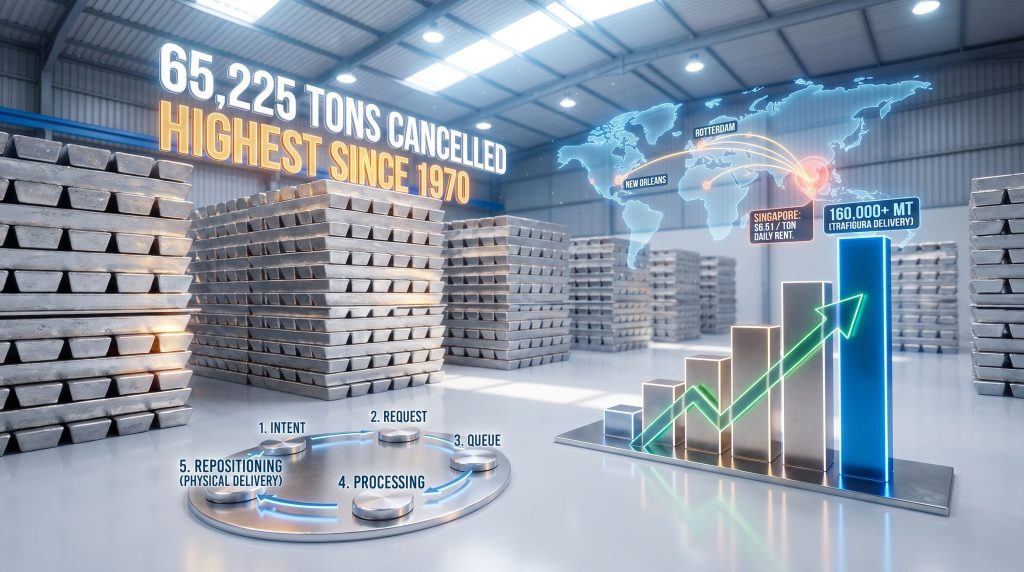
Singapore has emerged as the dominant location for this type of activity in the lead market. The city-state's geographic position creates significant logistical expense for any entity attempting to move large volumes of lead to Asian end-users, while simultaneously placing it close enough to major demand centres to remain credible as a delivery location. The daily LME rent rate for lead in Singapore sits at $0.51 per metric ton, meaning a position of 30,000 tonnes generates $15,300 per day and over $5.58 million annually in storage income.
How LME Lead Stocks Reached Their Highest Level Since 1970
The sequence of events that produced the current inventory situation unfolded rapidly in July 2026. Trading house Trafigura delivered more than 160,000 metric tons of lead into Singapore across two consecutive days, a volume large enough to push total LME lead stocks to their highest recorded level since 1970. This delivery was structured as a rent deal, providing Trafigura with ongoing income from the warehoused metal while creating a statistically anomalous stock figure that immediately attracted market attention.
The scale of the inventory surge and the subsequent warrant cancellation activity can be mapped across several key metrics:
| Metric | Figure |
|---|---|
| Trafigura delivery into Singapore (July 2026) | 160,000+ metric tons over two days |
| LME lead stock level reached | Highest since 1970 |
| Total LME lead warrants cancelled | 65,225 metric tons |
| Warrants cancelled in the preceding week | 46,100 metric tons |
| Cancelled stock located in Singapore | ~97% (only 1,725 tons elsewhere) |
| Glencore's planned withdrawal | ~30,000 metric tons |
| Daily LME rent rate in Singapore (lead) | $0.51 per metric ton |
| Daily income on 30,000 tons at Singapore rates | $15,300 |
| Annual storage income on 30,000 tons | ~$5.58 million |
The concentration of cancelled warrants in Singapore, representing approximately 97% of all cancellations, confirms that this market event is geographically specific rather than a broad signal of global physical demand acceleration. Consequently, base metal price delays caused by this geographic specificity may affect how traders respond across the broader metals complex.
Glencore's Planned Lead Withdrawal: Two Scenarios Worth Examining
Glencore LME lead withdrawals after stocks surge present the market with two structurally different interpretations, each carrying distinct implications for lead price discovery.
Scenario A: Physical Customer Supply
Glencore redirects the cancelled metal to industrial end-users, including battery manufacturers or industrial processors requiring refined lead. Under this scenario, the metal exits the LME system entirely and represents genuine demand-side consumption. This would be mildly constructive for lead prices, confirming that at least a portion of the inflated inventory position has been absorbed by the real economy.
Scenario B: Warehouse Repositioning
The metal moves to a non-LME or alternative LME-approved warehouse, potentially unlocking more favourable rent economics without changing the fundamental supply picture. Under this scenario, the withdrawal is a financial manoeuvre rather than a demand signal. The apparent reduction in LME stocks would be misleading as a market indicator.
Industry sources familiar with the situation have noted that it would be unusual for Glencore or Hartree Partners to engage in traditional rent deals of the type structured by Trafigura. This suggests the physical customer supply pathway may carry higher probability for Glencore specifically, though without direct confirmation from the company, both scenarios remain live possibilities.
Hartree Partners has also cancelled lead warrants at Singapore warehouses, though the precise volume has not been publicly disclosed. The simultaneous activity of two major trading houses signals that the post-Trafigura delivery environment has created commercial opportunities that multiple market participants are moving to exploit.
The Key Players and Their Roles in the Current LME Lead Cycle
| Entity | Role in Current Market Event |
|---|---|
| Trafigura | Delivered 160,000+ tons into Singapore, triggering the stock surge to 1970-era highs via a structured rent deal |
| Glencore | Planning ~30,000 ton withdrawal via warrant cancellation; motivation not publicly confirmed |
| Hartree Partners | Also cancelling lead warrants in Singapore; volume undisclosed |
| LME (London Metal Exchange) | Exchange infrastructure through which warrants are issued, cancelled, and tracked |
| Singapore warehouses | Physical location holding ~97% of all currently cancelled lead stock |
How a Warrant Cancellation Actually Works: Step by Step
For investors and market participants less familiar with the mechanics of exchange warehouse operations, the following sequence describes exactly what happens when an LME lead warrant is cancelled:
- A trader holding LME warrants instructs the exchange to formally cancel those title documents.
- The cancellation is recorded publicly, signalling the holder's stated intent to take physical delivery.
- The holder has a defined period within which the metal must be loaded out of the approved warehouse.
- Once loaded, the metal moves to one of three destinations: a physical customer, a non-LME storage facility, or another LME-approved warehouse.
- If the metal arrives at another LME warehouse, new warrants may be issued against it, effectively restarting the stock cycle.
- Only when metal reaches a genuine industrial consumer and is processed or used does it exit the exchange system in a way that constitutes real demand.
This cycle illustrates why warrant cancellation data requires careful contextual interpretation. The same physical metal can generate multiple apparent demand signals across a single inventory cycle without ever reaching an end-user.
Why Artificially Elevated LME Stocks Distort Lead Price Formation
When exchange inventory levels are inflated by rent deal deliveries, the resulting data creates a misleading impression of abundant supply. Lead market participants relying on LME stock figures as a real-time gauge of physical availability may interpret elevated inventories as a bearish signal, suppressing spot prices even when underlying consumption patterns remain healthy.
Elevated LME stocks driven by financial positioning rather than genuine oversupply can trap buyers into waiting for price declines that never materialise, while simultaneously encouraging producers to delay output decisions based on false inventory signals.
This distortion has real consequences across the lead supply chain. Battery manufacturers planning procurement schedules, recyclers assessing secondary market dynamics, and smelters making output decisions all reference LME data. When that data reflects warehousing arbitrage rather than genuine market conditions, the downstream planning quality of these industrial participants deteriorates.
The nearby spread structure provides a more reliable signal in these situations. During periods of genuine physical tightness, the nearby contract typically moves into backwardation, with prompt delivery prices exceeding forward prices. When inflated LME stocks are the product of financial engineering rather than real supply, the curve tends to remain in contango, reflecting the cost of carry rather than a scarcity premium. For a broader view of how these dynamics unfold, metals market analysis across related asset classes can provide useful comparative context.
The next major ASX story will hit our subscribers first
Lead-Acid Batteries and the Structural Demand Context
Understanding why LME lead dynamics carry real economic weight requires appreciating the scale of lead's ongoing industrial role. Despite the rapid expansion of lithium-ion battery technology across electric vehicles and consumer electronics, lead-acid batteries continue to occupy dominant positions across several critical application segments:
- Automotive starter batteries: The overwhelming majority of internal combustion engine vehicles globally continue to rely on lead-acid technology for starting, lighting, and ignition functions.
- Uninterruptible power supply (UPS) systems: Data centres, hospitals, and telecommunications infrastructure depend heavily on lead-acid UPS systems for backup power reliability.
- Industrial motive power: Forklifts, pallet jacks, and other warehouse logistics equipment continue to use flooded lead-acid and valve-regulated lead-acid batteries at scale.
- Stationary energy storage: In markets where cost per kilowatt-hour is the primary consideration, lead-acid remains competitive for grid-scale and off-grid storage applications.
The battery raw materials market continues to evolve rapidly, and the global lead-acid battery sector consumes the majority of refined lead production annually, making LME warehouse dynamics directly relevant to manufacturers operating across these segments. A prolonged suppression of lead spot prices caused by artificially inflated LME stocks can delay investment in primary and secondary production, creating the conditions for genuine tightness further down the cycle.
How to Read LME Lead Market Data Without Being Misled
Given the complexity introduced by large-scale warehouse operations, market participants benefit from applying multiple analytical lenses simultaneously rather than relying on any single data point.
Three frameworks for interpreting LME lead warrant cancellations:
- The Physical Demand Lens: Monitor whether cancellations are accompanied by tightening nearby spreads, rising spot premiums in key consuming regions, and falling on-warrant stock ratios. Genuine demand acceleration produces convergent signals across multiple indicators simultaneously.
- The Financial Arbitrage Lens: Assess whether the cancelling entity has a commercial history of rent deal activity and whether the destination of the cancelled metal is traceable through regional premium data and shipping intelligence. A lack of premium movement following large cancellations is often diagnostic of financial repositioning.
- The Market Sentiment Lens: Acknowledge that warrant cancellations at scale influence algorithmic trading systems and short-term speculative positioning regardless of their underlying motivation. Even a financially-motivated cancellation can produce temporary price momentum that creates real trading opportunities.
Key metrics to monitor continuously in the LME lead market include:
- The ratio of on-warrant to cancelled-warrant stocks across the full system
- Daily rent rates across major LME locations including Singapore, Rotterdam, and New Orleans
- The shape of the forward curve, particularly the cash-to-three-month spread
- Physical market premiums in Asia and Europe relative to LME spot
- Warrant ownership concentration, which can indicate whether a single entity controls a position large enough to influence market structure
Frequently Asked Questions: LME Lead Withdrawals and Warehouse Economics
What does it mean when a trader cancels LME lead warrants?
Cancelling LME warrants formally signals the holder's intention to take physical delivery of the metal. It does not confirm that the metal will reach an industrial end-user. The metal may move to another warehouse or be redirected to a physical customer.
Why are LME lead stocks at their highest level since 1970?
Trafigura delivered more than 160,000 metric tons of lead into Singapore across two consecutive days in July 2026 as part of a structured rent deal, generating an inventory level not recorded since 1970. According to the London Metal Exchange, warrant and stock data of this scale is exceptionally rare in the modern era of exchange warehousing.
What is a warehouse rent deal and how does it affect metal prices?
A rent deal involves delivering metal into an LME warehouse in exchange for a share of the ongoing storage income. The metal remains in the system rather than reaching consumers, which can suppress spot prices by creating a misleading appearance of abundant supply.
Is Glencore's planned lead withdrawal bullish for lead prices?
It depends on the destination of the metal. If Glencore directs the 30,000 tonnes to physical customers, the withdrawal represents genuine consumption and is constructive for prices. If the metal moves to another warehouse, the price impact is likely minimal. Analysts tracking base metal trading strategies note that destination transparency is key to accurate interpretation.
Why is Singapore the dominant location for LME lead warrant activity?
Singapore's logistical friction, including high cancellation costs, loading fees, and shipping expenses to regional consumers, makes it structurally advantageous for rent deals. Metal tends to remain warehoused for extended periods, generating sustained income at the $0.51 per tonne daily rate.
How does Trafigura's 160,000-ton lead delivery connect to Glencore's withdrawal plans?
Trafigura's delivery created the current inventory surplus and established the rent deal economics at Singapore warehouses. Glencore LME lead withdrawals after stocks surge may reflect either an opportunistic response to the elevated stock environment or independent commercial requirements for physical supply.
Key Takeaways for Market Participants
- LME lead stocks reached their highest level since 1970 following a delivery of over 160,000 metric tons into Singapore by a major trading house in July 2026, structured as a rent deal.
- A total of 65,225 metric tons of lead warrants have been cancelled across the LME system, with approximately 97% of that volume concentrated in Singapore warehouses.
- Glencore's reported plan to withdraw approximately 30,000 metric tons carries ambiguous market implications depending on whether the metal reaches industrial end-users or is repositioned within the warehousing system.
- Singapore's daily lead rent rate of $0.51 per metric ton generates more than $5 million annually on a 30,000-tonne position, creating powerful financial incentives for traders to manage large lead positions through warehousing strategies.
- Warrant cancellation data should be treated as a directional signal requiring corroboration from physical market premiums, spread structure, and destination intelligence before being interpreted as evidence of genuine supply tightening.
- Lead-acid battery demand across automotive, industrial, and stationary storage applications ensures that real shifts in LME lead market structure carry tangible consequences for manufacturers and supply chain planners globally.
This article is intended for informational purposes only and does not constitute financial or investment advice. Commodity markets involve significant risk, and all forecasts, scenarios, and analytical frameworks presented here reflect current available information and should not be relied upon as the basis for investment decisions.
Want to Catch the Next Major ASX Mineral Discovery Before the Market Moves?
Discovery Alert's proprietary Discovery IQ model delivers real-time alerts on significant ASX mineral discoveries, cutting through complex commodity data to surface actionable opportunities the moment they are announced — explore historic discoveries and their returns to see the potential at stake, and begin your 14-day free trial at Discovery Alert to position yourself ahead of the broader market.