
July 22, 2026
The Fiscal Architecture Beneath Every Barrel: Understanding Oil Economic Rent
Few concepts in resource economics carry more long-term consequence for producing nations than the distinction between profit and rent. In global hydrocarbon markets, this difference is not semantic — it determines whether a country's finite natural wealth accumulates in sovereign coffers or quietly migrates to the balance sheets of international operators. Across Latin America, where constitutional tradition vests subsoil ownership in the state, the capacity to correctly identify and systematically capture oil economic rent has proven to be one of the most consequential governance choices any resource-rich government can make.
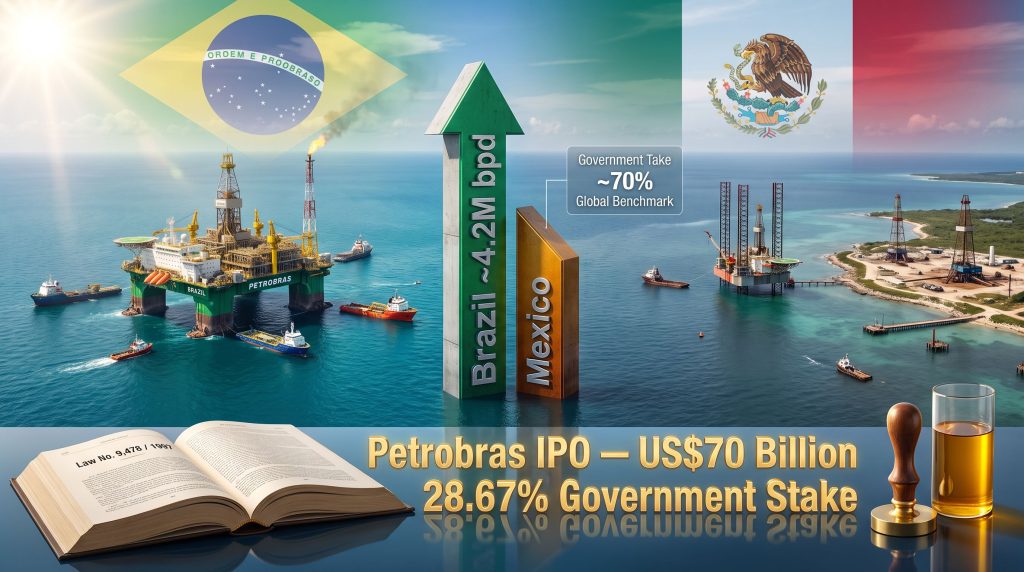
The divergence between Brazil and Mexico on this question represents one of the most instructive case studies in contemporary energy policy. Both countries share a Napoleonic legal heritage that establishes hydrocarbons as sovereign property. Both founded national oil companies under populist leaders with strong nationalist credentials. Yet today, Brazil produces approximately 4.2 million barrels per day — the largest output of any nation in Latin America — while Mexico's production continues to decline from historical highs. The institutional and ideological choices that produced this gap stretch back more than a century, and understanding them is essential for anyone analysing the comparative economics of Brazil oil economic rent vs Mexico.
When big ASX news breaks, our subscribers know first
What Oil Economic Rent Actually Means — and Why Most People Get It Wrong
The term "oil economic rent" is frequently used but rarely defined with precision outside specialist circles. In hydrocarbon economics, rent is not the same as profit. Profit is the financial return an operator earns after covering all legitimate costs — exploration, drilling, production, capital recovery, and a fair return on invested capital. Economic rent, by contrast, is the surplus value that remains after those costs are met: the premium generated by exploiting a finite, irreplaceable natural resource that belongs to the nation, not the operator.
Under the Napoleonic legal tradition adopted across most of Latin America, subsoil hydrocarbons are constitutionally vested in the sovereign state, regardless of who finances extraction. This means that every barrel produced generates two distinct value streams: one that belongs to the operator as legitimate return on investment, and one that belongs to the nation as the resource owner. Conflating these two streams — treating all surplus as corporate profit — has historically cost resource-rich nations enormous quantities of unrealised public revenue.
Understanding oil's role in the global economy helps contextualise why this distinction carries such outsized consequence. According to energy policy analysis published at Mexico Business News, the global average government take across oil-producing nations currently stands at approximately 70% of the value of each barrel produced, combining royalties, taxes, and other fiscal participation instruments. This benchmark encompasses diverse fiscal architectures, but the underlying logic is consistent: the majority of value generated by exploiting a state-owned resource should flow back to the state as rent, not to private shareholders as profit.
Key Concept: Oil economic rent is not interchangeable with corporate profit. It is the portion of surplus value that belongs to the sovereign owner of the resource. Designing a fiscal regime that captures this rent without deterring investment is the defining challenge of hydrocarbon governance.
A critical but underappreciated implication of this framework is the multiplicative effect of operator diversity. When a single state entity holds a monopoly over production, rent capture is bounded by that entity's operational capacity and cost structure. When multiple operators compete for licensed acreage, each one generates parallel royalty flows to the state — compounding total rent yield even if no single operator is individually more efficient. This multiplicative logic is central to understanding why Brazil's post-1997 liberalisation produced dramatically higher rent capture than Mexico's monopoly model.
Mexico's Golden Belt Era: When Rent Was Given Away for Cents Per Barrel
Mexico's entry into commercial oil production occurred earlier than almost any other major producing nation, shaped largely by its geographic proximity to US capital markets and the accessibility of the Faja de Oro — the Golden Belt — a remarkably productive geological corridor stretching between Tampico and Poza Rica along the Gulf Coast.
By the early 1920s, Mexico had ascended to become the world's second-largest crude oil producer, surpassed only by the United States. At its peak, Mexico supplied roughly one-quarter of total global oil output and, notably, functioned as the world's largest crude oil exporter at the time — since the United States consumed most of its own production domestically.
Production peaked in 1921 at 193 million barrels, then deteriorated rapidly. By 1926, annual output had already fallen below 100 million barrels. By 1930, Mexico's share of global production had collapsed from approximately 25% to under 3%, driven by geological depletion in exhausted fields, capital flight to more competitive jurisdictions — particularly Venezuela — and persistent institutional uncertainty around fiscal terms.
The critical insight from this period, documented in expert analysis published by Luis Miguel Labardini of Labardini & Christlieb Energy Experts in Mexico Business News, is that foreign oil companies operating in Mexico during this era — primarily American and Anglo-Dutch firms — were effectively paying only a few cents per barrel in royalties. The concept that economic rent legitimately belonged to the host state was not yet formally institutionalised in fiscal arrangements, even though Mexican constitutional law clearly established that subsoil resources belonged to the nation. The operators captured what should have been sovereign rent, and the state received almost nothing proportionate to the resource's true value.
The Poza Rica Precedent: A Road Not Taken
Before the landmark 1938 expropriation, the Mexican government achieved something historically underappreciated: it succeeded in fragmenting the coalition of foreign operators and negotiating a separate agreement with El Águila, the Anglo-Dutch oil company, covering the newly discovered and strategically significant Poza Rica field. Under this arrangement, El Águila agreed to pay the Mexican state an economic rent equivalent to between 15% and 35% of production — representing Latin America's first formally negotiated hydrocarbon royalty mechanism.
This agreement was short-lived. Under pressure from American oil company counterparts, El Águila withdrew from the arrangement to maintain industry solidarity, foreclosing a fiscally sophisticated, royalty-based path to rent capture. The political consequence was historically decisive: with negotiated solutions exhausted, the Mexican government proceeded with full expropriation in 1938, transforming what might have been a royalty framework into a state monopoly narrative that became inseparable from revolutionary nationalist identity.
The enduring myth that followed — that the only viable model was eliminating private operators entirely — was not an inevitable historical conclusion. It was the residual outcome of a failed negotiated rent-capture framework. The distinction matters enormously for evaluating Mexico's current policy options, particularly given ongoing debates around government intervention in resources across the region.
Brazil's Alternative Path: Three Economic Principles That Changed Everything
Brazil's hydrocarbon story begins significantly later. Until the 1950s, the country was not a meaningful oil producer, and hydrocarbons occupied a peripheral role in its economic architecture. Petrobras was founded in 1953 under President Getúlio Vargas — a populist leader whose nationalist credentials bear genuine comparison to Lázaro Cárdenas in Mexico — but with a critical difference: because oil was not yet central to Brazil's fiscal base, subsequent administrations were free to apply economic logic to hydrocarbon policy without the same ideological constraints that paralysed reform in Mexico.
According to analysis by Labardini published in Mexico Business News, Brazilian hydrocarbon governance came to rest on three foundational economic principles:
- Rent and profit are legally distinct. Economic rent is collected by the state through royalties; the operating company retains net profit only after the rent obligation is discharged. The state is compensated as the original resource owner under Napoleonic legal tradition.
- Operator competition multiplies rent yield. Each additional licensed operator generates incremental royalty flows to the state. Maximum rent capture occurs when each operator minimises extraction costs and maximises in-situ hydrocarbon recovery, increasing the rent generated per barrel.
- National oil companies must remain commercially solvent. A state enterprise that functions as a fiscal transfer mechanism rather than a profitable commercial entity ultimately undermines both energy sovereignty and long-term rent capacity.
These principles were not merely theoretical. They were encoded into Brazil's legislative architecture through Law No. 9,478 in 1997 under President Fernando Henrique Cardoso, which formally ended Petrobras's monopoly and established the National Petroleum Agency (ANP) — an autonomous regulatory body insulated from political interference and responsible for managing competitive licensing of the country's hydrocarbon resources. The ANP began awarding exploration and production contracts to private operators in 1999.
The 2010 Petrobras IPO: A Proof of Concept for Royalty-Based Rent Capture
On September 23, 2010, during President Luiz Inácio Lula da Silva's second term, Petrobras executed a public offering on the New York Stock Exchange and the Madrid Stock Exchange, raising more than US$70 billion — one of the largest equity capital raises in global financial history at that time.
The ownership structure that emerged from this offering reveals the underlying philosophy of Brazil's rent-capture model with remarkable clarity. Following the IPO:
- The Brazilian federal government held approximately 28.67% of Petrobras shares
- The National Bank for Economic and Social Development (BNDES) and the Brazilian Sovereign Wealth Fund together held an additional ~7.94%
- Combined public sector exposure totalled approximately 36.6% — well below majority ownership
For observers accustomed to the Mexican model — where state ownership of PEMEX has historically been treated as the mechanism through which the nation retains control over oil revenues — this structure appears counterintuitive. How can a government with a minority shareholding claim to be capturing its nation's oil rent?
The answer lies precisely in the royalty architecture. Brazil does not need majority ownership of Petrobras to receive its economic entitlement from hydrocarbon production. The ANP's royalty system ensures the state collects its rent from every barrel produced by any licensed operator, regardless of corporate ownership structure. Furthermore, this approach aligns closely with sound sovereign wealth fund strategy, separating fiscal instruments from corporate ownership decisions. The IPO was not a surrender of sovereign control — it was confirmation that rent capture and corporate ownership are separable policy instruments.
Structural Insight: The Petrobras IPO demonstrated that a government can extract full economic rent from its hydrocarbon endowment while simultaneously operating a commercially competitive, internationally listed national oil company. These objectives are complementary, not contradictory.
Comparing the Models: Brazil vs. Mexico Across Key Dimensions
| Policy Dimension | Brazil | Mexico |
|---|---|---|
| Primary rent-capture mechanism | Royalties via ANP competitive licensing | Direct fiscal extraction via state monopoly |
| Regulatory independence | ANP — autonomous, apolitical | Integrated with PEMEX structure |
| Operator diversity | High — multiple international operators since 1999 | Low — PEMEX dominant |
| State ownership of national oil company | ~36.6% (government + public entities) | Majority state-owned |
| Current crude production | ~4.2M bpd (Latin America's largest) | Declining from historical highs |
| Oil self-sufficiency achieved | 2007 | Achieved earlier; now declining |
| Fiscal flexibility | Higher — rent decoupled from corporate performance | Lower — fiscal revenues tied to PEMEX health |
| Federal revenue dependence on oil (peak) | Lower structural dependency | ~30-40% of federal revenue (2000-2010 peak) |
| Ideological burden on reform | Low — pragmatic policy evolution | High — 1938 expropriation as political cornerstone |
The next major ASX story will hit our subscribers first
The Rentier Trap: Why Mexico's Fiscal Model Created Structural Vulnerability
Mexico's historical use of oil revenues as a direct fiscal instrument rather than a sovereign rent-capture mechanism created a structural dependency with serious long-term consequences. During the peak period of 2000 to 2010, petroleum revenues financed an estimated 30% to 40% of total federal government revenue. This level of concentration created what economists describe as a rentier state dynamic: public finances become so dependent on a single commodity that fiscal governance, investment policy, and even political stability become entangled with hydrocarbon production cycles.
The structural problem with this model is compounded by the dual burden placed on PEMEX. As both the primary commercial operator and the principal mechanism for transferring oil revenues to the federal budget, PEMEX has historically been required to serve two incompatible objectives simultaneously. The fiscal extraction demands on the company constrained its ability to reinvest in exploration and field development, accelerating geological decline in mature assets without generating the new production needed to replace depleting reserves.
Brazil, by contrast, structured Petrobras as a commercial enterprise with a mandate for operational profitability — even under a state-associated ownership framework. The separation of regulatory authority (ANP) from commercial operations (Petrobras) meant that fiscal instruments could be designed to optimise rent capture without simultaneously degrading the operational capacity of the producing entity. This commodity-linked fiscal vulnerability remains one of the most underappreciated structural risks in Mexico's economic outlook.
The Bargaining Power Shift: Why Now Is a Critical Moment for Reform
One of the most significant structural shifts in global hydrocarbon economics over the past half-century is largely absent from mainstream commentary: national oil companies now control more than 75% of the world's proven oil reserves. This concentration of reserve ownership has fundamentally restructured the negotiating relationship between producing states and international oil companies.
In the early 20th century, when Mexico's Golden Belt fields were being developed, the reverse was true. International operators controlled both the capital and the technical knowledge required to develop reserves, granting them enormous leverage in fiscal negotiations — a power asymmetry that allowed them to appropriate rent that constitutionally belonged to sovereign states. The operators of Mexico's Golden Belt paid only cents per barrel not because governments were ignorant of the concept of rent, but because the institutional capacity to enforce fair fiscal terms was absent, and the geopolitical power of the operating companies was overwhelming.
That power dynamic has been structurally reversed. Producing nations, collectively controlling the dominant share of global reserves, possess unprecedented leverage to design and enforce rent-optimising fiscal regimes. The global average government take of approximately 70% per barrel reflects this shift. However, understanding resource geopolitics in 2025 reveals that Mexico benefits less from this favourable environment than it should, because its institutional architecture constrains its ability to attract the competitive multi-operator investment that would multiply rent yield across its underdeveloped basins.
Policy Observation: The current global energy environment represents a historically favourable window for hydrocarbon fiscal reform. Producing nations with sovereign reserve ownership have never had greater structural leverage to optimise rent capture. The constraint in Mexico is not external — it is institutional and ideological.
A Five-Step Reform Framework: What Mexico Could Learn from Brazil
Closing the rent-capture gap between Mexico and Brazil does not require ideological abandonment of PEMEX or sovereign resource ownership. It requires institutional redesign informed by the same economic principles that Brazil operationalised between 1997 and 2010. A viable reform pathway involves five sequential steps:
- Establish an independent regulatory authority modelled on Brazil's ANP, separating licensing and royalty administration from PEMEX's commercial operations to eliminate structural conflicts of interest.
- Redesign the fiscal regime to formally and legally distinguish royalty obligations (rent belonging to the state) from corporate income tax (profit belonging to the operator after rent payment), ending the structural ambiguity that has historically allowed rent to be misclassified.
- Introduce competitive licensing rounds for underdeveloped basins — including deepwater and unconventional resources — enabling multiple operators to generate parallel royalty streams, multiplying the state's total rent yield.
- Restructure PEMEX's balance sheet to reduce its function as a direct fiscal instrument, allowing the company to compete commercially and profitably alongside private operators rather than being perpetually drained by federal budget obligations.
- Establish a sovereign wealth fund mechanism to institutionalise long-term stewardship of oil rent revenues, insulating them from short-term political spending pressures and ensuring intergenerational equity in the use of finite resource wealth.
None of these steps require majority privatisation of PEMEX or a surrender of sovereign resource ownership. Brazil's experience demonstrates that all five are compatible with strong national control over hydrocarbon assets — provided the distinction between rent capture and corporate ownership is clearly understood and embedded in institutional design. Indeed, comparative analysis of Brazil vs Mexico shows that both nations still have significant structural room to optimise how resource revenues are governed over the long term.
Frequently Asked Questions: Brazil Oil Economic Rent vs. Mexico
What is the core difference between the Brazilian and Mexican approaches to oil economic rent?
Brazil captures oil economic rent primarily through royalties administered by the independent ANP, applied equally to all licensed operators regardless of nationality or ownership structure. Mexico has historically captured rent through PEMEX's direct fiscal contributions to the federal budget, conflating corporate performance with sovereign rent collection and making public finances structurally dependent on a single operator's operational health.
Why did Mexico's early oil boom not translate into lasting fiscal strength?
Mexico's peak production of 193 million barrels in 1921 occurred under a fiscal framework in which foreign operators paid only negligible royalties. The rent that constitutionally belonged to the Mexican state was largely appropriated by private operators. The subsequent collapse in production by the late 1920s left Mexico with neither a functioning royalty stream nor a diversified fiscal base. The 1938 expropriation addressed the political dimension of this failure but entrenched a monopoly model that foreclosed competitive rent multiplication.
How does the global 70% government take benchmark apply to Brazil and Mexico?
The global average take of approximately 70% per barrel — encompassing royalties, taxes, and fiscal participation instruments — represents the contemporary standard for hydrocarbon fiscal regimes. Brazil's competitive licensing model is broadly aligned with this range. Mexico's nominal take has historically appeared high, but a disproportionate share has been absorbed by PEMEX's operational costs and debt service rather than flowing to the state as pure economic rent. Furthermore, economic growth comparisons between Brazil and Mexico highlight how these structural differences compound over time into divergent development trajectories.
Why does Brazil's minority shareholding in Petrobras not compromise rent capture?
Because Brazil's rent-capture system operates through the royalty mechanism, not through corporate dividends. Every barrel produced by any licensed operator in Brazil generates a royalty payment to the state as the sovereign resource owner. The government's ~28.67% direct shareholding in Petrobras is commercially strategic, not fiscally essential. Mexico's conflation of ownership with rent capture is the architectural difference that has historically made PEMEX reform so politically fraught.
What does national oil company reserve dominance mean for future rent capture?
With national oil companies controlling more than 75% of proven global oil reserves, sovereign producers collectively hold unprecedented bargaining leverage over international operators. This structural reality makes the current period uniquely favourable for rent-optimisation reform in countries like Mexico that have historically failed to capture the full economic value of their hydrocarbon endowments. Consequently, the case for Brazil oil economic rent vs Mexico reform comparisons has never been more practically relevant than it is today.
This article draws on energy policy analysis published at Mexico Business News, including expert commentary by Luis Miguel Labardini of Labardini & Christlieb Energy Experts. All financial projections, reform scenarios, and policy recommendations discussed herein are analytical in nature and should not be construed as investment advice. Historical production figures and ownership statistics are cited from publicly referenced sources and may be subject to revision as official data is updated.
Want to Identify the Next Major Resource Discovery Before the Market Does?
Discovery Alert's proprietary Discovery IQ model delivers real-time alerts on significant ASX mineral discoveries — instantly translating complex resource data into actionable investment insights for both short-term traders and long-term investors. Explore Discovery Alert's discoveries page to understand how historic mineral discoveries have generated substantial returns, and begin your 14-day free trial today to position yourself ahead of the broader market.