August 6, 2026
The physics of underground seismic events at extreme depths creates unique challenges that extend far beyond surface mining operations. When extraction activities penetrate below 1,000 meters, geological stress patterns shift dramatically, transforming routine mining operations into complex engineering endeavors where ground stability becomes the primary operational constraint. Understanding these deep-level dynamics has become increasingly critical as global mining operations pursue ore bodies at unprecedented depths. Furthermore, the recent Boliden Garpenberg mine rockfall incident highlights the urgent need for enhanced safety protocols in deep underground mining environments.
What Triggers Catastrophic Rockfall Events in Deep Underground Mining Operations?
Seismic Activity Patterns in Polymetallic Extraction Zones
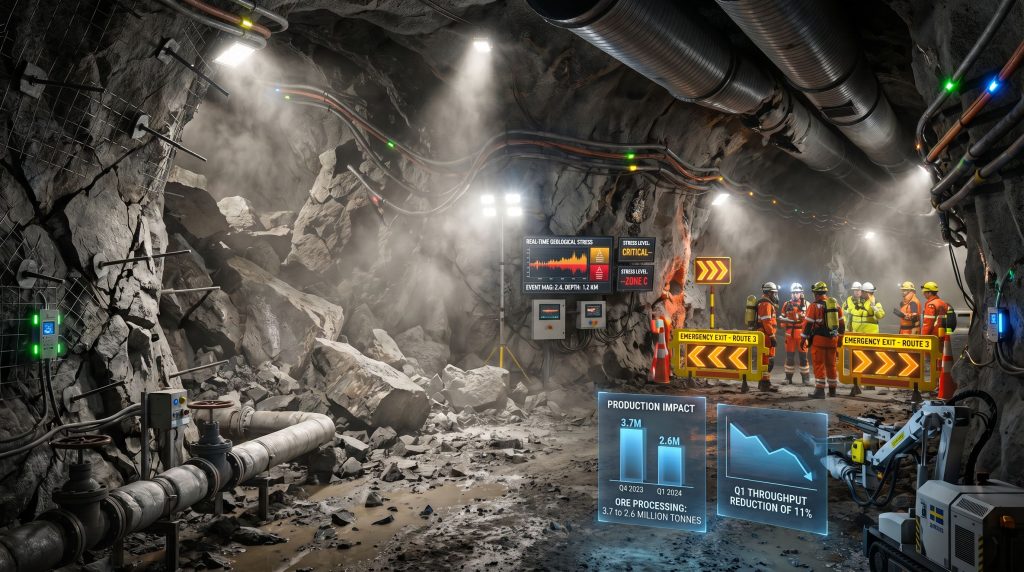
Deep underground mining environments experience fundamentally different seismic characteristics compared to surface or shallow operations. At the Boliden Garpenberg mine, operations at 1,120 meters below sea level place the facility within the ultra-deep mining category where geological stress concentrations reach critical thresholds. The facility's historical processing capacity of 3.7 million tonnes annually demonstrates the scale of material extraction that creates ongoing ground disturbance patterns.
The March 14, 2026 incident at Garpenberg illustrates how seismic activity can escalate rapidly in polymetallic extraction zones. While the mine maintained normal seismic monitoring protocols, activity increased to abnormal levels within hours, necessitating immediate evacuation protocols by March 15, 2026. This timeline suggests that deep mining seismic events can transition from manageable background activity to hazardous conditions with minimal warning.
Scandinavian mining districts experience unique geological conditions due to ancient shield rock formations that create distinct fracture patterns. These geological structures can amplify seismic energy transmission through underground networks, explaining why infrastructure damage patterns often appear selective rather than uniform throughout mining complexes. Moreover, the industry innovation trends demonstrate how technological advancement continues to address these complex geological challenges.
Pressure Wave Mechanics and Underground Worker Safety
Pressure waves generated by rockfall events in confined underground spaces create injury mechanisms not typically encountered in surface operations. At Garpenberg, several miners required medical attention for pressure wave-related injuries, though all individuals recovered without fatalities. The physics of confined pressure wave propagation explains why workers can sustain injuries even when positioned distant from the primary rockfall location.
Underground pressure waves travel through multiple pathways simultaneously:
- Air-transmitted shock waves through ventilation networks
- Ground-transmitted vibrations through rock formations
- Infrastructure-transmitted energy through support structures and equipment
Personal protective equipment effectiveness against seismic shock events requires specialized consideration beyond standard mining safety gear. Traditional hard hats and safety equipment provide limited protection against pressure wave injuries, which often affect respiratory systems and inner ear structures rather than external impact zones. Consequently, safety preparation tips have evolved to incorporate seismic-specific training protocols.
Emergency response protocols must account for the possibility of secondary rockfall events following initial seismic activity. The delayed evacuation timeline at Garpenberg (evacuated the day after the initial Saturday morning incident) demonstrates the complexity of assessing ongoing risk levels in unstable underground environments.
Infrastructure Vulnerability Assessment in Deep Mining Operations
The differential damage pattern observed at Garpenberg reveals critical insights into infrastructure vulnerability during seismic events. While major equipment including crushers, hoist systems, and workshops remained largely unaffected, distributed systems sustained significant damage requiring comprehensive repair.
Damaged Infrastructure Systems:
- Ventilation networks spanning multiple levels
- Compressed air distribution lines
- Water management systems
- Electrical infrastructure networks
- Paste backfill distribution systems
Undamaged Infrastructure Systems:
- Primary crushing equipment
- Main hoist systems
- Workshop facilities
- Material handling equipment
This damage distribution pattern suggests seismic energy propagated selectively through the mine's infrastructure network. Systems requiring extensive underground distribution (ventilation, compressed air, electrical) proved more vulnerable than concentrated, heavily-engineered equipment installations.
The upper Lappberget ore body sustained major damage preventing mining operations through 2026, while other extraction zones remained viable for Q2 2026 production resumption. This geological selectivity indicates that ore body characteristics and extraction history influence seismic vulnerability patterns within individual mining complexes. Additionally, the unique engineering marvels underground showcase how modern mining infrastructure is designed to withstand such challenges.
When big ASX news breaks, our subscribers know first
How Do Mining Companies Execute Large-Scale Emergency Evacuations?
Real-Time Seismic Monitoring and Decision-Making Protocols
The Garpenberg evacuation timeline provides insights into decision-making protocols during escalating seismic events. The approximately 12-hour window between abnormal seismic activity detection (late Saturday evening) and evacuation execution (March 15) demonstrates the complexity of real-time risk assessment in underground environments.
Modern seismic monitoring systems in deep mines operate continuously, establishing baseline activity levels that enable operators to identify anomalous patterns. However, the transition from monitoring to evacuation decision-making requires balancing worker safety against operational continuity, particularly in facilities processing nearly 1 million tonnes per quarter.
Critical decision thresholds typically incorporate multiple factors:
- Seismic magnitude escalation rates
- Frequency of successive events
- Geographic concentration of activity
- Infrastructure stress indicator readings
- Weather conditions affecting surface evacuation safety
The successful evacuation at Garpenberg, with no fatalities despite multiple pressure wave injuries, indicates effective communication networks remained functional during the emergency period. This suggests backup communication systems and personnel tracking technologies operated as designed during critical evacuation phases. Furthermore, data-driven operations increasingly support such emergency decision-making processes.
Medical Response Coordination for Mining Incidents
Pressure wave injuries present unique medical challenges requiring specialized treatment protocols. Unlike traditional mining injuries involving cuts, fractures, or crushing trauma, pressure wave effects can include:
- Respiratory system compression injuries
- Inner ear damage affecting balance and hearing
- Soft tissue trauma from rapid pressure changes
- Psychological trauma from sudden environmental instability
The successful medical response at Garpenberg, where all affected workers achieved full recovery, demonstrates the importance of immediate medical assessment capabilities. On-site medical facilities must maintain equipment and protocols specifically designed for pressure-related trauma rather than relying solely on conventional mining injury response procedures.
Hospital coordination becomes critical when multiple workers require simultaneous treatment. Regional medical facilities near major mining operations typically maintain emergency response agreements with mining companies, ensuring rapid access to specialized trauma care and transportation resources during mass casualty events.
What Are the Financial Implications of Extended Mine Shutdowns?
Production Capacity Loss Analysis
The financial impact of the Garpenberg seismic event extends beyond immediate production cessation to encompass long-term capacity reduction and recovery timeline uncertainty. Boliden's projection of approximately 30% annual output reduction for 2026 represents a significant operational and financial disruption.
| Metric | Pre-Incident Annual | Post-Incident Projection | Variance |
|---|---|---|---|
| Ore Processing (Million Tonnes) | 3.7 | 2.6 | -30% |
| Q1 Throughput | >0.9 | <0.8 | -11% |
| EBITDA Impact (SEK Million) | N/A | -400 | Negative |
The SEK 400 million EBITDA impact represents substantial financial exposure for Boliden's overall operations. Converting to USD equivalents (assuming typical SEK exchange rates of 8.5-10.5 to USD), this impact ranges from $38-47 million, though the percentage impact on total company profitability depends on Boliden's diversified operation portfolio.
The timeline for partial production resumption (Q2 2026, approximately 6 weeks post-incident) indicates relatively rapid restoration of unaffected mining areas. However, the permanent exclusion of upper Lappberget zones throughout 2026 creates ongoing production capacity constraints requiring alternative sourcing or reduced operational targets.
Market Response to Mining Operational Disruptions
Large-scale mining disruptions typically generate immediate market volatility as investors reassess production guidance and long-term operational stability. The Boliden Garpenberg mine rockfall impact on Boliden's stock performance would likely reflect several key factors:
- Immediate production loss estimates
- Timeline uncertainty for full operational restoration
- Capital expenditure requirements for infrastructure repair
- Insurance coverage adequacy for business interruption claims
The diversified nature of Boliden's operations, with multiple mining facilities across Scandinavia, potentially mitigated market reaction severity compared to single-asset mining companies facing similar disruptions. However, Garpenberg's status as one of Sweden's largest polymetallic operations amplifies the incident's significance within Boliden's operational portfolio.
Metal price movements during the incident period could either exacerbate or offset revenue impacts. Higher zinc, copper, lead, and gold prices might partially compensate for volume reductions, while price weakness would compound the financial impact of reduced production capacity. According to Boliden's official announcement, the company has been transparent about the operational challenges following the seismic event.
Insurance and Force Majeure Considerations
Seismic events in mining operations typically fall within force majeure categories, potentially providing contractual protection for delivery obligations and customer relationships. However, business interruption insurance coverage varies significantly in scope, deductible levels, and maximum payout limits.
Key insurance considerations include:
- Coverage scope for seismic-related infrastructure damage
- Business interruption claim eligibility and documentation requirements
- Deductible levels relative to total estimated losses
- Timeline limitations for claims filing and settlement
- Coverage for worker injury-related expenses and compensation
The restoration timeline's impact on insurance claims depends on policy-specific definitions of reasonable restoration efforts and acceptable operational resumption timeframes. Extended restoration periods might trigger additional coverage limitations or require supplementary risk mitigation measures.
Which Critical Infrastructure Systems Require Priority Restoration?
Underground Ventilation Network Reconstruction
Ventilation system restoration represents the highest priority for safe underground re-entry, regardless of other infrastructure repair status. At 1,120-meter depths, natural air circulation cannot maintain safe atmospheric conditions, making mechanical ventilation absolutely critical for worker safety.
Ventilation network damage assessment requires comprehensive inspection of:
- Primary ventilation shafts and intake systems
- Underground air distribution ductwork integrity
- Fan system mechanical condition and operational capacity
- Air quality monitoring equipment functionality
- Emergency ventilation backup system operability
The selective restoration approach at Garpenberg, enabling Q2 2026 production resumption in unaffected zones while deferring upper Lappberget operations, demonstrates zone-based ventilation restoration strategies. This approach allows partial operational resumption while maintaining safety standards in designated areas.
Air circulation requirements typically mandate specific volumes per worker underground (measured in cubic meters per minute), with additional requirements for equipment operation and dust control. Restoration verification requires pressure testing, air flow measurement, and atmospheric monitoring before personnel re-entry authorisation.
Electrical and Mechanical Systems Recovery Timeline
Electrical infrastructure restoration at underground mining depths involves complex safety verification procedures due to moisture exposure, ground fault risks, and high-voltage equipment integrity concerns. The fact that major equipment (crushers, hoists) remained largely unaffected at Garpenberg significantly accelerated restoration timelines compared to scenarios requiring complete electrical system reconstruction.
Critical electrical restoration priorities include:
- Main power distribution network integrity verification
- Hoist system electrical control restoration
- Lighting system functionality for safe navigation
- Communication system power supply restoration
- Emergency power backup system operational testing
Compressed air network restoration requires comprehensive pressure testing throughout the distribution system. Underground pneumatic equipment depends on consistent air pressure (typically 6-8 bar in mining applications) for safe and effective operation. Seismic damage can create seal failures, line ruptures, or pressure regulation system malfunctions requiring systematic verification.
The operational timeline for partial resumption (approximately 6 weeks) suggests that critical system restoration proceeded efficiently in unaffected zones, enabling production restart without complete facility-wide restoration.
Paste Backfill and Ground Support Restoration
Paste backfill system damage creates dual concerns: immediate production capability and long-term ground stability in previously extracted areas. The decision to permanently defer mining in upper Lappberget zones throughout 2026 likely reflects backfill system damage requiring extensive restoration and ground stability re-certification.
Backfill systems maintain structural integrity in extracted ore zones by:
- Preventing subsidence in overhead rock formations
- Maintaining access route stability for ongoing operations
- Reducing seismic risk from unsupported underground voids
- Enabling safe extraction in adjacent areas
Ground support restoration involves comprehensive assessment of rock bolt installations, mesh support systems, and structural steel reinforcement throughout affected areas. This process requires specialised geological engineering assessment to determine load-bearing capacity and stability margins before authorising personnel access.
The selective restoration approach prioritising unaffected ore bodies demonstrates risk management strategies that enable partial operational resumption while maintaining comprehensive safety standards in areas requiring extended restoration periods.
How Do Ore Body Characteristics Influence Recovery Strategies?
Lappberget Ore Body Damage Assessment
The upper Lappberget ore body sustained major damage during the March 14 seismic event, with mining operations deemed impossible throughout 2026. This assessment reflects not only immediate infrastructure damage but also geological stability concerns requiring comprehensive remediation before extraction activities can safely resume.
Ore body characteristics affecting recovery strategies include:
- Geological formation stability and fracture patterns
- Extraction depth and associated ground pressure levels
- Ore grade distribution and economic extraction viability
- Access route integrity and alternative development requirements
- Structural relationship to unaffected mining areas
The permanent exclusion of upper Lappberget zones for 2026 indicates that geological assessment revealed conditions unsuitable for safe mining operations within acceptable timeframes. This decision prioritises worker safety and long-term operational sustainability over immediate production recovery.
Alternative extraction pathway development in damaged ore bodies requires comprehensive geological mapping, structural engineering assessment, and economic viability analysis. The cost of developing new access routes and support systems must justify the value of accessible ore reserves. Detailed information about this incident can be found in investor reports regarding the operational impact.
Multi-Ore Body Production Diversification
Garpenberg's operation across multiple ore bodies provides operational flexibility that mitigated the total production impact of upper Lappberget damage. The facility's ability to resume production from two other ore bodies and unaffected Lappberget zones demonstrates the strategic value of diversified extraction capabilities.
Production diversification benefits include:
- Risk distribution across geological formations
- Operational continuity during localised disruptions
- Resource allocation flexibility based on market conditions
- Infrastructure utilisation optimisation during partial operations
- Financial performance stabilisation during recovery periods
The selective restoration strategy enabling Q2 2026 production resumption illustrates how multi-ore body operations can maintain economic viability while addressing complex restoration requirements in damaged areas. This approach balances immediate cash flow generation with comprehensive safety remediation.
Resource reserve accessibility evaluation becomes critical when major ore body areas become temporarily or permanently inaccessible. Companies must reassess total reserve calculations, mine life projections, and long-term production guidance based on accessible resource quantities.
What Advanced Technologies Enhance Underground Mining Safety?
Seismic Monitoring and Prediction Systems
Modern underground mining operations employ sophisticated seismic monitoring networks that continuously track geological activity patterns and stress concentrations. These systems operate 24/7, establishing baseline activity levels that enable rapid identification of anomalous patterns requiring immediate attention.
Advanced seismic monitoring capabilities include:
- Real-time magnitude and frequency tracking
- Geographic epicentre mapping within underground networks
- Stress concentration analysis at extraction boundaries
- Pattern recognition algorithms for escalation prediction
- Automated alert systems for threshold exceedances
However, the Boliden Garpenberg mine rockfall incident demonstrates that even sophisticated monitoring systems cannot prevent all seismic events. The transition from normal activity to evacuation-level conditions occurred within hours, highlighting the importance of rapid response capabilities rather than relying solely on prediction technologies.
Predictive analytics for rockfall risk assessment represents an evolving field incorporating machine learning algorithms, historical pattern analysis, and real-time geological data integration. These systems aim to provide early warning capabilities, though geological complexity limits prediction accuracy for specific event timing and magnitude. In addition, AI in mining safety continues to enhance predictive capabilities through advanced data analysis.
Remote-Controlled Mining Equipment Applications
The deployment of remote-controlled equipment in high-risk zones reduces personnel exposure during both normal operations and post-incident recovery phases. Autonomous scaling rigs, remote-operated extraction equipment, and drone-based inspection systems enable continued operations while maintaining safety distances.
Remote technology applications include:
- Autonomous scaling equipment for loose rock removal
- Remote-operated drilling and extraction machinery
- Drone-based infrastructure inspection in hazardous zones
- Automated material transport systems
- Remote environmental monitoring and sampling
The restoration process at Garpenberg likely incorporated remote inspection technologies to assess damage in areas deemed too hazardous for immediate personnel access. This approach enables comprehensive damage evaluation while protecting worker safety during initial recovery phases.
Integration of AI-driven safety monitoring platforms represents the next evolution in mining safety technology. These systems combine multiple data sources (seismic, environmental, operational) to provide comprehensive risk assessment and automated response recommendations.
Emergency Communication and Tracking Systems
Underground personnel location monitoring technology has become essential for emergency response coordination, particularly in complex multi-level mining operations like Garpenberg. These systems enable real-time personnel tracking and communication during normal operations and emergency evacuation procedures.
Critical communication system features include:
- Underground personnel location tracking with surface monitoring
- Emergency communication network redundancy and backup power
- Evacuation route optimisation using digital mapping systems
- Real-time status updates for surface coordination teams
- Integration with seismic monitoring for automated alerts
The successful evacuation at Garpenberg, with comprehensive personnel accountability and no fatalities, demonstrates effective emergency communication system implementation. These technologies proved crucial during the approximately 12-hour escalation period from abnormal seismic activity detection to full evacuation execution.
Emergency escape route verification systems provide real-time assessment of evacuation pathway safety, automatically redirecting personnel around damaged or hazardous areas during emergency situations. These capabilities become particularly critical in seismic events where traditional escape routes may become compromised.
The next major ASX story will hit our subscribers first
How Do Mining Safety Regulations Evolve After Major Incidents?
Regulatory Response to Deep Mining Accidents
Swedish mining authorities initiated comprehensive investigations following the Garpenberg incident, examining both immediate response effectiveness and long-term safety protocol adequacy. These investigations typically result in updated regulatory requirements, enhanced monitoring standards, and improved emergency response protocols.
Investigation procedures typically encompass:
- Immediate cause analysis and contributing factor identification
- Safety protocol compliance assessment
- Emergency response effectiveness evaluation
- Infrastructure design standard review
- Long-term operational safety requirement updates
The Swedish Work Environment Authority (Arbetsmiljöverket) maintains comprehensive oversight of underground mining safety standards, including specific requirements for deep mining operations exceeding 1,000-metre depths. The Boliden Garpenberg mine rockfall will likely influence future regulatory standards for seismic monitoring, evacuation protocols, and infrastructure resilience requirements.
International mining safety standard organisations monitor major incidents worldwide to identify best practices and potential regulatory improvements. The lessons learned from Garpenberg's seismic event and successful evacuation will likely influence safety standards beyond Swedish borders.
Industry-Wide Safety Protocol Improvements
Major mining incidents catalyse industry-wide safety protocol evolution as companies evaluate their own preparedness and implement improved procedures. The Garpenberg experience provides valuable insights for other deep mining operations worldwide regarding seismic risk management and emergency response effectiveness.
Technology adoption mandates following major incidents often include:
- Enhanced seismic monitoring system requirements
- Improved emergency communication network standards
- Advanced personnel tracking technology implementation
- Remote-controlled equipment deployment in high-risk zones
- Comprehensive emergency response training programme updates
Worker safety training programme enhancements typically incorporate lessons learned from actual incident experiences. The pressure wave injury patterns observed at Garpenberg provide valuable data for developing improved personal protective equipment and emergency response procedures for similar events.
Best practice sharing across mining companies accelerates safety improvement implementation throughout the industry. Professional organisations and safety institutes typically facilitate knowledge transfer regarding effective emergency response procedures and infrastructure resilience strategies.
What Lessons Can the Global Mining Industry Learn?
Risk Management Framework Development
The Garpenberg incident illustrates the importance of comprehensive risk assessment methodologies that account for both predictable operational hazards and unexpected geological events. Effective risk management frameworks must incorporate multiple scenario planning and response capability verification.
Comprehensive seismic risk assessment methodologies should include:
- Historical seismic activity pattern analysis
- Geological formation stability evaluation
- Infrastructure vulnerability assessment across multiple systems
- Emergency response capability verification and testing
- Recovery timeline planning for various damage scenarios
Emergency preparedness protocol standardisation across mining operations enables consistent response effectiveness regardless of specific facility characteristics. The successful Garpenberg evacuation demonstrates the value of well-trained personnel and tested communication systems during crisis situations.
Multi-scenario contingency planning requirements help mining operations prepare for various potential disruption types and severities. The selective restoration approach at Garpenberg (resuming partial operations while deferring damaged areas) exemplifies flexible response strategies that balance safety with operational continuity.
Operational Resilience Building Strategies
Infrastructure redundancy planning for critical systems reduces vulnerability to single-point failures during seismic events or other operational disruptions. The differential damage pattern at Garpenberg, where major equipment remained functional while distributed systems sustained damage, highlights the importance of robust design for essential operational components.
Production diversification across multiple extraction sites provides operational flexibility during localised disruptions. Garpenberg's multi-ore body operation enabled partial production resumption while damaged areas underwent restoration, maintaining cash flow generation during recovery periods.
Financial risk mitigation through comprehensive insurance coverage becomes essential for managing the economic impact of unexpected operational disruptions. The estimated SEK 400 million EBITDA impact at Garpenberg demonstrates the scale of financial exposure that proper insurance planning must address.
Building operational resilience requires integration of multiple protective strategies rather than reliance on individual safety measures. The combination of advanced monitoring systems, comprehensive emergency procedures, infrastructure redundancy, and financial protection creates layered defence against various operational risks.
Technology Investment Priorities for Mining Safety
Advanced geological monitoring system implementation represents a critical investment priority for deep mining operations worldwide. The Garpenberg incident demonstrates that even facilities previously recognised for technological advancement can experience unexpected geological events requiring comprehensive monitoring and response capabilities.
Automated emergency response system deployment reduces dependence on human decision-making during rapidly evolving crisis situations. While the Garpenberg evacuation proved successful, automated systems could potentially reduce response times and improve consistency during future emergency situations.
Worker safety technology integration requirements encompass both personal protective equipment improvements and facility-wide safety system enhancements. The pressure wave injuries at Garpenberg highlight the need for specialised protection against seismic-related hazards rather than conventional mining safety equipment alone.
Investment priorities should balance prevention technologies (enhanced monitoring and prediction systems) with response capabilities (emergency communication networks and evacuation systems). The Garpenberg experience demonstrates that comprehensive safety requires both predictive capabilities and effective response execution.
Frequently Asked Questions About Underground Mining Safety
How Common Are Major Rockfall Events in Deep Mining?
Statistical analysis of global underground mining incidents indicates that seismic events increase in frequency and severity with extraction depth. Operations below 1,000 metres, such as Boliden Garpenberg mine, experience elevated geological stress that creates higher seismic risk compared to shallow mining operations.
Depth correlation with seismic event frequency reflects the relationship between overburden pressure and geological stability. As extraction activities proceed deeper underground, the accumulated stress from overlying rock formations creates conditions that can trigger sudden energy release through rockfall events.
Comparative safety records across mining jurisdictions vary based on geological conditions, regulatory standards, and technological implementation. Scandinavian mining operations typically maintain high safety standards due to comprehensive regulatory oversight and advanced technology adoption, though geological conditions can still create unexpected challenges as demonstrated at Garpenberg.
The successful evacuation at Garpenberg with no fatalities, despite multiple pressure wave injuries, reflects effective safety protocol implementation and emergency response coordination. This outcome provides a positive example of risk management effectiveness during major seismic events.
What Recovery Timeline Should Investors Expect?
Typical restoration phases for major mining disruptions follow predictable patterns: immediate damage assessment, critical infrastructure repair, safety certification, and gradual production resumption. The Garpenberg timeline of approximately 6 weeks to partial production restart (Q2 2026) represents relatively rapid recovery for unaffected operational areas.
Production ramp-up schedules following infrastructure repairs depend on the scope of damage and complexity of restoration requirements. Garpenberg's 30% annual output reduction for 2026 reflects the permanent exclusion of damaged upper Lappberget zones rather than temporary shutdown impacts.
Long-term operational impact assessment methodologies must consider both immediate production losses and ongoing operational modifications required for safe extraction. The deferral of upper Lappberget mining throughout 2026 demonstrates how geological stability concerns can create extended operational impacts beyond infrastructure repair timelines.
Investors should expect graduated recovery rather than immediate return to full operational capacity. The Garpenberg experience illustrates that partial operations can resume relatively quickly while comprehensive restoration of all affected areas may require extended timeframes for safety verification and geological stabilisation.
This analysis is based on publicly available information regarding the Garpenberg mine incident. Mining investments involve inherent geological and operational risks that can result in unexpected production disruptions and financial impacts. Prospective investors should conduct comprehensive due diligence and consider multiple risk factors before making investment decisions.
Looking to Stay Ahead of Major Mining Discoveries?
Discovery Alert's proprietary Discovery IQ model delivers real-time alerts on significant ASX mineral discoveries, instantly empowering subscribers to identify actionable opportunities ahead of the broader market. Understand why historic discoveries can generate substantial returns by exploring Discovery Alert's dedicated discoveries page, showcasing historic examples of exceptional outcomes, and begin your 14-day free trial today to position yourself ahead of the market.