June 13, 2026
The Geology Was Never the Problem: Why Bolivia's Mining Moment Is a Story About Institutions, Not Resources
Across Latin America's mining belt, the countries that have consistently attracted sustained Bolivia foreign investment in mining share one defining characteristic: predictable institutions. Chile's copper dominance, Peru's silver output, and Argentina lithium brines ambitions have all been shaped less by geological luck and more by the frameworks governing how resources are discovered, developed, and monetised. Bolivia has long sat on the sidelines of this story, not for lack of minerals, but for lack of the institutional architecture that international capital demands before committing exploration dollars to a jurisdiction.
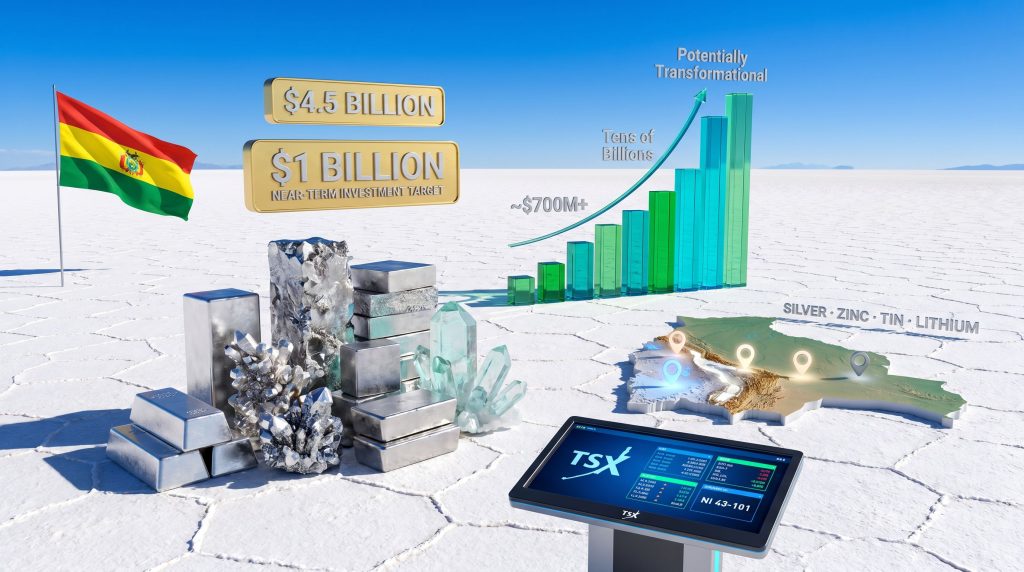
That dynamic is now shifting in ways that are measurable, not merely rhetorical. Bolivia generated approximately $4.5 billion in mineral export revenues in 2024, with gold, silver, tin, zinc, and lithium among the primary contributors. Yet the country's actual geological endowment remains dramatically underexplored relative to its neighbours. Correcting that imbalance is the central objective of Bolivia's current reform agenda, and the signals emerging from international capital markets suggest investors are beginning to pay attention.
When big ASX news breaks, our subscribers know first
Bolivia's Mineral Endowment: Substantial Reserves, Constrained Development
Understanding why Bolivia foreign investment in mining has historically underperformed requires separating the geological story from the institutional one. Bolivia's subsurface contains significant concentrations of silver, zinc, tin, lead, and gold, alongside one of the world's largest known lithium resource bases, primarily concentrated in the Salar de Uyuni salt flat in the southwest of the country.
The Salar de Uyuni is estimated to hold roughly 21 million tonnes of lithium, making it the single largest known lithium deposit globally by some assessments, though the precise resource figure depends on the measurement methodology and cut-off grades applied. Unlike hard-rock lithium deposits that require conventional mining and comminution processes, the Uyuni resource exists as lithium-bearing brine beneath the salt flat's crust, requiring evaporation-based or direct lithium extraction processing methods that carry their own technical and cost complexities.
This distinction matters for investors. Brine-hosted lithium projects are not evaluated using the same technical or financial metrics as spodumene lithium projects in Western Australia or hard-rock operations in Canada. Recovery rates, processing chemistry, capital intensity per tonne of lithium carbonate equivalent (LCE), and brine quality metrics including lithium-to-magnesium ratios all factor heavily into bankability assessments. Bolivia's brine has historically been characterised by elevated magnesium concentrations relative to other major brine deposits in Chile and Argentina, which adds processing complexity and cost.
Bolivia's challenge has never been geological. The country's resource endowment is substantial, but converting geological potential into productive capital requires regulatory infrastructure that international investors can trust and price with confidence.
For established metals, the calculus is more straightforward. Bolivia's silver and zinc sectors have a long operational history, with internationally partnered projects like the San Cristóbal Mine (operated by Japan's Sumitomo Corporation) demonstrating that large-scale foreign investment can function within Bolivia's framework. San Cristóbal ranks among the world's largest zinc-silver-lead operations and has been producing since 2007, providing an important proof-of-concept for investors sceptical of Bolivian operating conditions.
What Bolivia's New Investment Framework Actually Offers Foreign Capital
Bolivia's Ministry of Mining and Metallurgy has identified approximately $1 billion in near-term investment as an initial benchmark for the success of its reformed framework. This figure spans silver exploration, zinc development, and lithium project advancement, with fiscal incentive structures under consideration including early-stage tax relief provisions designed to reduce the cost of capital during pre-production phases.
The four structural pillars underpinning Bolivia's revised approach to foreign capital can be summarised as follows:
| Pillar | Description |
|---|---|
| Legal Certainty | Codified protections for investor rights and contract enforceability |
| Policy Transparency | Consistent and publicly accessible regulatory guidelines |
| Competitive Fiscal Design | Potential tax relief mechanisms in the first three years of operations |
| Sustainable Practice Standards | Environmental and social governance requirements aligned with international norms |
A critical credibility mechanism within this framework is the government's push for independent resource certification aligned with internationally recognised technical reporting standards. NI 43-101, the Canadian securities standard governing disclosure of scientific and technical information about mineral projects, has become the benchmark most relevant to Bolivia's current capital market strategy. Compliance with NI 43-101 requires that resource estimates be prepared or supervised by a Qualified Person, a designated category of experienced geoscientist or engineer who takes professional responsibility for the technical disclosure.
Furthermore, this matters because independent certification directly addresses information asymmetry — the single greatest barrier between early-stage mining jurisdictions and institutional capital. When a resource estimate lacks independent verification, investors apply a higher risk premium to the project, raising the cost of capital and sometimes making financing impossible altogether. Bolivia's alignment with NI 43-101 standards is therefore not merely procedural; it is a structural mechanism for reducing the discount applied to Bolivian projects in global capital markets. For context on how definitive feasibility studies underpin these credibility assessments, the process demands rigorous independent technical verification at every stage.
How Bolivia Compares to Regional Peers on Investment Risk
Investors assessing Bolivia foreign investment in mining opportunities should benchmark the jurisdiction against its regional competitors before committing capital. The comparison is instructive:
| Factor | Bolivia | Chile | Peru | Argentina |
|---|---|---|---|---|
| State Ownership Requirements | High (up to 55% in some arrangements) | Moderate | Low to Moderate | Low to Moderate |
| Foreign Ownership Restrictions | Restricted within 50 km of borders | Limited | Limited | Province-level flexibility |
| Judicial Recourse | Historically weak; reform underway | Strong | Moderate | Moderate |
| Lithium Policy | State-led with selective foreign participation | Private sector-led | Early-stage | Province-level flexibility |
| Overall Investment Risk | Elevated but improving | Low | Moderate | Moderate to Elevated |
Two structural features of Bolivian mining law deserve particular attention from prospective investors.
The 50-kilometre border restriction prohibits foreign entities from holding ownership rights within 50 kilometres of Bolivia's international borders. Given Bolivia's geography and the location of some of its most prospective mineral belts, this restriction has material implications for project selection and deal structuring. Thorough cadastral analysis is mandatory before exploration expenditure is committed near border zones.
The 55% state profit participation requirement applies in certain contractual arrangements, effectively meaning that in some project structures, state-owned entities retain the majority of project economics. For long-payback projects with high upfront capital requirements, this structure requires careful financial modelling. Experienced operators have navigated this through phased investment agreements, royalty-based financing structures, and joint venture arrangements with entities such as COMIBOL, Bolivia's state mining company.
The TSX Engagement and PDAC 2026: Capital Market Integration in Practice
One of the most symbolically significant developments in Bolivia's reform trajectory has been the inaugural visit of TMX Group, the owner of the Toronto Stock Exchange, to La Paz. The funding conference, hosted in partnership with the Canadian Bolivian Chamber of Commerce, brought together business and finance leaders to explore Bolivia's growing capacity to attract and responsibly manage international capital.
The TSX's institutional roots in resource-sector financing make it a particularly meaningful partner for Bolivia's ambitions. The exchange hosts hundreds of junior and mid-tier mining companies, many of which are the primary engines of early-stage geological discovery globally. Major mining companies rarely lead greenfield exploration; they acquire proven resources. Bolivia's strategy of targeting TSX-listed junior companies reflects a sophisticated understanding of the exploration capital cycle. Indeed, junior mining investment vehicles listed on the TSX represent the most active source of early-stage exploration financing globally.
This engagement built directly on Bolivia's appearance at PDAC 2026, the world's leading mineral exploration and mining convention, where the country formally launched its international capital strategy. PDAC conference insights from Bolivia's delegation confirmed that the country's Deputy Minister of Mining Policy, Regulation and Supervision outlined an intensive exploration phase incorporating new technologies, junior company participation, and diversified financial tools.
Among the companies already operating within Bolivia's reformed framework, New Pacific Metals (headquartered in Vancouver, British Columbia) has publicly committed to Bolivian projects currently in technical development and permitting stages. New Pacific's CEO Jalen Yuan has stated that the company's projects are expected to generate more than $700 million in direct economic contribution, with cumulative benefits potentially reaching tens of billions of dollars as additional companies advance their own permitted operations.
Pantera Silver Corp represents another TSX-listed company with active Bolivian exposure, with President and CEO Jay Roberge highlighting the strong community support the company has experienced in its operating regions as it pursues silver exploration and development.
The Real Risks Bolivia's Reform Narrative Cannot Obscure
Analytical honesty requires acknowledging that Bolivia's reform story coexists with persistent structural risks that have not yet been resolved by policy announcements alone.
Risk Advisory: While Bolivia's reform trajectory is positive, investors should conduct thorough independent due diligence. U.S. government investment risk assessments have flagged concerns including weak judicial recourse mechanisms, corruption exposure, unclear incentive frameworks, and negative U.S. foreign direct investment flows recorded since 2023. These conditions do not negate the opportunity but must be factored into risk-adjusted return modelling.
The key risk categories break down as follows:
1. Judicial and Contract Enforcement Risk
- Dispute resolution mechanisms remain underdeveloped relative to peer jurisdictions in the region
- The absence of bilateral investment treaty protections with key investor-origin countries amplifies exposure to unilateral policy changes
- Institutional reform operates on longer timelines than regulatory announcements
2. State Control and Profit Repatriation Risk
- Mandatory state participation structures can complicate dividend repatriation and lengthen capital recovery timelines
- Investors must model scenarios in which state entities exercise preferential rights at various stages of project development
3. Lithium-Specific Governance Risk
- Previous lithium agreements with Chinese and Russian entities encountered significant delays, renegotiations, and public controversy
- Demonstrating consistent contractual behaviour across multiple project cycles, not merely announcing policy openness, is the threshold credibility test for lithium investment
- The technical complexity of Bolivia's high-magnesium brine adds a layer of process risk that affects project bankability independent of regulatory conditions
4. Infrastructure and Operational Risk
- Bolivia's high-altitude geography, limited road and rail connectivity, and constrained grid infrastructure increase capital expenditure requirements for remote projects
- Water access and logistics costs in the altiplano region must be incorporated into feasibility-stage financial models, not treated as contingencies
The next major ASX story will hit our subscribers first
Sector-by-Sector Opportunity Assessment: Where the Capital Should Flow
Not all of Bolivia's mineral opportunities carry the same risk-return profile. Investors should, however, differentiate between near-term, medium-term, and long-term opportunity sets:
Silver remains the most immediately accessible opportunity for foreign investors. Bolivia has a long and well-documented silver mining history with established geology, existing processing infrastructure, and demonstrated precedent for internationally partnered operations. Exploration-stage projects in proven silver belts where NI 43-101-compliant resource estimates can be developed represent the clearest near-term pathway to TSX-listed financing.
Zinc and Tin offer brownfield expansion and processing efficiency opportunities built on Bolivia's status as a globally significant producer. These commodities benefit from established export pathways and existing smelting relationships, reducing market access risk for new entrants.
Lithium is the long-duration, high-conviction opportunity that requires the greatest patience and risk tolerance. The Salar de Uyuni's scale is genuinely transformational in potential terms, but the path to credible, bankable lithium contracts runs through demonstrated regulatory consistency, resolution of the brine chemistry challenges, infrastructure development, and sustained political will across successive government administrations.
The projected economic impact across these scenarios can be framed as follows:
| Scenario | Projected Economic Contribution |
|---|---|
| Near-term (established metals pipeline) | $700 million+ in direct economic generation from advanced projects |
| Medium-term (regulatory reform fully embedded) | Tens of billions in cumulative economic activity as additional projects reach production |
| Long-term (lithium development unlocked) | Potentially transformational, with scale dependent on contract structures and global EV demand |
A Practical Market Entry Framework for Foreign Investors
For investors seriously evaluating Bolivia foreign investment in mining opportunities, the following sequential approach reduces execution risk:
-
Conduct jurisdictional due diligence first by reviewing current mining law, border restriction zones, and state participation requirements before identifying target projects or tenements.
-
Map project geography against the 50 km border exclusion zone and assess whether target tenements require deal structure adjustments or project selection changes.
-
Engage dual-jurisdiction legal counsel with demonstrable Bolivian mining law experience alongside home-country legal expertise for contract structuring.
-
Apply NI 43-101 or equivalent resource reporting standards from the earliest technical work stages to maintain capital market credibility and satisfy TSX-listed financing vehicle requirements.
-
Engage COMIBOL and relevant state entities at term sheet stage, not post-discovery, to structure state participation agreements early and reduce renegotiation risk later.
-
Build community relationships as a parallel track to regulatory approvals, treating social licence as a prerequisite for permitting rather than an afterthought.
-
Access capital through TSX or TSX Venture Exchange listing structures, which align with Bolivia's current capital market strategy and provide access to the largest pool of resource-sector exploration financing globally.
-
Model fiscal scenarios conservatively by incorporating state profit participation, royalty obligations, and potential tax structure evolution into base-case financial models rather than upside cases.
The Strategic Outlook: Three Pathways for Bolivia's Mining Trajectory
Bolivia's reform momentum is genuine, and the geological foundation is exceptional. However, the distance between policy intent and institutional delivery remains the central variable that investors cannot yet resolve with confidence.
Three plausible scenarios define the range of outcomes:
Scenario 1: Reform Momentum Sustained. Regulatory improvements embed across multiple project cycles, TSX-listed companies advance projects from exploration through to production, lithium contracts gain credibility through demonstrated consistency, and Bolivia establishes itself as a growing second-tier destination for Latin American mining capital.
Scenario 2: Partial Reform. Established metals attract steady foreign capital flows, but lithium development stalls due to governance complexity and brine processing challenges. Bolivia captures mid-tier investment flows without unlocking its transformational potential.
Scenario 3: Reform Reversal. Political cycle shifts toward resource nationalism, investor confidence erodes, and capital redirects to Chile, Peru, or Argentina. Bolivia's geological potential remains unrealised for another decade.
What determines which scenario prevails is not geology or even policy design; it is the consistency of institutional behaviour across successive administrations. A single major foreign-partnered project reaching production under the new framework would do more to attract the next wave of capital than any number of conference appearances or regulatory announcements. Notably, Bolivia's minister pledges on legal certainty for investors represent an encouraging signal, though sustained delivery across project cycles remains the ultimate test.
For investors with long time horizons, appropriate risk tolerance, and strong in-country relationships, Bolivia's silver and zinc sectors offer near-term entry points with existing operational precedent. Lithium remains the highest-potential but longest-dated opportunity in the portfolio, one that rewards patience and penalises overconfidence in policy timelines.
The material in this article is provided for informational purposes only and does not constitute investment advice. Investors are encouraged to conduct their own independent research and consult a qualified financial adviser before making investment decisions. Forecasts, scenario projections, and financial estimates referenced in this article involve inherent uncertainty and should not be treated as guaranteed outcomes.
For ongoing coverage of Bolivia's mining sector and broader Latin American resource developments, readers can explore related analysis at themarketonline.com.au/mining-news/.
Want To Be First When the Next Major Mineral Discovery Hits the ASX?
Discovery Alert's proprietary Discovery IQ model delivers real-time alerts on significant ASX mineral discoveries, transforming complex geological and commodity data into actionable investment insights — ideal for investors tracking high-potential opportunities across silver, zinc, lithium, and beyond. Explore historic discoveries and their extraordinary returns, then start your 14-day free trial to position yourself ahead of the broader market.