June 22, 2026
The Quiet Mineral That Holds Up Modern Civilization
Most investors scanning critical minerals headlines gravitate toward lithium, cobalt, or rare earth elements. These are the names attached to electric vehicles, clean energy transitions, and geopolitical flashpoints. Yet beneath this familiar narrative sits a mineral that has quietly underpinned defense armour, agricultural productivity, permanent magnets, and residential construction for decades, largely without attracting the scrutiny its strategic position deserves.
Boron added to the US critical minerals list in 2025 represents one of the most consequential supply chain policy decisions of the decade, not because it is a new discovery, but because its addition arrives at the precise moment when domestic supply is fracturing, global pricing is spiking, and the window for establishing alternative sources is narrowing rapidly.
Understanding why this matters requires looking beyond the policy announcement itself and into the structural mechanics of the global boron market, the defence dependencies it carries, and what it actually takes to finance a new domestic source from the ground up.
When big ASX news breaks, our subscribers know first
From Strategic Material to Critical Mineral: Understanding the Distinction
What the USGS Designation Actually Means in Practice
Boron was not entirely invisible to US federal agencies before 2025. The Defense Logistics Agency had previously classified it as a strategic material, a designation that acknowledges military relevance but operates largely within defence procurement channels rather than broader industrial policy.
The USGS critical minerals designation is qualitatively different. It operates under the Energy Act framework, applying a three-part test: economic criticality, supply chain vulnerability, and national security relevance. When all three conditions are satisfied, a mineral moves onto the official list, and that status unlocks a meaningfully different set of federal tools. The USGS final 2025 list of critical minerals reflects a significant broadening of strategic priorities across industrial and defence sectors.
Practically speaking, the designation creates eligibility for:
- DOE competitive grant programmes, providing non-dilutive capital for qualifying domestic projects
- EXIM Bank loan facilities, offering structured debt pathways for early-stage critical mineral development
- Defense Industrial Base Consortium (DIBC) programmes, including white paper and full application processes with panel-based award decisions
- Strategic equity participation by US government entities as projects mature toward construction readiness
The designation itself does not guarantee funding. Competitive application processes determine actual award outcomes, and the field of applicants across all 60 listed minerals is substantial.
How the 2025 List Differs From Its Predecessors
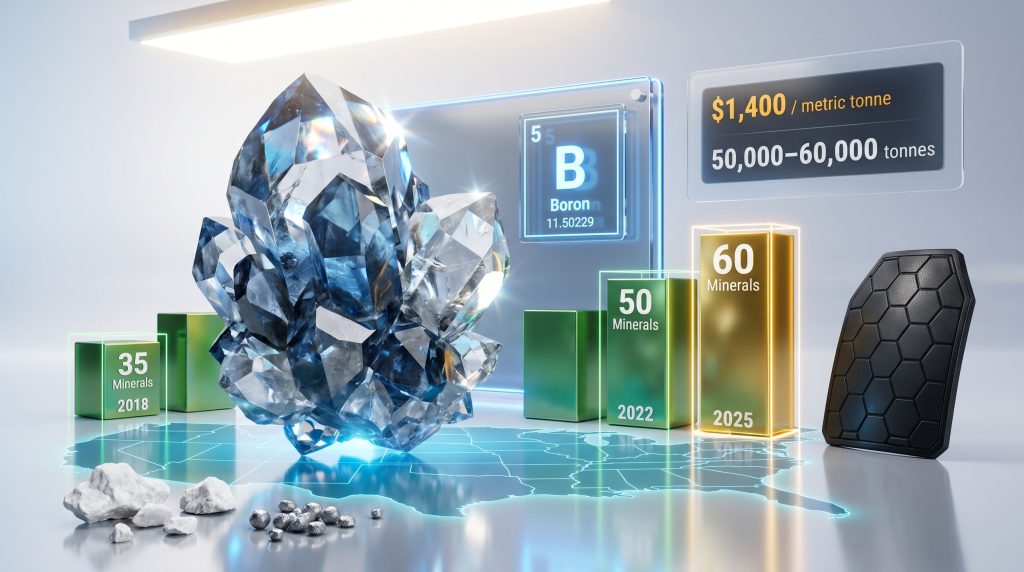
The 2025 USGS update was the most expansive revision since the critical minerals list was first introduced in 2018. The progression reflects a deliberate broadening of what the US considers strategically vulnerable.
| Edition | Total Minerals | Notable Additions | Strategic Theme |
|---|---|---|---|
| 2018 | 35 | Cobalt, lithium, REEs | Battery metals focus |
| 2022 | 50 | Nickel, zinc | Supply chain diversification |
| 2025 | 60 | Boron + 9 others | Industrial + defence broadening |
The shift from battery metals to industrial and defence-grade materials signals that US policymakers are now acknowledging supply chain risks that extend well beyond the energy transition. Boron's addition, driven by public advocacy through the Federal Register comment process and interagency review, reflects a relatively rare convergence of cross-agency consensus on strategic risk.
Furthermore, between eight and nine separate public comments were formally submitted advocating for boron's inclusion, an unusual level of coordinated external input that contributed to its approval. The critical minerals demand surge across defence and industrial sectors has been a key driver of this expanded policy scope.
Why Boron Deserves a Separate Strategic Category
A Super Mineral Hiding in Plain Sight
Boron sits as the fifth element on the periodic table. Its physical properties are genuinely unusual: it is lightweight, heat-resistant, energy-dense, and antimicrobial. These characteristics make it useful across more than 300 industrial applications, a cross-sector ubiquity that structurally differentiates it from single-use critical minerals like cobalt.
| Application Category | Key Boron Compound | Strategic Relevance |
|---|---|---|
| Defence and Armour | Boron carbide | Kevlar and tank armour, currently sourced from China |
| Permanent Magnets | Ferroboron | 20 to 25% of magnet composition, Chinese-dominated supply |
| Construction and Housing | Borates | Core input for North American residential construction |
| Agriculture | Boric acid | Soil health and crop yield dependency |
| Glass and Ceramics | Borosilicates | Industrial and consumer manufacturing input |
The Defence Dependency No One Is Talking About
Public discourse on defence supply chains has focused heavily on rare earth elements and the magnets they enable. This framing is incomplete. Neodymium-iron-boron permanent magnets, which are central to electric motors, missile guidance systems, and defence electronics, are composed of 20 to 25% ferroboron by weight. Securing rare earth supply without simultaneously securing ferroboron feedstock leaves a structural gap in US defence manufacturing resilience.
The situation is compounded by boron carbide, the primary input for US military-grade body armour and armoured vehicle plating. That production currently relies on Chinese-sourced material. The Defence Logistics Agency's pre-existing classification of boron as a strategic material acknowledged this dependency, but the USGS designation now brings it into mainstream industrial policy visibility. Indeed, its strategic mineral applications across defence manufacturing reveal a level of cross-sector exposure that has been consistently underappreciated.
Rare earth supply chain discussions have largely overlooked ferroboron as a co-dependency. Addressing magnet supply chains without securing ferroboron feedstock leaves a critical gap in US defence manufacturing resilience.
The Oligopoly Problem and the Supply Shock Already Underway
A Textbook Commodity Concentration Risk
The global boron market is not structured like most commodity markets. Two companies control 80 to 85% of global supply, creating a textbook oligopoly with extreme concentration. The primary US-based borate producer currently holds a position of strategic importance, accounting for approximately 20 to 25% of global supply. However, it is a depleting asset and is currently listed for sale, creating genuine uncertainty about its long-term ownership and operational trajectory.
This concentration means that single points of failure are embedded into the supply architecture of every downstream industry that depends on borates, from defence contractors to housing manufacturers to agricultural input suppliers.
The 2025 Supply Disruption: A Stress Test the Market Failed
Events in early 2025 provided a live demonstration of just how thin the US boron supply buffer had become. A smaller domestic boric acid producer filed for Chapter 11 bankruptcy protection and exited the market, removing an estimated 50,000 to 60,000 tonnes of boric acid from domestic supply. The consequences were immediate:
- Downstream manufacturers across multiple sectors reported production curtailments due to inability to source boric acid domestically.
- Customers who had contracted with the exiting producer received force majeure notices, triggering scrambles to source product from South American producers and other international suppliers.
- The domestic supply shock propagated outward, eventually rippling into Asian spot markets that had initially remained insulated.
- Independent pricing data confirmed boric acid spot prices reaching approximately $1,400 per metric tonne in both Asian and Indian markets, a significant premium over contracted price levels.
When a relatively modest volume exit of 50,000 to 60,000 tonnes is sufficient to push an entire national market into deficit, it reveals just how thin the supply buffer was to begin with.
Tariff Pass-Through: The 2027 Pricing Inflection
Turkish boron exports to the US carry existing tariff structures that have, until recently, been absorbed by the supplier rather than passed to customers. That posture is changing. At least one major non-US supplier has signalled it will pass tariff costs through to customers beginning in 2027, reversing its previously customer-friendly approach.
For North American industries dependent on boron-containing products, particularly the residential construction sector, this represents a meaningful cost structure shift. Consequently, domestic boron production is transitioning from a strategic preference to an economic imperative for price-sensitive downstream buyers.
The Contracting Season That Will Define Market Structure
Why 2027 Off-Take Negotiations Are Happening Right Now
Annual boron supply contracts are typically negotiated in the second half of the calendar year for the following year's supply. The 2027 contracting cycle is currently underway, and buyers are entering negotiations in a fundamentally different position than in prior years. Domestic supply has contracted, spot prices have risen sharply, and the tariff environment for imported product is deteriorating.
The leverage dynamic has inverted. What was historically a buyer-dominated market, with multiple suppliers competing for large customer contracts, is shifting toward supplier-controlled conditions where securing volume at predictable pricing requires longer commitments and more structured agreements.
For new domestic boron projects seeking to establish their commercial foundations, however, this environment creates genuine traction for off-take discussions. The contracting structures being discussed include:
- Fixed-price contracts: providing revenue certainty for project financing models
- Collared structures: floor and ceiling pricing mechanisms that protect both buyer and seller against extreme price movements
Both structures serve a critical function for project debt underwriting, allowing lenders to model revenue with sufficient confidence to establish debt service coverage ratios.
Financing a Critical Minerals Project: What Lenders Actually Require
The Debt Underwriting Framework for Resource Projects
Raising equity capital for an early-stage critical minerals project is challenging. Raising the debt that constitutes the majority of a project's capital structure requires a fundamentally different level of de-risking. The lender's due diligence process for a project of this nature examines:
- Mass and energy balance verification: confirming that the physical production model is internally consistent and technically credible
- Variable and fixed cost profiling: establishing the cost structure under different operating scenarios
- Debt service coverage modelling: stress-testing whether projected revenues can service debt obligations under adverse pricing conditions
- Off-take agreement quality: binding purchase agreements, not heads of agreement, represent the primary de-risking instrument
A pre-feasibility study serves as the foundational document for establishing project economics credibility with capital markets. Customer qualification processes, including meeting specifications for parameters such as chloride content, particle size, and moisture levels, directly support the financing narrative by demonstrating that the project can serve real customers at commercial scale.
The Staged Contracting Logic for Large-Scale Production
A large-scale boric acid producer cannot realistically sell its entire output volume into contracted arrangements from day one of commercial operations. The practical contracting timeline follows a staged logic:
| Production Year | Target Volume Under Contract | Spot Market Allocation |
|---|---|---|
| Year 1 | ~50,000 tonnes | 10,000 to 20,000 tonnes |
| Year 2 | 100,000 to 110,000 tonnes | Residual |
| Full Run Rate | ~130,000 tonnes | Minimal |
This progression allows customers to qualify product specifications, build procurement relationships, and scale their own supply transitions while the project ramps up production capacity.
The Lithium Byproduct Opportunity: A Financing Tool, Not a Distraction
One underappreciated dimension of certain boron deposit types is the co-occurrence of lithium-rich clays alongside colemanite, the calcium-based boron mineral. In some deposits, recovered solution consistently carries 50 to 70 parts per million of lithium chloride alongside boron concentrations in the thousands of parts per million range.
At commercial-scale boron production, this co-occurrence may yield approximately 500 tonnes of lithium as a byproduct stream. Processing via solar evaporation ponds uses proven, low-technology methods employed extensively in the Atacama Desert region, and high-desert environments with similar climate profiles offer directly analogous conditions.
At approximately $18 per kilogram of lithium pricing, this byproduct stream becomes commercially viable as a prepayment or streaming structure, providing an alternative financing instrument that does not encumber the primary boron revenue stream. This is a meaningful structural advantage: attaching a royalty or stream to a primary borate product carries strategic risks for long-term project economics, but monetising a byproduct stream through the same mechanism preserves core revenue while unlocking upfront capital.
The next major ASX story will hit our subscribers first
The Geopolitical Stakes: What Happens If the US Loses Its Position of Strength?
China's Long-Horizon Advantage in Boron
China currently dominates the production of both boron carbide for defence applications and ferroboron for permanent magnet manufacturing. Its industrial planning operates on generational timeframes, contrasting sharply with the two-to-six-year electoral cycle constraints that shape US resource policy. This asymmetry has allowed China to entrench dominant positions across multiple critical mineral value chains while the US has been slower to recognise equivalent vulnerabilities.
The US currently maintains a position as a net exporter of boron, underpinned by its single large-scale domestic producer. If that asset is sold to a non-aligned buyer, or if its depleting reserves are exhausted before alternative domestic sources reach commercial production, the US transitions from exporter to importer without an obvious near-term domestic alternative.
The Case for Treating Boron Like a Strategic Reserve Asset
The United States manages strategic petroleum reserves as a national security instrument, buying, holding, and releasing supply to manage price shocks and geopolitical disruptions. An analogous framework for critical minerals, applied specifically to assets like the primary US borate producer, would provide a mechanism for preventing strategic acquisition by non-allied entities while preserving domestic supply chain sovereignty.
The Committee on Foreign Investment in the United States (CFIUS) review framework theoretically applies to foreign acquisitions of strategically sensitive assets. In addition, Defense Production Act support mechanisms offer further instruments to ensure that boron production assets receive scrutiny equivalent to semiconductor facilities or defence contractors. This would represent a meaningful policy step beyond list designation alone.
Allied Coordination: Building a Western Boron Supply Chain
Global boron reserves are geographically distributed across Turkey, the United States, Russia, and parts of South America, with production heavily concentrated among a small number of operators. The potential for allied-nation coordination among the US, Australia, and Canada to construct a diversified Western boron supply chain, underpinned by bilateral critical minerals agreements, represents an underexplored dimension of supply chain resilience strategy.
Furthermore, critical minerals and energy security considerations are increasingly driving allied governments to formalise co-investment frameworks that extend beyond bilateral trade agreements into structured production partnerships.
Adding boron to the critical minerals list is a necessary but insufficient step. Without parallel mechanisms to prevent the acquisition of existing US boron assets by non-allied entities, the designation may arrive too late to preserve domestic supply chain sovereignty.
Key Milestones That Will Determine Project Viability
Off-Take Agreements: The Defining Commercial Catalyst
For any boron development project seeking project financing, the single most important milestone is securing binding off-take agreements. Not heads of agreement or memoranda of understanding, but legally binding purchase contracts with credible counterparties at pricing structures that lenders can model.
The pricing structure disclosed in those agreements matters as much to lenders as the identity of the customer. Fixed-price or collared structures provide the revenue predictability that debt service coverage modelling requires.
Government Funding Decisions: Non-Dilutive Capital as a Credibility Signal
DOE grant outcomes carry significance beyond their dollar value. A successful grant award signals federal validation of a project's technical and commercial credibility, which strengthens lender confidence and reduces the equity dilution required in subsequent capital raises. Applications targeting approximately $31 million represent meaningful non-dilutive capital that changes the overall financing calculus.
The DIBC pathway, while unconventional in its Shark Tank-style pitch panel format, offers access to defence-oriented funding streams that align directly with boron's armour and magnet supply chain relevance. The broader context of the critical minerals executive order has also accelerated the availability of these federal funding mechanisms for qualifying domestic projects.
FEED Engineering: The Commitment Threshold
Front-End Engineering and Design (FEED) work, estimated at $8.5 to $9 million for a large-scale boric acid facility, represents the point of no return in a project development cycle. FEED requires large engineering teams working in coordinated parallel streams, and stop-start cycles are genuinely costly in terms of both expenditure and timeline integrity.
The optimal sequencing requires that off-take term sheets, debt facility applications, and engineering contracts reach sufficient maturity simultaneously before FEED initiation is authorised. Premature FEED commencement, before commercial and financing foundations are sufficiently solid, risks cost blowout and lender confidence erosion.
Frequently Asked Questions: Boron and the US Critical Minerals List
What triggered boron's addition to the US Critical Minerals List in 2025?
Boron was added through the USGS's 2025 list update following a public comment period through the Federal Register designation process and interagency review. Between eight and nine formal public submissions advocated for boron's inclusion, reflecting unusual cross-sector advocacy. The designation reflected concerns about supply concentration, defence application dependencies, and the vulnerability of US domestic production capacity.
How Many Minerals Are Now on the US Critical Minerals List?
The 2025 update brought the total to 60 minerals, with boron among 10 newly designated additions.
Does the Critical Minerals Designation Provide Direct Financial Support to Boron Producers?
The designation itself does not guarantee funding. It unlocks eligibility for federal programmes including DOE grants, EXIM Bank facilities, and Defence Industrial Base support mechanisms. Competitive application processes determine actual award outcomes.
Why Is Boron Strategically Important Despite Its Low Public Profile?
Boron's strategic importance stems from its cross-sector criticality across defence materials, magnet inputs, agricultural essentials, and construction industry inputs simultaneously. Its historically low public profile relative to lithium or cobalt has masked the depth of supply chain exposure across these sectors.
What Happens If the Primary US Borate Producer Is Sold to a Foreign Entity?
The US would transition from a net exporter to a net importer of boron, losing its primary domestic production asset. Without alternative domestic sources in near-term production readiness, this would create simultaneous structural vulnerabilities across defence, construction, and industrial sectors.
What Does the $1,400 Per Tonne Boric Acid Spot Price Signal?
The emergence of $1,400 per metric tonne spot pricing confirmed by multiple independent sources in both Asian and Indian markets reflects genuine supply-demand imbalance driven by the 2025 domestic supply disruption. The fact that a 50,000 to 60,000 tonne market exit was sufficient to produce this pricing response reveals the structural thinness of the global supply buffer.
The Strategic Verdict: Correct Direction, Compressed Timeline
The decision to add boron to the US critical minerals list reflects correct policy reasoning. The designation acknowledges a supply chain vulnerability that has been building for years across defence, industrial, and agricultural sectors simultaneously. The public comment process, interagency review, and final USGS approval represent a genuine policy achievement.
The harder question is whether the designation arrived early enough to matter. The primary domestic producer is a depleting asset currently for sale. A smaller domestic producer has exited the market. No near-term alternative domestic source exists at commercial scale. The 2027 contracting season is underway in a market defined by tightening supply and rising prices.
A genuine long-term boron strategy requires moving beyond list designation to encompass procurement commitments, domestic processing incentives, allied coordination, and robust scrutiny of foreign acquisition attempts targeting existing US boron assets. The Chinese industrial planning model, characterised by generational timeframes rather than electoral cycles, offers an instructive contrast for how strategic resource security is actually built and maintained.
The minerals added to critical lists receive policy recognition. Whether that recognition translates into supply chain sovereignty depends entirely on what comes next.
Readers interested in exploring the strategic importance of boron and the evolving US critical minerals landscape in greater depth can find related industry conversations through the Dig Deep: The Mining Podcast, which features discussions with executives and operators across the global mining sector.
Want to Track the Next Major Critical Mineral Discovery Before the Broader Market Does?
Discovery Alert's proprietary Discovery IQ model delivers real-time alerts the moment significant ASX mineral discoveries are announced — across boron, lithium, and more than 30 other commodities — giving subscribers an immediate edge in identifying actionable opportunities. Explore how historic discoveries have generated substantial returns on Discovery Alert's dedicated discoveries page, and begin your 14-day free trial today to position yourself ahead of the market.