June 22, 2026
When the Unthinkable Becomes the Template: Rethinking Gulf Energy Infrastructure
Every generation of energy analysts inherits a set of assumptions so deeply embedded in market structure that questioning them feels almost theoretical. For decades, one such assumption dominated global oil market thinking: the Strait of Hormuz would always remain functionally open, regardless of how volatile the surrounding geopolitical environment became. The waterway was too important, the consequences of closure too severe, for any actor to actually follow through.
Then it happened anyway.
The Hormuz crisis Middle East pipeline boom that followed is not simply a story about infrastructure investment. It is a story about what happens when the entire architecture of a global commodity market gets stress-tested against a scenario that was priced at near-zero probability. The results have permanently altered how Gulf producers, energy importers, and infrastructure investors think about export route redundancy.
When big ASX news breaks, our subscribers know first
The Chokepoint That Everyone Knew Was Fragile
How Concentrated Is the World's Oil Supply Chain?
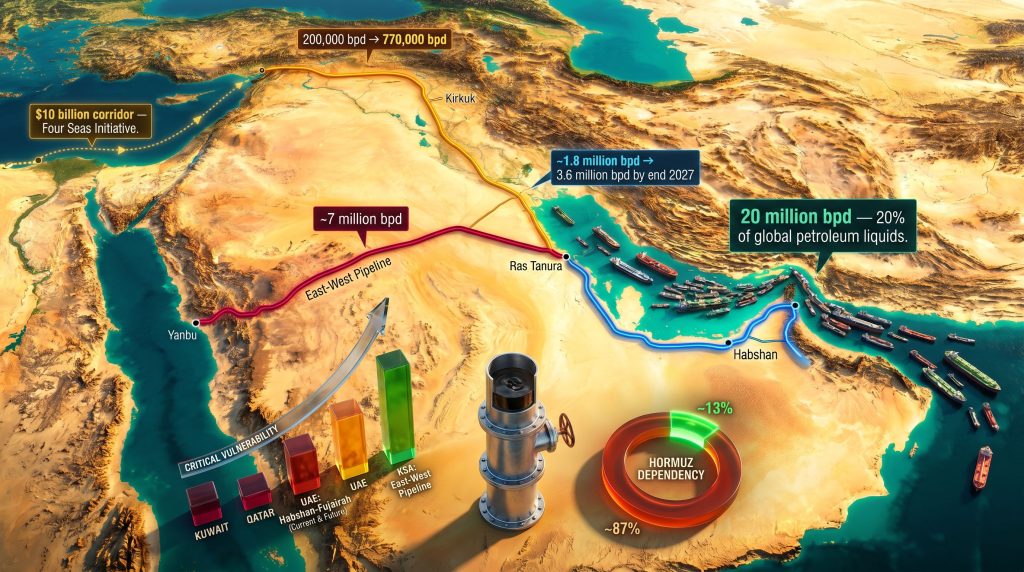
The Strait of Hormuz is a narrow maritime passage connecting the Persian Gulf to the Gulf of Oman, stretching just 21 nautical miles at its narrowest navigable point. Despite its modest geography, approximately 20 million barrels per day (bpd) of oil and petroleum liquids transited the strait in 2024, representing roughly 20% of total global petroleum liquids consumption, according to the U.S. Energy Information Administration (EIA). Beyond crude oil, the strait also serves as the dominant export corridor for a significant share of global liquefied natural gas (LNG) volumes, particularly from Qatar, the world's largest LNG exporter.
What makes Hormuz so structurally consequential is not just its throughput volume but the concentration effect it creates. A partial or complete closure does not simply slow down supply chains: it simultaneously severs export capacity for Iraq, Kuwait, Qatar, Iran, the UAE, and parts of Saudi Arabia. No other single geographic feature in global commodity trade carries that level of systemic risk embedded within it. The oil market geopolitics surrounding this corridor had long signalled fragility, yet markets consistently underpriced the probability of an actual disruption.
Key Insight: The Strait of Hormuz is not simply a geographic feature. It is a systemic vulnerability embedded into the architecture of global energy trade. No single alternative route can replicate its throughput capacity, which is why the Hormuz crisis Middle East pipeline boom represents a mitigation strategy rather than a replacement solution.
The 2026 Disruption: Numbers That Redefined the Risk Calculus
When the strait's effective closure materialised in 2026, markets encountered a supply shock that validated the worst-case scenario modelling that most participants had never genuinely stress-tested. According to Brookings, tanker traffic stalled, cargo queues built to extraordinary levels, with reports of between 60 and 80 million barrels of crude lined up and waiting to exit the strait at peak disruption.
The impact on individual producers was severe:
- Iraq's oil production, which had averaged over 4 million bpd, collapsed to barely 1 million bpd during the disruption period, triggering acute fiscal stress on the Baghdad government.
- More than 90% of Iraq's oil exports traditionally moved through the Persian Gulf, leaving the country almost entirely without functioning export infrastructure.
- India, one of the world's largest crude importers, reported an 82% surge in its energy import bill as a direct consequence of elevated prices and rerouting costs.
- Goldman Sachs issued analysis warning that Hormuz shipping traffic patterns may never fully return to pre-crisis configurations, even following a ceasefire, given the lasting structural adjustments underway among major importers. (Goldman Sachs market research, June 2026, as reported by OilPrice.com)
The Bypass Coverage Gap: A Structural Reality
Before examining each producer's response, it is worth framing the scale of the challenge numerically. The following table maps the vulnerability profile of key Gulf exporters against the bypass capacity that existed when the crisis began:
| Country | Pre-Crisis Gulf Export Share | Estimated Bypass Capacity Available | Vulnerability Rating |
|---|---|---|---|
| Iraq | Over 90% via Persian Gulf | ~200,000 bpd (Kirkuk-Ceyhan) | Critical |
| Kuwait | Near-total Hormuz dependency | Minimal | Critical |
| Qatar | Near-total Hormuz dependency | Limited | Very High |
| UAE | ~70-80% via Hormuz | ~1.8 million bpd (Habshan-Fujairah) | High |
| Saudi Arabia | ~50-60% via Hormuz | ~7 million bpd (East-West Pipeline) | Moderate |
The data reveals a pattern that holds across the entire region: bypass coverage is heavily skewed toward the two largest producers, leaving smaller exporters with structural exposure they cannot resolve through domestic infrastructure investment alone. Furthermore, the broader geopolitical mining landscape has demonstrated that resource-dependent economies face compounding vulnerabilities when both energy corridors and supply chains are simultaneously disrupted.
How Gulf Producers Responded: The Immediate Infrastructure Pivot
Saudi Arabia's East-West Pipeline: Decades of Foresight Validated
The most important infrastructure story of the 2026 crisis was not a new pipeline. It was an old one. Saudi Arabia's East-West Pipeline, originally constructed in the 1980s as a direct strategic response to the perceived threat of Iranian interdiction, became the critical pressure valve during the disruption period. The pipeline reroutes crude flows from Gulf-side terminals to Yanbu Port on the Red Sea, bypassing the strait entirely.
During the crisis, the East-West Pipeline ramped throughput to approximately 7 million bpd, well above its historical operational volumes. Reuters energy columnist Ron Bousso noted in a post-crisis analysis of alternative regional export routes that the original rationale for building the East-West Pipeline was precisely the Hormuz interdiction risk that eventually materialised. (Reuters, June 2026)
The primary operational constraint was not the pipeline itself but the loading and export capacity at Yanbu Port, which became the binding bottleneck when throughput scaled rapidly. Saudi Aramco has signalled this will be addressed through targeted port infrastructure investment.
Strategic Lesson: Infrastructure built for low-probability, high-consequence scenarios delivers asymmetric returns when those scenarios materialise. Saudi Arabia's pipeline investment from the 1980s paid for itself many times over in a single crisis event.
The UAE's Doubling Down on Bypass Capacity
The UAE entered the crisis with a partial solution already in place: the Habshan-to-Fujairah pipeline, which terminates at a port positioned just outside the strait's geographic boundary. Operational capacity stood at approximately 1.8 million bpd. While this provided partial relief, it fell significantly short of covering the UAE's full export volumes under normal conditions.
Abu Dhabi has now committed to fast-tracking a second parallel pipeline to double total bypass export capacity from 1.8 million bpd to 3.6 million bpd, targeting completion by the end of 2027. This investment represents a deliberate strategic shift: bypass export capacity is no longer treated as a contingency reserve, but as a core architectural pillar of the UAE's export infrastructure. In addition, this move mirrors broader shifts in how nations approach resource and energy exports under heightened geopolitical pressure.
Iraq's Northern Corridor: From Marginal to Strategic
Iraq's response illustrates perhaps the most dramatic infrastructure ambition of the post-crisis period. The Kirkuk-Ceyhan pipeline, which runs from northern Iraqi oil fields to the Turkish Mediterranean port of Ceyhan, historically operated at approximately 200,000 bpd, a marginal fraction of Iraq's total export volume. Baghdad is now pursuing a capacity expansion targeting 770,000 bpd, with ambitions to deliver this increase within months.
Even at the expanded capacity, the Kirkuk-Ceyhan route would cover only a fraction of Iraq's pre-crisis Gulf export volumes of over 3.3 million bpd. Recognising this gap, Iraq is simultaneously evaluating a broader pipeline network connecting its oil fields to Mediterranean port terminals in Syria and Jordan, creating multiple non-Hormuz exit points and reducing dependency on any single corridor. Iraq has also signalled it intends to maintain its Syria route even after Hormuz normalises, treating it as permanent infrastructure rather than emergency backup. (OilPrice.com, June 2026)
The Capacity Gap Problem: Why Pipelines Cannot Replace Hormuz
The Mathematics of Bypass Coverage
A critical analytical point is often lost in the coverage of the Hormuz crisis Middle East pipeline boom: the pipeline investments currently underway do not solve the Hormuz problem. They reduce the severity of the next disruption.
Consider the arithmetic:
- Combined Saudi and UAE bypass pipeline capacity, even after planned expansions, totals approximately 10.6 million bpd under theoretical maximum conditions.
- Against a baseline Hormuz throughput of 20 million bpd, this represents a bypass coverage ratio of roughly 53% at best, and significantly less under operational constraints.
- Iraq's Kirkuk-Ceyhan expansion to 770,000 bpd, Kuwait's near-zero bypass capacity, and Qatar's constrained transit options add relatively little to this total.
Critical Framing: The pipeline boom is not a solution to the Hormuz problem. It is a risk mitigation layer. The strategic objective is not to replicate Hormuz capacity, but to ensure that no single closure event can again reduce Gulf exports to near-zero.
The following table summarises the current and planned bypass route landscape:
| Pipeline Route | Operator Country | Current Capacity | Planned Capacity | Timeline | Destination |
|---|---|---|---|---|---|
| East-West Pipeline | Saudi Arabia | ~7 million bpd | Yanbu port upgrades planned | Near-term | Red Sea (Yanbu) |
| Habshan-Fujairah | UAE | ~1.8 million bpd | ~3.6 million bpd | End 2027 | Gulf of Oman |
| Kirkuk-Ceyhan | Iraq | ~200,000 bpd | ~770,000 bpd | Months | Mediterranean (Turkey) |
| Syria/Jordan corridors | Iraq (proposed) | None (planned) | TBD | Medium-term | Mediterranean |
The Tanker Premium Effect: Markets Price Structural Vulnerability
One of the less-discussed mechanisms through which the Hormuz closure transmitted economic pain was via tanker rates. As cargo queues built and rerouting became necessary, elevated tanker rates compounded the cost burden on Asian importers well beyond the crude price increase alone. High tanker rates disrupted Persian Gulf oil shipments to Asia, adding a layered cost structure that affected refinery economics across the region. (OilPrice.com, June 2026)
India's 82% import bill surge reflects both the price shock and this tanker premium layer. The country's subsequent decision to order a major expansion of its strategic petroleum reserves signals a recognition that physical inventory buffers are now a necessary hedge against Hormuz-style disruptions, not an optional luxury. (OilPrice.com, June 2026)
The Longer Game: The Four Seas Initiative and Mediterranean Connectivity
A $10 Billion Pipeline Vision
Beyond country-level expansions, a more ambitious regional infrastructure concept has crystallised in the post-crisis environment: the Four Seas Initiative. The proposal envisions a $10 billion pipeline network linking Middle Eastern oil and gas production zones to Mediterranean port cities, with Turkey and Syria positioned as central transit hubs.
The Washington-based New Lines Institute, which has been a primary advocate for the initiative, has framed the post-conflict transition period in Syria as a narrow but consequential window to reshape the Levant's role in global energy logistics. The think tank has articulated four compounding strategic rationales for the initiative:
- Reducing European energy dependence on Russian and Iranian supply chains.
- Creating American commercial positioning in the region's most strategically leveraged infrastructure.
- Funding Syrian economic reconstruction through transit fee revenues.
- Establishing durable geopolitical alignment between transit states and Western partners.
Turkey's Hub Strategy: Leverage and Complexity
Turkey has been actively constructing a regional energy hub identity for several years, particularly in natural gas. The Four Seas Initiative aligns with Ankara's long-term positioning, though Turkey's simultaneous role as a conduit for Russian gas via TurkStream introduces strategic tensions with Western partners that cannot be easily resolved.
Scenario Analysis: If the Four Seas Initiative advances to construction phase, Turkey would consolidate its position as the dominant energy transit nation between the Middle East, Caspian, and Europe. This concentration of transit leverage gives Ankara significant geopolitical influence independent of its NATO membership obligations.
The $10 billion cost estimate, while substantial, would likely be assessed by Gulf exporters as a rational premium against the documented revenue losses from future Hormuz disruptions. However, as analysts at the TCF have noted, new pipelines alone will not resolve the deeper structural and political dimensions of the Hormuz crisis.
Syria as a Transit State: Revenue Opportunity Against Governance Risk
The post-conflict stabilisation of Syria opens a geographic corridor that was previously inaccessible for energy infrastructure planning. Transit revenues represent one of the few scalable near-term income streams available to any Syrian governing authority, which creates alignment between infrastructure investors and local political incentives.
The risk calculus for pipeline investors includes:
- Political continuity risk: Whether current governing arrangements will persist through the multi-year construction and operational lifecycle.
- Physical security risk: Whether pipeline infrastructure can be protected against sabotage or conflict escalation.
- Enforceability risk: Whether transit agreements remain legally binding under uncertain governance conditions.
The Structural Losers: Kuwait and Qatar's Bypass Constraints
Dependent on Neighbours for Export Survival
Two of the Gulf's most significant energy producers face a structurally more difficult bypass challenge than Saudi Arabia or the UAE. Both Kuwait and Qatar lack domestic pipeline infrastructure capable of routing exports around Hormuz independently. Any meaningful bypass strategy requires relying on neighbouring states' pipeline systems, introducing a geopolitical dependency layer on top of the technical challenge.
Qatar's situation carries an additional dimension of complexity. The most logically proximate pipeline transit partners are the UAE and Saudi Arabia, both of which maintained a multi-year diplomatic and economic blockade against Doha that ended only in 2021. This history means Qatar's Hormuz bypass options are constrained not by engineering limitations, but by diplomatic architecture — a problem that no amount of capital expenditure can resolve unilaterally. Consequently, the critical minerals and energy security debate has widened to encompass LNG corridor vulnerabilities that were previously treated as secondary concerns.
The next major ASX story will hit our subscribers first
What the Macro Analysts Are Saying
The IEA's 2027 Surplus Scenario
The International Energy Agency has projected a significant oil surplus emerging in 2027 as Middle Eastern supply returns to global markets following the disruption period. (IEA, June 2026, as reported by OilPrice.com) This surplus scenario assumes that pipeline expansions and Hormuz normalisation combine to release pent-up export volumes simultaneously into a market that has already begun adjusting to reduced Gulf supply.
The surplus projection creates a complex incentive structure for producers:
- There is strong motivation to accelerate bypass infrastructure to capture early market share in the post-disruption recovery.
- However, a rapid return of volumes could suppress the price environment that makes infrastructure investment financially attractive in the first place.
The ECB's Warning on Persistent Price Shock
The European Central Bank has assessed that even a formalised peace agreement between the U.S. and Iran will not immediately erase the energy price shock that European economies absorbed during the disruption period. (ECB, June 2026, as reported by OilPrice.com) Energy supply disruptions are asymmetric in character: they manifest rapidly but resolve slowly, with downstream economic effects persisting well beyond the physical normalisation of supply.
TotalEnergies has similarly noted that key Saudi refinery capacity affected during the conflict period will not be fully operational until 2027, adding a further supply-side constraint to the recovery timeline. (OilPrice.com, June 2026)
A Step-by-Step Framework for Bypass Strategy Planning
For Gulf producers assessing their own Hormuz exposure in the aftermath of the crisis, the following analytical sequence provides a structured approach to infrastructure risk management:
- Quantify Hormuz exposure by calculating what percentage of total export volume currently transits the strait under normal operations.
- Audit existing bypass capacity to identify what pipeline, terminal, and loading infrastructure already operates outside Hormuz dependency.
- Model the revenue loss scenario by calculating the fiscal impact of a 30, 60, or 90-day Hormuz closure against current export price assumptions.
- Identify the most capital-efficient bypass expansion, whether that involves pipeline upgrades, new construction, or cross-border transit agreements.
- Assess geopolitical dependencies embedded in any bypass route that requires transit through a third country.
- Sequence investment against timeline, prioritising projects that can become operational within 12 to 24 months over longer-horizon initiatives.
Furthermore, producers must account for global supply chain risks that extend beyond the strait itself, as tariff environments and logistical disruptions can amplify the financial impact of any export route closure.
The Infrastructure Insurance Premium: A New Investor Framework
Repricing Redundancy as Core Infrastructure Value
The 2026 Hormuz crisis has fundamentally repriced the strategic value of redundant export infrastructure across the Gulf. Analysts broadly expect this repricing to sustain elevated investment in cross-border pipeline links, alternative terminal capacity, and strategic petroleum storage across the region and among its key import partners for the foreseeable future.
The investment case is not purely commercial. For Gulf sovereign producers, bypass infrastructure represents fiscal resilience: the operational capacity to maintain export revenues during geopolitical disruptions that originate entirely outside their direct control. Saudi Arabia's East-West Pipeline, conceived and built four decades ago for this precise contingency, demonstrated in a single crisis event that the return on investment horizon for strategic infrastructure can span generations.
Investment Framing: For Gulf producers, bypass pipeline investment functions as an insurance premium against geopolitical risk. The 2026 disruption demonstrated that the cost of being unprepared — measured in collapsed production volumes, lost revenues, and acute fiscal stress — far exceeds the capital cost of building redundant export routes.
The Hormuz crisis Middle East pipeline boom is not a temporary emergency response. It is the beginning of a structural reconfiguration of the region's energy export architecture that will define how Gulf oil reaches global markets for decades. The fundamental constraint remains: no pipeline network can replicate the throughput scale of Hormuz, and the strait will remain the dominant Gulf export artery under normal conditions. However, the tolerance for treating that dominance as permanent and uninterruptible has been permanently revised.
Disclaimer: This article is intended for informational and educational purposes only and does not constitute investment, financial, or legal advice. References to future projections, surplus scenarios, and infrastructure timelines involve uncertainty and should not be relied upon as predictions of actual outcomes. Readers should conduct independent research and consult qualified advisers before making investment decisions.
Want to Stay Ahead of the Next Major Resource Market Shift?
Discovery Alert's proprietary Discovery IQ model delivers real-time alerts on significant ASX mineral discoveries, transforming complex market signals into actionable investment insights the moment they emerge — ideal for investors navigating volatile commodity and energy landscapes like those reshaping Gulf export infrastructure today. Explore historic discoveries and their remarkable market returns, then begin your 14-day free trial at Discovery Alert to position yourself ahead of the next major opportunity.