July 17, 2026
The Quiet Reshaping of Global Diamond Power
For most of the twentieth century, the diamond industry operated under a model of concentrated corporate control, with a handful of entities dictating supply, pricing, and access to global markets. That structure is now fracturing. Across Africa's diamond-producing nations, a generational shift is underway, one driven not by political upheaval but by commercial logic, sovereign ambition, and the mathematics of a market under structural pressure. The unfolding sale of Anglo American's stake in De Beers represents the most consequential ownership transition in the diamond world in decades, and the decisions being made right now by the Botswana Anglo American De Beers buyer field will reverberate far beyond a single corporate transaction.
When big ASX news breaks, our subscribers know first
Anglo American's Strategic Exit and the Forces Behind It
Anglo American restructuring placed De Beers on the market in May 2024 as part of a sweeping portfolio redesign to reposition the diversified miner as a focused producer of critical minerals, including copper and iron ore. The timing was not coincidental.
Between 2023 and 2025, rough diamond prices declined sharply, compressing margins across the midstream and upstream segments of the industry. At the same time, lab-grown diamonds accelerated their penetration of consumer markets, particularly in the United States and China, with synthetic stones achieving near price parity with natural equivalents in the lower and mid-tier quality segments.
The combined effect on De Beers was significant:
| Market Pressure | Impact on De Beers |
|---|---|
| Rough diamond price decline (2023–2025) | Compressed EBITDA and revenue per carat |
| Rising lab-grown diamond penetration | Structural demand erosion in key markets |
| Shifting Gen Z consumer preferences | Long-term brand repositioning challenge |
| Multi-sovereign ownership complexity | Governance and strategic alignment friction |
Anglo American's decision to divest reflects broader mining consolidation trends occurring across major mining conglomerates, where legacy gemstone assets are being deprioritised in favour of battery metals and electrification-linked commodities. De Beers, for all its brand equity and operational depth, no longer fits the clean-energy metals thesis that major institutional investors are demanding.
De Beers' Operational Footprint: What Is Actually Being Sold
Understanding what makes this transaction so consequential requires appreciating De Beers' physical and commercial reach. The company maintains producing operations and active exploration across Botswana, Namibia, Angola, South Africa, and Canada, spanning open-pit kimberlite mining, marine diamond recovery, and alluvial operations.
The most strategically significant component is the Debswana partnership, a joint venture between De Beers and the Botswana government that encompasses some of the highest-value diamond mines in the world, including Jwaneng, often described as the richest diamond mine on Earth by revenue per tonne processed. Debswana's output represents approximately 70% of De Beers' annual rough diamond production by value, making Botswana's participation in any ownership change not merely symbolic but operationally decisive.
Jwaneng and the Grade Premium That Defines the Asset
What makes Debswana's mines particularly compelling from a geological standpoint is not just volume but diamond grade quality. Jwaneng processes ore yielding stones with an unusually high proportion of gem-quality diamonds relative to industrial-grade material. In kimberlite mining, the value per carat varies enormously depending on crystal clarity, colour, and size frequency distribution. Jwaneng consistently produces large, high-clarity stones that command premium pricing in the rough market, which is why controlling access to this production stream is a strategic prize that extends well beyond the headline sale price of Anglo's stake. Indeed, among the top diamond-producing countries, Botswana stands apart for the exceptional quality of its kimberlite resource.
The Global Diamond Consortium: Who Is the Preferred Bidder?
Anglo American ran a competitive process that began with six interested parties in 2025 before narrowing to three shortlisted bidders. The company has since identified the Global Diamond Consortium as its preferred buyer for its De Beers stake. According to reporting on the preferred bidder, Anglo American's CEO confirmed the consortium model as the most likely path forward.
Botswana's Minister for State President, Defence and Security, Moeti Mohwasa, confirmed the selection to lawmakers, noting that the consortium's proposal to incorporate Angola and Namibia as participating stakeholders was viewed positively. This signals an emerging preference within African diamond-producing nations for multi-sovereign ownership architectures, a model with limited precedent in the global mining industry.
The two remaining consortia in the final stages of the process are understood to include the following stakeholder profiles:
| Stakeholder | Role / Affiliation |
|---|---|
| Gareth Penny | Former De Beers CEO; current Chair of asset manager Ninety One |
| Nir Livnat | Israeli businessman with documented diamond sector exposure |
| Qatari Investment Fund | Sovereign wealth participant in one of the remaining consortia |
| Governments of Angola and Namibia | Diamond-producing nations pursuing strategic ownership |
Notably, the full composition of the Global Diamond Consortium has not been publicly disclosed. What is clear is that the preferred bid was distinguished by its emphasis on bringing in the producing nations themselves as equity participants, rather than positioning them solely as regulatory gatekeepers.
"The consortium model that has emerged from this process reflects a broader principle gaining traction across African resource transactions: that the nations bearing the geological and environmental costs of extraction should participate in the financial upside of ownership, not merely in royalty and tax flows."
Botswana's Pre-Emptive Rights: A Legal Lever of Extraordinary Scope
At the heart of this transaction lies a legal mechanism that gives Botswana extraordinary flexibility: a pre-emptive right, also known as a right of first refusal, over Anglo American's stake. Under this provision, Botswana can match any accepted offer and acquire the stake on the same commercial terms. Furthermore, as Botswana pushes for control ahead of the bid deadline, the country has made clear it intends to exercise its options strategically rather than passively.
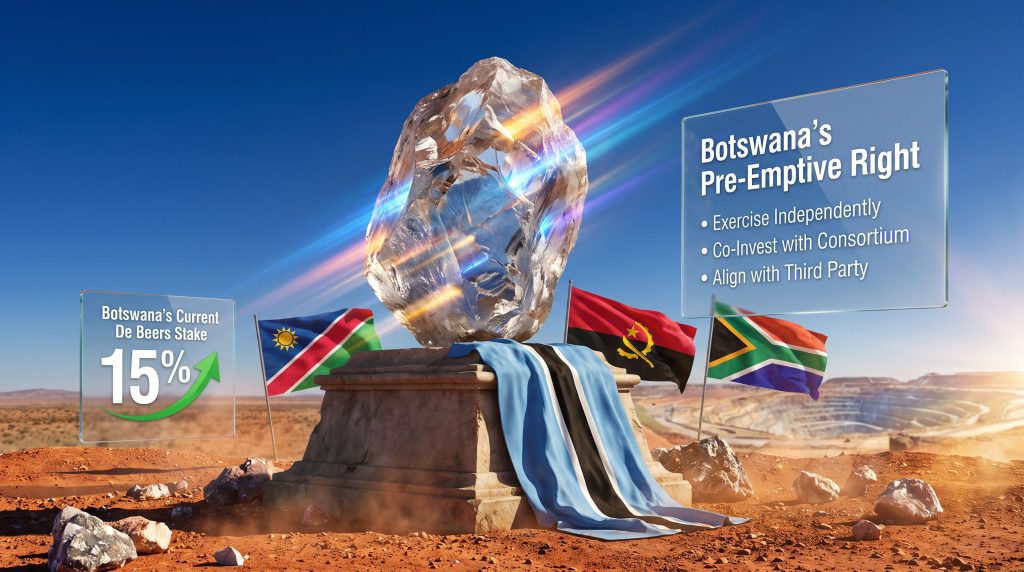
As confirmed by Minister Mohwasa, Botswana currently has three distinct strategic pathways available:
- Exercise pre-emption rights independently and acquire Anglo American's stake outright without consortium involvement.
- Co-invest alongside the Global Diamond Consortium, participating as an equity partner within the preferred bidder's structure while benefiting from the consortium's operational and financial expertise.
- Align with a third-party financier, such as a Gulf sovereign wealth fund from the UAE or Oman, to co-finance the acquisition outside of the consortium framework entirely.
The phrase used by Mohwasa — that Botswana retains complete freedom to choose its path — is not merely diplomatic language. It confirms that the country's legal architecture around this asset gives it genuine optionality that most resource-owning nations simply do not possess when a major corporate shareholder decides to exit.
Why Botswana's 15% Stake Understates Its True Leverage
Botswana currently holds a 15% direct stake in De Beers, but this figure substantially understates the country's actual influence over the asset. Through the Debswana joint venture structure, the Botswana government is a 50% co-owner of the mines themselves, meaning it already exercises co-equal operational authority at the asset level regardless of the corporate holding company structure above it.
A controlling stake at the De Beers holding company level would layer corporate governance power on top of this existing asset-level influence. Consequently, this would create a degree of resource sovereignty over diamond production that represents one of the most significant ownership transitions in sub-Saharan African mining history, achieved entirely through market mechanisms rather than expropriation.
Gulf Sovereign Wealth and the Financing Architecture
Botswana is understood to be in active discussions with sovereign wealth entities from the UAE and Oman as potential co-financing partners. This reflects a well-established pattern in African resource transactions, where Gulf sovereign funds have increasingly sought exposure to hard assets as portfolio diversification tools. The broader mining geopolitical landscape supports this trend, as resource-rich nations and sovereign investors recalibrate relationships built around extractive industries.
For Gulf investors, the De Beers asset offers a rare combination of:
- Brand recognition with genuine pricing power in the luxury goods segment
- Long-life mine assets with defined geological resource estimates
- Exposure to natural diamond markets at a potential cyclical inflection point
- Diplomatic alignment with African sovereign partners in a period of heightened resource nationalism
The involvement of Angola and Namibia in a potential multi-nation ownership structure adds a pan-African dimension that could appeal to development finance institutions and sovereign co-investors looking beyond pure financial return metrics.
The next major ASX story will hit our subscribers first
Timeline, Conditions, and the Path to Q4 2026
According to Minister Mohwasa's statement to lawmakers, the transaction is targeted for completion by the final quarter of 2026, subject to a series of conditions that must be satisfied before any transfer of ownership can be finalised.
Key conditions expected to govern the timeline include:
- Formal approval from the Botswana government following its assessment of the optimal deal structure
- Regulatory clearances across the multiple jurisdictions where De Beers operates
- Completion of due diligence processes by Botswana's financial advisors
- Agreement on the precise equity participation structure involving any co-investors
- Possible competition authority reviews in South Africa, Namibia, and Canada
The involvement of financial advisors at the Botswana government level is significant. It suggests the country is approaching this not as a passive pre-emption decision but as a proactive strategic transaction that requires sophisticated structuring to optimise the economic and governance outcomes for its citizens.
What New Ownership Means for the Global Diamond Market
A change of this magnitude at De Beers would inevitably ripple through the entire rough diamond supply chain. De Beers operates a distinctive sales model through its Sightholder system, under which a select group of approved buyers purchase rough diamonds at periodic sales events known as Sights. This system gives De Beers significant influence over rough diamond pricing and the flow of stones into the cutting and polishing centres of Antwerp, Mumbai, and Tel Aviv.
A transition to sovereign-led or consortium ownership introduces questions about whether this model would be maintained, modified, or fundamentally restructured in favour of greater value retention within producing countries. Several African nations have long advocated for more beneficiation — the processing of raw materials domestically before export — and new ownership structures could accelerate policy alignment in this direction.
The Lab-Grown Diamond Variable No Owner Can Ignore
No analysis of De Beers' future trajectory is complete without confronting the lab-grown diamond disruption head-on. Synthetic diamonds, produced using Chemical Vapour Deposition (CVD) or High-Pressure High-Temperature (HPHT) processes, have achieved production scale at a pace that few industry participants anticipated a decade ago.
The key challenge for natural diamond producers is not technological but psychological: repositioning natural diamonds as meaningfully distinct in the minds of younger consumers who increasingly view the two products as functionally equivalent. De Beers itself launched its Lightbox synthetic diamond brand in 2018, a deliberate strategy to commoditise the lab-grown segment while defending the premium positioning of natural stones. Whether this strategy has succeeded remains contested within the industry.
Any new owner will inherit this unresolved tension as a core strategic challenge, one that no amount of operational efficiency or ownership restructuring can resolve without a compelling consumer narrative. In addition, the dimension of resource geopolitics will increasingly shape how natural diamond producers communicate provenance and scarcity to discerning buyers.
Frequently Asked Questions: The De Beers Sale and Botswana's Role
What is the Global Diamond Consortium?
The Global Diamond Consortium is the preferred bidder selected by Anglo American through its competitive sale process for its De Beers stake. The consortium's full membership has not been publicly disclosed, but it is understood to incorporate diamond-producing nation governments alongside private investors.
Why is Botswana involved in the De Beers sale process?
Botswana holds a 15% direct equity stake in De Beers and is the host nation for Debswana, the joint venture that accounts for approximately 70% of De Beers' rough diamond output by value. Botswana also holds contractual pre-emptive rights over Anglo American's stake.
Can Botswana block the sale to the Global Diamond Consortium?
Botswana's pre-emptive rights give it the ability to supersede the preferred bid by matching terms independently, or to restructure its participation through a third-party co-investor arrangement. It does not constitute a veto in the traditional sense but provides legally equivalent leverage.
What happens if Botswana exercises its pre-emptive rights alone?
An independent exercise of pre-emption rights would require Botswana to finance the full acquisition of Anglo's stake without consortium support, which is why Gulf sovereign wealth discussions are believed to be part of the government's financial advisory process.
When is the De Beers sale expected to be finalised?
The transaction is targeted for completion in the fourth quarter of 2026, subject to Botswana government approval and broader regulatory conditions across multiple jurisdictions.
How does this deal affect De Beers' mining operations in Botswana?
Operational continuity at Debswana mines is expected to be maintained regardless of the ownership outcome at the De Beers holding company level. The Debswana joint venture operates under its own governance framework, and any change at the De Beers corporate level would not automatically alter existing mining agreements.
What This Transaction Signals for Resource Sovereignty and M&A in Mining
The De Beers ownership process is being watched closely by resource economists, sovereign wealth managers, and mining sector investors not only for its immediate financial implications but for the precedent it may set. A successful transition to a multi-sovereign or African-led ownership model for one of the world's most recognised mining brands would demonstrate that resource nationalism can be executed through capital markets rather than through regulatory compulsion.
For investors monitoring this space, the Botswana Anglo American De Beers buyer dynamic represents a live case study in how the balance of power between corporate extractors and resource-owning nations is being renegotiated in real time. The outcome in Q4 2026 will carry lessons that extend well beyond diamonds.
Disclaimer: This article is intended for informational purposes only and does not constitute financial advice. Statements regarding transaction timelines, ownership structures, and market conditions involve forward-looking elements subject to material change. Readers should conduct independent research before making any investment decisions related to companies or assets discussed herein.
For ongoing coverage of diamond sector developments across southern Africa, Mining Weekly's diamonds sector page at miningweekly.com provides continuous updates on industry transactions and policy developments.
Want to Stay Ahead of the Next Major Mineral Discovery Before the Market Moves?
The reshaping of global resource ownership — from diamond majors to ASX-listed explorers — underscores how swiftly transformative opportunities can emerge and disappear; Discovery Alert's proprietary Discovery IQ model delivers real-time alerts on significant ASX mineral discoveries, ensuring subscribers can act on actionable opportunities the moment they are announced. Explore historic discoveries and their remarkable returns, then begin your 14-day free trial to position yourself ahead of the broader market.