July 17, 2026
The Energy Bottleneck Quietly Threatening Global EV Battery Supply Chains
Long before a single tonne of copper or cobalt reaches an electric vehicle battery, it must be extracted from some of the most energy-deprived mining regions on earth. The Copperbelt, straddling the Democratic Republic of Congo and Zambia, holds an extraordinary concentration of the world's most critical minerals and energy security assets. Yet the mines operating across this zone face a paradox that rarely surfaces in mainstream EV market coverage: the electricity required to extract and process these minerals is chronically scarce, unreliable, and frequently supplemented by diesel generators at enormous cost.
This structural energy deficit is the essential backdrop for understanding why Trafigura withdraws from Angola DRC Zambia power line project carries implications far beyond a single consortium reshuffling. It touches on the broader fragility of mineral supply chains that the global clean energy transition depends upon, and it raises pointed questions about how governance failures in commodity trading can cascade into infrastructure setbacks with continent-wide consequences.
When big ASX news breaks, our subscribers know first
Southern Africa's Power Geography: Surplus in the Wrong Places
Angola's hydroelectric infrastructure represents one of sub-Saharan Africa's most underutilised energy assets. The country's northern river systems, anchored by dams including the Laúca facility on the Kwanza River, generate capacity that significantly exceeds domestic demand. Angola's installed hydropower capacity has expanded substantially over the past decade, with the Laúca dam alone contributing approximately 2,070 megawatts when operating at full generation levels.
The geographic irony is stark. Angola's surplus generation sits within reasonable transmission distance of some of the DRC's most productive mining provinces, particularly Lualaba, which hosts major copper and cobalt operations supplying global battery manufacturers. Yet inadequate high-voltage transmission infrastructure means that this surplus power cannot reach the mines that desperately need it.
This mismatch between generation and consumption is not a new problem. The Southern African Power Pool, a regional body coordinating electricity trade across 12 member states, has long identified cross-border transmission capacity as the primary constraint on regional energy integration. The challenge is not that southern Africa lacks generating capacity in aggregate. It is that electrons cannot flow where the wires do not exist.
The Mining Sector's Hidden Energy Cost
For investors tracking the global copper supply forecast and cobalt producers in the DRC and Zambia, energy costs represent a less visible but significant drag on operational margins. Mines relying on diesel backup generation face fuel costs that can consume a substantial portion of operating budgets, particularly at remote sites where logistics chains are already expensive. Grid instability also forces mines to operate heavy equipment at suboptimal load factors, reducing throughput and increasing maintenance cycles.
The energy constraint has a direct bearing on mine expansion decisions. A project that looks economically viable at stable grid electricity tariffs may not pencil out when modelled against the true cost of diesel-dependent generation. This creates a situation where resource endowment alone is insufficient to unlock production growth. Reliable, affordable power is the enabling variable.
What the 2,000 MW Project Was Actually Designed to Do
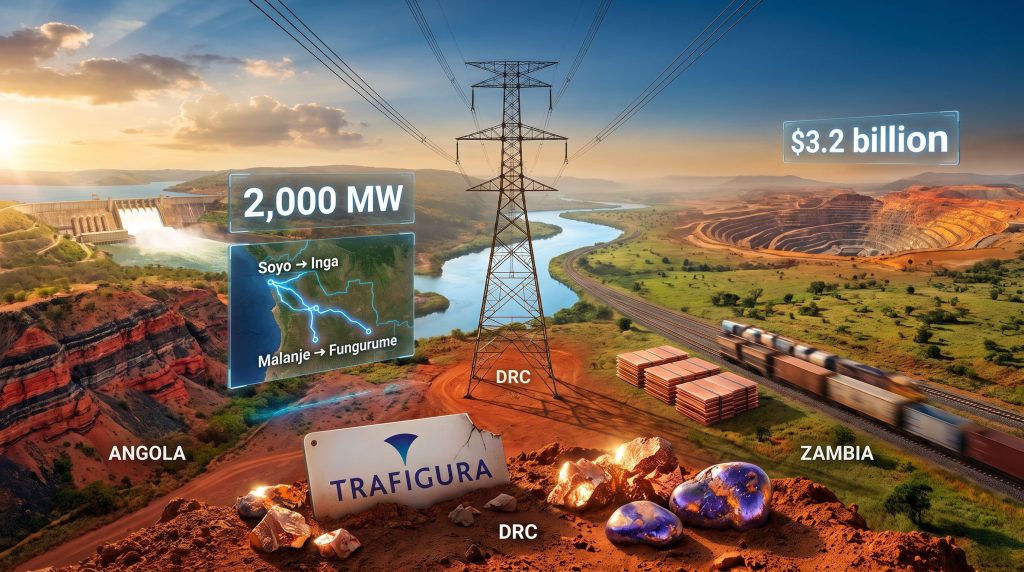
The proposed Angola-DRC-Zambia transmission corridor was conceived to address this bottleneck at scale. The project envisaged a 2,000-megawatt high-voltage line routing surplus Angolan hydropower eastward into the DRC's Lualaba province and northward into Zambia's Copperbelt, with integration into the Southern African Power Pool's regional grid as a longer-term connectivity objective.
The commercial model was built around power purchase agreements with mining operators serving as anchor offtakers. This is a critical structural detail. Rather than relying on speculative retail demand, the project was designed with industrial buyers locked in from the outset — a financing structure that development banks and infrastructure funds typically view favourably because it provides predictable revenue streams to service project debt.
Project Milestone Summary
| Milestone | Detail |
|---|---|
| MOU Signed | July 2024 |
| Agreement Type | Non-binding Memorandum of Understanding |
| Parties to MOU | Trafigura, ProMarks, Angolan government |
| Stated Purpose | Technical and economic feasibility studies |
| Trafigura Exit Confirmed | July 2025 |
| Current Status | Consortium restructuring underway |
The non-binding nature of the MOU deserves emphasis. In complex African infrastructure transactions, non-binding agreements serve a dual function. They signal commitment to a project concept while deliberately preserving optionality for all parties. This structure enables feasibility work to proceed without triggering the legal obligations that accompany binding concession agreements or financing term sheets. It also, as this case illustrates, creates a low-friction pathway to exit.
Why Trafigura's Withdrawal Happened: The Governance Collision
The withdrawal cannot be fully understood without examining what happened in a Swiss courtroom in January 2025. Switzerland's Federal Criminal Court convicted Trafigura of corruption connected to oil trading activities in Angola conducted between 2009 and 2011. The case centred on bribes totalling $5 million paid to an official at Angola's state oil company, Sonangol, routed through a network of intermediaries. The arrangement enabled Trafigura to secure a dominant position in Angolan petroleum product trading during that period.
The financial penalties imposed were significant in their composition if not their absolute scale. The court ordered:
- A fine of approximately 3 million Swiss francs (roughly $3.3 million)
- Compensation payments of approximately $145 million
- A 32-month prison sentence for former chief operating officer Mike Wainwright, with 12 months to be served in custody
Both Trafigura and Wainwright have filed appeals against the verdict. However, appeals do not suspend the reputational and financing consequences of the conviction itself.
The Reputational Paradox That Made Continuation Untenable
Pursuing a government-linked infrastructure project in Angola while simultaneously appealing a bribery conviction tied to Angolan state energy contracts created a reputational paradox that no amount of commercial logic could resolve.
Civil society organisations responded to the conviction by calling on the US Export-Import Bank to suspend approximately $400 million in loan disbursements to Trafigura. Whether or not those calls produced direct action, the signal to multilateral and development finance institutions was unambiguous. Entities under active criminal proceedings face heightened due diligence requirements from the very lenders whose participation is typically essential to closing large-scale African infrastructure transactions.
This is the understated mechanism through which governance failures translate into infrastructure delays. It is not simply that a convicted entity is unwelcome at a project site. It is that the multilateral financing architecture that underwrites cross-border infrastructure in frontier markets requires consortium members to pass ESG screening at the eligibility stage. A conviction of this nature places that eligibility in serious doubt.
Furthermore, the non-binding MOU provided the contractual mechanism to exit cleanly. According to Reuters, Trafigura declined to comment publicly on the withdrawal — a posture consistent with orderly commercial disengagement rather than adversarial dispute.
The Project Survives: Alternative Developers Step Forward
An Angolan government official confirmed that Trafigura's exit does not mean the project has been abandoned. Consortium negotiations are continuing, with the composition being revised to identify replacement investors who can satisfy both governance requirements and financing eligibility criteria. No confirmed replacement partner had been publicly announced as of July 2025.
Crucially, the corridor is attracting parallel interest from other developers, suggesting that the underlying investment thesis remains intact regardless of Trafigura's participation. The Congolese cobalt rivalry between major powers adds further strategic urgency to securing reliable power infrastructure across this corridor.
Competing Transmission Projects in the Angola-DRC Corridor
| Project | Developer | Route | Capacity |
|---|---|---|---|
| Malanje-Fungurume Line | Meridia Energy (Averi Finance + Somagec JV) | Malanje, Angola to Fungurume, DRC (Lualaba province) | Not publicly disclosed |
| Soyo-Inga Line | Meridia Energy (Averi Finance + Somagec JV) | Soyo, northern Angola to Inga Dam site, western DRC | 2,000 MW |
Meridia Energy is a joint venture between Dubai-based Averi Finance and Moroccan construction group Somagec. The Soyo-to-Inga corridor is particularly significant in scale, targeting 2,000 megawatts of capacity primarily for Congolese consumers, rather than being exclusively oriented toward mining offtakers. The Malanje-to-Fungurume line, by contrast, is routed directly into Lualaba province, placing it in close proximity to major copper and cobalt operations.
As Construction Review Online reports, with more than $3.2 billion in competing regional transmission projects reportedly in active development across the corridor, institutional and private capital clearly has not been deterred by Trafigura's exit.
Trafigura's Remaining Angola Exposure
It is important to distinguish between project-specific withdrawal and full commercial retreat. Trafigura retains an active role in the Lobito Corridor Railway consortium, which provides surface transport infrastructure connecting DRC mining regions to Angola's Atlantic port at Lobito. This means the company maintains commodity trading and logistics exposure across the same mineral supply chain, even as it exits the power infrastructure development component.
The next major ASX story will hit our subscribers first
The Broader Investment Implications for African Energy Infrastructure
The Trafigura episode offers a case study in how governance risk functions as a structural variable in African infrastructure finance, not merely a reputational consideration. In addition, it highlights how the battery metals investment landscape is increasingly shaped by decisions made far from the mine site.
Several dynamics deserve attention from investors and project developers tracking this space:
1. Non-binding MOU structures cut both ways. They reduce entry costs and allow feasibility work to commence, but they also mean that any party can exit without triggering formal breach claims. For projects in politically complex markets, this creates a persistent uncertainty around consortium stability that can complicate financing timelines.
2. Multilateral ESG screening is tightening. Development finance institutions and multilateral lenders are applying more rigorous governance screens at the consortium eligibility stage, not just at financial close. This shifts the due diligence burden earlier in the project cycle and raises the reputational bar for lead sponsors.
3. The energy-minerals nexus is a genuine supply chain risk. Power infrastructure deficits in the DRC and Zambia are not simply an operational inconvenience for mining companies. They represent a potential binding constraint on copper and cobalt output at a moment when global EV battery production is scaling rapidly. Every megawatt of reliable grid power delivered to the Copperbelt translates into incremental production capacity for metals that have no near-term substitutes in lithium-ion battery cathode chemistry.
4. Corridor competition reduces single-project dependency. The emergence of Meridia Energy as an active developer across two separate transmission routes suggests that the market is beginning to price in the strategic value of this corridor. Competition among developers, while it can fragment financing, also creates redundancy that reduces the risk of the entire regional connectivity agenda stalling on any single setback.
Why Copper and Cobalt Cannot Wait for Perfect Infrastructure Conditions
Tracking global cobalt production reveals just how concentrated supply has become. The DRC accounts for approximately 70% of global cobalt mine supply, with a significant share of that production concentrated in Lualaba province. Cobalt remains a critical cathode material for nickel manganese cobalt and nickel cobalt aluminium battery chemistries used in high-energy-density EV applications. Zambia is the world's second-largest cobalt producer and a major copper supplier.
Energy constraints that limit mine throughput in these jurisdictions have a direct pass-through effect on global battery material availability. The timeline pressure is real. EV adoption curves in Europe, North America, and Asia are accelerating at a pace that requires upstream mineral supply to keep pace. Infrastructure deficits that were manageable at lower production volumes become critical bottlenecks as demand scales.
This is the structural logic that keeps the Angola-DRC-Zambia transmission corridor relevant regardless of which consortium ultimately develops it. Consequently, the question of who replaces Trafigura in this project matters not just commercially, but strategically — for battery supply chains, energy security, and the clean energy transition itself. When Trafigura withdraws from Angola DRC Zambia power line project considerations, the underlying imperative for this infrastructure does not withdraw with it.
Disclaimer: This article is intended for informational purposes only and does not constitute financial or investment advice. Statements regarding project timelines, financing, and market conditions reflect publicly available information as of the date of publication and are subject to change. Forecasts and forward-looking assessments involve inherent uncertainty and should not be relied upon as the basis for investment decisions.
Want to Track the Next Major Mineral Discovery Before the Market Does?
Discovery Alert's proprietary Discovery IQ model scans ASX announcements in real time, instantly identifying high-potential opportunities across copper, cobalt, and more than 30 other commodities — ensuring subscribers are positioned ahead of the broader market. Explore historic discoveries and their returns, then begin your 14-day free trial at Discovery Alert to gain your market-leading edge.