June 6, 2026
The Ownership Gap at the Heart of Africa's Diamond Economy
For decades, the global diamond trade has operated on a fundamental asymmetry: the nations whose soil contains the world's most valuable rough stones have rarely held the commercial power to match their geological wealth. Pricing decisions, marketing strategies, and distribution networks have historically been concentrated in the hands of corporations headquartered thousands of kilometres from the mines themselves. That structural imbalance is now being directly challenged, and the Botswana De Beers stake acquisition represents the most consequential test of that challenge in the modern era of African resource economics.
Understanding why this deal matters requires moving beyond the transaction itself and examining the deeper mechanics of how diamond value is created, captured, and distributed across a global supply chain that stretches from the Kalahari Basin to cutting workshops in Surat, Mumbai, and Antwerp.
When big ASX news breaks, our subscribers know first
Why the Botswana–De Beers Relationship Has Always Been Structurally Unequal
Botswana's existing 15% equity position in De Beers is not insignificant in historical terms. When the post-independence arrangement was formalised, it represented a more equitable resource-sharing model than most African nations had managed to negotiate with extractive multinationals. The partnership genuinely transformed Botswana's economic trajectory, elevating the country from one of the world's lowest-income nations in the 1960s into a functioning upper-middle-income economy — a development achievement that stands in sharp contrast to the commodity-curse outcomes experienced across much of sub-Saharan Africa.
However, a 15% ownership in a company where Anglo American controls 85% means Botswana has never had meaningful influence over the decisions that determine how much its diamonds are actually worth on the global market. The sightholder system — De Beers' proprietary mechanism for allocating rough diamond parcels to the world's leading cutters and polishers — operates as a commercial tool that shapes global pricing benchmarks. Botswana has been a recipient of that system's outcomes rather than an architect of its parameters.
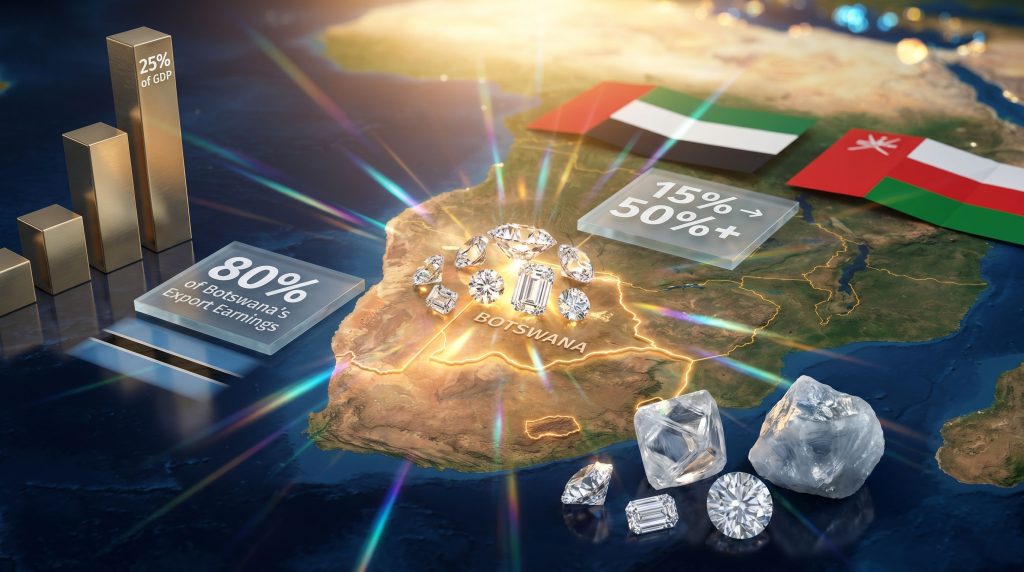
President Duma Boko's administration is pursuing a majority stake exceeding 50%, a threshold that would fundamentally shift that dynamic. At majority ownership, Botswana would move from passive equity participant to active commercial decision-maker, with direct influence over rough stone valuations, brand positioning, and the geographic distribution of value-added processing activities.
Diamonds represent approximately 80% of Botswana's total export earnings and contribute roughly 25% of the country's GDP, according to reporting by Business Insider Africa. This is not a corporate acquisition in the conventional sense; it is an act of macroeconomic self-determination.
The Anglo American Divestiture: Why the Window Is Open Now
The immediate catalyst for the Botswana De Beers stake acquisition is Anglo American's strategic restructuring. After successfully defending against a $49 billion hostile takeover approach from BHP, Anglo American's leadership committed to a fundamental portfolio transformation. The company is concentrating its future around copper and iron ore — commodities positioned at the structural centre of the global energy transition — and has placed De Beers on the market as a non-core asset.
This is a rare configuration. De Beers is not in financial distress. It is being sold by a motivated seller executing a corporate strategy, not by a company in crisis. That distinction matters because it means the asset is available at a moment of cyclical weakness in diamond pricing rather than at a peak valuation — a dynamic that simultaneously presents Botswana with an acquisition opportunity and introduces the risk of buying into a structurally challenged industry at scale.
Furthermore, Anglo American has confirmed it has received expressions of interest from multiple parties, meaning the negotiation is competitive. Botswana's preferred outcome is not guaranteed.
Current Shareholding and What a Majority Stake Would Actually Transfer
| Shareholder | Current Stake | Strategic Position |
|---|---|---|
| Anglo American | 85% | Active seller pursuing full exit |
| Botswana Government | 15% | Existing partner seeking majority |
| UAE / Oman | To be confirmed | Financing partners under discussion |
| Angola | To be confirmed | Competing bidder with reported interest |
Securing majority ownership would give Botswana control over several commercially critical functions that a minority stake does not provide:
- Direct governance over De Beers' global sightholder allocation system, determining which cutting and polishing centres receive rough stone parcels and on what terms
- Ability to reshape benchmark pricing strategies for rough diamonds at a time when the natural stone market urgently needs a credible consumer narrative
- Access to revenue streams from De Beers operations in Canada, South Africa, and Namibia, diversifying Botswana's diamond income beyond its own territorial mines
- Influence over De Beers' response to the lab-grown diamond disruption, including marketing investment decisions and the company's long-term brand positioning strategy
Three Structural Forces Threatening the Industry Botswana Wants to Control
The Botswana De Beers stake acquisition is being pursued at a moment of genuine structural stress for the natural diamond market. Three simultaneous demand shocks are reshaping the economics of the industry in ways that no single actor can fully control.
The Lab-Grown Diamond Disruption
Synthetic diamonds have transitioned from a niche curiosity to a mainstream consumer product with remarkable speed. The technological processes behind lab-grown stones — primarily High Pressure High Temperature (HPHT) and Chemical Vapour Deposition (CVD) methods — have improved substantially in quality while falling sharply in production cost. The price gap between a laboratory-grown stone and a natural diamond of equivalent appearance has widened to a point where many consumers, particularly younger demographics in Western markets, are making deliberate choices in favour of synthetics.
What makes this disruption particularly difficult for the natural diamond industry to counter is that lab-grown stones are chemically and physically identical to natural diamonds. The differentiation argument must therefore be built entirely on narrative and provenance rather than measurable material difference. De Beers itself acknowledged this shift by launching its own lab-grown diamond brand, Lightbox, though the long-term implications of that decision for natural stone pricing remain contested within the industry.
China's Demand Withdrawal
China had been one of the most important growth engines for natural diamond jewellery over the preceding two decades. That growth engine has stalled significantly. Broader macroeconomic softness, a generational shift in luxury consumption preferences among younger Chinese consumers, and a cultural pivot away from Western-influenced romantic gifting traditions have collectively reduced Chinese purchasing volumes. The consequence has been inventory accumulation across key trading hubs, amplifying downward pressure on rough diamond prices globally.
This is not simply a cyclical correction. The structural drivers of reduced Chinese demand reflect longer-term demographic and cultural forces that may not fully reverse even as economic conditions improve.
Trade Uncertainty and Price Volatility
Geopolitical friction and unpredictable shifts in global trade policy frameworks have introduced an additional layer of uncertainty into diamond pricing cycles. The ability of producers to forecast revenue with confidence has diminished, creating planning challenges for governments whose fiscal positions are substantially tied to diamond revenues. Indeed, the broader mining geopolitical landscape is reshaping how resource-dependent nations navigate these pressures.
S&P Global Ratings downgraded Botswana's credit outlook in response to weakening diamond revenues and mounting fiscal pressures — a concrete signal that the country's existing ownership position provides insufficient protection against sector-wide headwinds, according to Business Insider Africa reporting.
Why Gulf Capital Is Central to Making This Deal Work
Botswana cannot finance a majority acquisition in De Beers unilaterally. Acquiring a meaningful portion of Anglo American's 85% stake in a company of De Beers' scale and operational complexity requires capital commitments that exceed what any single African sovereign balance sheet can absorb without creating unacceptable fiscal risk. This is where the Gulf dimension becomes structurally essential rather than merely diplomatically convenient.
President Boko has confirmed that discussions with an Omani sovereign wealth fund have specifically addressed financing structures for the De Beers stake acquisition. The government has also engaged the United Arab Emirates as part of a broader effort to assemble the capital base required for a controlling position.
The involvement of Gulf sovereign wealth in this context reflects a well-established pattern of expanding Middle Eastern resource investment in Africa. In addition, African mining finance trends increasingly point toward this kind of sovereign co-investment model as a structural feature of future resource deals:
| Gulf State | African Investment Focus | Relevant Vehicles |
|---|---|---|
| UAE | Mining, logistics, agriculture | Abu Dhabi Investment Authority (ADIA), Mubadala |
| Oman | Mining, sovereign co-investments | Oman Investment Authority (OIA) |
| Saudi Arabia | Infrastructure, energy, food security | Public Investment Fund (PIF) |
The structural logic of this arrangement is pragmatic. Botswana seeks financing partners rather than strategic co-owners. Gulf sovereign wealth funds bring capital depth without necessarily bringing competing commercial agendas in the diamond sector itself. For the Gulf states, the arrangement offers exposure to hard asset returns and deepens the African investment relationships that both the UAE and Oman have been systematically building over the preceding decade.
What is less commonly understood is that the co-investment model being pursued here could set a template for future African resource acquisitions. If Botswana successfully structures a Gulf-financed majority stake in De Beers, it establishes a proof-of-concept for how resource-rich African governments with limited sovereign capital can use external financial partners to capture ownership positions that were previously only accessible to large multinational corporations. Consequently, this mirrors the ambitions seen in Saudi Arabia mining expansion efforts, where state-backed capital is being deployed to reshape global resource dynamics.
The next major ASX story will hit our subscribers first
Angola's Competing Interest and the Regional Dimension
Angola, itself a significant producer through its state mining enterprise Endiama, has reportedly expressed interest in the De Beers asset. Angola's potential involvement introduces a competitive element that complicates Botswana's negotiating position but also raises the conceptually interesting possibility of a pan-African diamond ownership consortium.
A structure in which multiple Southern African diamond-producing nations collectively hold a majority position in De Beers would create an unprecedented producer bloc with real commercial leverage. Botswana has also engaged Namibia in discussions aimed at building regional coordination within the diamond value chain. Namibia's existing Namdeb joint venture with De Beers — a 50/50 arrangement widely cited as a benchmark for stable resource revenue sharing — provides a model that a regional approach might seek to replicate at a larger scale.
The governance challenges of aligning sovereign interests across multiple governments with different fiscal needs, political priorities, and economic timelines should not be underestimated. However, the strategic logic of a unified Southern African diamond producer position is compelling enough that it is clearly being actively explored.
Comparing African Resource Sovereignty Models
The Botswana De Beers stake acquisition does not exist in isolation. It is the latest and most ambitious chapter in a long-running continental debate about how African nations should engage with the natural resources extracted from their territories. For instance, the DRC resource wealth story illustrates precisely how substantial mineral endowments can coexist with limited sovereign value capture when ownership structures remain unfavourable.
| Country | Resource | State Ownership Model | Outcome |
|---|---|---|---|
| Botswana | Diamonds | Partnership (15% rising to target 50%+) | Upper-middle income development; now seeking deeper control |
| Zambia | Copper | Nationalisation followed by privatisation cycles | Mixed; instability periodically reduced investor confidence |
| Namibia | Diamonds | Namdeb joint venture (50/50 with De Beers) | Stable revenue sharing; frequently cited as a benchmark |
| DRC | Cobalt and Copper | State enterprise combined with foreign concessions | Substantial resource wealth with limited sovereign value capture |
Botswana's historical approach has been notably different from the nationalisation models pursued elsewhere. Rather than attempting to seize control of assets through legal instruments, successive Botswana governments have used negotiated partnership deepening as their primary tool. The current acquisition push is an extension of that philosophy rather than a departure from it.
Timeline, Risks, and Unanswered Questions
Reports indicate Botswana is working toward finalising a deal structure by the end of October 2026, though no binding agreement has been publicly confirmed at the time of writing. Several critical variables remain unresolved.
Upside scenarios for Botswana if the acquisition succeeds:
- Pricing sovereignty over rough diamond valuations and sightholder allocation terms
- Direct influence over De Beers' global brand strategy and marketing investment priorities
- Revenue diversification through De Beers operations outside Botswana's borders
- Enhanced geopolitical leverage in global commodity and trade diplomacy
Downside risks that warrant serious consideration:
- Acquiring a controlling stake in a structurally challenged industry at a cyclical low concentrates rather than diversifies Botswana's commodity exposure
- Sovereign debt obligations tied to Gulf-financed acquisition structures could constrain fiscal flexibility if diamond revenues remain suppressed
- Operating a global diamond enterprise of De Beers' scale requires institutional capacity that differs substantially from the experience of managing a minority equity position
- Angola or other competitive bidders may offer Anglo American terms that are commercially superior to Botswana's proposal
Disclaimer: This article contains forward-looking analysis, projections, and scenario assessments based on publicly available information. Nothing herein constitutes financial or investment advice. Deal terms, timelines, and outcomes described are subject to ongoing negotiation and may change materially. Readers should conduct independent research before making any investment decisions.
The Bigger Strategic Signal: African Nations Are Changing the Rules
Whether or not the Botswana De Beers stake acquisition ultimately closes on Botswana's preferred terms, the negotiation itself represents something historically significant. African governments are increasingly moving from passive fiscal recipients of resource extraction to active ownership participants with direct influence over commercial strategy.
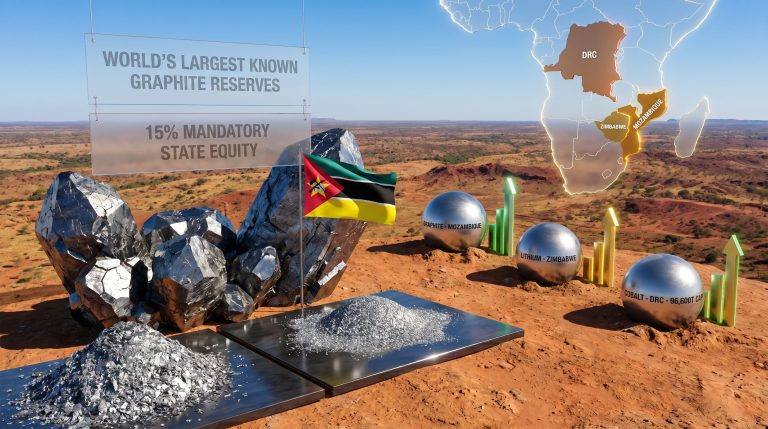
This shift is occurring simultaneously across multiple commodity categories, from lithium in Zimbabwe to copper in Zambia and the Democratic Republic of Congo. The common thread is a reassessment of the terms on which foreign corporations are permitted to access mineral wealth, and a growing institutional confidence among African sovereign governments that ownership is both achievable and desirable. Furthermore, the resource geopolitics driving these discussions extend well beyond Africa's borders, reshaping how producer nations worldwide approach extractive industry negotiations.
The triangular relationship now emerging between African sovereign governments, Gulf capital pools, and legacy Western mining corporations is a structural configuration that is likely to define a significant portion of African resource transactions over the coming decade. Botswana is not merely trying to buy a bigger share of De Beers. It is attempting to establish a new model for how resource-dependent nations exercise economic agency in a world where the old terms of extractive industry engagement are increasingly being renegotiated from the ground up.
Want to Stay Ahead of Significant Mineral Discoveries on the ASX?
Discovery Alert's proprietary Discovery IQ model delivers real-time alerts the moment significant ASX mineral discoveries are announced, transforming complex geological and commodity data into clear, actionable investment insights — explore the historic returns major discoveries have generated to understand what's possible, then begin your 14-day free trial at Discovery Alert to position yourself ahead of the broader market.