May 10, 2026
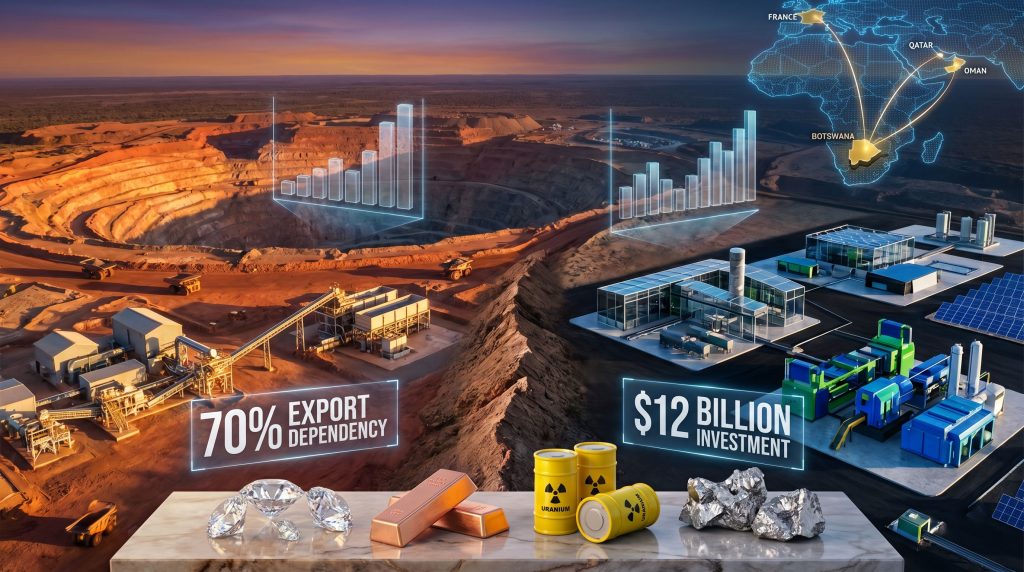
Botswana's diamond-dependent economy demonstrates how resource concentration vulnerabilities drive strategic diversification when commodity markets collapse. These structural challenges accelerate international partnership formation as governments seek technological capabilities and capital investment to unlock alternative mineral assets. Botswana expands mining ties with Gulf and Europe as diamond production declined 40%, forcing rapid economic pivot strategies toward critical minerals exploration.
Economic Vulnerability Assessment: Why Diamond Dependency Creates Strategic Risk
Botswana's economic structure demonstrates extreme concentration in diamond exports, creating systemic vulnerabilities that extend far beyond typical commodity price fluctuations. The diamond sector's dominance across multiple economic indicators reveals the depth of dependency challenges facing the nation. Furthermore, the relationship between economic diversification urgency and partnership formation follows predictable patterns across commodity-exporting nations.
Diamond Revenue Concentration Analysis
• Export dependency ratio: 70% of total exports
• Government revenue exposure: 33% of fiscal income
• GDP contribution: 25% of national output
• Production decline impact: 40% output reduction (2023-2025)
The economic contraction triggered by diamond sector performance illustrates how single-commodity dependency amplifies external market shocks. Debswana, operating as a joint venture between the Botswana government and De Beers, reduced production by 40% between 2023 and 2025, directly contributing to consecutive years of economic recession. Consequently, this mining industry evolution demonstrates the urgent need for strategic diversification.
Recession Impact Metrics
| Year | GDP Growth Rate | Primary Driver |
|---|---|---|
| 2024 | -2.8% | Diamond sector contraction |
| 2025 | -0.4% | Continued commodity pressure |
| 2026 | Projected recovery | Diversification initiatives |
The synthetic diamond competition factor represents a structural challenge rather than cyclical market pressure. Natural diamond prices face permanent headwinds from laboratory-grown alternatives that offer identical physical properties at significantly reduced costs. In addition, these developments fundamentally alter market dynamics for traditional producers, necessitating immediate strategic responses from diamond-dependent economies.
When big ASX news breaks, our subscribers know first
Strategic Partnerships: How Mining Diversification Accelerates International Engagement
The acceleration of international partnership formation reflects sophisticated resource diplomacy targeting complementary technological and financial capabilities. Botswana expands mining ties with Gulf and Europe through carefully structured agreements that address specific exploration, development, and market access requirements. However, these partnerships represent more than simple capital investments; they embody comprehensive technology transfer initiatives.
Oman Strategic Alliance Framework
The Botswana Geo-Science Institute partnership with Minerals Development Oman represents comprehensive exploration strategy targeting multiple mineral categories. This collaboration focuses on systematic geological surveying across 70% of unexplored national territory, utilising advanced exploration methodologies developed through Oman's diversified mining experience. For instance, this strategic alignment provides crucial mineral exploration insights for unlocking previously inaccessible resource deposits.
Key partnership elements include:
• Uranium reserves: Estimated 800,000 tons nationally
• Copper expansion: Beyond current 100,000+ ton annual capacity
• Critical minerals: Energy transition technology components
• Unexplored territory coverage: 70% of national landmass
Qatar Investment Commitments
Al Mansour Holdings' $12 billion multi-sector agreement signed in August 2025 demonstrates Gulf state interest in long-term resource extraction partnerships. The investment framework encompasses mining infrastructure development, technology transfer protocols, and regional supply chain integration initiatives. Moreover, this represents the big pivot strategy toward critical minerals positioning within global energy transition markets.
"The scale of Qatar's commitment reflects strategic positioning within global supply chains for critical minerals essential to energy transition technologies," according to industry analysis.
European Integration: French Nuclear Supply Chain Alignment
France's post-Niger uranium supply diversification strategy creates opportunities for Botswana's uranium development projects. Orano's exploration permits align with European energy security priorities following geopolitical disruptions in traditional African uranium supplier relationships. Furthermore, this positioning addresses growing uranium market volatility that affects global nuclear fuel supply chains.
French Nuclear Supply Chain Integration
Orano's uranium exploration permits position Botswana within France's supply diversification strategy. Recent diplomatic developments indicate strengthening bilateral cooperation frameworks targeting long-term supply security.
• Letlhakane project potential: 3 million pounds annual uranium output
• 10-year production timeline projection
• Strategic timing amid European energy security concerns
• Advanced exploration methodologies transfer
Technology Transfer Opportunities
European partnerships extend beyond capital investment to include comprehensive capability development initiatives:
• Advanced geological exploration methodologies
• Environmental compliance frameworks
• Processing technology upgrades
• Sustainable mining practices implementation
These technology partnerships address critical capability gaps in Botswana's mining infrastructure. Consequently, they ensure compliance with international environmental and social governance standards required for global market access.
Critical Mineral Inventory: What Untapped Resources Drive International Interest
Geological assessments indicate substantial mineral potential across multiple commodity categories, supporting diversification strategies beyond traditional diamond operations. The resource inventory reveals strategic positioning within global supply chains for energy transition materials. However, the establishment of a comprehensive raw materials facility requires systematic development approaches targeting specific market requirements.
Critical Mineral Inventory Assessment
| Resource Type | Estimated Reserves | Development Status | Key Projects |
|---|---|---|---|
| Uranium | 800,000 tons | Advanced exploration | Letlhakane (Lotus Resources) |
| Copper | Expansion potential | Active production | Motheo, Khoemacau |
| Manganese | Battery-grade potential | Feasibility stage | K.Hill (Giyani Metals) |
| Gold/Graphite | Preliminary surveys | Early exploration | Multiple prospects |
Exploration Territory Analysis
The systematic geological surveying reveals significant untapped potential across previously unexplored regions:
• Surveyed area: 30% of national territory
• Remaining exploration potential: 70% unexplored landmass
• Priority mineral corridors under assessment
• Regional geological formations suggesting significant deposits
Lotus Resources' Letlhakane uranium project demonstrates the scale of potential development. Studies indicate possible annual output of 3 million pounds over a decade. This single project could establish Botswana as a significant uranium supplier within global nuclear fuel supply chains.
Current Mining Operations: Expansion Beyond Diamonds
Existing base metal operations provide foundational infrastructure for broader mining sector development. Current copper production demonstrates operational capabilities that support expanded mineral extraction across multiple commodity categories. For instance, these established operations create platforms for accelerated diversification implementation.
Copper Production Scale-Up
Current operational capacity demonstrates successful diversification implementation across multiple mining sites:
• Motheo Mine (Sandfire Resources): Established production
• Khoemacau (MMG): $700 million expansion to 130,000 tons annually
• BHP exploration investment: $25 million through Cobre partnership
Manganese Development Pipeline
Giyani Metals' K.Hill project specifications target electric vehicle battery supply chains through high-purity manganese sulfate production:
• Projected annual output: 80,000 tons high-purity manganese sulfate
• Target market: Electric vehicle battery supply chain
• Feasibility study completion: Q2 2026
• Strategic positioning in battery materials market
The manganese project timing aligns with global electric vehicle adoption curves. Consequently, this positions Botswana within critical mineral supply chains essential for transportation electrification initiatives.
Fiscal Pressures: Understanding Diversification Urgency
Government financial constraints intensify the urgency for successful mining diversification implementation. Sovereign rating pressures and fiscal deficit projections create time-sensitive requirements for revenue source expansion beyond diamond dependency. In addition, these fiscal challenges demonstrate why Botswana expands mining ties with Gulf and Europe through accelerated partnership formation strategies.
Fiscal Constraint Analysis
| Metric | 2024 Position | 2025 Position | 2026-2027 Projection |
|---|---|---|---|
| Sovereign Rating | BBB stable | BBB- negative | Under review |
| Fiscal Deficit | Moderate | Elevated | 8.9% of GDP |
| Sovereign Wealth Fund | 5.4 billion pulas | 846 million pulas | Critical depletion |
International Monetary Assessment
International Monetary Fund recommendations emphasise structural economic reforms targeting sustainable fiscal management:
• Reduced state diamond sector exposure
• Enhanced private sector mining participation
• Accelerated export base diversification
• Sustainable fiscal management protocols
The sovereign wealth fund depletion from 5.4 billion pulas to 846 million pulas between mid-2024 and end-2025 illustrates rapid consumption. Furthermore, this demonstrates the critical nature of fiscal reserves during economic contraction periods.
The next major ASX story will hit our subscribers first
Development Timeline Reality: When Will Mining Diversification Deliver Results
Mining project development cycles create significant time gaps between partnership formation and revenue generation. Understanding realistic timelines prevents overoptimistic expectations regarding immediate economic impact from current diversification initiatives. However, these extended development periods require interim fiscal management strategies to bridge transition challenges.
Development Timeline Reality Check
• Exploration to production cycle: 5-10 years typical
• Regulatory approval processes: 2-3 years average
• Infrastructure development requirements: Significant capital investment
• Market access establishment: Regional integration necessary
What Can Investors Expect in Different Time Horizons?
Short-term (1-2 years):
• Partnership agreements and exploration permits
• Foreign investment attraction and technology transfer
• Regulatory framework modernisation
Long-term (5-10 years):
• New mine production commencement
• Substantial revenue diversification
• Regional supply chain integration
• Economic model transformation
The realistic assessment suggests current partnerships will deliver measurable economic impact in the late 2020s to early 2030s. Consequently, this requires interim fiscal management strategies to bridge the transition period effectively.
Regional Competition: Botswana's Strategic Positioning
Southern African mining landscape competition requires differentiated value propositions to attract international investment and partnership formation. Botswana's strategic positioning leverages governance advantages and political stability factors that distinguish it from regional competitors. Furthermore, these advantages become increasingly important for long-term mining investments requiring stable regulatory environments.
Southern African Mining Landscape
Competitive positioning challenges include established regional mineral producers:
• South Africa's established mining infrastructure
• Zambia's copper production dominance
• Zimbabwe's platinum and chrome resources
• Namibia's uranium and diamond operations
How Does Botswana Differentiate Itself?
• Political stability advantage
• Transparent regulatory environment
• Strategic geographic positioning
• Established mining expertise base
The governance framework advantage becomes particularly relevant for long-term mining investments. These projects require stable regulatory environments and predictable policy implementation across multi-decade project lifecycles.
Investment Risk Assessment: Critical Considerations for Mining Diversification
Mining sector investment involves substantial capital requirements and extended payback periods that demand careful risk evaluation. The transition from diamond dependency to diversified mineral production creates both opportunities and challenges for potential investors and government fiscal planning. However, successful diversification requires comprehensive risk management strategies addressing multiple operational variables.
Capital Intensity Factors
• Infrastructure development costs: Transportation, processing facilities
• Technology implementation requirements: Advanced extraction methods
• Environmental compliance investments: Sustainable operations standards
• Workforce development expenses: Specialised skills training programmes
Future Outlook: Economic Transformation Scenarios
The success of mining diversification initiatives depends on multiple variable factors including commodity price trajectories, infrastructure development progress, and international market access establishment. Scenario planning helps evaluate potential outcomes for Botswana expands mining ties with Gulf and Europe transformation efforts. Consequently, these scenarios provide frameworks for strategic planning and risk assessment.
Optimistic Scenario Outcomes
• Successful uranium production by 2030
• Expanded copper output reaching 200,000+ tons annually
• Manganese battery materials market integration
• Reduced diamond dependency below 40% of exports
Conservative Scenario Projections
• Extended development timelines due to infrastructure constraints
• Commodity price volatility affecting project economics
• Limited immediate fiscal relief from new mining operations
• Continued reliance on diamond revenues through 2028-2030
Disclaimer: This analysis contains forward-looking statements and projections based on current available information. Mining project development involves significant risks including commodity price volatility, regulatory changes, and operational challenges. Investment decisions should be based on comprehensive due diligence and professional financial advice. Past performance and current estimates do not guarantee future results.
Looking for Opportunities in Africa's Evolving Mining Landscape?
Discovery Alert's proprietary Discovery IQ model delivers real-time notifications on significant ASX mineral discoveries, instantly empowering subscribers to identify actionable opportunities ahead of the broader market. Explore how historic discoveries can generate substantial returns and begin your 14-day free trial today to position yourself ahead of the market.