
August 5, 2026
When Pipelines Become Battlefields: The New Logic of Energy War
Energy infrastructure has always carried dual significance in warfare. From the Allied bombing campaigns that throttled Nazi Germany's synthetic fuel production in 1944 to the tanker wars of the 1980s that turned the Persian Gulf into a commercial minefield, controlling or destroying an adversary's energy supply chain has historically ranked among the most potent instruments of strategic coercion. What is unfolding across Russian territory in 2026 follows this same logic, but with a technological twist that would have been unthinkable a decade ago: autonomous drones, manufactured domestically by a nation under full-scale invasion, are now reaching deep into the Ural Mountains to ignite storage tanks more than 1,500 kilometres from the front line.
This is not simply a military story. It is an energy markets story, a geopolitical economy story, and increasingly, an investor risk story as the cumulative weight of Ukraine drone strikes on Russian oil facilities reshapes supply assumptions across global crude benchmarks. Furthermore, these developments intersect directly with broader oil price geopolitics that are already under considerable strain heading into the second half of the decade.
When big ASX news breaks, our subscribers know first
From Attrition to Economic Strangulation: The Strategic Pivot
For much of the conflict's early phase, long-range strike operations focused on military logistics: ammunition depots, rail nodes, command infrastructure. The deliberate and sustained pivot toward oil and gas facilities reflects a fundamental doctrinal evolution. Ukraine has identified the Russian energy sector not merely as a symbolic target but as the financial engine of the entire war machine.
The arithmetic is straightforward. Russia funds its military procurement, troop pay, and weapons manufacturing through hydrocarbon export revenues. Disrupting the refineries that process crude, the pipelines that move it, and the export terminals that ship it abroad directly constrains the Kremlin's capacity to sustain offensive operations. What was once considered a secondary theatre of the conflict has become, by April and May 2026, arguably its most consequential front.
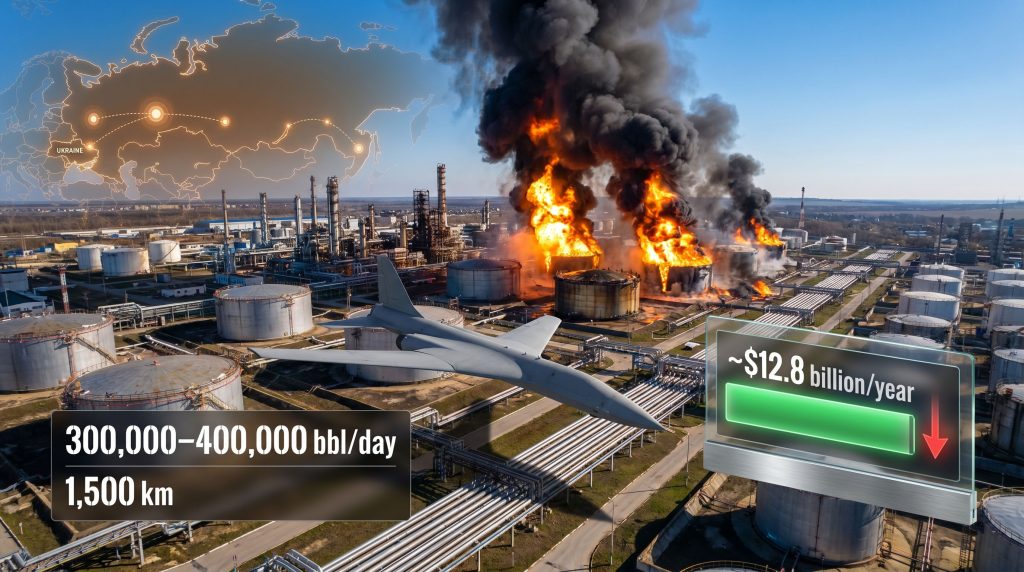
According to reporting by Reuters, cumulative infrastructure damage from Ukraine's long-range drone campaign has forced Russia to reduce crude oil output by an estimated 300,000 to 400,000 barrels per day, a volume comparable to the entire daily production of several mid-sized OPEC member states. Russian refinery throughput has fallen to levels not recorded since 2009, a 17-year low that signals structural rather than temporary disruption.
The scale of production loss is not a rounding error. At prevailing Brent prices above $100 per barrel, a 350,000 barrel per day shortfall translates to roughly $12.8 billion in annualised revenue disruption, enough to materially constrain a war economy already under multi-front financial pressure.
Mapping the Strike Geography: A Network Under Siege
What distinguishes Ukraine's current campaign from earlier drone activity is its geographic breadth. Rather than concentrating strikes on border-adjacent facilities, Ukrainian forces have distributed pressure across an arc spanning from the Black Sea coastline to the Ural Mountains, exploiting the fundamental vulnerability of Russia's sprawling territorial footprint.
The confirmed and reported strike record through late April 2026 illustrates the scope:
| Region | Facility / Target | Reported Impact | Distance from Border |
|---|---|---|---|
| Perm (Ural Mountains) | Transneft oil pumping station | Near-total storage tank destruction | 1,500+ km |
| Tuapse (Black Sea) | Rosneft refinery | Third strike in two weeks; oil spills, black rain reported | Coastal export node |
| Primorsk and Ust-Luga (Baltic) | Export terminal hubs | Operational disruptions, export curbs | Northern revenue corridor |
| Yaroslavl | Slavneft-YANOS refinery (15M t/year) | Fires confirmed; operations disrupted | Russia's second-largest refining complex |
| Nizhny Novgorod | NORSI refinery | Production halted | Major inland refining centre |
| Leningrad Oblast | Export terminals near St. Petersburg | Multiple strikes; governor declared frontline status | Baltic crude export gateway |
| Orenburg Oblast (near Orsk) | Industrial energy facilities | Attempted strikes reported | 1,500+ km from border |
| Rostov-on-Don | Industrial and oil-adjacent sites | Fires; state of emergency declared | Southern logistics hub |
| Luhansk (occupied) | Fuel depots | Confirmed destruction | Forward military fuel supply |
In April 2026 alone, at least 21 confirmed strikes targeted Russian energy infrastructure, with at least nine of those specifically hitting processing facilities. The Tuapse Rosneft refinery on the Black Sea has become emblematic of the campaign's deliberate repetition strategy: being struck three times within a two-week window, generating severe environmental consequences including coastal oil contamination and what local reports described as black rain falling on surrounding communities.
The April 28 strike on Transneft's production and dispatch station in the Perm region, confirmed by the SBU, represented a significant escalation in demonstrated range. Located more than 1,500 kilometres from the Ukrainian border, the facility sits deep within the Ural Mountain zone, an area that Russia's military planners had arguably considered beyond practical strike reach.
The Technology Behind the Reach: How Ukrainian Drones Extended Their Range by 170%
Understanding why these strikes are now possible requires appreciating the speed of Ukraine's domestic drone development programme. Since the full-scale invasion began in February 2022, Ukraine has expanded its confirmed long-range strike capability by approximately 170%, transitioning from systems capable of reaching border-adjacent targets to platforms that can engage hardened industrial infrastructure deep within Russian territory.
Several technical and organisational factors underpin this progression:
- Domestic manufacturing scale-up: Ukraine has achieved a production surplus of roughly 50% in certain drone categories, meaning output now exceeds immediate battlefield consumption, enabling both stockpiling and export consideration.
- Guidance precision improvements: Ukrainian President Volodymyr Zelenskyy specifically acknowledged the growing precision of SBU-coordinated strikes, indicating advances in terminal guidance systems capable of targeting discrete industrial components within larger facility complexes.
- Operational coordination architecture: Strikes are coordinated between Ukraine's Security Service (SBU) and its dedicated Unmanned Systems Forces, creating a layered command structure that integrates intelligence, targeting, and strike execution.
- Simultaneous multi-vector attacks: Rather than concentrating drone waves on single corridors, Ukraine has demonstrated the capability to conduct geographically dispersed strikes across multiple regions simultaneously, overwhelming Russian early warning and intercept capacity.
The Institute for the Study of War has assessed that Russia's vast geographic footprint creates an inherent and irresolvable air defence dilemma: comprehensive protection of every critical infrastructure node across thousands of kilometres is physically and logistically impossible. Ukraine's campaign deliberately engineers this saturation problem by distributing strike pressure rather than concentrating it.
The May 8–9 period underscored this dynamic. Russian authorities reported intercepting 26 drones over Moscow in a single overnight operation, yet confirmed strikes on major facilities continued regardless, demonstrating that even high intercept rates in specific corridors cannot prevent damage across a network of thousands of dispersed targets.
The Revenue Calculus: What These Strikes Actually Cost Russia
Translating physical damage into financial terms requires a framework that accounts for both direct production losses and indirect costs that erode any compensating effects from elevated global oil prices.
Direct Revenue Loss Scenarios
| Scenario | Daily Barrels Lost | Price Assumption (Brent) | Daily Revenue Loss | Annual Projection |
|---|---|---|---|---|
| Conservative | 300,000 bbl/day | ~$100/bbl | ~$30 million | ~$10.9 billion |
| Central estimate | 350,000 bbl/day | ~$100/bbl | ~$35 million | ~$12.8 billion |
| Elevated | 400,000 bbl/day | ~$100/bbl | ~$40 million | ~$14.6 billion |
Note: Brent crude was trading above $101 per barrel as of May 9, 2026, consistent with the price assumptions used above. These projections are estimates based on reported production disruption figures and are subject to revision as facility repair timelines and actual output data become available.
Russia's counter-argument — that higher global oil prices partially offset volume losses — carries surface plausibility but breaks down under scrutiny. Several compounding cost burdens erode any windfall effect:
- Air defence redeployment costs: Positioning additional intercept systems around energy facilities nationwide requires significant logistical and financial resources.
- Facility reconstruction expenditure: Repairing storage tanks, refinery units, and pipeline infrastructure to operational standards represents substantial capital outlay that diverts funds from other priorities.
- Export rerouting complexity: With Baltic and Black Sea terminal hubs under recurring strike pressure, Russia faces increasing costs to reroute crude through alternative channels, including premium freight rates on sanctioned shipping networks.
- Shadow fleet exposure: Sanctioned tankers operating alternative export routes have been directly targeted, adding maritime risk premia that further compress effective realised export revenues. The broader consequences of Russian oil trading sanctions have already significantly narrowed Moscow's available export options.
Global Oil Markets: Understanding the Dual Shock Environment
Ukraine drone strikes on Russian oil facilities are not occurring in an isolated market context. They are compounding a separate and simultaneous supply shock driven by Strait of Hormuz disruptions linked to the ongoing US-Iran confrontation. As of early May 2026, Brent crude was trading above $101 per barrel and WTI above $95 per barrel, with both benchmarks reflecting layered geopolitical risk premiums. The impact on oil markets from these converging pressures is being felt across multiple trading regions simultaneously.
The interaction between these two supply disruption vectors creates a genuinely complex analytical challenge for energy market participants:
- Russian production losses tighten the global supply-demand balance from the European and Asian supply angle.
- Hormuz disruptions simultaneously constrain Gulf crude availability, pushing energy-importing nations toward alternative sources.
- US fuel exports have hit record highs as American refiners capitalise on the supply gap, partially offsetting but not eliminating the shortfall.
- OPEC's market influence, with the OPEC basket price at approximately $112 per barrel as of early May 2026, reflects how Gulf producers are benefiting from elevated prices even as they navigate their own regional risk environment.
A critical but underappreciated dynamic: Ukraine's campaign creates an asymmetric information problem for oil traders. Unlike OPEC production cuts, which are publicly announced and subject to compliance monitoring, the actual extent of Russian infrastructure damage remains partially obscured by Kremlin information management, creating persistent uncertainty about true available supply volumes.
The next major ASX story will hit our subscribers first
Environmental and Collateral Consequences
The environmental dimension of repeatedly striking coastal oil refineries deserves separate analytical attention. The Tuapse Rosneft facility, struck three times within a fortnight, sits directly on the Black Sea coastline. Fires at oil refineries generate complex hydrocarbon combustion byproducts, and reports of black rain and coastal oil contamination in the surrounding area raise questions about long-term ecological liability.
Under international humanitarian law, energy infrastructure that directly supports military operations may qualify as a legitimate military objective, a legal framework Ukraine invokes when characterising these strikes as justified responses to Russian conduct. The debate remains active and contested in international legal circles, with the dual-use nature of export revenue infrastructure occupying a particularly ambiguous legal space.
Ukraine's Drone Programme as an Export Asset
One strategically significant development that has received less attention than the strikes themselves is Zelenskyy's explicit announcement that Ukraine intends to export its drone technology to partner nations. With domestic production running at a 50% surplus in certain categories, Ukraine has transitioned from a recipient of weapons technology transfers to a potential supplier.
This development carries several layered implications:
- It signals the maturity and reliability of Ukraine's domestic defence industrial base, a remarkable achievement for a nation under active invasion.
- It creates potential revenue streams that could partially offset wartime economic costs.
- It raises important questions about technology proliferation — specifically which partner nations might acquire long-range strike drone capability and how that reshapes security calculations in other conflict-adjacent regions. In addition, these geopolitical trade tensions are already complicating supply chain relationships across multiple sectors beyond energy.
Historical Parallels: Economic Warfare Through Energy Targeting
The strategic logic underpinning Ukraine's campaign has historical precedents worth examining. Allied bombing campaigns targeting German synthetic fuel production facilities in 1944 are credited by military historians as among the most decisive factors in collapsing Nazi Germany's offensive capability. When Luftwaffe aviation fuel stocks fell critically low, it grounded training programmes and combat sorties simultaneously, creating cascading military failure.
The Iran-Iraq War's tanker conflict in the 1980s demonstrated a different variant of the same principle: by targeting the maritime oil export infrastructure that funded both belligerents, external actors could influence the conflict's duration and intensity through economic pressure rather than direct military intervention.
What distinguishes the 2026 Ukrainian campaign is the democratisation of deep-strike capability. Previously, attacking targets 1,500 kilometres behind enemy lines required sophisticated cruise missiles or strategic aircraft — platforms available only to major military powers. Domestically produced drones have fundamentally altered this calculus, placing long-range economic warfare capability within the operational reach of a mid-sized nation defending against invasion. Ukraine drone strikes on Russian oil facilities have, consequently, rewritten the rulebook on modern economic warfare.
Scenarios: Where This Campaign Leads
Four plausible trajectories emerge from current trends, each with distinct implications for energy markets and geopolitical stability:
Scenario 1: Sustained Attrition
Ukraine maintains or escalates strike tempo, progressively degrading refinery throughput and export capacity. Russian military procurement faces growing fiscal constraints as revenue shortfalls compound over multiple quarters.
Scenario 2: Reciprocal Energy Warfare
Russia responds by intensifying strikes on Ukrainian energy infrastructure, potentially drawing European energy networks into the disruption calculus and creating broader supply implications for the continent.
Scenario 3: Price-Driven Diplomatic Pressure
Nations facing sustained energy price elevation, particularly large oil-importing economies in Asia and Europe, apply diplomatic pressure on both parties, creating negotiating leverage that constrains further escalation.
Scenario 4: Technology Proliferation
Ukraine's drone export programme successfully transfers long-range strike capability to allied or partner nations, permanently altering the security risk calculus for energy infrastructure across multiple potential conflict zones globally. Furthermore, Ukraine drone strikes on Russian oil facilities may ultimately prove to be the case study that redefines how future conflicts approach the targeting of energy networks.
This article is analytical and informational in nature. It does not constitute financial or investment advice. Energy price projections, production loss estimates, and scenario analyses involve inherent uncertainty and should not be relied upon as predictive of actual market outcomes. All figures cited reflect information available as of May 2026.
Want to Stay Ahead of the Next Major Resource Discovery Triggered by Shifting Energy Markets?
As geopolitical disruptions reshape global commodity supply chains and energy markets face mounting uncertainty, Discovery Alert's proprietary Discovery IQ model scans ASX announcements in real time, delivering instant alerts on significant mineral discoveries so subscribers can identify actionable opportunities before the broader market reacts — explore historic discovery returns or start your 14-day free trial today.