August 11, 2026
Modern extractive industries face mounting pressure to maximize resource utilization while minimizing environmental impact. Countries with abundant mineral endowments increasingly recognize that raw commodity exports represent missed value-addition opportunities, prompting sophisticated research initiatives that transform geological assets into high-value industrial products. This shift toward domestic beneficiation requires advanced metallurgical engineering, specialized process optimization, and systematic integration of local resource inputs across entire value chains.
The emergence of university-industry-government research collaborations represents a critical pathway for developing nations to build technical capacity while reducing import dependencies. These partnerships leverage academic expertise, government funding, and private sector resource access to pilot innovative processing technologies that can fundamentally reshape national economic profiles.
How Is Botswana Leveraging Iron-Ore for Metallurgical Innovation?
What Makes Botswana's Iron-Ore Unique in Global Context?
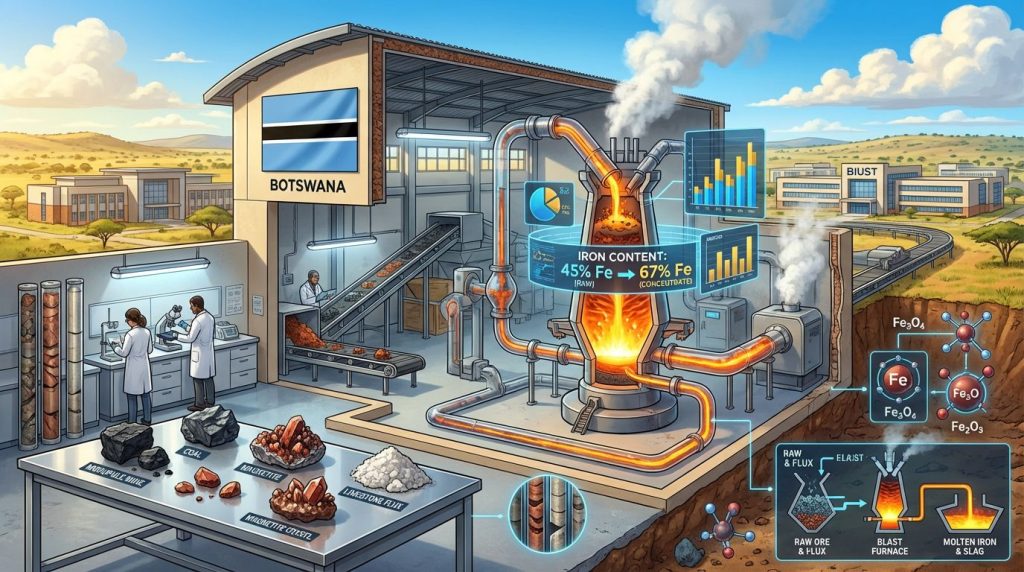
The Xaudum Iron Project (XIF) in Botswana contains magnetite with distinctive characteristics that position it favorably within global iron ore price trends. Initial core sampling reveals 45% Fe content in raw magnetite, with projected beneficiation capabilities to achieve greater than 67% Fe after processing. This upgraded specification places XIF among the top 4-5% of global producers by iron grade, according to Tsodilo Resources analysis published in Mining Weekly.
The geological context of Botswana's iron-ore deposits provides additional strategic advantages through co-located resources. Limestone and dolomite deposits suitable for fluxing applications exist within economical transport distances, while Morupule mine coal offers potential reductant capabilities for metallurgical processes. This geographic clustering of complementary materials creates opportunities for integrated processing operations that minimize input costs while maximizing domestic content.
| Resource Type | Grade/Specification | Strategic Advantage |
|---|---|---|
| Iron Magnetite (XIF) | 45% Fe initial, >67% Fe upgraded | Premium pellet feed quality |
| Limestone/Dolomite | Fluxing-grade deposits | Local sourcing for steel production |
| Coal (Morupule) | Proven metallurgical viability | Reductant substitute for imports |
Why Focus on Domestic Resource Utilization?
Botswana's strategic emphasis on domestic resource integration reflects broader economic imperatives beyond simple value-addition. The country's trade balance suffers from heavy reliance on raw commodity exports, creating foreign exchange vulnerabilities and limiting industrial diversification opportunities. Research conducted through the Botswana iron-ore research collaboration explicitly targets this challenge by developing processes that utilize exclusively Botswana-sourced inputs for steel production.
Furthermore, Tsodilo Resources emphasizes that sustainable national wealth requires the ability to transform natural resources into high-value finished products that can be competitively exported, thereby securing healthier trade balance metrics. This philosophy drives the technical approach toward proving commercial viability of integrated domestic supply chains rather than merely optimizing individual process steps.
The potential product portfolio extends across multiple industrial sectors:
- Construction materials: Rebar, structural steel, reinforcement products
- Mining equipment: Heavy machinery components, extraction tools
- Consumer goods: Household items, fabricated products, tools
- Engineering applications: Specialized components for regional infrastructure projects
When big ASX news breaks, our subscribers know first
What Are the Core Technical Objectives of the Botswana Iron-Ore Collaboration?
How Is the Experimental Workflow Structured?
The Botswana International University of Science and Technology (BIUST) collaboration operates through a systematic research framework designed to validate commercial-scale processing parameters. Dr. RVS Prasad and Thapelo Shomana from BIUST's Department of Chemical, Materials and Metallurgical Engineering received grant funding in 2024 from the Botswana Digital and Innovation Hub through the Botswana Innovation Fund.
The experimental progression follows a methodical approach, which incorporates lessons from mining industry evolution trends:
Phase 1: Core Characterization
- 18 meters of core extracted from XIF containing 45% Fe magnetite
- Comprehensive metallurgical analysis to inform furnace design parameters
- Chemical and physical property determination for process optimization
Phase 2: Bulk Sampling Operations
- 2 tonnes per iron-ore type targeting for pilot-scale testing
- Representative sampling to validate core analysis findings
- Material preparation for experimental furnace operations
Phase 3: Equipment Construction
- Lab-scale oven design and construction at BIUST facilities
- Experimental blast furnace engineering for controlled testing
- Custom equipment specifications tailored to Botswana feedstock characteristics
Phase 4: Process Validation
- Pig iron production using integrated domestic inputs
- Systematic operational parameter variation for optimization
- Continuous product quality monitoring and analysis
What Novel Methodologies Are Being Trialed?
The research initiative explicitly focuses on applying a novel metallurgical coke blend in pig-iron production through experimental blast furnace operations. This approach represents a significant departure from standard industrial practices by prioritizing local resource integration over proven international feedstock specifications.
Morupule coal serves as the primary reductant candidate, building on previous demonstrations of its viability as a substitute for imported metallurgical materials in metalliferous ore processing. The research team systematically evaluates coal performance parameters including:
- Calorific value optimization for furnace temperature control
- Ash content management to minimize slag production
- Volatile matter behavior during reduction reactions
- Coke strength characteristics for furnace burden support
Local limestone and dolomite deposits undergo parallel evaluation as fluxing agents to determine their effectiveness in iron reduction processes. This comprehensive domestic sourcing strategy eliminates foreign exchange exposure while building technical knowledge of indigenous resource capabilities.
How Is Product Quality Optimized and Measured?
The optimization methodology emphasizes systematic parameter variation combined with continuous product quality assessment. Research protocols include controlled modification of operational variables such as:
- Temperature profiles throughout furnace operation
- Feed ratios between ore, coal, and flux materials
- Residence times for optimal reduction kinetics
- Gas flow patterns for heat transfer efficiency
Product quality monitoring employs comprehensive analytical techniques including chemical composition analysis and microstructural characterization. The target specification of greater than 67% Fe in upgraded magnetite concentrate aligns with international Direct Reduced Iron (DRI) pellet feed requirements, positioning the output for premium steel production applications.
What Are the Operational and Market Implications for Botswana's Iron-Ore Value Chain?
What Is the Pathway from Ore to Finished Steel Products?
The integrated production pathway demonstrates how raw mineral resources can be systematically transformed into finished industrial products through controlled metallurgical processes:
Raw Material Processing
- XIF magnetite (45% Fe) → Beneficiation → Pellet feed (>67% Fe)
- Morupule coal → Metallurgical coke → Blast furnace reductant
- Local limestone/dolomite → Flux preparation → Slag formation agents
Primary Steel Production
- Pig iron generation via experimental blast furnace
- Basic Oxygen Furnace (BOF) route for traditional steelmaking
- Electric Arc Furnace (EAF) pathway for modern low-carbon production
Secondary Processing
- Steel billets as intermediate products
- Value-added manufacturing for construction, mining, and consumer applications
- Export-oriented finished goods targeting regional markets
How Does This Support Botswana's Export Competitiveness?
The transformation from raw mineral exports to semi-finished and finished steel products offers substantial economic advantages through value multiplication and trade balance improvement. Current raw iron-ore exports generate limited foreign exchange relative to the resource extraction costs and economic rent captured by downstream processors.
In addition, finished steel products command significantly higher per-tonne values while creating domestic employment opportunities in:
- Technical engineering roles for process optimization
- Quality control positions for product specification management
- Logistics coordination for regional export distribution
- Maintenance and operations supporting production facilities
Regional market opportunities exist across Southern African Development Community (SADC) nations experiencing infrastructure development and industrialization demand for steel products.
What Role Does Decarbonisation Play in the Project?
Global steel industry trends toward reduced carbon emissions create strategic advantages for high-grade magnetite operations. Climate change pressures and emission control regulations, particularly smog-reduction measures affecting Chinese steel production, drive increased demand for low-carbon steelmaking inputs.
The transition from traditional sintering processes to Direct Reduced Iron (DRI) production offers significant decarbonization potential. Furthermore, this aligns with sustainable mining transformation initiatives. DRI pathways using high-grade magnetite and optimized reductants can achieve:
- 30-50% lower CO2 emissions compared to conventional blast furnace routes
- Reduced energy intensity through elimination of sintering operations
- Improved material utilization via higher-grade feedstock specifications
Botswana's competitive positioning benefits from this structural market shift as DRI-quality pellet feed demand continues expanding among steel producers prioritizing environmental compliance.
Which Technical Milestones Define Success in the Botswana Iron-Ore Research Project?
Key Performance Indicators (KPIs)
| Milestone | Target/Benchmark | Current Status | Success Metrics |
|---|---|---|---|
| Bulk core analysis | ≥2 tonnes samples | Initial samples supplied | Complete characterization data |
| Magnetite upgrade | >67% Fe (pellet feed) | Pilot beneficiation phase | Consistent grade achievement |
| Furnace commissioning | Fully operational | Equipment construction | Stable production rates |
| Steel product quality | Global BOF/EAF standards | Optimization ongoing | Specification compliance |
| Process decarbonization | DRI pathway validation | Reductant testing | Emission reduction confirmation |
How Is Continuous Improvement Built In?
The research framework incorporates systematic feedback mechanisms to optimize process parameters through iterative experimentation. Each production cycle generates data that informs subsequent operational adjustments, creating a knowledge accumulation system that progressively improves technical performance.
Feedback Loop Components:
- Real-time monitoring of furnace operational parameters
- Product quality analysis after each experimental run
- Process parameter adjustment based on analytical results
- Performance trending to identify optimal operating windows
- Scale-up planning using pilot-scale validated parameters
Stakeholder engagement ensures research outcomes align with commercial objectives through regular consultation with government officials, resource owners, and potential off-take customers. This collaborative approach maintains focus on economically viable solutions rather than purely academic research interests.
What Are the Broader Implications for Botswana's Industrial and Skills Ecosystem?
How Does the Collaboration Strengthen Research and Innovation Capacity?
The BIUST partnership creates substantial knowledge transfer opportunities that extend beyond immediate project outcomes. Students and faculty gain hands-on experience with advanced metallurgical processes, building technical capabilities that support broader industrial development objectives.
Specific capacity-building outcomes include:
- Advanced analytical skills in ore characterization and product testing
- Process engineering expertise in furnace design and operation
- Quality control methodologies for industrial-scale production
- Research project management capabilities for complex technical initiatives
This human capital development creates a foundation for sustained technological innovation within Botswana's industrial sector, reducing dependence on foreign technical expertise while building indigenous problem-solving capabilities.
What Are the Long-Term Industrialization Scenarios?
Successful demonstration of integrated steel production using domestic resources could catalyze broader industrial development across multiple economic sectors. The vision encompasses establishment of Botswana-based steel and engineering products industries that serve both domestic and regional markets.
Potential Industrial Clustering:
- Primary steel production facilities using proven domestic processes
- Secondary manufacturing operations for construction and mining equipment
- Component fabrication supporting regional infrastructure projects
- Technical services for process optimization and equipment maintenance
Such clustering effects create supply chain anchoring that attracts complementary industries while generating multiplier effects throughout the broader economy.
How Might the Botswana Iron-Ore Collaboration Serve as a Technical Model for Other African Nations?
Lessons for Process Design and Local Content Maximization
The systematic approach to domestic resource integration offers replicable methodologies for other resource-rich African nations seeking to capture greater value from mineral endowments. Key transferable principles include:
Integrated Resource Assessment: Comprehensive evaluation of co-located materials (ore, coal, flux) to identify synergistic processing opportunities rather than single-commodity optimization.
University-Industry Partnerships: Strategic use of academic institutions to provide technical expertise and research capabilities while building domestic capacity for sustained innovation.
Government Funding Mechanisms: Targeted research grants that support commercial viability studies rather than purely academic research, ensuring outcomes align with economic development objectives.
Systematic Scale-Up Planning: Laboratory-scale validation followed by pilot testing before commercial implementation, reducing capital risk while generating robust technical data.
The model demonstrates how feasibility study insights can be conducted using domestic resources and capabilities, reducing dependence on foreign technical services while building confidence in local processing solutions.
The next major ASX story will hit our subscribers first
Frequently Asked Questions on Botswana's Iron-Ore R&D Collaboration
Can Botswana Become a Regional Steel Hub?
Several factors support Botswana's potential as a regional steel production center. The high-grade magnetite resource base combined with domestic coal and flux availability creates cost advantages relative to import-dependent competitors. Additionally, Botswana's political stability and established mining sector expertise provide favorable investment conditions for industrial development.
Regional demand across SADC nations for construction steel, mining equipment, and infrastructure materials offers substantial market opportunities. Botswana's geographic position enables efficient distribution to neighboring countries while maintaining competitive transport costs.
What Is Distinctive About the XIF Magnetite Project vs. Other African Operations?
The XIF project's emphasis on high-grade magnetite with DRI readiness differentiates it from traditional African iron-ore operations focused on export-oriented bulk commodity production. The integrated domestic resource approach using local coal and flux materials creates unique value-chain control that many competitors cannot replicate.
Furthermore, the explicit focus on low-carbon process development aligns with global steel industry trends toward environmental compliance, positioning XIF ahead of operations still dependent on traditional sintering technologies.
How Might the Project Expand Export Markets?
Initial target markets within Southern Africa offer the most immediate opportunities due to transport cost advantages and established trade relationships. However, the premium quality specifications (>67% Fe magnetite) enable access to global steel markets seeking DRI-quality inputs for low-carbon production.
Sub-Saharan demand trends indicate growing steel consumption driven by urbanization and infrastructure development, creating sustained regional market growth. International steel buyers increasingly prioritise sustainable sourcing and carbon footprint reduction, creating premium market opportunities for demonstrably low-carbon steel products.
How Does Global Steel Industry Evolution Create Strategic Opportunities for Botswana?
The international steel sector faces unprecedented pressure to reduce carbon emissions while maintaining production quality and cost competitiveness. Emission control regulations and demand for less carbon-intensive steel production represent structural rather than cyclical market shifts that favor high-grade ore operations.
Chinese steel mill restrictions on sintering and coal use create supply gaps for premium inputs that projects like XIF can potentially fill. The global transition toward Electric Arc Furnace (EAF) production using DRI feedstocks supports sustained demand growth for high-grade magnetite concentrate, which is evident from current iron ore demand insights.
Industry Insight: Steel producers' demands for DRI-quality pellet feed continue increasing as emission controls and low-carbon production requirements become industry standards rather than optional sustainability measures.
This transformation creates significant opportunities for high-grade magnetite projects that can demonstrate consistent quality, reliable supply, and environmental compliance capabilities.
Technical Innovation and Process Optimization in African Metallurgy
The Botswana iron-ore research collaboration represents broader trends in African metallurgical innovation that emphasise technical self-sufficiency and value-chain integration. Traditional approaches relied heavily on foreign technology transfer and imported processing expertise, creating dependency relationships that limited domestic capacity building.
Modern research initiatives prioritise indigenous technical development using local universities, government funding, and private sector partnerships to create sustainable innovation ecosystems. This approach generates:
- Intellectual property development within domestic institutions
- Technical workforce development aligned with national industrial objectives
- Process optimization expertise specific to local resource characteristics
- Research infrastructure supporting sustained technological advancement
The systematic documentation and validation of domestic processing solutions creates technology assets that can be licensed or adapted for similar resource endowments across the continent.
Economic Impact Assessment and Trade Balance Implications
Transform raw mineral exports into finished steel products offers substantial economic multiplier effects beyond direct production value. Import substitution benefits include reduced foreign exchange exposure, improved trade balance metrics, and decreased vulnerability to international commodity price volatility.
Employment creation extends across multiple skill levels from technical engineering roles to manufacturing operations and logistics support. The integrated approach creates supply chain clustering effects that attract complementary industries while generating sustained economic activity.
Regional export opportunities provide foreign exchange earnings at significantly higher unit values compared to raw ore exports, while domestic market development reduces reliance on imported steel products for construction and industrial applications.
Financial projections require detailed market analysis and capital cost estimates that exceed the scope of current research phases, but preliminary assessments suggest positive economic returns given favourable resource characteristics and growing regional demand trends.
Conclusion
The Botswana iron-ore research collaboration demonstrates how systematic technical innovation can transform geological assets into strategic economic advantages. Through careful integration of domestic resources, university-based research capabilities, and government funding mechanisms, the project creates a replicable model for value-chain optimisation in resource-dependent economies.
Technical achievements in metallurgical coke blending, pig iron production, and process optimisation generate intellectual property and operational expertise that extend well beyond immediate project boundaries. The emphasis on domestic resource utilization reduces import dependencies while building industrial capabilities that support broader economic diversification objectives.
Market positioning benefits from global steel industry trends toward low-carbon production methods and premium-grade inputs, creating sustained demand opportunities for high-quality magnetite concentrate and finished steel products. Regional export markets offer immediate commercialisation pathways while international opportunities provide longer-term growth potential.
The success of this collaboration depends on continued investment in research infrastructure, technical workforce development, and systematic scale-up planning that maintains focus on commercial viability rather than purely academic outcomes. Sustained government support, private sector engagement, and international market development will determine whether these technical innovations translate into lasting economic transformation for Botswana and potential replication across resource-rich African nations.
Disclaimer: This analysis is based on publicly available information and industry research. Investment decisions should consider comprehensive due diligence, market analysis, and professional financial advice. Projections and forecasts represent potential scenarios rather than guaranteed outcomes and are subject to significant economic, technical, and regulatory uncertainties.
Looking for Iron Ore Investment Opportunities?
Discovery Alert's proprietary Discovery IQ model delivers real-time alerts on significant iron ore discoveries across the ASX, instantly empowering subscribers to identify actionable opportunities ahead of the broader market. Begin your 30-day free trial today and secure your market-leading advantage in the rapidly evolving minerals sector.