July 25, 2026
The Geopolitical Realignment Reshaping Australia's Most Consequential Gas Project
North Asian energy buyers have spent the better part of two decades navigating the structural vulnerability of Middle East LNG dependency. The Strait of Hormuz, through which roughly 20% of global LNG trade flows, has long represented the single most consequential chokepoint in the world's energy supply chain. When geopolitical shocks strike that corridor, the scramble for alternative supply anchors accelerates rapidly. Australian LNG, politically stable and geographically insulated from Gulf conflict zones, moves to the top of the acquisition list. That dynamic is now actively reshaping the ownership structure of what is widely regarded as Australia's largest undeveloped oil and gas resource: the Browse Basin. BP to sell stake in Browse LNG project is, consequently, a transaction that carries strategic weight far beyond its headline percentage.
When big ASX news breaks, our subscribers know first
Australia's Browse Gas Basin: The Scale of What Remains Untapped
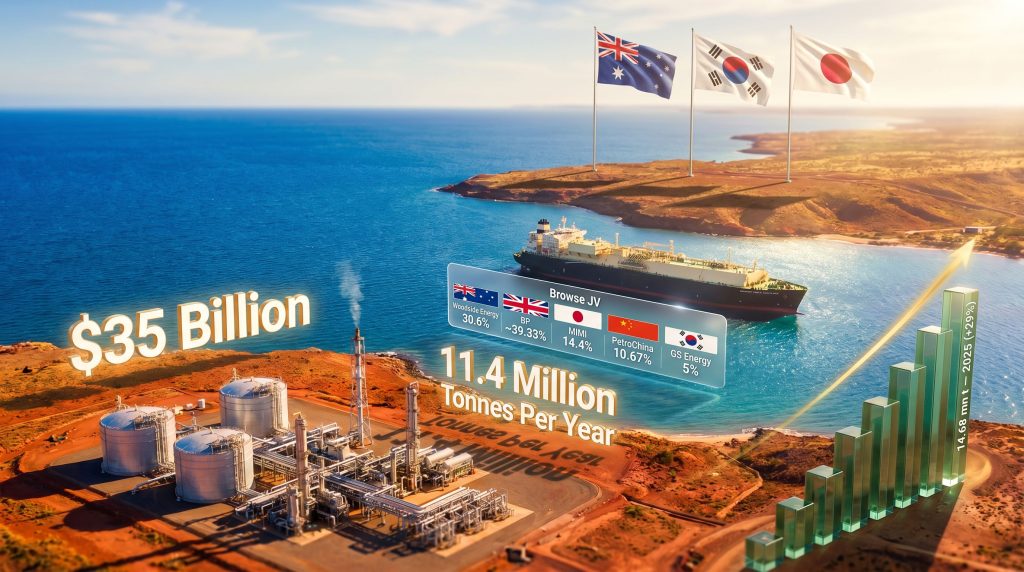
Understanding why the Browse LNG project commands such intense strategic interest requires grasping the sheer magnitude of what remains undeveloped offshore Western Australia. With an estimated project value of $35 billion, Browse is not simply another resource prospect. It is a potential cornerstone of Australia's LNG export architecture for decades to come.
The numbers that define Browse's development case are substantial:
| Metric | Figure |
|---|---|
| Estimated project value | $35 billion |
| Forecast LNG production capacity | 11.4 million tonnes per year |
| Peak condensate production rate | 50,000 barrels per day |
| North West Shelf terminal capacity | 14.3 million tonnes per year |
| Karratha Gas Plant pipeline capacity | 630 TJ/day |
Browse's output would span LNG, LPG, and domestic gas, alongside meaningful condensate volumes, making it a multi-product development with cash flow diversification that few other uncommitted projects anywhere in the world can match. Its intended processing destination, the North West Shelf extension terminal at Karratha, already has 14.3 million tonnes per year of liquefaction capacity, but that infrastructure is facing an accelerating feedstock deficit as legacy reservoir fields deplete.
Woodside Energy's share of NWS output fell to 2.94 million tonnes in 2025, down from 3.64 million tonnes the prior year, a decline that followed the retirement of a 2.5 million tonne per year train at the terminal in late 2024. Browse is not simply an incremental growth opportunity; for the NWS terminal and Western Australia's domestic gas network, it is increasingly an operational necessity.
How Browse Compares to Australia's Operational LNG Fleet
| Project | Operator | Capacity (mn t/yr) | Status |
|---|---|---|---|
| North West Shelf | Woodside | 14.3 | Operational (declining) |
| Ichthys LNG | Inpex | 9.3 | Operational |
| Prelude FLNG | Shell | 3.6 | Operational |
| Browse LNG | Woodside (proposed) | 11.4 | Pre-FEED |
Browse, at 11.4 million tonnes per year, would represent a material addition to Australia's energy exports and restore a significant portion of NWS terminal utilisation rates that are sliding as ageing fields exhaust their proven reserves.
BP's Decision to Sell a Stake in Browse LNG: Portfolio Logic, Not Retreat
When BP confirmed its intention to sell a 5% working interest in the Browse joint venture to South Korea's GS Energy, the transaction was framed internally as consistent with the company's broader portfolio management approach. The description of GS Energy as a partner that complements substantial work already completed to advance Browse toward the front-end engineering and design (FEED) phase reflects a deliberate dual objective: moderating capital exposure to a long-duration, pre-FID asset while simultaneously anchoring a buyer-side stakeholder with long-term offtake motivation into the consortium.
This distinction matters enormously for how the transaction should be interpreted. BP to sell stake in Browse LNG project does not mean BP is exiting Browse entirely. Following completion of the deal, which remains subject to both regulatory approval and joint venture partner consent, BP will retain a ~39.33% working interest, keeping it as the single largest stakeholder in the project. That position would be difficult to reconcile with a strategic view that Browse is either uneconomic or politically untenable.
What the partial sell-down more accurately reflects is the capital allocation calculus facing every major oil company managing pre-FID, multi-decade development assets in an environment where investor pressure to demonstrate near-term returns has intensified considerably since 2024. Browse has been in various stages of planning and assessment for decades. Carrying a 44.33% stake in a project that has not yet reached FEED carries a capital commitment burden that, at the margin, becomes easier to manage at 39.33%, particularly when the incoming partner adds strategic value beyond the cheque.
The Browse Joint Venture Ownership Structure Post-Transaction
| Partner | Country | Stake |
|---|---|---|
| Woodside Energy | Australia | 30.6% |
| BP | United Kingdom | ~39.33% (post-sale) |
| MIMI (Mitsui + Mitsubishi JV) | Japan | 14.4% |
| PetroChina | China | 10.67% (sale pending) |
| GS Energy | South Korea | 5% (incoming) |
Separately, PetroChina has confirmed its intention to exit Browse entirely, with Japan's Inpex reported as the prospective buyer of its 10.67% interest. Inpex already operates the 9.3 million tonne per year Ichthys LNG facility in the Browse Basin and holds a 17.5% stake in Shell's 3.6 million tonne per year Prelude floating LNG project, also located in the same basin. Should that transaction conclude, the Browse consortium would transform from a broadly international grouping into one overwhelmingly aligned with north Asian energy importers, a compositional shift with significant implications for how offtake agreements and project development timelines are ultimately negotiated.
GS Energy and South Korea's Supply Security Imperative
GS Energy is a South Korean private-sector energy firm with upstream investment interests spanning the Asia-Pacific region. Its entry into Browse is not a speculative financial play. It reflects a structural energy security priority that has been building urgency for South Korea as a nation.
South Korea has no meaningful domestic hydrocarbon production. Its industrial economy, one of the most energy-intensive in Asia on a per-capita basis, runs on imported LNG to a degree that leaves it acutely exposed to supply disruptions originating in the Persian Gulf. The escalating military exchange between the United States and Iran near the Strait of Hormuz in 2026 has transformed what was previously a theoretical energy supply shock into an active geopolitical flashpoint. For energy planners in Seoul, securing long-term, non-Middle East supply chains is no longer simply prudent policy; it has become operationally urgent.
Australia is already South Korea's most important LNG trading partner. Furthermore, the bilateral energy relationship is characterised by a reciprocal interdependence that goes beyond a simple buyer-seller dynamic:
| Commodity | Volume | Direction |
|---|---|---|
| LNG exports to South Korea | 14.68 million tonnes | Australia to South Korea |
| Year-on-year LNG growth | +29% (from 11.4 mn t in 2024) | |
| Gasoil imports from South Korea | ~150,000 barrels per day | South Korea to Australia |
| Thermal coal exports to South Korea | Australia to South Korea |
Australia's reliance on South Korean refiners for approximately 30% of its gasoil imports is a detail that often escapes mainstream commentary but is analytically critical. Australia's limited domestic refining capacity means its mining and agricultural sectors, both of which are diesel-intensive and economically foundational, depend heavily on a supply chain that runs through South Korean industrial infrastructure. This interdependence creates strong bilateral incentives to deepen the energy investment relationship, and GS Energy's Browse stake is a direct expression of that logic at the corporate level.
The Hormuz Factor: Why North Asian LNG Strategy Is Being Rewritten
The US-Iran conflict near the Strait of Hormuz has introduced a supply security variable into north Asian energy planning that market participants had long modelled as a tail risk but rarely priced as a base case. Iranian threats to close the strait, combined with active military exchanges involving US forces and Iranian proxies, have elevated the perceived vulnerability of Middle East LNG routes to a degree that is altering procurement strategy in real time.
For Japan and South Korea, whose combined LNG import dependency makes them among the world's most exposed economies to Hormuz disruption, the global LNG supply outlook increasingly points toward Australian supply as a strategically differentiated proposition. Its geographic position, well clear of Middle East conflict geography, combined with its status as a long-established, politically stable exporting jurisdiction, makes it the natural anchor for supply diversification strategies.
The convergence of Japanese capital (through Inpex's potential acquisition of PetroChina's Browse stake) and South Korean capital (through GS Energy's incoming position) into a single project consortium is not coincidental. It reflects a coordinated north Asian response to structural supply chain vulnerability, channelled through commercial investment rather than intergovernmental agreements.
This pattern of allied energy buyers acquiring equity stakes in Australian upstream assets, rather than simply purchasing spot or term LNG cargoes, represents a meaningful evolution in how north Asian importers are approaching long-term energy security. Equity participation gives buyers preferential access to project economics, influence over development timelines, and a structural hedge against spot market price volatility, all of which become more valuable when geopolitical risk premiums are elevated.
The Obstacles on Browse's Path: Environmental, Regulatory, and Commercial
Despite the strategic case for Browse's development, the project's journey to Final Investment Decision remains genuinely uncertain. The obstacles are substantive and multi-layered.
The Scott Reef Environmental Campaign
Browse faces an active and well-organised national environmental campaign centred on two primary concerns: the project's greenhouse gas emissions footprint and the potential ecological impact on Scott Reef, a remote and ecologically sensitive shoal system within the Browse Basin. Scott Reef supports a complex marine ecosystem, and environmental advocates argue that industrial development in proximity to it carries unacceptable ecological risk.
Navigating Australian federal and state environmental approval frameworks represents a significant regulatory hurdle. Environmental litigation has been a persistent contributor to Browse's extended pre-FEED status, and there is no clear timeline certainty for when approvals might be obtained.
Western Australia's Domestic Gas Argument
Western Australian Premier Roger Cook has publicly characterised Browse as critical infrastructure for the state's domestic gas supply, distinguishing it from a purely export-oriented project. The Karratha Gas Plant, with its 630 TJ/day pipeline capacity, underpins energy supply for WA's industrial and residential consumers. As natural field depletion reduces throughput at Karratha, the urgency of Browse's development from a domestic energy security standpoint intensifies.
This domestic gas imperative creates a counterweight to environmental opposition in the regulatory debate, potentially influencing how federal and state approvals processes weigh competing public interest considerations. It does not, however, guarantee approval or accelerate any specific regulatory pathway.
Key Milestones Remaining Before Browse Reaches FID
- Completion of regulatory and JV partner approvals for the BP-GS Energy transaction
- Resolution of PetroChina's stake sale to Inpex or an alternative buyer
- Advancement through front-end engineering and design (FEED)
- Environmental approvals under Australian federal and state frameworks
- Securing long-term offtake agreements with north Asian buyers
- Final Investment Decision by Browse JV partners
Each of these milestones carries execution risk. The sequential dependency between some of them, particularly the relationship between offtake agreements and FID, means that delays at any point can have cascading consequences for the overall timeline. Broader concerns around oil market disruption and global trade uncertainty add further complexity to these commercial negotiations.
The next major ASX story will hit our subscribers first
Three Development Scenarios: What Browse's Future Could Look Like
| Scenario | Key Assumption | Likely Outcome |
|---|---|---|
| Accelerated Development | Environmental approvals granted; Inpex joins JV; strong north Asian offtake demand | FID achievable by late 2020s; NWS backfill secured |
| Prolonged Delay | Environmental litigation continues; global LNG oversupply dampens buyer urgency | FEED stalls; JV partners reassess capital commitments |
| Partial Development | Domestic gas priority overrides full LNG export scope | Scaled-back project focused on WA gas supply; reduced export volumes |
The accelerated scenario depends on regulatory momentum, consortium stability following the PetroChina exit, and continued north Asian demand urgency driven by Hormuz-related supply insecurity. The prolonged delay scenario becomes more likely if global LNG markets move into structural oversupply as new capacity from the United States, Qatar, and Canada enters service through the late 2020s, reducing the economic urgency that north Asian buyers feel to lock in Australian equity positions.
The partial development scenario, while less discussed in commercial circles, is arguably underappreciated as a genuine policy outcome if WA state priorities dominate the federal approval framework.
What the Browse Ownership Shift Signals for Australia's LNG Strategy
The incremental changes accumulating within the Browse JV — BP's partial divestment to GS Energy, PetroChina's prospective exit to Inpex, and the broader realignment toward north Asian equity ownership — collectively signal something more consequential than a routine portfolio transaction.
They indicate that Browse is transitioning from a project dominated by Western major oil companies managing transition-era capital allocation pressures into one increasingly anchored by the end-market economies that need its production most. That compositional shift has historically been associated with improved project momentum, because equity-holding importers have a direct commercial incentive to see development proceed, not simply to hold an option on future supply.
Whether that momentum translates into a timely FID will ultimately depend on factors that no consortium restructuring can resolve: environmental regulatory outcomes, global LNG supply-demand dynamics, and the capital markets environment that will determine the economics of a $35 billion investment commitment. What the BP sell-down confirms, however, is that the appetite for Browse among the world's most strategically motivated LNG buyers remains very much intact. Notably, GS Energy's acquisition of the Browse stake underscores just how seriously north Asian importers are repositioning their long-term supply strategies.
Frequently Asked Questions: BP, Browse LNG, and Australia's Gas Sector
What stake is BP selling in the Browse LNG project?
BP is divesting a 5% working interest in the Browse joint venture to South Korea's GS Energy. Following completion, subject to regulatory and JV partner approvals, BP's holding will reduce from approximately 44.33% to around 39.33%.
Who operates the Browse LNG project?
Woodside Energy, the Australian independent, serves as operator of the Browse joint venture and holds a 30.6% equity stake in the project.
Why is BP selling part of its Browse stake?
The partial divestment reflects BP's portfolio management approach, reducing capital exposure to a long-duration pre-FID asset while bringing in GS Energy as a strategically motivated partner that supports Browse's progression toward FEED.
What is Browse LNG's estimated value and production capacity?
Browse carries an estimated project value of $35 billion and is forecast to produce approximately 11.4 million tonnes per year across LNG, LPG, and domestic gas, alongside peak condensate output of around 50,000 barrels per day.
Is Browse LNG facing environmental opposition?
Yes. An active campaign raises concerns about greenhouse gas emissions and potential impacts on Scott Reef, a protected marine ecosystem. These represent a significant regulatory hurdle on the path to development approval.
What is the significance of South Korea's involvement in Browse?
South Korea is Australia's largest LNG customer by volume, receiving 14.68 million tonnes in 2025, up 29% from the prior year. GS Energy's entry deepens a structurally interdependent bilateral energy relationship and reflects South Korea's strategic priority of securing long-term, non-Middle East LNG supply chains. Consequently, the decision for BP to sell stake in Browse LNG project to a South Korean buyer carries implications that extend well beyond the transaction itself.
Want to Stay Ahead of Major Resource Developments Like Browse LNG?
Discovery Alert's proprietary Discovery IQ model delivers real-time alerts on significant ASX mineral discoveries, turning complex resource data into actionable investment insights — explore historic discoveries and their returns to understand the magnitude of opportunities that early positioning can unlock, then begin a 14-day free trial at Discovery Alert to ensure the next major find doesn't pass unnoticed.