June 30, 2026
The Hub-and-Spoke Logic Reshaping LNG Exploration Investment
Long before a single molecule of natural gas reaches an Asian import terminal, the economics of LNG development are determined by one factor above all others: proximity to existing infrastructure. The capital required to build a greenfield LNG hub from scratch, spanning upstream wells, pipelines, liquefaction trains, and export terminals, can exceed tens of billions of dollars and consume more than a decade of development time. Against that backdrop, exploration acreage sitting adjacent to an already-operating liquefaction facility carries a fundamentally different risk-reward profile. Understanding this distinction is central to making sense of bp's latest upstream moves in Indonesia, where three new bp Indonesia exploration blocks tied to Tangguh LNG represent a calculated extension of an infrastructure-anchored growth strategy rather than speculative frontier exploration.
When big ASX news breaks, our subscribers know first
bp's Indonesian Upstream Footprint: Bigger Than Most Realise
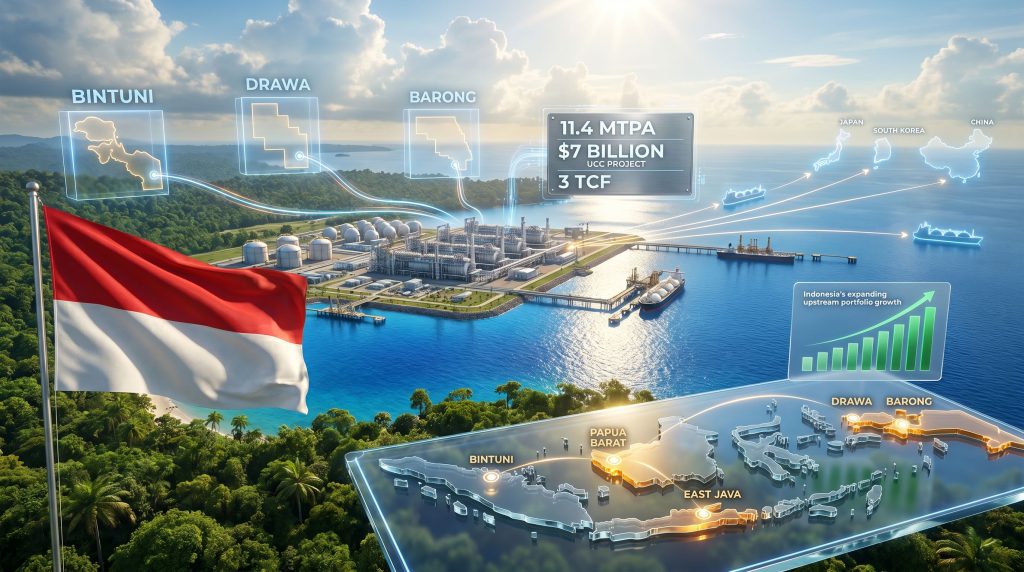
bp's position in Indonesia is frequently discussed in the context of Tangguh LNG alone, but the company's upstream exposure across the archipelago is considerably broader. Following the execution of three new Production Sharing Contracts (PSCs), bp now holds participating interests across 11 Indonesian oil and gas blocks, cementing its status as one of the most active international upstream operators in the country's gas sector.
The Tangguh LNG facility in Papua Barat remains the centrepiece of this portfolio. Operating through BP Berau and related subsidiary structures, bp manages a three-train liquefaction complex capable of producing approximately 11.4 million tonnes of LNG per year. That output scale places Tangguh among Southeast Asia's most significant gas export hubs, with established offtake relationships directing cargoes to buyers across Northeast and Southeast Asia.
What makes Tangguh strategically durable is not simply its current output but the investment committed to sustaining and growing it. The separately sanctioned Tangguh UCC project, encompassing Ubadari field development, Carbon Capture Utilisation and Storage (CCUS) infrastructure, and compression technology, carries a capital commitment of approximately $7 billion. This investment is engineered to unlock an estimated 3 trillion cubic feet (Tcf) of incremental gas volumes, extending plateau production well into the next decade.
The UCC project reframes Tangguh from a mature producing asset into an actively expanding platform, with CCUS integration serving the dual function of volume growth and emissions credential enhancement simultaneously.
The Three New Blocks: What Each One Brings to the Portfolio
Bintuni and Drawa: Near-Field Exploration in Papua Barat
The Bintuni and Drawa blocks are geographically proximate to the existing Tangguh LNG infrastructure in Papua Barat, and this location is the defining feature of their investment thesis. bp has indicated that successful exploration in these blocks could support shorter-cycle development pathways, a direct reference to the brownfield leverage that comes from tying new discoveries back into existing processing and export facilities rather than building standalone infrastructure.
In practical terms, this compression of development timelines can be substantial:
| Development Pathway | Typical Timeline to First LNG | Approximate Infrastructure Cost |
|---|---|---|
| Greenfield LNG Hub | 10 to 15 years | $10B to $50B+ |
| Near-Field Tie-Back to Existing LNG | 3 to 7 years | $500M to $3B |
| Compression or CCUS Add-On | 5 to 8 years | $5B to $10B |
The brownfield advantage also extends to commercial alignment. bp's partners in both the Bintuni and Drawa blocks are not newcomers to the Tangguh system. They include:
- CNOOC Southeast Asia, a Chinese national oil company with established regional upstream operations
- MI Berau B.V., a joint venture between INPEX Corporation and Mitsubishi Corporation, both carrying deep historical involvement in the Tangguh area
- Indonesia Natural Gas Resources Muturi, Inc., a subsidiary of LNG Japan Corporation, reinforcing the Japanese buyer-investor alignment that has long characterised Tangguh's commercial structure
This partner composition is significant beyond the obvious capital-sharing function. When exploration partners are also legacy stakeholders in the receiving LNG infrastructure, the commercial path from discovery to production is considerably more direct. Furthermore, alignment on offtake terms, infrastructure access, and fiscal structures is pre-built into the consortium rather than requiring lengthy renegotiation.
Barong Block: East Java Diversification Under INPEX's Stewardship
The Barong block occupies a different strategic position within bp's expanded Indonesian portfolio. Located in East Java rather than Papua Barat, this block introduces genuine basin diversification, reducing bp's concentration exposure to a single geological province. bp will hold a 49% participating interest as a non-operating partner, with INPEX Corporation retaining the operator role at 51%.
The non-operating structure is a deliberate capital efficiency choice. By accepting a minority, non-operating position in exploratory acreage located in an unfamiliar basin, bp gains exposure to potential upside without assuming full operational costs or management burden. For acreage at an early exploration stage, this is a rational allocation of both financial and human capital resources.
| Block | Location | bp Interest | Operator | Strategic Function |
|---|---|---|---|---|
| Bintuni | Papua Barat | Majority | bp | Near-field Tangguh feed gas |
| Drawa | Papua Barat | Majority | bp | Near-field Tangguh feed gas |
| Barong | East Java | 49% | INPEX (51%) | Basin diversification, non-op exposure |
PSCs, SKK Migas, and the Indonesian Regulatory Architecture
All three agreements were structured as Production Sharing Contracts, the standard fiscal instrument governing upstream investment in Indonesia. Under this framework, contractors fund exploration and development activities in exchange for a contractually defined share of production, while subsurface resource ownership remains vested in the Indonesian state. SKK Migas, the Satuan Kerja Khusus Pelaksana Kegiatan Usaha Hulu Minyak dan Gas Bumi, administers these arrangements as the country's upstream oil and gas regulatory authority.
The PSCs were executed during the Indonesian Petroleum Association (IPA) Convention and Exhibition 2026, forming part of Indonesia's second 2025 petroleum bidding round. Indonesia's Minister of Energy and Mineral Resources, Bahlil Lahadalia, was present at the signing ceremony, reflecting the ministerial significance attached to these awards within Indonesia's national energy agenda.
Indonesia's upstream sector experienced years of declining exploration investment as PSC terms in earlier rounds were perceived as less competitive relative to other Asian basins. Recent rounds have introduced improved fiscal terms designed to attract international capital back into the country's sedimentary basins. The three blocks awarded to bp represent exactly the class of investment Indonesia's upstream renewal programme is designed to attract: experienced operators with existing infrastructure, established commercial networks, and multi-decade basin knowledge.
Indonesia's upstream renewal is not simply a fiscal adjustment exercise. It reflects a broader recognition that reserve replacement has lagged production rates for an extended period, and that sustained LNG export capacity requires fresh exploration commitments in proven but under-drilled basin areas.
Why Asian LNG Demand Makes Indonesian Supply Increasingly Valuable
The commercial logic underpinning bp's Indonesian expansion is inseparable from the demand dynamics reshaping Asian energy markets. Asia absorbs the majority of globally traded LNG, with demand anchored by Japan, South Korea, and China while growing rapidly across Vietnam, the Philippines, Bangladesh, and other emerging import markets. The LNG supply outlook for the region underscores why Indonesia's geographic proximity to these buyers creates a structural freight cost advantage that compounds meaningfully over long-term contract cycles.
Long-cycle LNG supply from established facilities carries particular premium in the current environment. New greenfield LNG projects globally are facing compounding challenges, driven in part by energy transition pressures that are reshaping financing conditions and buyer procurement criteria simultaneously:
- Financing institutions applying tighter scrutiny to long-dated fossil fuel commitments
- Construction cost inflation extending project timelines and raising breakeven prices
- Permitting and community consent processes adding years to development schedules
- Skilled labour shortages in LNG construction affecting project delivery certainty
Against these headwinds, an existing, operating facility like Tangguh with brownfield expansion potential represents a genuinely scarce asset class. Any incremental volumes unlocked through near-field exploration in Bintuni or Drawa can flow into a pre-built, pre-permitted, pre-staffed export system, bypassing the most capital-intensive and time-consuming stages of LNG development entirely.
CCUS Integration: The Competitive Differentiator Most Analysts Underestimate
One dimension of the Tangguh expansion strategy that deserves closer analytical attention is the role of carbon capture within the UCC project. The integration of CCUS infrastructure alongside the Ubadari field development and compression additions is not a purely compliance-driven exercise. It has the potential to reposition Tangguh-sourced LNG as a lower-carbon product in a market where differentiation on emissions intensity is becoming commercially meaningful.
Japanese and Korean utilities, which represent a large share of Tangguh's contracted offtake, face intensifying pressure to demonstrate reductions in Scope 3 emissions from imported energy. LNG cargoes sourced from a facility with embedded CCUS credentials offer a measurable and verifiable carbon intensity advantage relative to competing supply chains operating without carbon capture. The broader energy security trends across Asia are accelerating this dynamic, as buyers seek to renew or renegotiate long-term supply agreements on more favourable emissions terms. As a result, this distinction could translate into:
- Preferential contract renewal terms for existing Tangguh offtake agreements
- Premium pricing for specifically designated lower-carbon LNG volumes
- Stronger competitive positioning against new LNG supply sources lacking CCUS integration
- Enhanced ESG reporting outcomes for importing utilities facing domestic regulatory pressure
The compounding effect is worth emphasising. More gas molecules, sourced from new near-field exploration, flowing through infrastructure with lower carbon intensity credentials, directed toward buyers under active decarbonisation pressure, creates a reinforcing commercial advantage that extends well beyond simple volume growth.
The next major ASX story will hit our subscribers first
What bp's 11-Block Indonesian Position Signals for the Broader Sector
The execution of three new bp Indonesia exploration blocks tied to Tangguh LNG is most usefully read not as an isolated transaction but as a signal about where capital is flowing within the global LNG investment landscape. However, the full significance of this move only becomes clear when viewed alongside the US-China trade impacts reshaping global energy procurement patterns and the commodity outlook for 2025 that is driving urgency around long-cycle supply commitments. A number of strategic conclusions emerge from this expansion:
- Infrastructure-anchored exploration commands a risk-adjusted premium over frontier basin acreage, particularly when brownfield tie-back potential compresses development timelines meaningfully
- Consortium composition matters as much as acreage quality, and bp has assembled a partner group in Bintuni and Drawa with both technical capability and pre-aligned commercial interests in the Tangguh system
- CCUS-integrated LNG is transitioning from a reputational asset to a potential contractual differentiator as Asian buyer procurement criteria evolve
- Basin diversification through non-operating interests offers capital-efficient optionality without diverting operational focus from core producing assets
- Indonesia's regulatory environment, while historically complex, is actively recalibrating to attract upstream investment at scale
In addition, bp's strategy of layering new exploration commitments onto an established infrastructure base — rather than pursuing unanchored frontier exploration — reflects a disciplined approach to capital deployment that other international operators with legacy Asian positions may increasingly look to replicate. The Tangguh LNG terminal has historically served as a model for infrastructure-led upstream expansion, and the current wave of investment suggests that model retains its relevance well into the next decade.
Disclaimer: This article contains forward-looking analysis, market projections, and strategic assessments based on publicly available information. It does not constitute financial or investment advice. Exploration activity does not guarantee commercial discovery or development, and actual outcomes may differ materially from projections discussed herein.
Want to Know Which ASX Energy and Mineral Discoveries Could Move Markets Next?
Discovery Alert's proprietary Discovery IQ model delivers real-time alerts the moment significant ASX mineral and energy discoveries are announced, transforming complex geological data into clear, actionable insights for investors at every level — explore historic discovery returns on Discovery Alert's dedicated discoveries page to understand the scale of opportunity, then begin your 14-day free trial to position yourself ahead of the broader market.