
June 11, 2026
The Hidden Cost of Import Dependency: Why Domestic Feedstock Security Has Become Unavoidable
Few industrial vulnerabilities are as structurally embedded as a nation's reliance on imported chemical feedstocks. Unlike commodity imports that respond to short-term price signals, dependencies on ammonia, methanol, and liquefied natural gas represent long-cycle exposure — built into the architecture of entire industries, from fertilizer manufacturing to city gas distribution. When those supply chains face geopolitical disruption or price shocks, the downstream consequences ripple across agriculture, manufacturing, and household energy simultaneously.
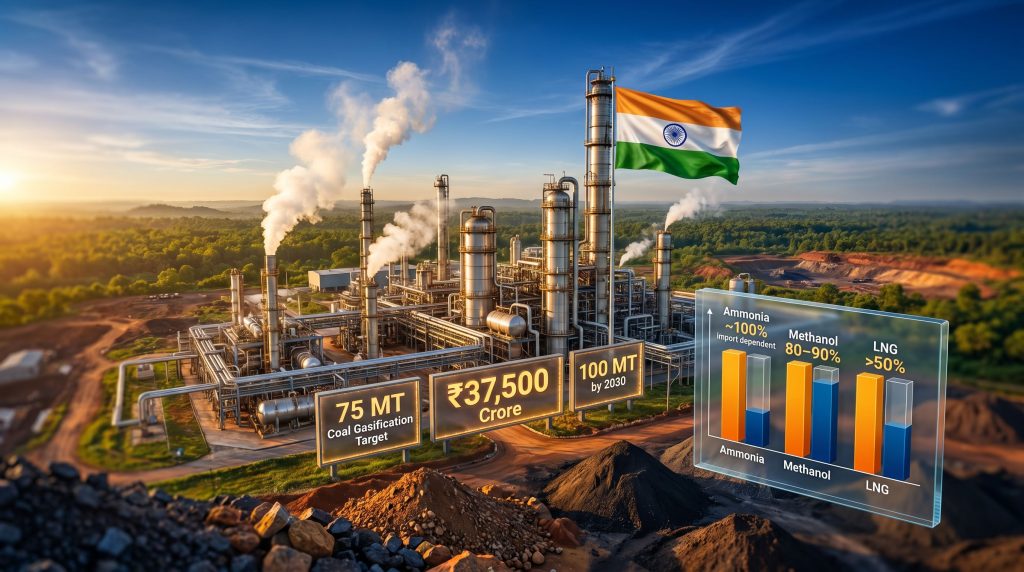
India's position within this dynamic is particularly acute. The country currently imports more than 50% of its LNG demand, approximately 100% of its ammonia requirements, between 80% and 90% of its methanol consumption, and around 20% of its urea demand, according to official government data accompanying the scheme's approval. These are not marginal dependencies — they represent structural foreign exchange outflows embedded in the very foundations of India's industrial economy.
The India coal gasification scheme, approved by the Union Cabinet with a financial outlay of ₹37,500 crore, represents India's most substantial policy response to this problem. However, understanding why this programme is meaningful requires looking beyond the headline figure and examining what it is actually trying to solve.
When big ASX news breaks, our subscribers know first
Why India's Coal Reserves Represent an Underutilised Strategic Asset
The Gap Between Resource Ownership and Industrial Utilisation
India holds one of the world's largest proven coal and lignite reserve bases, yet the overwhelming majority of this resource has historically been directed toward a single application: direct combustion for electricity generation. This single-use orientation has created a paradox — India sits atop vast domestic energy resources while simultaneously spending significant foreign exchange to import the chemical building blocks that coal could theoretically produce.
The concept underpinning coal gasification is chemically straightforward: rather than burning coal to release heat, gasification converts it into syngas (a mixture of hydrogen and carbon monoxide) through a controlled reaction with steam and oxygen at high temperatures. This syngas then becomes the feedstock for producing methanol, ammonia, synthetic natural gas, and other industrial chemicals. In effect, gasification transforms a combustion fuel into a versatile chemical precursor.
The economic logic follows directly. If India can produce ammonia domestically from its own coal rather than importing it at international spot prices, it insulates its fertilizer sector from global price cycles. The same logic applies to methanol, where India's near-total import reliance makes domestic industries vulnerable to price movements driven by production decisions in China, the Middle East, and the United States. These broader energy security challenges underscore why the policy case for gasification has strengthened considerably in recent years.
Lignite's Role as an Often-Overlooked Contributor
Lignite — sometimes called brown coal due to its lower carbon content and higher moisture levels compared with bituminous coal — is often considered a lower-grade resource with limited economic potential. However, the India coal gasification scheme explicitly includes lignite alongside coal as a gasification feedstock, a design choice that carries meaningful geographic implications.
Lignite deposits in India are concentrated predominantly in Rajasthan, Tamil Nadu, and Gujarat — states that sit outside the primary coal belt of Jharkhand, Odisha, and Chhattisgarh. By including lignite within the scheme's scope, the programme effectively extends its geographic reach and allows states with lignite reserves but limited bituminous coal access to participate in the domestic chemical production transition.
What Is the India Coal Gasification Scheme? A Structural Breakdown
Scheme Architecture: Incentive Design and Financial Parameters
The scheme's design reflects a deliberate choice to employ market mechanisms over direct subsidy allocation. Rather than providing blanket capital grants, the government has structured incentives as competitive, milestone-linked payments tied to demonstrable project progress — a framework that prioritises fiscal discipline and performance accountability.
The scheme's capital-cost incentive model directly addresses the fundamental economics of gasification: the challenge is not ongoing production cost competitiveness but the high upfront capital barrier that makes projects difficult to finance without de-risking instruments.
The key financial parameters are summarised below:
| Parameter | Detail |
|---|---|
| Total Financial Outlay | ₹37,500 crore |
| Incentive Cap (% of Cost) | Up to 20% of plant and machinery costs |
| Per-Project Cap | ₹5,000 crore |
| Per-Product Category Cap | ₹9,000 crore (excluding SNG and urea) |
| Per-Entity Group Cap | ₹12,000 crore across all projects |
| Disbursement Structure | Four equal instalments tied to project milestones |
| Project Selection Method | Competitive bidding process |
The four-instalment disbursement structure is particularly noteworthy from a risk management perspective. By linking payments to milestones rather than disbursing capital upfront, the government retains fiscal protection against projects that fail to progress while still providing meaningful financial commitment that supports early-stage project financing. For private developers, this means demonstrating progress at each stage to unlock subsequent tranches.
The scheme also explicitly permits stacking with other central and state government incentives, including those available under commercial coal mining programmes. This additive design significantly improves project economics compared with schemes where incentive eligibility is mutually exclusive.
Gasification Targets and the 2030 National Roadmap
The scheme sits within a broader national framework targeting 100 million tonnes of coal gasification capacity by 2030, a goal established through the National Coal Gasification Mission. The new incentive programme specifically aims to drive approximately 75 MT of that total, leaving the remaining 25 MT to be achieved through other policy mechanisms and market-driven initiatives.
The scale of anticipated private capital mobilisation is substantial. Government estimates suggest the programme could attract between ₹2.5 lakh crore and ₹3 lakh crore in investment — a figure that would represent one of the largest single-theme capital formation events in India's industrial history if realised. Annual government revenue from coal and lignite utilisation under the programme is estimated at approximately ₹6,300 crore, with additional GST and downstream levy flows on top of that baseline.
Coal Linkage Reform: The Structural Enabler Often Overlooked
One of the most consequential but least-discussed elements of the package is the extension of coal linkage tenure to 30 years for the gasification sub-sector within the Non-Regulated Sector linkage auction framework. In practical terms, this means that approved gasification projects will have contractual certainty over their primary feedstock supply for three decades — a prerequisite that simply did not exist under standard linkage arrangements.
This matters enormously for project financing. Infrastructure-scale gasification facilities require capital expenditures running into thousands of crore rupees, with payback periods extending across multiple decades. Lenders and equity investors performing due diligence on these projects require confidence that feedstock will be available at known price structures throughout the debt tenure. Without the 30-year linkage guarantee, financing committees would face an unbridgeable uncertainty gap, making debt structuring extremely difficult regardless of the project's underlying economics.
What Products Does India's Coal Gasification Programme Target?
From Syngas to Industrial Chemicals: The Downstream Value Chain
Syngas itself is not the end product — it is the platform. From this foundational output, a hierarchy of derivative products becomes accessible through different processing pathways:
- Ammonia: Produced via the Haber-Bosch process using hydrogen derived from syngas; India's near-total import dependency (~100%) makes this the most strategically critical target product
- Methanol: Synthesised directly from syngas; currently 80-90% imported; anchors downstream uses in fuel blending, plastics, and specialty chemicals
- Urea: Derived from ammonia and CO2; approximately 20% of current demand is imported; domestic production reduces agricultural input costs
- Synthetic Natural Gas (SNG): Produced through methanation of syngas; can partially substitute for imported LNG in industrial heating and city gas distribution
- Ammonium Nitrate: An explosives and fertilizer precursor currently heavily import-dependent; included in the scheme's target product list
The inclusion of coking coal substitution as a secondary objective is less widely discussed but potentially significant. India imports substantial volumes of coking coal for steel production, primarily from Australia and North America. Furthermore, gasification pathways using domestic coal can produce syngas-based reducing agents for direct reduced iron (DRI) steelmaking — offering a partial substitution route that would reduce India's exposure to international coking coal price cycles. These developments intersect directly with steel feedstock dynamics playing out across Asian markets more broadly.
How Does the Incentive Structure Compare to Other Indian Industrial Schemes?
Benchmarking Against PLI and Prior Energy Incentive Frameworks
India's Production Linked Incentive scheme has become the dominant template for industrial policy over the past several years, making it the natural benchmark against which the coal gasification scheme should be evaluated. The structural differences between the two approaches are revealing:
| Feature | Coal Gasification Scheme | Production Linked Incentive (PLI) Model |
|---|---|---|
| Incentive Basis | % of capital cost (plant and machinery) | % of incremental sales or output |
| Disbursement Trigger | Project milestones | Production performance |
| Technology Neutrality | Technology-agnostic | Varies by sector |
| Indigenous Tech Preference | Encouraged but not mandatory | Sometimes mandated |
| Stacking with Other Schemes | Explicitly permitted | Varies by scheme |
The capital-cost basis of the coal gasification incentive reflects an accurate diagnosis of the problem. Gasification projects are not struggling to compete on production costs once operational — they struggle to attract the upfront capital required to get built in the first place. PLI-style output incentives would not address this barrier effectively.
Why the Technology-Agnostic Approach Carries Both Promise and Risk
The decision to make the scheme technology-agnostic allows developers to deploy proven international gasification technologies — including entrained flow, fixed bed, and fluidised bed systems — without navigating regulatory technology restrictions. This design choice prioritises near-term deployment speed over technology localisation, which reflects a pragmatic recognition that India has limited commercial-scale gasification experience and cannot afford to restrict the first generation of projects to immature domestic technologies.
However, the risk embedded in this approach is that the "encouraged" preference for indigenous technology development may remain aspirational rather than commercially meaningful. Without scoring advantages in the competitive bidding process, or specific technology development incentive tiers, the market signal for investing in domestic gasification technology may remain too weak. The long-term ambition of reducing dependence on foreign engineering, procurement, and construction contractors requires structured incentives for technology transfer, joint venture requirements, or progressive localisation mandates across successive bidding rounds.
What Are the Economic and Employment Implications?
Job Creation Across Coal-Bearing Regions
The programme's projected employment impact of approximately 50,000 direct and indirect jobs across an estimated 25 projects carries geographic specificity that extends its policy significance beyond pure economics. Coal-bearing regions in Jharkhand, Odisha, Chhattisgarh, and West Bengal have historically faced significant employment challenges as mining mechanisation has reduced direct labour intensity. Gasification complexes, by contrast, require sustained operational workforces in process operations, maintenance, safety management, and logistics — job categories that tend to offer better remuneration profiles than basic mining roles.
The multiplier effect from large chemical production facilities is also substantial. A single gasification-to-methanol complex creates secondary employment across chemical processing, packaging, transportation, utilities, and maintenance services. Consequently, if the scheme successfully anchors downstream chemical parks around gasification facilities, the indirect employment figure could ultimately exceed the direct job creation estimate significantly.
Macroeconomic Import Substitution Value
The foreign exchange savings potential of the programme, if fully realised, would operate across multiple product categories simultaneously:
| Product | Current Import Dependency | Potential Substitution Impact |
|---|---|---|
| LNG | Over 50% of demand | Partial substitution via SNG and methanol fuel switching |
| Ammonia | Approximately 100% of demand | Near-complete domestic coverage potential |
| Methanol | 80-90% of demand | Significant reduction in import expenditure |
| Urea | Approximately 20% of demand | Incremental domestic production increase |
| Coking Coal | Substantial import volumes | Partial substitution via syngas-DRI steelmaking |
The cumulative foreign exchange benefit of meaningfully reducing dependencies across these product categories would be substantial. In particular, India LNG import taxes and pricing structures mean that ammonia and LNG are both priced in US dollars and subject to significant international price volatility. During periods of global commodity price stress — such as the 2022 energy crisis — India's import bills in these categories expanded sharply, underscoring the macroeconomic case for domestic production alternatives.
The next major ASX story will hit our subscribers first
How Does India's Coal Gasification Policy Fit Within the Global Energy Transition Debate?
The Climate Tension: Cleaner Utilisation Versus Fossil Fuel Lock-In
Coal gasification occupies genuinely contested territory within decarbonisation frameworks, and it is important to engage with this tension honestly rather than dismissing it. The scheme frames the technology as enabling "cleaner utilisation of domestic coal resources" compared with direct combustion — a characterisation that is technically accurate in specific dimensions (higher efficiency, potential for carbon capture integration) but does not eliminate the fundamental carbon challenge.
Gasification produces syngas from coal, and the carbon content of that coal must go somewhere. Without carbon capture, utilisation, and storage (CCUS) integration, the CO2 generated during gasification is released to atmosphere, either directly or embedded in downstream products that are eventually consumed. The scheme currently does not mandate CCUS — a deliberate choice that prioritises near-term commercial viability over low-carbon performance. Whether CCUS requirements will be introduced as eligibility conditions in future bidding rounds remains an open and important policy question.
Comparing India's Approach to Global Coal Gasification Strategies
India's policy framework gains additional context when viewed against how other major economies have approached the same technology:
| Country or Region | Strategic Focus | Climate Integration Approach |
|---|---|---|
| India | Import substitution, chemical feedstocks, energy security | Technology-agnostic; CCUS not currently mandated |
| China | World's largest gasification capacity; chemicals and SNG | Scale-first approach; selective CCUS pilots |
| United States | Historical industrial base; pivot toward hydrogen and CCUS | DOE-funded CCUS integration programmes |
| South Africa (Sasol) | Synfuels from coal via long-established CTL operations | Under significant decarbonisation pressure |
China's experience is particularly instructive for India. China developed its coal gasification capacity at massive scale over the past two decades primarily through industrial policy prioritising domestic energy and chemical security, with climate integration following rather than leading deployment. The productivity gains and technology learning that resulted from that scale have since enabled more sophisticated CCUS integration pilots. India appears to be following a broadly analogous sequencing — prioritise commercial viability and scale first, then integrate decarbonisation pathways as the technology ecosystem matures.
Where Hydrogen Fits Into the Gasification Roadmap
A dimension of India's coal gasification programme that rarely receives adequate attention is its relationship to the country's separate National Green Hydrogen Mission. Coal gasification produces hydrogen as a component of syngas, and with CCUS integration, this pathway can yield what the energy industry terms blue hydrogen — hydrogen produced from fossil fuels with carbon capture. India's green hydrogen mission pursues green hydrogen via electrolysis powered by renewable energy.
These are not inherently competing pathways, but they do represent different cost curves, technology readiness levels, and capital requirements. Blue hydrogen from gasification is currently cost-competitive with green hydrogen in most scenarios, but green hydrogen costs are falling rapidly as electrolyser technology scales. The policy design question — whether coal gasification creates a bridge toward a hydrogen economy or locks in a competing production pathway — will become increasingly important as both programmes scale. This debate also intersects with green steel economics, where hydrogen sourcing decisions are similarly contested.
What Is the Timeline of India's Coal Gasification Policy Evolution?
From Mission Statement to Capital Commitment
The progression of India's coal gasification policy reveals a characteristic pattern of industrial strategy development: extended gestation, incremental policy scaffolding, and then a concentrated capital commitment once enabling conditions converge.
- Pre-2021: Coal gasification discussed as a long-term diversification option within India's coal sector planning frameworks; no structured commercial incentive programme existed
- 2021-2022: Government announces formal policy support intent; the National Coal Gasification Mission establishes the 100 MT by 2030 target; early project identification begins but large-scale capital commitment does not follow immediately
- 2023-2024: Incremental linkage policy adjustments and smaller incentive announcements; private sector interest grows but project economics remain challenging without comprehensive support structures
- 2025-2026: Union Cabinet approves the ₹37,500 crore scheme; coal linkage tenure extended to 30 years; competitive bidding framework established; the most comprehensive financial commitment to coal gasification in India's policy history
The shift from mission declaration to milestone-linked competitive bidding signals that policymakers have moved beyond aspirational frameworks and are now deploying structured market mechanisms designed to drive actual investment outcomes rather than stated intentions.
Key Risks and Implementation Challenges
Capital Deployment and Project Execution Risks
Despite the scheme's structural sophistication, substantial execution risks remain that investors and policymakers should assess carefully:
- High ash content challenge: Indian coal is characterised by elevated ash content relative to international benchmarks, creating specific technical difficulties for entrained flow gasifiers (which dominate global commercial installations) and potentially requiring technology modifications that increase capital costs and reduce efficiency
- Technology risk: India has limited domestic experience operating commercial-scale surface gasification facilities, meaning early projects will face steeper learning curves than comparable investments in China or the United States
- EPC dependency: Near-term reliance on foreign engineering contractors increases project costs and introduces procurement lead time risks; the scheme's ambition to build domestic EPC capability requires parallel investment that is not yet visible at scale
- Water intensity: Gasification processes are significantly water-intensive, and India's coal-bearing regions include areas facing existing water stress — a constraint that could limit project siting options and create community opposition
- Offtake development: Downstream chemical and fuel markets must develop in parallel with gasification capacity; if methanol or ammonia production ramps up faster than domestic offtake infrastructure, project economics will be strained
Financial Viability Under Commodity Price Scenarios
The economic rationale for domestic coal gasification is fundamentally sensitive to the price differential between imported alternatives and domestically produced substitutes. If global LNG, ammonia, or methanol prices decline sharply — whether through technology improvements in producing regions, geopolitical resolutions, or demand contraction — the import substitution economics that underpin the scheme's commercial logic weaken correspondingly.
The milestone-linked disbursement structure protects public fiscal exposure, but it creates a potential cash flow challenge for project developers during multi-year construction phases. Projects relying partly on incentive receipts to service construction financing would face timing mismatches between capital expenditure requirements and incentive disbursement, potentially requiring bridge financing arrangements that add cost and complexity to project structures.
Regulatory and Environmental Clearance Bottlenecks
Large industrial facilities in coal-bearing regions require environmental impact assessments, forest clearances, and various statutory approvals that have historically introduced multi-year delays into Indian infrastructure projects. Gasification complexes — which combine coal handling, high-temperature processing, chemical synthesis, and storage — face particularly complex regulatory evaluation processes. Without streamlined clearance pathways specifically designed for gasification projects, the gap between policy approval and actual project commissioning could be substantially longer than the scheme's timeline implies. The global steel outlook offers a comparable lesson: industrial policy ambition frequently outpaces regulatory infrastructure, creating execution delays that compress projected returns.
Frequently Asked Questions: India Coal Gasification Scheme
What is the India coal gasification scheme?
The India coal gasification scheme is a Union Cabinet-approved programme with a total financial outlay of ₹37,500 crore, designed to incentivise new surface coal and lignite gasification projects for producing syngas and downstream industrial products including methanol, ammonia, urea, and synthetic natural gas. The scheme was approved in May 2026 and operates through a competitive bidding process with milestone-linked incentive disbursements.
How much coal does the scheme target for gasification?
The scheme targets approximately 75 million tonnes of coal and lignite under its incentive framework, contributing toward India's national objective of reaching 100 million tonnes of coal gasification capacity by 2030.
What financial incentives are available under the scheme?
Incentives are structured as a capital cost subsidy capped at 20% of plant and machinery expenditure. Additional caps apply: ₹5,000 crore per individual project, ₹9,000 crore per product category (excluding SNG and urea), and ₹12,000 crore per entity group across all projects. Payments are disbursed in four equal milestone-linked instalments and can be stacked with other central and state government incentives.
Why is India pursuing coal gasification?
India's core motivation is reducing structural import dependency across multiple critical industrial products. More than 50% of LNG demand, approximately 100% of ammonia requirements, 80-90% of methanol consumption, and roughly 20% of urea needs are currently sourced from international markets. Converting domestic coal and lignite reserves into these products through gasification would reduce foreign exchange outflows, insulate Indian industries from international price volatility, and strengthen food and energy security simultaneously.
How many jobs could the coal gasification scheme create?
Government estimates project approximately 50,000 direct and indirect jobs across around 25 projects concentrated in India's coal-bearing regions, including Jharkhand, Odisha, Chhattisgarh, West Bengal, and Rajasthan for lignite-focused facilities.
Is the scheme compatible with India's climate commitments?
This remains an evolving policy question. The scheme positions coal gasification as enabling cleaner utilisation of domestic coal compared with direct combustion and does not currently mandate carbon capture integration. The relationship between this programme and India's green hydrogen ambitions, net-zero commitments, and future CCUS policy frameworks will be a critical determinant of the scheme's long-term climate compatibility. This article does not constitute financial or investment advice. Projections and government estimates referenced are subject to change. Readers should conduct independent assessment before making investment or policy decisions.
Strategic Outlook: What the ₹37,500 Crore Commitment Signals for Industry and Investors
Reading the Policy Signal Correctly
The scale of the financial commitment and the structural sophistication of its design communicate something important beyond the headline number: coal gasification in India has transitioned from aspirational policy language into a funded programme with defined market mechanisms, supply-side reforms, and performance accountability structures. These are the hallmarks of a programme that has moved through the design phase and is approaching implementation.
For long-duration infrastructure investors, the 30-year coal linkage tenure extension is arguably the most consequential single element of the package. It removes a supply-side uncertainty that previously prevented meaningful project financing conversations by providing contractual feedstock certainty that aligns with the debt tenure requirements of infrastructure capital.
The Secondary Industrial Policy Outcome
If the ₹2.5 to ₹3 lakh crore in projected private investment materialises, the downstream effects extend well beyond the gasification facilities themselves. A domestic gasification technology and equipment manufacturing sector, an indigenous EPC engineering capability, and the chemical parks that would anchor around production facilities all represent secondary industrial policy outcomes that compound the programme's direct economic value over time. The scheme's stated ambition to reduce dependence on foreign engineering contractors and strengthen India's domestic gasification technology ecosystem signals that policymakers are thinking in these multi-order terms.
The India coal gasification scheme, viewed in its entirety, represents a sophisticated attempt to leverage a domestic resource surplus to address multiple structural import dependencies simultaneously — using industrial policy architecture that has been refined through the lessons of previous programmes. Whether it succeeds will depend substantially on execution quality, environmental clearance timelines, and whether commodity price dynamics remain supportive of the underlying import substitution economics.
Readers seeking additional context on India's energy security strategy and coal sector policy evolution may find value in reviewing ongoing coverage from ET EnergyWorld at energy.economictimes.indiatimes.com, which provides detailed reporting on India's coal and energy transition landscape. This article is for informational purposes only and does not constitute financial or investment advice.
Want to Track the ASX Companies Positioned to Benefit From the Global Shift Toward Energy and Resource Security?
Discovery Alert's proprietary Discovery IQ model delivers real-time alerts the moment significant mineral discoveries are announced on the ASX, transforming complex geological data into clear, actionable opportunities across more than 30 commodities — ideal for investors seeking exposure to the resources driving industrial and energy transitions. Explore how major discoveries have historically generated exceptional returns on Discovery Alert's dedicated discoveries page, and begin your 14-day free trial today to position yourself ahead of the broader market.