June 23, 2026
The Hidden Fragility Behind North America's Aluminium Supply Chain
The aluminium flat-rolled products industry operates on a deceptively thin margin of resilience. While modern manufacturing facilities project an image of robust, continuous production, the reality is that a handful of highly specialised facilities shoulder the entire burden of supplying automotive-grade sheet to some of the world's largest vehicle manufacturers. When even one of these nodes fails, the consequences extend far beyond the facility gates, threading through supplier networks, assembly schedules, and ultimately, the financial statements of companies across multiple sectors.
The Novelis Oswego hot mill restart after fires has become one of the most closely watched industrial recovery stories in recent aluminium industry history, not simply because of the scale of financial damage involved, but because of what it reveals about the structural vulnerabilities embedded in concentrated, specialised manufacturing ecosystems. Understanding this story requires looking beyond the incident chronology and examining the deeper mechanics of how hot mill infrastructure functions, why it cannot be easily replicated, and what the recovery trajectory tells investors, supply chain planners, and industry observers about the future of aluminium manufacturing resilience. Furthermore, shifts in aluminium and alumina markets across the globe have only amplified the scrutiny on facilities like Oswego.
When big ASX news breaks, our subscribers know first
Understanding the Oswego Facility's Role in North American Aluminium Supply
Why Hot Mill Capacity Is Not Interchangeable
Before examining what happened at Oswego, it is worth understanding precisely what a hot mill does and why its disruption carries consequences that ripple far beyond the facility itself.
A hot mill is where cast aluminium ingots undergo their first transformation into usable sheet product. Ingots are heated to temperatures typically ranging between 400°C and 550°C and then passed through a series of rolling stands that progressively reduce their thickness while simultaneously developing the microstructural properties that determine the final product's mechanical performance. This thermal mechanical processing is irreplaceable in the production sequence. Without it, cold mills, finishing lines, and downstream fabricators have no material to work with.
What makes hot mills particularly difficult to substitute in the short term is the combination of several compounding factors:
- Capital investment thresholds typically exceeding USD 500 million for a new installation
- Construction and commissioning timelines ranging from 24 to 36 months for a greenfield facility
- Extended automotive qualification periods requiring 12 to 18 months of production trials before OEM approval
- Highly specialised workforce requirements covering metallurgical, mechanical, and process control expertise
- Physical infrastructure demands including reinforced foundations capable of supporting multi-hundred-tonne roll stands and overhead crane systems
The following comparison illustrates the structural differences between hot mill operations and other facility functions:
| Facility Function | Restart Complexity | Alternative Sourcing Feasibility | Typical Lead Time After Major Damage |
|---|---|---|---|
| Hot Mill | Very High | Very Limited | 6–18 months |
| Cold Mill | Moderate | Moderate | 3–9 months |
| Finishing Lines | Low–Moderate | Moderate–High | 1–6 months |
| Recycling and Casting | Low | High | 1–4 months |
This asymmetry in recovery complexity explains why the Oswego situation attracted such intense attention from automotive manufacturers, aluminium analysts, and supply chain risk managers from the moment the first fire was reported.
Oswego's Position Within Novelis' North American Network
Novelis operates as one of the top aluminium producers of rolled products globally, with Oswego serving as a critical production node for automotive-grade aluminium sheet in North America. The facility's specialisation in 5000 and 6000 series aluminium alloys places it at the centre of the automotive lightweighting trend, where manufacturers are increasingly substituting steel with aluminium across body panels, closures, and structural components to meet fuel efficiency and emissions targets.
Only a small number of facilities across North America are certified to produce aluminium sheet meeting current automotive OEM body panel specifications. This concentration of qualified capacity amplifies the impact of any single facility disruption, creating a supply pinch point that cannot be quickly resolved through alternative sourcing.
A Two-Fire Crisis: The Oswego Incident Across Two Separate Events
The September 2025 Fire and Initial Recovery Planning
The first fire at the Oswego hot mill occurred in September 2025. The incident was contained to the hot mill area, and all employees were evacuated safely with no injuries reported. While the structural and equipment damage within the hot mill zone was significant, critically, other operational areas of the facility remained fully intact and continued functioning throughout the disruption.
The assets that remained unaffected included:
- Cold mill operations
- Finishing lines
- Recycling and casting facilities
- Heat treatment systems
This operational segmentation within the facility's design proved essential to limiting the total financial damage, even though the hot mill's centrality to the overall production sequence meant that total rolled product output was severely constrained regardless of which adjacent systems remained operational.
Initial recovery projections following the September incident targeted an early 2026 restart, and repair crews were mobilised during October and November 2025 with revised targets pointing toward late Q2 calendar 2026.
The November 2025 Second Fire: Compounding Risk During Active Repairs
What transformed a significant but manageable industrial incident into a more complex multi-phase recovery scenario was the occurrence of a second fire at Oswego on 20 November 2025, precisely during the active restoration period. This second incident disrupted previously established repair schedules and created what operational risk specialists describe as a cascading failure dynamic, where an initial disruption generates conditions that elevate vulnerability to subsequent incidents during the recovery phase.
Recovery operations during a fire restoration involve temporary structures, interim power systems, and construction activities that inherently carry different risk profiles to routine operations. Safety management protocols developed for normal production environments do not always fully account for the dynamic hazard profile of emergency restoration work, creating potential gap areas that can contribute to secondary incidents.
Despite the second fire, cold mill and heat treatment operations resumed by the morning of 21 November 2025, further demonstrating the effective physical separation between the hot mill zone and the rest of the production complex.
Timeline Reconstruction: How Restart Estimates Shifted
| Milestone | Date / Period | Projected Restart Timeline |
|---|---|---|
| First fire occurs | September 2025 | Early 2026 |
| Repair crews mobilised | October–November 2025 | Late Q2 calendar 2026 |
| Second fire during repairs | 20 November 2025 | Timeline uncertainty increases |
| Ford's communicated expectation | Late November 2025 | Late November / Early December 2025 |
| Official company guidance | May 2026 | Within weeks, ahead of June end target |
| Confirmed restart trajectory | May 2026 | Weeks ahead of prior schedule |
What Did the Fires Actually Cost? Breaking Down the Financial Damage
Quantifying the Full Financial Impact
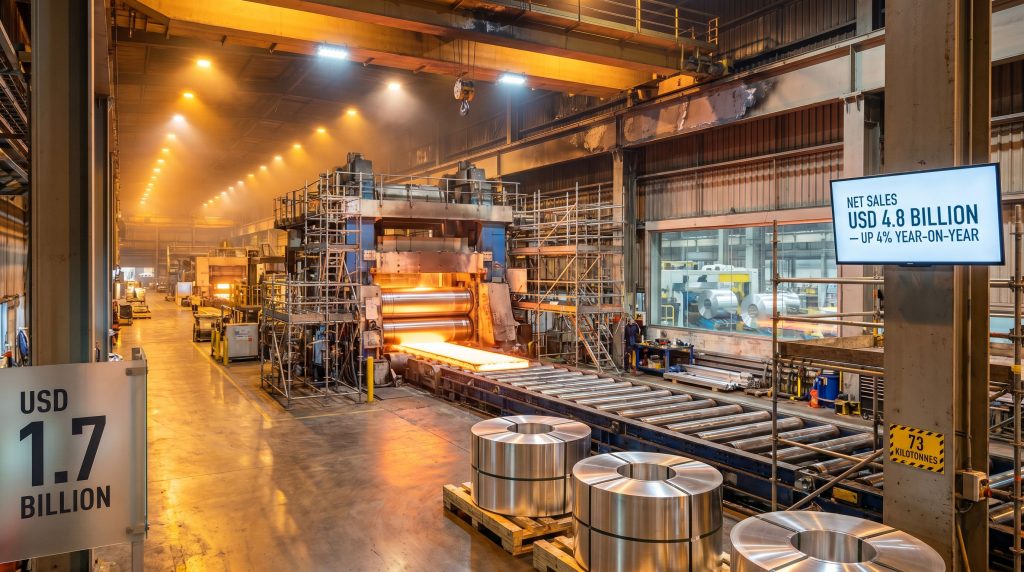
The combined financial damage from both fire events at the Oswego facility reached approximately USD 1.7 billion, representing one of the most significant insured industrial losses in recent North American manufacturing history. The breakdown of financial consequences reveals several distinct dimensions:
- Reduction in rolled product shipments attributable to production interruptions: approximately 73 kilotonnes
- Negative impact on adjusted EBITDA from the production shortfall: approximately USD 53 million
- Shift from net income of USD 294 million in the prior year to a net loss of USD 84 million
- Net sales performance despite operational disruption: USD 4.8 billion, representing 4% year-on-year growth
The 4% revenue growth achieved despite fire-related disruptions illustrates a critical dynamic in commodity-intensive manufacturing: when market prices for the underlying commodity rise sufficiently, revenue can increase even as physical volumes decline. This creates a situation where headline financial performance can be misleading as an indicator of operational health during recovery periods.
The Aluminium Price Effect: Revenue Resilience vs. Operational Recovery
The distinction between price-driven revenue resilience and volume-driven operational recovery is particularly important for analysts evaluating Novelis' financial position during this period. Net sales growth of 4% to USD 4.8 billion, driven primarily by elevated aluminium prices rather than shipment volume recovery, does not reflect a return to full operational capacity. Instead, it illustrates how commodity price appreciation can partially offset volume losses at the revenue line while margin recovery remains incomplete due to the fixed cost burden of maintaining partially idle infrastructure.
This dynamic creates what financial analysts sometimes describe as a "false positive" in revenue-focused analysis, where surface-level growth metrics obscure underlying operational underperformance. A more accurate picture of operational health during this period emerges from the adjusted EBITDA and net income figures, both of which clearly reflect the material impact of reduced throughput volumes. Consequently, broader green metals pricing trends have added further complexity to how such revenue figures are interpreted across the sector.
Capital Allocation Complexity During Recovery
The financial management challenge facing Novelis extended beyond quantifying losses. The company simultaneously needed to:
- Fund emergency restoration at Oswego, involving specialised contractors, equipment procurement with extended lead times, and complex structural repairs
- Navigate property and business interruption insurance claims processes, which for incidents of this magnitude typically involve extended assessment periods before funds are released
- Continue progressing the commissioning of the Bay Minette aluminium plant in Alabama, a strategically critical investment representing the company's long-term North American capacity expansion
- Maintain customer relationship management across automotive OEM accounts facing their own production planning disruptions
Managing these competing capital demands simultaneously represents a significant organisational and financial challenge, particularly when insurance recovery timelines may not align with the urgent capital requirements of emergency restoration work.
How Did the Fires Affect Automotive Supply Chains?
Novelis as a Tier-1 Automotive Aluminium Supplier
The automotive industry's transition toward aluminium-intensive vehicle architectures has created deep structural dependencies on a small number of qualified hot mill suppliers. Modern light-duty vehicles now incorporate an average of over 200 kg of aluminium per vehicle, compared to approximately 150 kg a decade ago, with body sheet representing one of the fastest-growing application segments as manufacturers pursue lightweighting strategies to meet increasingly stringent emissions regulations.
Ford Motor Company's direct exposure to the Oswego disruption became publicly evident when the company communicated its own timeline expectations for hot mill restoration in late November 2025, projecting resolution by late November or early December of that year. The divergence between Ford's communicated expectation and Novelis' actual recovery trajectory highlights how automotive OEMs and their suppliers can hold materially different assessments of recovery timelines, with suppliers operating closer to the technical realities of complex restoration work and customers often projecting more optimistic scenarios based on operational urgency.
How Automotive OEMs Manage Supplier Disruptions
When a critical tier-1 supplier experiences extended downtime, automotive manufacturers typically deploy a combination of mitigation strategies:
- Strategic inventory draw-down: Utilising pre-built buffer stocks of aluminium sheet, though these typically provide weeks rather than months of coverage
- Production scheduling adjustments: Resequencing vehicle production to prioritise models with alternative material specifications or from less affected platforms
- Dual-sourcing activation: Engaging secondary qualified suppliers, though for specialised automotive-grade aluminium sheet, the pool of qualified alternatives is extremely limited
- Direct technical collaboration: Deploying engineering resources to support supplier recovery efforts, reflecting the high cost of production stoppages at assembly plants
The pent-up demand dynamics in aluminium flat-rolled supply chains are particularly complex because automotive production schedules operate with rigid forward planning horizons. When a key supplier resumes output, the ramp-up period, not simply the restart date, determines when downstream manufacturers can fully normalise operations. Gradual volume builds during commissioning phases can create continued downstream planning challenges even after a formal restart announcement.
North American Hot Mill Capacity Constraints
The structural limitation of North American hot mill capacity dedicated to automotive applications means that substitute sourcing for the volumes lost at Oswego during the disruption period was not practically achievable at scale. This reality forced automotive manufacturers to absorb some level of production impact rather than simply redirecting procurement to alternative suppliers, reinforcing the systemic nature of single-facility disruptions in a concentrated supply infrastructure. In addition, ongoing US aluminium tariffs have further constrained the ability of OEMs to source equivalent materials from international alternatives.
Is the Oswego Restart Ahead of Schedule a Genuine Recovery Signal?
What Accelerated Commissioning Actually Means
Novelis' May 2026 confirmation that hot mill commissioning was progressing faster than previously estimated, positioning restart within weeks ahead of the end-of-June target, represents a positive operational signal. However, the distinction between commissioning commencement and full production capacity is critical for accurately interpreting the recovery trajectory.
Hot mill recommissioning involves a sequential series of milestones, each of which must be successfully completed before the next phase can begin:
- Structural integrity verification of crane runways, foundations, and equipment supports
- Electrical system recertification for high-power drive systems and control infrastructure
- Mechanical alignment of roll stands to precision tolerances measured in microns
- Hydraulic system commissioning and pressure testing of roll gap control systems
- Thermal system qualification including reheating furnace performance verification
- Trial rolling with test material to verify strip quality and process consistency
- Automotive qualification trials producing material for OEM laboratory testing and approval
- Ramp-up to commercial production with progressive volume increases
The formal restart announcement typically corresponds to Steps 1 through 5 being substantially complete, while Steps 6 through 8 can extend over several additional months before full shipment normalisation is achieved.
Scenario Analysis: Three Possible Post-Restart Trajectories
Scenario A: Accelerated Recovery (Optimistic)
The hot mill achieves near-full capacity within 60 to 90 days of restart, with pent-up demand absorbed within one to two fiscal quarters. Adjusted EBITDA recovers toward prior-year levels by the end of calendar 2026. This scenario assumes smooth qualification trials and rapid automotive OEM recertification, which is achievable if the recommissioned equipment demonstrates consistent metallurgical performance from early in the ramp-up phase.
Scenario B: Gradual Normalisation (Base Case)
Ramp-up extends over four to six months due to quality recertification requirements and workforce reintegration. Shipment normalisation occurs progressively through the second half of calendar 2026. Revenue growth continues but margin recovery lags due to elevated operating costs during the ramp-up phase, including premium contractor costs and higher energy consumption per tonne during low-throughput operation.
Scenario C: Extended Disruption (Downside)
Unforeseen technical or structural issues delay full capacity restoration beyond Q3 2026. Automotive customers accelerate alternative sourcing arrangements, potentially establishing new qualified supply relationships that could reduce Oswego's long-term market share even after full recovery. Financial recovery is pushed into fiscal year 2027.
The next major ASX story will hit our subscribers first
What Is Novelis' Broader Strategic Position Beyond Oswego?
The Bay Minette Commissioning: Parallel Complexity
The Oswego recovery is occurring simultaneously with one of Novelis' most significant strategic initiatives: the commissioning of a new aluminium plant in Bay Minette, Alabama. This greenfield facility represents a major expansion of the company's North American production footprint and carries a distinct product mix profile from Oswego's hot mill operations.
Managing simultaneous major operational projects — one being emergency recovery from fire damage and the other being the commissioning of a new greenfield facility — creates organisational complexity that extends across engineering, procurement, project management, and financial resources. The ability to maintain progress on both fronts simultaneously reflects significant organisational capability and resource depth.
Novelis leadership has indicated the company is focused on completing both the Novelis Oswego hot mill restart after fires and the Bay Minette commissioning as concurrent strategic priorities, along with maintaining customer delivery commitments across its broader product portfolio. The company has expressed confidence in its ability to serve growing market demand for high-recycled-content, low-carbon aluminium. Furthermore, the recovery period has been positioned as a foundation for capturing structurally expanding demand rather than merely returning to pre-disruption operational levels.
The Low-Carbon Aluminium Opportunity
Beyond immediate recovery considerations, the Oswego restart connects to a broader strategic opportunity in the aluminium market. Automotive manufacturers, consumer goods companies, and packaging producers are increasingly specifying low-carbon, high-recycled-content aluminium as part of their supply chain sustainability commitments.
Novelis has positioned its recycling-intensive production model as a competitive advantage in meeting this demand. The Oswego facility's recycling and casting operations, which remained operational throughout both fire incidents, are central to delivering on this value proposition. The growing premium that end markets are willing to pay for certified low-carbon aluminium creates an economic incentive that extends well beyond simple volume recovery, potentially positioning Novelis to capture improved margins on Oswego output following the restart. This mirrors the broader approach to aluminium operations in Gladstone, where low-carbon positioning is similarly reshaping long-term commercial strategy.
Frequently Asked Questions: Novelis Oswego Hot Mill Restart
When is the Novelis Oswego hot mill expected to restart?
As of May 2026, Novelis confirmed the hot mill is expected to resume production within a matter of weeks, ahead of the previously communicated end-of-June 2026 target. Commissioning activities have been progressing faster than originally projected, though the distinction between restart and full production normalisation remains important for assessing the complete recovery timeline.
How many fires occurred at the Oswego plant?
Two separate fire incidents affected the Oswego facility. The first occurred in September 2025 and the second on 20 November 2025 during active repair work on damage from the initial incident. Both fires were contained to the hot mill area, and no injuries were reported during either event.
What was the total financial impact of the Oswego fires?
The combined estimated financial impact from both fire events reached approximately USD 1.7 billion. Production losses reduced rolled product shipments by around 73 kilotonnes, contributing to an adjusted EBITDA impact of approximately USD 53 million and a net loss of USD 84 million for the relevant reporting period.
Were any other parts of the Oswego plant affected?
No. Cold mill operations, finishing lines, and recycling and casting facilities remained operational throughout both incidents. These areas were not damaged by either fire, and cold mill and heat treatment operations resumed the morning after the second fire in November 2025.
How did the fires affect Novelis' overall revenue?
Despite fire-related disruptions and a net loss position, Novelis reported a 4% year-on-year increase in net sales to USD 4.8 billion, largely supported by higher prevailing aluminium prices rather than volume recovery.
What is Novelis building at Bay Minette?
Novelis is commissioning a new aluminium plant in Bay Minette, Alabama, representing a significant strategic expansion of the company's North American production footprint. This initiative is proceeding as a concurrent priority alongside the Oswego hot mill recovery effort.
Key Takeaways: What Oswego Reveals About Industrial Resilience in Aluminium Manufacturing
Structural Lessons for the Aluminium Sector
The Oswego incident offers a series of important structural lessons for aluminium manufacturers, supply chain planners, and investors:
- Concentration risk in specialised hot mill capacity remains one of the most underappreciated vulnerabilities in the aluminium flat-rolled products sector, where a small number of facilities serve disproportionately large shares of total automotive demand
- Sequential disruption events require fundamentally different business continuity frameworks than single-incident scenarios, with dedicated protocols for managing recovery operations safely without creating compounding risks
- Financial resilience through commodity price exposure can partially offset volume-related losses at the revenue level but does not address underlying margin and profitability impacts from reduced throughput
- Accelerated restart timelines signal effective crisis management, contractor mobilisation capability, and supply chain agility in sourcing replacement equipment, even when the full volume recovery trajectory extends well beyond the formal restart announcement
- Pent-up demand dynamics following extended supply disruptions can support above-normal shipment volumes during the ramp-up phase, potentially accelerating the financial recovery trajectory if hot mill performance qualifies quickly for automotive production
Implications for Automotive Supply Chain Planning
The Oswego disruption strengthens the business case for increased supply chain diversification among automotive OEMs reliant on aluminium sheet. The practical limitations of such diversification, given the small number of qualified suppliers and the lengthy qualification timelines involved, mean this is a medium to long-term strategic objective rather than a short-term operational fix.
The longer-term structural opportunity lies in the intersection of hot mill capacity recovery and the accelerating demand for low-carbon aluminium sheet as automotive manufacturers pursue lifecycle emissions reductions across their vehicle fleets. For Novelis, the Novelis Oswego hot mill restart after fires represents not simply a return to baseline operations but a re-entry into a market that has continued to evolve in favour of the low-carbon, high-recycled-content aluminium positioning that the company has built as its core strategic differentiator.
This article is intended for informational purposes only and does not constitute financial advice. Forward-looking statements, scenario projections, and timeline estimates are subject to material uncertainty and should not be relied upon as predictions of future outcomes. Readers should conduct their own due diligence before making any investment or operational decisions based on the information presented.
Want To Stay Ahead of Major Commodity Disruptions and Market-Moving Discoveries?
Discovery Alert's proprietary Discovery IQ model delivers real-time alerts on significant ASX mineral discoveries, instantly translating complex commodity data into actionable investment insights — the same analytical edge that matters when supply chain shocks like Oswego ripple across global aluminium markets. Explore historic discovery returns on Discovery Alert's dedicated discoveries page and begin your 14-day free trial today to position yourself ahead of the broader market.