
August 22, 2026
When Tax Policy Becomes the Product: How Fiscal Design Shapes Upstream Investment Decisions
There is a paradox at the heart of mature basin management that rarely receives the analytical attention it deserves. The moment a government extracts maximum fiscal value from an ageing hydrocarbon province is often the same moment it accelerates that province's terminal decline. Operators do not simply absorb higher tax rates and continue investing at the same pace. They recalibrate, reprioritise, and ultimately redirect capital toward jurisdictions where the risk-adjusted return clears the hurdle. What looks like a windfall from a treasury perspective frequently reads as an exit signal from a boardroom.
This mechanism sits at the centre of what is arguably the most consequential upstream divestment in recent UK energy history. BP's decision to launch a formal sale process for its BP UK North Sea business portfolio, announced on 31 July 2026, is not primarily a story about one company's strategic pivot. It is a case study in how fiscal regime design determines the long-term trajectory of an entire producing basin. Furthermore, the broader trade war economic impact on energy markets adds another layer of complexity to how operators are reassessing long-term capital commitments.
When big ASX news breaks, our subscribers know first
Sixty Years in One Portfolio: What BP Is Actually Selling
Understanding the significance of this transaction requires appreciating the geological and commercial weight of the assets involved. This is not a collection of tail-end producing fields being quietly offloaded to reduce decommissioning exposure. The portfolio contains some of the most substantive remaining upstream positions on the UK continental shelf.
The five production hubs at the centre of the sale process span two distinct operational theatres:
- Andrew (Central North Sea) — an established production hub with existing infrastructure and tieback optionality
- Etap (Central North Sea) — includes the Murlach field tieback, which came onstream in 2025, signalling that BP has continued investing in the portfolio even as the fiscal environment deteriorated
- Glen Lyon (West of Shetland) — a floating production, storage and offloading vessel operation in a region characterised by more technically challenging and weather-exposed conditions
- Clair (West of Shetland) — described by BP as the largest oil field on the UK continental shelf, carrying an estimated 7 billion barrels of oil in place, a resource base that gives any acquirer genuine multi-decade optionality
- Clair Ridge (West of Shetland) — the second development phase at Clair, which commenced production in 2018 and was engineered to recover an estimated 640 million barrels
The combined production profile of this portfolio is material by any measure:
| Metric | Figure |
|---|---|
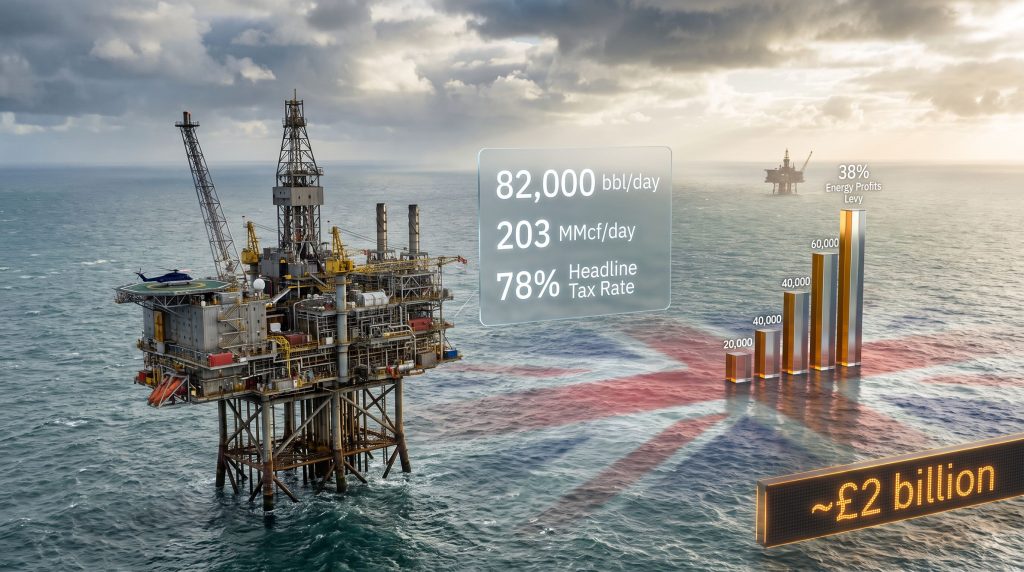
| Liquids production (2025) | 82,000 barrels per day |
| Natural gas production (2025) | 203 million ft³/day |
| Direct workforce | approximately 1,100 people |
| Estimated transaction value | approximately £2 billion |
The West of Shetland assets deserve particular attention from a geological standpoint. The Clair field sits within a fractured basement reservoir, a geological setting that presents both opportunity and complexity. Fractured basement reservoirs can deliver high initial flow rates but are notoriously difficult to characterise and produce predictably over time.
The 7 billion barrel in-place figure at Clair reflects an enormous resource, but the ultimate recovery factor will be determined by reservoir management quality, sustained capital investment, and the technical capability of whoever operates the asset going forward. A change of ownership introduces meaningful uncertainty across all three variables.
The Fiscal Architecture That Changed Everything
To understand why BP is selling rather than continuing to invest, the evolution of the UK upstream tax regime must be examined in sequence. The picture that emerges is one of compounding pressure applied to a basin already in structural decline.
| Year | Policy Event | Cumulative Impact |
|---|---|---|
| 2022 | Energy Profits Levy introduced | First windfall tax layer added to existing upstream tax structure |
| November 2024 | Levy rate increased to 38% | Headline upstream tax rate reaches 78% |
| 2024 | Main investment allowance removed | Primary mechanism for offsetting levy impact eliminated |
| March 2030 | Levy extended to this date | Fiscal uncertainty extended across the medium-term planning horizon |
The compounding effect of these changes is more damaging than any single measure in isolation. At a 78% headline tax rate, the arithmetic of upstream capital allocation shifts fundamentally. Operators must generate returns on the pre-tax portion of a project's economics that are sufficient to justify the risk of deploying capital into a maturing basin where production decline rates require continuous reinvestment simply to maintain output.
When the investment allowance that previously provided partial offsetting relief is simultaneously removed, the investment case for new development activity collapses rapidly. In addition, the oil price movements driven by global trade tensions have further compressed the margin available to operators already navigating an unfavourable fiscal regime.
Critical insight: The removal of the investment allowance is arguably more economically damaging than the rate increase itself. The allowance was specifically designed to preserve capital deployment incentives even within a higher-rate environment. Its removal signals that the fiscal architecture is no longer structured to encourage reinvestment, fundamentally altering operator behaviour.
Offshore Energies UK, the industry association representing North Sea operators, has formally stated that the current fiscal framework is deterring capital investment and accelerating the natural production decline trajectory across the basin. BP's then-incoming chief executive Meg O'Neill had raised similar concerns as early as October 2022, making the case that abrupt changes to the tax regime conducted without meaningful industry consultation send adverse signals to prospective investors.
The Investment Calculus: Why Independent Operators May See Value Where a Supermajor Cannot
One of the more counterintuitive dimensions of this transaction is that assets a diversified supermajor finds uneconomical at its cost of capital may be genuinely attractive to a different class of operator. The fiscal regime does not change for the buyer, but several other variables do.
The Case for Acquisition
- Independent operators with a singular basin focus and leaner cost structures can often extract higher margins from the same production base than a large, complex organisation
- The Clair and Clair Ridge assets represent genuinely long-life resource positions, where patient capital with a low base-cost structure can generate acceptable returns even under a challenging fiscal regime
- Buyers with existing West of Shetland or Central North Sea infrastructure can realise significant synergy value through operational consolidation, reducing per-barrel operating costs materially
- The Murlach tieback commencing production in 2025 demonstrates that BP has maintained the operational quality of the portfolio, reducing the immediate capital remediation risk for a buyer
Structural Headwinds Any Acquirer Must Navigate
- The 78% headline tax rate applies with equal force to any new owner, meaning the tax constraint that challenges BP's return calculation will challenge a buyer's return calculation by a similar order of magnitude
- West of Shetland operations carry materially higher per-barrel operating costs than Central North Sea or other global basins, driven by weather exposure, logistics complexity, and the technical demands of fractured reservoir management at Clair
- The UK government's North Sea Future Plan, published in November 2025, supports continued production from existing fields but ends the award of new exploration licences, which constrains long-term reserve replacement potential
- Decommissioning obligations across a portfolio of mature hubs, particularly Andrew and Etap, represent substantial contingent liabilities that must be carefully priced into any bid
The Norwegian Template: A Structural Precedent Worth Examining
BP's 2016 decision regarding its Norwegian North Sea position offers a potentially instructive model for how the UK transaction might ultimately be structured. Rather than a clean disposal, BP merged its Norwegian upstream operations with Det Norske to form Aker BP, retaining a 30% equity stake in the combined entity.
This approach achieved several objectives simultaneously: it removed BP from the operational complexity and capital commitment of direct operatorship while preserving financial exposure to the underlying resource base. It transferred operational control to an entity with a more focused basin strategy and lower organisational overhead, while allowing BP to participate in any upside without bearing the full burden of capital deployment.
A comparable structure in the UK context would depend heavily on the quality of the counterparty and the terms achievable in the current market. Whether the UK buyer landscape can support an equivalent outcome remains uncertain, particularly given the reported breakdown of discussions with Ithaca Energy, which had been widely considered the most natural consolidation candidate.
Why Ithaca Talks Stalled: Reading the Decommissioning Variable
The failure of reported negotiations with Ithaca Energy before the formal sale process was launched reveals important information about the structural complexity of this transaction. Ithaca, itself the product of prior North Sea consolidation activity, would have represented a strategically coherent acquirer with existing basin infrastructure and operational knowledge.
The most probable explanation for the breakdown involves the allocation of decommissioning liabilities. North Sea decommissioning obligations are not simply an accounting line item. They represent contractually binding commitments that can span decades, with cost estimates subject to material uncertainty as engineering assessments evolve and commodity prices fluctuate.
Mapping the potential acquirer landscape:
| Buyer Category | Strategic Logic | Key Constraint |
|---|---|---|
| UK-focused independent operators | Basin consolidation, operational synergies | Balance sheet capacity relative to decommissioning exposure |
| Private equity-backed upstream platforms | Yield-oriented; mature basin cash flow profile | Financing cost sensitivity under a 78% tax rate environment |
| International national oil companies | Resource security, long-term positioning | Regulatory approval complexity and political scrutiny |
| Infrastructure and pension funds | Long-duration asset exposure | Requires stable, predictable cash flows; fiscal uncertainty is a structural deterrent |
The next major ASX story will hit our subscribers first
The Political Dimension: Burnham, Trump, and the Policy Signal Problem
BP's announcement landed at a moment of heightened political sensitivity for UK North Sea policy. The Trump policy impact on energy investment has reverberated well beyond American borders, with President Trump publicly advocating for greater utilisation of North Sea resources and applying diplomatic pressure on the incoming administration of Prime Minister Andy Burnham.
Burnham indicated on 30 July 2026, the day before BP's announcement, that he would adopt a pragmatic approach to North Sea development, language that stops well short of a formal policy reversal but signals a degree of flexibility not present in the previous government's position.
The current published policy framework remains the North Sea Future Plan, released in November 2025. Its key features are:
- Support for continued production from existing fields throughout their operating lives
- No new exploration licence awards, constraining long-term reserve replacement across the basin
- Introduction of Transitional Energy Certificates, designed to incentivise incremental production linked to existing infrastructure during the energy transition period
Policy observation: Transitional Energy Certificates represent an attempt to thread a politically difficult needle, maintaining production from existing assets while signalling commitment to the energy transition. Whether the revenue visibility they provide is sufficient to anchor the investment confidence of a North Sea acquirer is a question that will be answered by market behaviour rather than policy intent.
Energy Security: The Dimension That Cannot Be Ignored
At 203 million cubic feet per day, BP's North Sea gas production contributes meaningfully to UK indigenous gas supply at a time when European energy security remains a persistent concern. The gas component of this portfolio arguably carries more national strategic weight than the liquids production, given the UK's structural reliance on gas for heating and power generation. The LNG market implications of continued supply tightness make domestic production assets even more strategically significant.
Any production continuity disruption during an ownership transition, or a reduction in capital investment by a successor operator, would directly increase the UK's dependence on imported gas. This creates a public interest dimension to the sale process that extends beyond the commercial negotiation itself and may attract a level of government attention that influences how the transaction is ultimately structured.
The employment dimension compounds this policy sensitivity. The approximately 1,100 direct employees associated with the BP UK North Sea business represent only the visible portion of a much broader supply chain ecosystem centred on Aberdeen, spanning subsea engineering, specialist inspection and maintenance services, logistics and marine operations.
What BP Is Keeping: The Strategic Pivot in Plain Sight
Perhaps the clearest signal of BP's strategic direction is not what it is selling but what it is choosing to retain in the UK market:
- Fuel retail and aviation fuels operations
- Energy trading activities
- Electric vehicle charging infrastructure
- Offshore wind development
- Carbon capture and storage projects
This retained portfolio is almost entirely oriented toward energy transition aligned activities and infrastructure-style business lines with lower capital intensity and more predictable return profiles than upstream oil and gas development. The sale of the North Sea upstream business is therefore not a retreat from the UK energy market. It is a deliberate reallocation of balance sheet capacity toward a different risk and return architecture.
Key Questions for Investors and Industry Observers
Why is BP selling its UK North Sea business?
The decision reflects both portfolio simplification logic and the structural challenge of deploying capital in an upstream environment where the headline tax rate reached 78% and the investment allowance that previously provided offsetting relief has been removed. Furthermore, the wider geopolitical landscape analysis suggests that supermajors are increasingly redirecting capital away from jurisdictions where fiscal and political risk has escalated materially.
How much could the transaction be worth?
Financial media reporting, including coverage from the Herald Scotland, has indicated an approximate valuation of £2 billion for a full divestment, though the final figure will depend critically on how decommissioning liabilities are allocated and the structure of any deal ultimately agreed.
Does the Clair field's resource scale change the buyer calculus?
The 7 billion barrel in-place estimate at Clair gives the portfolio genuine long-term optionality that is unusual in a mature basin context. However, recoverable resource estimates and ultimate recovery factors are sensitive to reservoir management quality and sustained capital investment, both of which could be affected by a change of ownership to an operator with a tighter capital budget.
Will BP leave the UK entirely?
No. BP's retained UK activities across retail, trading, EV charging, offshore wind, and carbon capture mean the company will maintain a substantial UK presence. The exit is from upstream fossil fuel production, not from the UK energy sector.
Three Forces, One Decision: The Structural Logic of the BP North Sea Sale
Stepping back from the transaction-level detail, three structural forces have converged to make this divestment not merely possible but, from BP's strategic perspective, necessary:
- Fiscal regime escalation has fundamentally altered the return profile of UK upstream capital, with a 78% headline rate and the removal of investment allowances creating an environment where new capital deployment cannot clear the hurdle rate for a diversified supermajor competing its UK allocation against lower-cost international alternatives
- Portfolio rationalisation is reshaping the geographic footprint of every major integrated oil company, with supermajors systematically reducing exposure to mature, high-cost basins in favour of higher-margin, lower-breakeven international positions
- Energy transition repositioning is directing BP's retained capital toward business lines aligned with the company's longer-term strategic direction, concentrating UK exposure in transition-oriented activities rather than upstream hydrocarbon production
What remains unanswered is whether the UK government will adjust its fiscal approach in response to the political pressure generated by a high-profile supermajor exit, and whether any such adjustment would arrive in time to influence the buyer universe and transaction structure for this sale. The trajectory of UK continental shelf production over the next decade may ultimately be determined by that question as much as by the commercial terms of any individual deal.
This article is analytical in nature and does not constitute financial or investment advice. Forecasts, valuations, and production figures referenced are based on publicly available information and should not be relied upon as the basis for investment decisions. Readers seeking ongoing market intelligence on the UK North Sea and upstream oil and gas markets can access related coverage via Argus Media.
Want Real-Time Alerts on the Next Major Resource Discovery Before the Market Moves?
Discovery Alert's proprietary Discovery IQ model scans ASX announcements daily, instantly identifying high-potential mineral discoveries across 30+ commodities and delivering actionable insights directly to subscribers — explore the historic returns major discoveries have generated and begin a 14-day free trial at Discovery Alert to secure a genuine market-leading edge.