July 9, 2026
Asian Refiners Are Rewriting the Crude Supply Playbook
For decades, the flow of crude oil into Asia followed a predictable geography: Middle Eastern barrels dominated, supplemented by West African and Russian grades depending on refinery configuration and market pricing. That architecture is now being actively dismantled, not by policy mandates, but by the compounding pressure of geopolitical disruption, sanctions compliance risk, and the hard mathematics of supply concentration. The crude trade map is being redrawn in real time, and India's state refiners are among the most active agents of that change.
Understanding why BPCL buys 1 million barrels of US crude requires looking beyond the transaction itself. It is a data point within a much larger structural recalibration, one that reflects how India's refining sector is responding to simultaneous threats from two entirely different directions. The oil market geopolitics at play here are reshaping procurement decisions across the entire Asian refining landscape.
When big ASX news breaks, our subscribers know first
The Hidden Cost of Crude Concentration
India imports approximately 85 to 87 percent of its total crude oil requirements, a structural dependency that places it among the world's most import-reliant major economies. For years, this vulnerability was partially offset by geographic diversification across Middle Eastern, African, and Latin American suppliers. That balance shifted materially after Western sanctions followed Russia's invasion of Ukraine in 2022, when steeply discounted Russian crude flooded into Indian refineries.
At peak, Russian crude accounted for roughly 40 to 41 percent of India's total crude imports. For individual refiners within the state-owned sector, that figure was even more concentrated. The discount economics were compelling in the short term, but they introduced a form of supply risk that many procurement teams may have initially underweighted: the risk that a single origin accounting for nearly half a refinery's crude diet could become operationally inaccessible through sanctions enforcement, logistical disruption, or payment settlement breakdown.
What the Russian crude boom demonstrated is that price-driven procurement decisions, while rational in isolation, can create structural fragilities that take years to unwind. When that single origin faces enforcement pressure, the entire crude slate is exposed simultaneously.
That unwinding is now underway. India's aggregate Russian crude imports declined by an estimated 300,000 barrels per day from peak levels since late 2025, driven by escalating Russian oil sanctions targeting shadow fleet operators, specific tanker operators, and associated financial intermediaries. For BPCL and its peers, the compliance risk calculation has shifted: the discount that made Russian crude attractive has been progressively eroded by higher freight costs, insurance constraints on sanctioned vessels, and the reputational exposure of operating near sanctions boundaries.
What the BPCL Transaction Actually Reveals
The mechanics of the BPCL purchase carry as much analytical weight as the headline volume. Bharat Petroleum Corporation Limited acquired 1 million barrels of West Texas Intermediate crude via a competitive tender process, with the transaction executed through global trading house Vitol for August delivery. The cargo was priced at a premium of approximately $6 per barrel above dated Brent.
Several technical details within this transaction deserve unpacking for those less familiar with how physical crude markets operate:
- Tender-based procurement signals that BPCL is seeking competitive pricing across multiple sellers rather than accepting a bilateral offer, which is consistent with a refiner actively benchmarking Atlantic Basin crude against alternatives.
- Vitol's involvement as counterparty is significant. As one of the world's largest independent energy trading houses, Vitol has deep access to US Gulf Coast loading programmes, making it a natural intermediary for large spot cargoes of WTI destined for Asia.
- The Aframax tanker booking confirms this is a physical delivery transaction, not a paper or derivatives position. An Aframax vessel carries up to 600,000 barrels, meaning the 1 million barrel purchase likely requires either two vessels or a transshipment arrangement at a regional hub before final refinery delivery.
- The $6 per barrel premium to dated Brent represents the all-in cost of bringing US crude to Asia, incorporating freight from the Gulf Coast, Panama Canal or Cape of Good Hope routing costs, and the quality differential of WTI relative to benchmark grades.
| Transaction Detail | Specification |
|---|---|
| Crude Grade | WTI (West Texas Intermediate) |
| Volume | 1 million barrels |
| Seller | Vitol |
| Delivery | August 2026 |
| Price Premium | ~$6/bbl above dated Brent |
| Vessel Type | Aframax (up to 600,000 bbl capacity) |
The 3.7 Million Barrel Picture: Reading the Full Portfolio
How Does the Full Procurement Campaign Break Down?
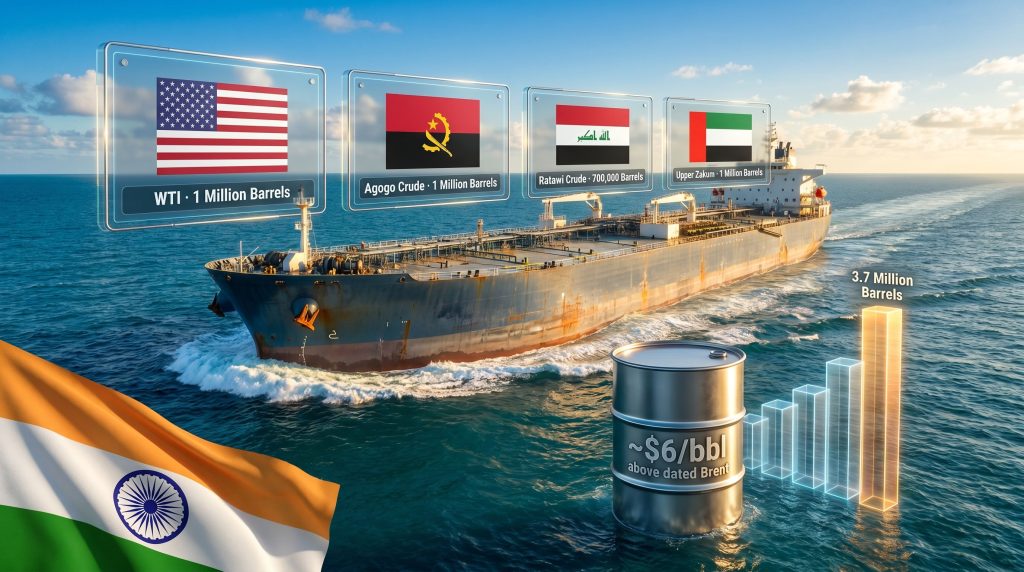
The WTI purchase is one component of a coordinated multi-origin spot procurement campaign totalling approximately 3.7 million barrels. Viewing each cargo in isolation misses the strategic logic that emerges when the full portfolio is mapped. According to reports on BPCL's recent crude purchases, the diversification across origins and counterparties is a deliberate structural decision rather than opportunistic spot trading.
| Crude Grade | Origin | Volume | Counterparty | Notable Feature |
|---|---|---|---|---|
| WTI | United States | 1 million bbl | Vitol | Competitive tender, August delivery |
| Agogo | Angola, West Africa | 1 million bbl | Eni | First-ever BPCL purchase of this grade |
| Ratawi | Iraq, Middle East | 700,000 bbl | Chevron | Supplementary Gulf volume |
| Upper Zakum | Abu Dhabi, UAE | 1 million bbl | Trafigura | Established light-sweet Gulf grade |
The inclusion of Angola's Agogo crude is particularly noteworthy for industry observers. The fact that BPCL is purchasing this grade for the first time indicates active exploration of new supply corridors rather than simple gap-filling. Agogo is a relatively recently developed deepwater field operated by Eni off the coast of Angola, producing a light, low-sulphur crude that suits refineries configured for sweet processing.
Its first appearance in BPCL's procurement portfolio signals that Indian state refiners are extending their sourcing reach into frontier West African production, not just rotating between established grades. Furthermore, the multi-seller structure across Vitol, Eni, Chevron, and Trafigura is also deliberate. Distributing counterparty exposure across four of the world's major trading and integrated energy companies reduces the risk that any single seller relationship becomes a bottleneck.
Geopolitics as a Procurement Driver: The Iran Dimension
How Are Regional Tensions Reshaping Supply Decisions?
The timing of these purchases is inseparable from geopolitical developments. The geopolitical trade shifts reshaping energy flows have been particularly acute in the Middle East, where Asian refiners had meaningfully reduced their US crude intake following the emergence of a US-Iran ceasefire framework. That agreement temporarily reduced the perceived risk premium on Middle East supply routes, however that calculus reversed sharply when fresh hostilities resumed and the ceasefire was declared effectively ended by the Trump administration in early July 2026.
The Strait of Hormuz, through which approximately 20 percent of global seaborne oil trade transits, sits at the geographic centre of this risk. Any credible threat to Hormuz transit, whether through Iranian interdiction capability or broader regional escalation, creates immediate supply uncertainty for refiners dependent on Gulf crude. For Indian refiners, that risk is compounded by the fact that Middle Eastern grades already feature prominently in their crude slates even before accounting for Russian exposure.
The strategic logic becomes clear when both risk vectors are considered together: Russian supply is constrained by sanctions compliance pressure from the west, while Middle East supply faces geopolitical disruption risk from the east. Atlantic Basin crude, particularly from the US and West Africa, sits outside both risk zones.
The trade war oil impact on Asian energy procurement has, consequently, accelerated this diversification impulse well beyond what market pricing alone would have driven.
A Structural Shift, Not an Emergency Response
Perhaps the most significant indicator that BPCL's US crude engagement represents a durable strategic shift rather than a reactive spot purchase is the prior execution of a five-month tender for 10 million barrels of US crude through Glencore. That transaction effectively doubled BPCL's previous US import volumes over its duration, an outcome that suggests institutionalisation of Atlantic Basin supply within the refiner's crude planning cycle.
The parallel behaviour of Japan's Taiyo Oil, which purchased 2 million barrels of US crude for early October delivery at a comparable premium of approximately $6 per barrel above ICE Brent, confirms this is not an India-specific phenomenon. In addition, the alignment of pricing premiums across both transactions points to a market-clearing price that the Asian refining community has collectively arrived at for US crude under current conditions. The broader crude price geopolitics influencing these decisions are unlikely to ease in the near term.
| Refiner | Country | Volume | Delivery | Premium |
|---|---|---|---|---|
| BPCL | India | 1 million bbl (WTI) | August 2026 | ~$6/bbl above Brent |
| Taiyo Oil | Japan | 2 million bbl | Early October 2026 | ~$6/bbl above ICE Brent |
The next major ASX story will hit our subscribers first
Why WTI Works for Indian Refineries
Does Crude Quality Influence the Economics?
There is a refinery-configuration dimension to this story that is often overlooked in coverage focused on geopolitics. WTI is a light, low-sulphur crude with an API gravity typically in the 39 to 41 degree range and sulphur content of approximately 0.24 percent by weight. These characteristics make it well-suited to complex refineries that run hydrocracking and fluid catalytic cracking units, which are designed to maximise the yield of high-value products like gasoline, diesel, and jet fuel from lighter feedstocks.
Indian state refiners have invested heavily in refinery complexity over the past decade, with several facilities now capable of processing a wide range of crude grades. The ability to blend WTI or other light-sweet grades into a crude slate otherwise dominated by heavier sour Middle Eastern or Russian grades can improve overall refinery economics, reduce sulphur-processing costs, and increase the yield of premium products.
This quality dimension is part of why the $6 per barrel premium over Brent does not tell the complete economic story. The relevant comparison is not simply WTI versus Brent, but WTI versus the full landed cost and refinery margin contribution of the alternative crude grades being displaced.
US Crude Export Infrastructure: The Enabling Factor
The practical viability of this shift was not always a given. Before the United States lifted its crude oil export ban in December 2015, WTI was structurally unavailable to international buyers regardless of price. The subsequent decade of infrastructure investment, including expanded loading capacity at Gulf Coast terminals like those in Corpus Christi and the Houston Ship Channel, has dramatically improved the logistics of large-volume US crude exports to Asia.
Several modern terminals can now load Very Large Crude Carriers (VLCCs), which carry up to 2 million barrels and dramatically reduce the per-barrel freight cost for long-haul Asian deliveries. The use of an Aframax for the BPCL cargo may reflect scheduling or port-specific constraints rather than a freight cost limitation, as VLCCs are increasingly the preferred vessel type for US-to-Asia crude voyages.
Key Takeaways
- BPCL buys 1 million barrels of US crude through Vitol at a ~$6/barrel premium to dated Brent for August delivery, confirmed by multiple trading sources
- The purchase is part of a broader 3.7 million barrel multi-origin spot campaign spanning the US, Angola, Iraq, and Abu Dhabi
- Angola's Agogo crude enters BPCL's portfolio for the first time, signalling active expansion of the refiner's supply geography
- A prior 10-million-barrel US crude tender through Glencore demonstrates this is a sustained strategic commitment, not a one-off response
- Japan's Taiyo Oil purchasing 2 million barrels at equivalent premiums confirms the trend extends across Asian refining markets
- The dual pressure of Russian sanctions compliance risk and Middle East conflict supply disruption is driving diversification simultaneously from two directions
- WTI's light, low-sulphur quality profile offers refinery margin benefits beyond simple geographic diversification
This article contains forward-looking analysis based on publicly available trade data and market reporting. Crude oil procurement strategies are subject to change based on market conditions, geopolitical developments, and individual company decisions. This content should not be construed as financial or investment advice.
Want to Stay Ahead of the Next Major Resource Discovery?
Discovery Alert's proprietary Discovery IQ model scans ASX announcements in real time, instantly identifying significant mineral discoveries and turning complex data into actionable investment insights — explore historic discoveries and their returns to understand the opportunity, then begin your 14-day free trial at Discovery Alert to position yourself ahead of the broader market.