July 9, 2026
Japan's Aluminium Import Problem Has a Solution Hiding in Plain Sight
Across Japan's commercial districts, office towers, and retail corridors, millions of air conditioning units quietly accumulate years of operational use before being decommissioned and sent to industrial waste facilities. For decades, the metals locked inside these machines, primarily aluminium and copper, have been lost to low-grade mixed scrap streams that serve little strategic purpose. The material was technically recovered, but not in any form useful to high-specification manufacturing. That systemic inefficiency is now being directly challenged by a partnership between two of Japan's most significant industrial names.
The collaboration between trading house Itochu and HVAC manufacturer Daikin Industries targets the Itochu and Daikin aluminium recycling from commercial air conditioners at a level of material specificity that has never before been applied to this equipment category at scale. Understanding why this matters requires stepping back to examine the broader aluminium supply crisis that is quietly reshaping Japan's industrial priorities.
When big ASX news breaks, our subscribers know first
Japan's Aluminium Dependency: A Vulnerability That Has Grown Quietly for Decades
Japan occupies an unusual position among the world's major industrialised economies. It maintains a sophisticated, export-oriented manufacturing base heavily reliant on aluminium, yet it produces virtually no primary aluminium domestically. The country's last primary aluminium smelter closed decades ago, driven out of viability by energy costs, leaving Japan structurally dependent on imports to feed its automotive, electronics, and consumer goods industries.
In 2025, Japan imported 2.11 million tonnes of aluminium metal, according to trade data from Japan's Ministry of Finance. Of that total, approximately 580,000 tonnes, or 28%, originated from Middle Eastern supply corridors, a region whose geopolitical stability has remained a persistent concern for procurement teams across Japanese industry. That single-source concentration creates a vulnerability that has moved from background concern to active policy priority.
What makes this structural dependency particularly difficult to address through conventional means is the narrow supply-side optionality available. Expanding primary smelting domestically is economically unviable given Japan's energy costs. Diversifying import sources requires years of relationship development and long-term offtake commitments. The faster lever, and the one now being pulled, is the aggressive development of domestic secondary aluminium recovery from installed bases of metal-rich equipment. The broader aluminium tariffs impact on global supply chains has further reinforced the urgency of domestic recycling solutions.
The Regulatory Blind Spot That Left Tonnes of Aluminium on the Table
Japan's recycling legislation is sophisticated by international standards. The Home Appliance Recycling Law, introduced in 2001, created a mandatory material recovery framework for residential cooling equipment that has successfully diverted significant volumes of metal from landfill. However, the law's scope contains a structural gap that has persisted for over two decades: commercial-grade air conditioning systems are entirely excluded from its provisions.
Commercial units have instead been classified under general industrial waste regulations, which impose material separation requirements far less granular than those governing residential appliances. When a commercial air conditioner reaches end-of-life under this framework, it is typically processed by industrial waste contractors who aggregate non-ferrous materials into broad mixed-metal categories. The result is a low-purity output that cannot meet the quality thresholds demanded by aluminium-intensive manufacturers producing automotive components, heat exchangers, or new air conditioning equipment.
This regulatory exclusion has, paradoxically, created a high-value opportunity. Because no mandatory framework has forced the development of sophisticated commercial HVAC recycling infrastructure, the space remains largely uncontested. The metals are there, the logistics challenge is solvable, and the demand for high-purity secondary aluminium is growing under new government mandates. Itochu and Daikin identified this convergence before others moved to occupy it.
What Is Actually Inside a Commercial Air Conditioner?
The material composition of a standard small mass-produced commercial air conditioning unit is richer than most industrial waste frameworks have historically treated it. According to data released by Daikin, a single unit contains approximately 63 kg of recyclable metal scrap and plastics, broken down into distinct recoverable streams:
- Aluminium: approximately 7 kg per unit, primarily concentrated in heat exchangers and structural components
- Copper: approximately 8 kg per unit, found in coil windings, electric motors, and refrigerant tubing
- Iron: recoverable from structural framing and compressor housings
- Rare and specialty metals: present in electronic control boards and motor assemblies
The challenge has never been the absence of recoverable material. It has been the absence of processing infrastructure capable of separating these streams at the component level rather than the bulk material level. That distinction, between component-level disassembly and bulk mixed-metal processing, is the technical core of what the Itochu-Daikin programme is engineering.
Projected Recovery at Scale
| Recovery Metric | Estimated Volume |
|---|---|
| Target annual units recycled | 300,000 units |
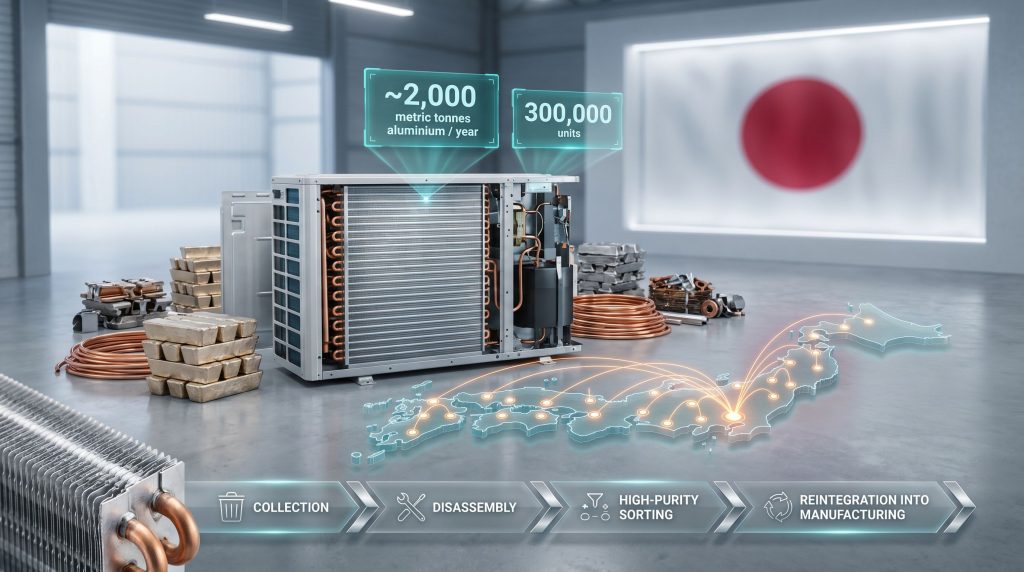
| Aluminium scrap recovered | ~2,000 metric tonnes |
| Copper scrap recovered | ~2,300 metric tonnes |
| Total market shipments (FY2025) | ~850,000 units |
| Daikin's estimated market share | 40% to 50% |
At the programme's initial target of 300,000 units per year, the combined metal recovery figures represent a genuinely meaningful contribution to Japan's secondary materials supply, particularly given the quality specifications these streams are designed to meet.
The Four-Phase Operational Architecture
The venture operates through a structured processing chain that distinguishes it fundamentally from conventional industrial waste handling. Each phase is designed to preserve material quality, not merely recover material volume.
Phase 1: Collection and Logistics
Itochu Metals Corporation will manage the retrieval of decommissioned Daikin commercial units from office buildings and commercial properties across Japan. Critically, this capability does not need to be built from scratch. Itochu Metals already operates a nationwide collection and transport network comprising 570 logistics partners and 22 maintenance and distribution bases, assembled over years of servicing convenience store chains with refrigerated display cabinet collection and store shelving maintenance. Repurposing this infrastructure for HVAC recovery dramatically reduces the capital and time cost of programme launch.
Phase 2: Component-Level Disassembly
Rather than shredding units into bulk material streams, the programme applies disassembly at the component level. Heat exchangers, which contain the programme's primary aluminium target, are separated from electric motors, structural frames, and electronic assemblies before any metal processing occurs. This granularity is what makes downstream purity achievable.
Phase 3: High-Purity Metal Recovery
Separated components are transferred to specialist scrap processors equipped with sorting and processing capabilities calibrated for high-purity output. The aluminium recovered through this pathway meets quality specifications for re-entry into demanding manufacturing applications, including automotive parts and new air conditioning components. This is categorically different from the mixed non-ferrous output produced by conventional industrial waste processing. Furthermore, this advanced recycling process mirrors approaches being developed in other sectors where material purity is equally critical.
Phase 4: Closed-Loop Reintegration
The recovered aluminium is directed back into Daikin's own manufacturing operations, specifically for the production of heat exchangers and air conditioning components. This closed-loop architecture ensures that material quality is preserved through a controlled supply chain rather than dissipated into spot commodity markets.
Closed-Loop vs. Open-Market Scrap: Why the Framework Distinction Matters
The difference between a closed-loop recycling model and conventional open-market scrap trading is frequently understated in industry commentary, yet it carries profound implications for material quality, supply chain resilience, and strategic value.
| Framework Dimension | Closed-Loop Model | Open-Market Industrial Scrap |
|---|---|---|
| Material purity outcome | High-purity, application-specific | Mixed-grade, broad specification |
| End-use destination | Manufacturer's own production | Spot market or secondary smelters |
| Collection control | Manufacturer-linked logistics | Third-party waste contractors |
| Quality consistency | Controlled via component sorting | Variable, batch-dependent |
| Strategic value | Supply chain security plus ESG credentials | Commodity revenue only |
The closed-loop structure means Daikin effectively recovers a portion of the aluminium it originally purchased, processed, and installed, then reintegrates it into new production at a quality level sufficient for demanding specifications. This creates a compounding supply chain security benefit that open-market scrap trading simply cannot replicate.
"The closed-loop architecture positions this venture as a supply chain resilience instrument rather than a traditional recycling business. That distinction has significant implications for how its strategic value should be assessed across industry, investor, and policy frameworks."
The next major ASX story will hit our subscribers first
Japan's Recycled Content Mandates: Converting ESG Intent into Commercial Necessity
The business case for this initiative would be compelling purely on supply chain security grounds. However, the policy environment introduced in April 2026 has converted what was previously an aspirational ESG objective into a binding compliance requirement for Japanese manufacturers.
Japan's government formalised recycled content targets requiring that:
- Recycled aluminium must constitute 40% of the wrought aluminium used in automobiles and other domestically manufactured products
- Recycled copper must constitute 30% of copper used in equivalent manufacturing applications
These targets create a direct and binding demand signal for high-purity secondary aluminium and copper, precisely the material streams this programme is designed to produce. Manufacturers who cannot demonstrate compliance with these targets face growing regulatory exposure. That compliance pressure is now a structural tailwind for ventures capable of delivering consistent, high-purity recycled metal at scale.
The programme is also structured under Japan's Act Concerning Sophistication of Recycling Business, providing a formal legislative framework that legitimises the integrated supply chain approach and reduces execution risk for both partners. In addition, the aluminium sector investment landscape more broadly is responding to exactly these kinds of policy-driven demand signals across major industrial economies.
Sizing the Opportunity: How Large Could This Become?
The Japan Refrigeration and Air Conditioning Industry Association reported approximately 850,000 commercial air conditioner shipments in fiscal year 2025. Daikin's estimated market share of 40% to 50% places roughly 340,000 to 425,000 Daikin units entering the replacement cycle annually. The programme's initial target of 300,000 units represents a substantial portion of that replacement volume.
Itochu has also signalled clear strategic intent to extend the programme beyond Daikin-branded equipment. The company's existing convenience store logistics relationships provide natural access points for collecting commercial HVAC units from other manufacturers installed across Japan's dense convenience store network. Asia's Nikkei reporting on this venture highlights just how closely regional markets are watching the programme's rollout as a potential model for broader adoption.
Three distinct scenarios frame the programme's potential trajectory:
-
Full market penetration scenario: If collection expands to capture the majority of Japan's annual commercial HVAC replacement cycle across all manufacturers, recoverable aluminium could approach 6,000 to 7,000 tonnes annually, constituting a measurable share of Japan's secondary aluminium supply for high-specification manufacturing.
-
Industry platform scenario: Itochu's logistics infrastructure and processing relationships could be extended to competing HVAC manufacturers, establishing a de facto industry recycling standard for commercial cooling equipment and positioning Itochu Metals as the dominant intermediary in a newly formalised secondary material category.
-
Manufacturer-specific scenario: Even if expansion stalls at the Daikin-only scope, the programme delivers meaningful supply chain security for one of Japan's largest HVAC manufacturers and provides a proven proof-of-concept that competitors may seek to replicate independently.
Lesser-Known Technical Dynamics: Why Aluminium Purity in Recycling Is So Difficult to Achieve
One aspect of secondary aluminium markets that receives insufficient attention outside specialist circles is the profound effect that contamination has on usability. Aluminium alloys used in heat exchangers and automotive applications often carry precise compositional specifications that leave very little tolerance for trace elements introduced during scrap processing. Iron contamination, for instance, can significantly degrade the formability of wrought aluminium alloys even at concentrations measured in fractions of a percent.
This is why the granularity of disassembly in the Itochu and Daikin aluminium recycling from commercial air conditioners model is not merely an operational detail but a material science necessity. When heat exchangers are separated from steel structural components before processing, the risk of iron contamination in the aluminium stream drops substantially. The resulting secondary aluminium is qualitatively closer to primary specification material than anything produced by conventional bulk industrial waste processing.
This technical reality also explains why Japan's April 2026 recycled content mandates cannot simply be met by purchasing any available secondary aluminium scrap. The mandated 40% recycled content in wrought aluminium for automotive applications demands material that actually meets automotive grade specifications, not just material that has been technically categorised as recycled. Programmes capable of delivering this quality distinction will command premium positioning in Japan's secondary aluminium market. Indeed, aluminium operations repowering initiatives in other markets similarly reflect this growing premium placed on quality-controlled, low-emissions aluminium supply chains.
Frequently Asked Questions
Why are commercial air conditioners excluded from Japan's recycling laws?
Japan's Home Appliance Recycling Law was designed specifically to address residential consumer products. Commercial HVAC systems fall under industrial waste regulations that historically applied less rigorous material separation requirements. This legislative gap has meant recoverable metals from commercial units have been systematically processed at quality levels insufficient for high-specification reuse.
How much aluminium can be recovered from a single commercial unit?
A standard small mass-produced commercial air conditioner contains approximately 7 kg of aluminium, alongside approximately 8 kg of copper, within a total recoverable material mass of roughly 63 kg per unit including plastics and other metals.
When is the venture expected to begin operations?
The Itochu-Daikin recycling programme is expected to commence operations by the end of 2026, with a nationwide rollout planned to follow.
What makes this process different from standard industrial waste processing?
The critical distinction is component-level disassembly and high-granularity sorting, which produces aluminium and copper streams of sufficient purity for re-entry into demanding manufacturing specifications. Conventional industrial waste processing produces lower-purity mixed-metal outputs that cannot meet automotive or air conditioning manufacturing quality thresholds.
Will the programme expand beyond Daikin equipment?
Itochu has publicly indicated plans to extend the collection programme to commercial units from other manufacturers, particularly those installed in Japan's extensive convenience store networks, though the initial phase focuses exclusively on Daikin equipment. Furthermore, the top aluminium companies globally are watching this closed-loop model with considerable interest as secondary material mandates spread across other major economies.
Key Strategic Takeaways
- Regulatory gaps create commercial opportunity: The exclusion of commercial HVAC from Japan's recycling law created an underexploited secondary material stream that this partnership is now positioned to systematically capture
- Logistics infrastructure is a genuine competitive moat: Itochu Metals' existing 570-partner national network provides a first-mover advantage that would be capital-intensive and time-consuming for any competitor to replicate from scratch
- Material purity is the critical value differentiator: The programme's component-level disassembly approach produces secondary aluminium that actually meets manufacturing grade specifications, unlike the mixed-metal outputs of conventional processing
- Government mandates have converted ESG objectives into commercial necessity: Japan's 40% recycled aluminium content target for manufactured goods creates binding compliance demand for exactly the high-purity secondary material this venture is designed to produce
- The platform expansion logic is structurally sound: Itochu's stated intent to extend collection to other manufacturers' equipment transforms what began as a bilateral manufacturer programme into a potential industry-wide secondary material recovery platform with significantly larger addressable volume
Readers seeking broader context on Japan's aluminium supply chain dynamics and secondary metal market developments may find ongoing coverage at AL Circle a useful reference for the recycled aluminium sector.
Want to Stay Ahead of the Next Major ASX Resource Discovery?
Discovery Alert's proprietary Discovery IQ model scans ASX announcements in real time, instantly identifying significant mineral discoveries across aluminium, copper, and 30+ other commodities — turning complex data into clear, actionable opportunities for investors at every level. Explore how historic discoveries have generated substantial returns on the Discovery Alert discoveries page, and begin your 14-day free trial today to position yourself ahead of the broader market.