July 13, 2026
The Comminution Bottleneck Nobody Talks About
In the economics of large-scale mining, grinding is everything. Comminution, the process of crushing and milling ore into fine particles to liberate target minerals, accounts for between 35% and 50% of a typical mine site's total energy consumption. Within that process, the components lining the interior of SAG mills and ball mills, collectively known as mill liners, are among the most operationally critical consumables on any site. They protect the mill shell, shape the trajectory of grinding media, and directly govern how efficiently ore is processed.
Yet for decades, mines across Latin America have sourced these components from foundries located thousands of kilometres away, accepting the lead time penalties that come with offshore procurement as an unavoidable cost of doing business. That assumption is now being systematically dismantled, and the Bradken Peru mining liners hub represents one of the most concrete expressions of that shift.
When big ASX news breaks, our subscribers know first
Understanding Mill Liners: More Than Just Wear Parts
The Engineering Behind the Lining
Mill liners are not passive components. Their geometry, material composition, and lift-bar profiles are engineered to control how ore and grinding media cascade inside a rotating mill shell. A poorly designed or worn liner does not simply degrade — it actively reduces throughput, increases specific energy consumption per tonne of ore processed, and accelerates mill shell wear.
Two primary liner categories dominate large-scale mining applications:
- Steel mill liners, typically cast from high-chrome or manganese alloy steel, used in applications where impact resistance and hardness are paramount, particularly in SAG mills processing hard rock ores.
- Composite mill liners, constructed from rubber or rubber-steel hybrid materials, which offer lighter weight and extended service life in certain grinding environments, particularly in ball mills handling finer feed sizes.
The distinction matters strategically because full-spectrum liner supply requires manufacturing capability across both product types. A supplier offering only one category cannot serve as a single-source partner for a modern milling circuit. For more on mill and crusher liners, Bradken's product range illustrates the breadth of capability required at this scale.
Why Lead Times Are a Hidden Productivity Variable
Most mine operators plan liner change-outs during scheduled maintenance shutdowns — windows that are planned months in advance and measured in hours of lost production value. When offshore foundries fail to deliver on schedule, the consequences cascade through the entire maintenance programme.
Consider the arithmetic: a large copper concentrator processing 100,000 tonnes of ore per day at a copper recovery value of US$40 per tonne faces opportunity costs exceeding US$4 million per day of unplanned downtime. If a delayed liner shipment pushes a planned change-out into an unscheduled extension, even a single additional day of outage can dwarf the cost differential between local and imported liner procurement.
Reducing lead times by 30% to 50% through regional manufacturing does not merely improve logistics. It fundamentally restructures how maintenance planners operate, enabling tighter scheduling windows, reduced safety stock requirements, and more responsive liner design iteration when performance data is collected on-site. Furthermore, these improvements have direct implications for broader copper market trends, where supply chain efficiency increasingly determines competitive advantage.
The Chilca Foundry: Anatomy of a US$100 Million Industrial Commitment
Location and Industrial Logic
The Bradken Peru mining liners hub is situated in Chilca, approximately 70 kilometres south of Lima, within an established industrial corridor that benefits from proximity to grid infrastructure, Pacific port access, and an existing manufacturing labour pool. The site was acquired from Funtec in 2024 and underwent comprehensive redevelopment to meet the specifications required for large-scale steel casting operations.
Chilca's positioning within Peru's central industrial zone is not incidental. The location provides road connectivity to the major mining regions of the central and southern Andes, while Pacific port access enables efficient export logistics to Chile, Ecuador, Mexico, and markets further afield.
Production Specifications at Scale
The facility's rated capacity and component specifications position it among the most substantial regional foundry investments in Latin American mining services history:
| Metric | Detail |
|---|---|
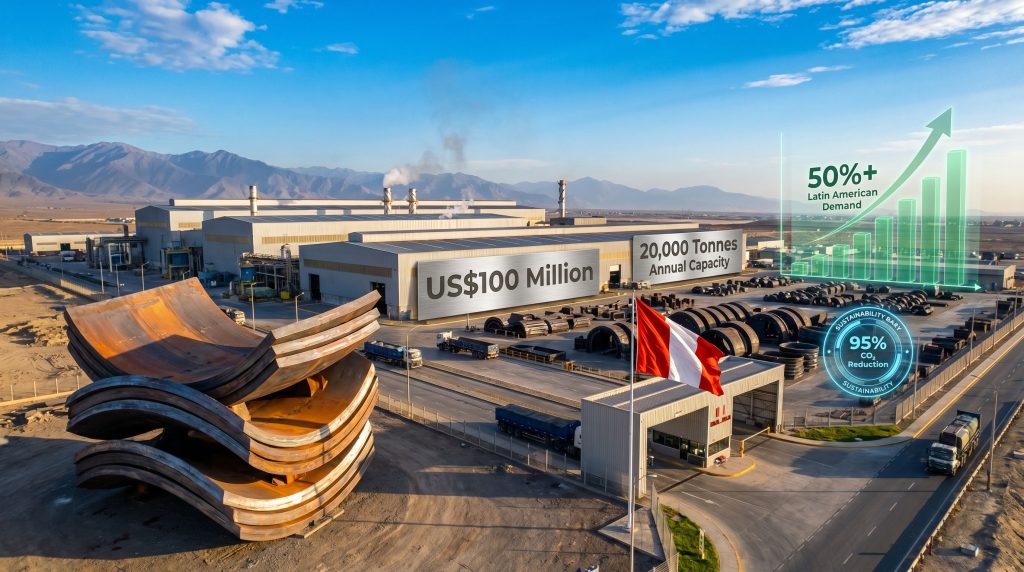
| Annual Production Capacity | Up to 20,000 tonnes of steel mill liners |
| Maximum Single Component Weight | Up to 7,000 kg per cast piece |
| Primary Product Type | SAG and ball mill liner components |
| Primary Markets | Peru and Chile |
| Secondary Export Reach | Brazil, Argentina, Suriname, Ecuador, Mexico |
| Regional Demand Target | Over 50% of Latin American demand within 3 to 5 years |
| Total Capital Investment | Exceeding US$100 million (approximately 13.8 billion yen) |
| Formal Inauguration | July 2026 |
The capacity to cast individual components weighing up to 7,000 kilograms is particularly significant. SAG mill liners for the largest grinding mills in operation — units with shell diameters exceeding 12 metres — require precisely this scale of casting capability. Without it, a regional foundry cannot serve the full range of large-scale copper and gold milling operations that define the Andean mining corridor.
Building a Full-Range Manufacturing Network in Peru
How Two Lima-Region Facilities Create an Integrated Offering
The Chilca foundry does not operate in isolation. Bradken already operates a composite mill liner manufacturing facility in Lima, which was expanded in 2023. The addition of the Chilca steel casting foundry means that both primary liner product categories — steel and composite — are now manufactured within the same national jurisdiction, by the same supplier, within proximity of each other.
This integration carries practical advantages that are easy to underestimate:
- Single-source accountability: Mine operators can consolidate liner procurement with one regional supplier rather than managing parallel import relationships for different liner types.
- Coordinated delivery scheduling: Steel and composite liners for a planned change-out can be dispatched together from Peruvian facilities, simplifying logistics coordination.
- Shared technical knowledge: Proximity between manufacturing sites and customer operations enables faster feedback loops, supporting iterative liner design improvements based on real wear data.
Market Geography: Reaching Latin America from a Pacific Hub
Peru's Pacific coast positioning creates natural logistical advantages for serving both the Andean copper belt and more distant Latin American markets. Chile, the world's largest copper producer, is accessible via established overland and coastal shipping routes. Brazilian operations on the Atlantic side require longer transit times, but the availability of reliable regional production still represents a meaningful improvement over Asian or European sourcing.
Secondary markets including Suriname, Ecuador, Argentina, and Mexico reflect the breadth of Latin America's active mining jurisdictions. Many of these host mid-tier producers who have historically faced higher barriers to accessing premium liner products from offshore suppliers — a challenge not unlike the broader resource export challenges that confront resource-dependent economies worldwide.
Environmental Performance: Where Heavy Industry Meets Renewable Energy
Peru's Hydroelectric Advantage as a Manufacturing Enabler
One of the least-discussed advantages of Peru as a heavy manufacturing location is its electricity generation mix. Hydroelectric generation accounts for a substantial proportion of Peru's national grid supply, and this structural characteristic makes Peru an unusually favourable jurisdiction for energy-intensive industrial operations seeking to reduce carbon intensity.
The Chilca foundry is targeting 99% to 99.5% renewable electricity consumption, sourced predominantly from hydroelectric generation. Against this baseline, the facility projects a reduction in CO₂ emissions of up to 95% compared to conventional fossil fuel-powered foundry operations.
A foundry achieving near-total renewable energy consumption while maintaining the casting scale required for large SAG mill liners represents a rare convergence. Heavy foundry work, by nature, is energy-intensive and thermally demanding, making the renewable energy credentials of this facility genuinely notable rather than performative.
Scope 3 Emissions and the Mining Procurement Shift
The significance of the facility's environmental profile extends beyond operational efficiency. Major copper and gold producers operating in Chile and Peru are increasingly subject to Scope 3 emissions reporting requirements, meaning the carbon intensity of their supply chains — including consumables procurement — falls within their ESG disclosure obligations.
A liner supplier capable of offering verifiably low-carbon manufactured components provides mine operators with a procurement pathway that actively contributes to their own sustainability targets. This dynamic is reshaping how mining companies evaluate consumable suppliers, with environmental credentials moving from a secondary consideration to a genuine procurement criterion. In addition, renewable energy in mining is increasingly viewed as foundational to long-term operational viability rather than an optional enhancement.
Economic Impact: Jobs, Skills, and Industrial Multipliers
Direct and Indirect Employment
| Employment Category | Projected Figure |
|---|---|
| Direct Jobs Created | Approximately 200 |
| Indirect Jobs Supported | More than 1,200 |
| Total Economic Footprint | 1,400+ employment opportunities |
The employment profile of a large-scale foundry extends beyond production floor roles. Metallurgical engineers, quality assurance specialists, pattern makers, heat treatment technicians, and logistics coordinators all represent skill categories that develop around sustained foundry operations. Over time, a facility of this scale can anchor a broader industrial skills ecosystem in its host region.
Beyond Raw Extraction: Peru's Manufacturing Identity
Peru has long been defined internationally by its role as a raw mineral exporter, ranking among the world's leading producers of copper, gold, silver, zinc, and lead. The establishment of a world-scale mining consumables manufacturing facility on Peruvian soil represents a qualitatively different kind of industrial investment — one that creates value-added production capacity rather than simply extracting and exporting unprocessed resources.
This distinction matters for Peru's long-term industrial trajectory. Large-scale foreign manufacturing investments of this magnitude can catalyse complementary domestic supplier development, as local businesses develop the capability to supply inputs, services, and components to an established anchor facility. Consequently, the Bradken Peru mining liners hub serves as a model for how industrial localisation can create lasting economic multipliers.
The next major ASX story will hit our subscribers first
Competitive Dynamics and Market Scenarios
What a 20,000-Tonne Capacity Means for Regional Pricing
Annual production capacity of 20,000 tonnes creates meaningful economies of scale. At this throughput level, fixed costs associated with foundry infrastructure, energy contracts, and skilled labour are distributed across a volume that can support competitive pricing relative to imported alternatives, particularly when import tariff exposure, freight cost volatility, and currency fluctuation risk are factored into the total landed cost of offshore-sourced liners.
The competitive calculus has shifted materially in recent years. Ocean freight rates experienced significant volatility during and after the COVID-19 pandemic, exposing the cost vulnerability of supply chains dependent on long-haul shipping for heavy industrial components. Regional manufacturing insulates buyers from this variability.
Three Scenarios for Regional Market Evolution
Scenario A: Accelerated Adoption
If the Chilca hub reaches its regional demand coverage target ahead of the three-to-five-year horizon, it effectively establishes a new regional supply benchmark. Competing suppliers lacking regional production infrastructure would face pressure to respond with their own localisation strategies, potentially accelerating the broader transition away from offshore dependency across the Latin American wear parts market.
Scenario B: Steady-State Integration
A five-year pathway to covering more than 50% of Bradken's Latin American demand from Chilca allows for methodical customer transition, quality validation across multiple liner change-out cycles, and logistics network optimisation without disrupting existing supply relationships.
Scenario C: Mid-Tier Market Expansion
Increased local availability at reduced lead times may unlock demand from mid-tier mining operators who previously faced barriers to accessing premium liner products. This scenario suggests the total addressable market for regional liner supply may be larger than current demand figures imply.
Disclaimer: The above scenarios represent analytical frameworks for understanding potential market outcomes and should not be interpreted as forecasts or financial projections. Actual market developments will depend on a range of factors including commodity prices, regional mining investment levels, and competitive responses from other suppliers.
Why Peru Became the Chosen Location
Factors That Favour Chilca Over Alternative Jurisdictions
The selection of Peru, and specifically the Chilca industrial corridor, over alternative Latin American locations reflects a convergence of structural advantages:
- Grid composition: Peru's hydroelectric-dominant electricity supply enables the facility's renewable energy targets at scale — an advantage that would be significantly harder to replicate in jurisdictions with coal or gas-heavy generation mixes.
- Proximity to anchor demand: Peru hosts some of the world's largest copper mining operations, and its northern border with Chile places the Chilca foundry within practical logistics range of the highest-volume demand concentration in the region.
- Existing operational footprint: Bradken's prior establishment of composite liner manufacturing in Lima reduced the regulatory, logistical, and operational complexity of adding a second major facility within the same country.
- Infrastructure maturity: The Chilca industrial zone offers the utility infrastructure necessary to support energy-intensive foundry operations without requiring greenfield grid development.
- Port access: Pacific coast positioning enables export logistics to Chile, Ecuador, and Mexico, while also providing connectivity to Atlantic markets via Panama Canal routing.
Frequently Asked Questions: Bradken Peru Mining Liners Hub
What is the Bradken Peru mining liners hub?
The Bradken Peru mining liners hub is a large-scale steel mill liner foundry located in Chilca, approximately 70 km south of Lima. Inaugurated in July 2026 following a US$100 million-plus investment and acquisition of the Funtec facility in 2024, it serves as Bradken's primary regional production centre for SAG and ball mill liner components across Latin America.
How much can the Chilca foundry produce annually?
The facility has a rated annual production capacity of up to 20,000 tonnes of steel mill liners, with the capability to cast individual components weighing as much as 7,000 kilograms.
Which countries does the Bradken Peru hub supply?
Primary markets are Peru and Chile, with secondary supply extending to Brazil, Argentina, Suriname, Ecuador, and Mexico.
What are the environmental targets?
The Chilca foundry targets 99% to 99.5% renewable electricity consumption, primarily from hydroelectric sources, with a projected CO₂ emission reduction of up to 95% compared to conventional foundry energy profiles. These credentials align directly with the broader push for mining decarbonisation benefits that major producers are increasingly required to demonstrate across their supply chains.
How many jobs will the facility create?
The hub is projected to generate approximately 200 direct employment positions and support more than 1,200 indirect jobs within the broader regional economy.
How does Chilca relate to Bradken's other Peru operations?
The Chilca steel foundry complements Bradken's Lima composite mill liner facility, which was expanded in 2023. Together, the two sites give Bradken the capability to supply a complete range of locally manufactured mill liners — both steel and composite — to South American mining customers from within Peru.
A Reference Model for Latin American Industrial Localisation
The Bradken Peru mining liners hub is significant not only for what it delivers to current customers, but for what it signals to the broader mining services industry. The convergence of supply chain resilience priorities, ESG-driven procurement evolution, and sustained growth in Andean copper and gold output has created structural conditions that make regional manufacturing genuinely competitive rather than merely convenient.
For mine operators managing multi-site portfolios across the Andean copper belt, the availability of a world-scale regional liner manufacturer introduces new possibilities: tighter maintenance scheduling, closer technical collaboration on liner design, and procurement pathways that actively contribute to Scope 3 emissions reduction targets. These are not marginal improvements. Furthermore, mining electrification and supply chain localisation are increasingly interconnected priorities for operations where every hour of downtime carries seven-figure cost exposure.
Whether other global mining consumables suppliers interpret the Chilca investment as a market signal requiring a competitive response will be one of the more consequential questions for Latin American mining services infrastructure over the next decade. The template now exists. The question is who follows it.
Want to Capitalise on the Next Major Mineral Discovery Before the Market Moves?
Discovery Alert's proprietary Discovery IQ model delivers real-time alerts on significant ASX mineral discoveries, transforming complex geological data into actionable investment insights for both short-term traders and long-term investors — explore the historic returns major discoveries have generated and begin a 14-day free trial to position yourself ahead of the broader market.