July 13, 2026
The Invisible Architecture of Modern Industry: Why Steel's Second Life Matters More Than Its First
Across the global economy, few transformations are as quietly consequential as what happens to steel after its first use ends. Long before discussions of carbon neutrality entered the mainstream, metallurgists understood something that broader industry is only now grasping at scale: the most efficient tonne of steel is one that never requires a new mine. The steel recycling benefits sit at the intersection of industrial chemistry, resource economics, and climate strategy, and understanding them reveals why this sector is becoming one of the most strategically important in modern manufacturing.
When big ASX news breaks, our subscribers know first
The True Cost of Starting from Scratch
Producing steel from raw materials is an extraordinarily resource-intensive undertaking. Conventional blast furnace and basic oxygen furnace operations depend on three primary inputs: iron ore, coking coal, and limestone. Together, these materials must be extracted, transported, processed, and combusted at extreme temperatures to yield liquid steel. For every tonne of virgin steel produced through this route, approximately 2,500 pounds of iron ore and 1,400 pounds of coal are consumed, alongside roughly 120 pounds of limestone.
The emissions profile of this process is severe. Carbon dioxide and methane are released at multiple points along the production chain, from mining operations through to the furnace itself. Industrial byproducts including slag, particulate dust, and chemical effluents create additional waste management obligations that many producers struggle to handle without environmental consequence.
Furthermore, what makes this increasingly untenable is not simply the environmental cost in isolation, but its collision with expanding global demand. Infrastructure requirements across Asia, Africa, and South America are accelerating steel consumption at precisely the moment when high-grade ore reserves are thinning, energy costs are rising, and regulatory frameworks governing industrial emissions are tightening. The economics of primary steelmaking are shifting in one direction, and not favourably.
What Are the Core Environmental Benefits of Steel Recycling?
A Direct Comparison: Recycled Steel vs. Virgin Steel Production
The environmental case for secondary steelmaking is compelling precisely because it can be quantified across multiple dimensions simultaneously.
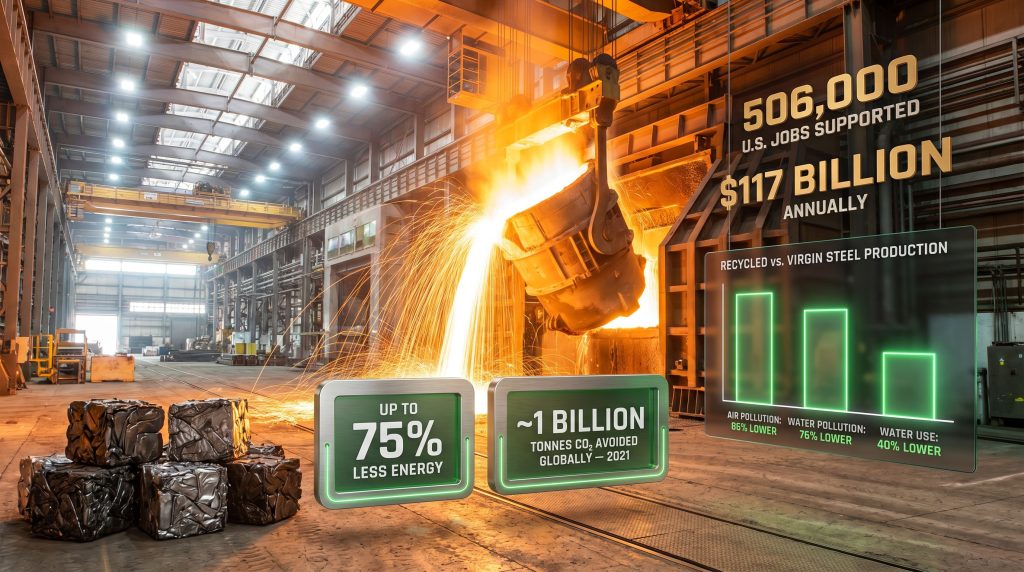
Key Insight: Recycling steel consumes up to 75% less energy than producing it from raw iron ore and coking coal. When applied to vehicle scrap alone, that saving is equivalent to powering approximately 18 million homes per year.
| Environmental Metric | Virgin Steel Production | Recycled Steel Production | Reduction |
|---|---|---|---|
| Energy Consumption | Baseline | 60–75% lower | Up to 75% |
| CO₂ Emissions | Baseline | 58% lower | ~1 billion tonnes avoided globally in 2021 |
| Air Pollution | Baseline | Significantly lower | 86% reduction |
| Water Pollution | Baseline | Significantly lower | 76% reduction |
| Water Usage | Baseline | Meaningfully lower | 40% reduction |
The billion-tonne figure for avoided CO₂ emissions is not an aspirational projection but a measured outcome from existing global scrap utilisation in 2021. It represents one of the largest single contributions any industrial process makes to emissions abatement, without requiring new technology or government subsidy to achieve.
Carbon Emissions at Industrial Scale
The mechanism behind these reductions lies primarily in the electric arc furnace (EAF). Rather than combusting coal to generate the heat required for steelmaking, EAFs use electrical energy to melt scrap directly. This architectural shift in production removes the need for the most carbon-intensive steps in the conventional process.
As grids increasingly incorporate renewable generation, the carbon intensity of EAF-based steelmaking continues to fall, creating a compounding emissions reduction effect over time. For industries with net-zero commitments, sourcing steel from high-scrap-ratio EAF producers represents one of the most immediately available Scope 3 emission reduction levers. This is not a future technology; it is operating at commercial scale across dozens of countries today.
Consequently, this progress is reshaping broader conversations around steel decarbonisation in Europe, where regulatory frameworks are accelerating the transition away from blast furnace production routes.
Air, Water, and Soil Pollution Mitigation
Beyond carbon, the steel recycling benefits extend across the full pollution spectrum:
- Air pollutant emissions fall by 86% compared to primary production processes
- Water contamination associated with secondary steelmaking is 76% lower
- Landfill diversion prevents the long-term leaching of heavy metals into soil and groundwater
- Reduced need for slag and dust disposal lowers the risk of industrial waste site contamination
Steel's non-biodegradable nature makes landfilling particularly problematic. Unlike organic waste, steel in landfill does not break down but continues to occupy space and can contribute to groundwater contamination through oxide and coating leachates over decades. Recycling interrupts this cycle entirely.
How Much Raw Material Does Steel Recycling Actually Save?
Resource Conservation Metrics Per Tonne of Recycled Steel
*Resource Snapshot: Every tonne of steel recycled preserves approximately 1.5 tonnes of iron ore, 0.5 tonnes of coal, 120 pounds of limestone, and reduces water consumption by 40%, keeping finite geological resources in the ground.*
These numbers aggregate to enormous totals when viewed at global recycling volumes. The steel industry recycles hundreds of millions of tonnes annually, meaning the cumulative preservation of iron ore reserves alone runs into the billions of tonnes each decade.
Iron Ore, Coal, and Limestone Preservation
High-grade iron ore deposits are not evenly distributed and are, by geological definition, finite. The most accessible and richest seams in regions including the Pilbara in Australia and the Iron Quadrangle in Brazil have been in continuous extraction for decades. As ore grades decline over time, the energy and cost required to extract and process each tonne of usable iron rises.
Every tonne of scrap steel that enters the recycling stream directly displaces the need to mine, transport, and process additional ore, effectively extending the productive life of existing reserves. In addition, developments in green iron production are further reducing reliance on conventionally mined inputs, complementing what scrap-based steelmaking already achieves.
Limestone extraction carries its own overlooked ecological cost. Karst landscapes, which are among the most biodiverse terrestrial ecosystems on Earth, are disproportionately targeted for limestone quarrying due to their geological character. Reducing demand for limestone in steelmaking has direct biodiversity co-benefits that rarely appear in conventional carbon accounting.
Reducing the Mining Footprint
- Habitat destruction from mine development affects watersheds, wildlife corridors, and indigenous territories
- Water table disruption from open-cut operations can persist for generations after mine closure
- Increased scrap utilisation reduces greenfield mine approvals required over the long term
- Fewer active mining sites translates directly to reduced acid mine drainage and tailings dam risk
Is Steel Truly 100% Recyclable? Understanding Infinite Recyclability
The Material Science Behind Steel's Circular Potential
One of the most commercially significant and scientifically underappreciated properties of steel is its behaviour under repeated thermal cycling. Unlike polymers, paper, or glass, steel does not experience meaningful structural degradation when melted and resolidified. The iron-carbon lattice reforms with consistent mechanical properties regardless of how many previous production cycles the material has passed through.
This is not true of most industrial materials. Aluminium can accumulate trace contamination that affects alloying specifications. Plastics degrade in polymer chain length and mechanical performance with each cycle. Steel, however, behaves as a permanently recyclable material with no theoretical recycling ceiling under standard processing conditions. You can explore the benefits of recycling steel in greater depth to appreciate why this property is so commercially valuable.
What Infinite Recyclability Means for Circular Economy Design
The implications for industrial design are substantial. Products engineered with end-of-life steel recovery in mind can contribute to circular material flows without quality penalty. A structural beam in a building demolished in 2060 can yield steel that is chemically indistinguishable from freshly produced primary material. This enables:
- Automotive manufacturers to specify recycled-content steel without performance trade-offs
- Construction engineers to use secondary steel in load-bearing and structural applications
- Appliance producers to close material loops without compromising product specifications
- Packaging manufacturers to meet recycled-content mandates without supply quality risk
How Does the Steel Recycling Process Work?
From Scrap Collection to Finished Steel Product
Understanding the process flow clarifies where value is created and where technological innovation is having the greatest impact.
Step 1: Scrap Collection and Source Identification
- End-of-life vehicles represent one of the highest-volume and most consistent scrap streams globally
- Construction and demolition projects generate structural steel, reinforcing bar, and cladding material
- Industrial manufacturing offcuts from stamping, machining, and fabrication operations provide high-purity prompt scrap
Step 2: Sorting, Grading, and Contamination Removal
- Magnetic separation isolates ferrous material from mixed waste streams efficiently at scale
- Eddy current systems separate non-ferrous metals including aluminium and copper
- Optical sorting and spectroscopic analysis technologies grade material by alloy content and quality
- Hazardous surface coatings, galvanising layers, and plastic attachments are identified and removed
Step 3: Melting in Electric Arc Furnaces and Induction Furnaces
The EAF is the technological centrepiece of modern steel recycling. High-current electrical arcs, typically generated between graphite electrodes, create temperatures exceeding 1,600 degrees Celsius, sufficient to reduce a full charge of scrap to molten steel within a single heat cycle.
EAFs offer a dramatically lower emissions profile than blast furnace routes and can be throttled to match grid electricity availability, making them natural partners for intermittent renewable energy systems. Induction furnaces serve a complementary role in specialty and smaller-scale operations, where tight alloy control and compact facility footprints are priorities.
Step 4: Refining and Alloy Composition Control
Molten scrap-derived steel requires compositional adjustment to meet specification. This involves:
- Removal of residual phosphorus, sulphur, and dissolved gases through slag chemistry and vacuum degassing
- Addition of alloying elements such as manganese, chromium, molybdenum, and nickel to target mechanical properties
- Ladle metallurgy operations for temperature and composition homogenisation before casting
Step 5: Continuous Casting and Finished Product Formation
Continuous casting replaced batch ingot casting as the dominant forming method because it dramatically improves yield, reduces segregation, and cuts energy consumption per tonne of finished product. Molten steel solidifies progressively as it passes through a water-cooled mould, emerging as billets, slabs, or blooms that feed downstream rolling mills.
The next major ASX story will hit our subscribers first
What Are the Economic Benefits of Steel Recycling?
The Financial Case for a Scrap-Based Steel Economy
The steel recycling benefits are not confined to environmental metrics. The economic architecture of secondary steelmaking delivers structural advantages across employment, revenue generation, and supply chain resilience.
Job Creation and Workforce Development
The scrap recycling sector supports more than 506,000 jobs across the United States alone, distributed across collection logistics, processing operations, quality control, and distribution functions. These are predominantly non-exportable roles anchored to local geography, creating regional economic multiplier effects that persist through commodity price cycles.
Revenue Generation and Market Scale
Economic Scale: The U.S. recycling industry generates nearly $117 billion annually, with iron and steel scrap contributing an estimated $23 billion through domestic sales and international export activity.
Ferrous scrap is itself a globally traded commodity with sophisticated pricing mechanisms. Domestic scrap markets serve as a buffer against the volatility of seaborne iron ore pricing, which is subject to disruption from weather events, geopolitical friction, and demand shocks from major consuming nations. Manufacturers sourcing from domestic scrap processors can lock in more predictable input costs than those relying on primary raw material procurement chains.
Price Stability and Supply Chain Resilience
| Economic Benefit | Mechanism | Strategic Value |
|---|---|---|
| Input cost stability | Domestic scrap pricing decoupled from seaborne ore | Reduces exposure to iron ore spot volatility |
| Supply chain localisation | Regional scrap processors reduce import dependency | Buffers against geopolitical supply disruption |
| Manufacturing cost efficiency | Lower energy and raw material inputs vs. primary | Improves competitive margin for steelmakers |
| Export revenue | Processed scrap exported to global markets | Generates foreign exchange from waste streams |
What Technologies Are Driving the Future of Steel Recycling?
Innovation Reshaping the Secondary Steel Sector
The technological frontier of steel recycling is advancing across three parallel dimensions: furnace design, sorting intelligence, and process digitalisation.
Electric Arc Furnace Advancements
Next-generation EAF designs are being optimised for higher scrap charge ratios, lower electrode consumption, and direct integration with renewable electricity contracts. Some operators are exploring hydrogen plasma as an additional energy source within the EAF vessel, which could push Scope 1 emissions toward zero even without full grid decarbonisation.
This development connects directly to advances in hydrogen iron ore reduction, where hydrogen is increasingly being applied across multiple stages of the steelmaking value chain. These combined innovations position EAF steelmakers advantageously within emerging carbon pricing frameworks.
Advanced Sorting and Contamination Detection
Two spectroscopic technologies are reshaping scrap quality control at the intake stage:
- X-ray fluorescence (XRF) enables rapid elemental analysis of scrap pieces without sample preparation, allowing real-time grading decisions on processing lines
- Laser-induced breakdown spectroscopy (LIBS) offers higher throughput and can distinguish between closely related alloy grades that would otherwise contaminate furnace charges
AI-powered optical sorting systems are being integrated across shredding and separation lines, using machine vision to classify scrap by geometry, surface condition, and estimated alloy class before magnetic separation stages.
Digital Twin and Process Optimisation Technologies
Real-time digital twin modelling allows operators to simulate furnace conditions, predict tap-to-tap cycle times, and optimise charge compositions before committing physical material. Predictive maintenance algorithms trained on sensor data from electrical systems, electrode mechanisms, and refractory wear monitoring reduce unplanned downtime and extend vessel campaign life. These tools are compressing the gap between theoretical and actual energy efficiency in EAF operations.
How Do Government Policies Support Steel Recycling Growth?
The Regulatory and Policy Architecture Enabling a Circular Steel Economy
Policy frameworks globally are evolving in ways that structurally favour secondary over primary steelmaking, though the pace and design of these mechanisms varies significantly by jurisdiction.
Carbon Pricing and Trade Mechanisms
Carbon taxes and emissions trading schemes alter the relative economics of steel production routes by imposing costs proportional to emissions intensity. The EU Carbon Border Adjustment Mechanism (CBAM) extends this logic to imported steel, meaning that high-carbon steel produced outside Europe faces import levies equivalent to the carbon cost borne by European producers.
This creates direct financial incentive for trading partners to reduce the emissions intensity of their steel exports, typically by increasing scrap utilisation. Furthermore, the China steel and iron ore market is increasingly subject to these pressures as its export partners demand lower-carbon supply chains.
Extended Producer Responsibility and End-of-Life Regulations
- Vehicle end-of-life directives in the EU, U.S., and Asia-Pacific markets mandate minimum material recovery rates from deregistered vehicles
- Construction and demolition waste regulations are establishing minimum scrap diversion requirements for major projects
- Product stewardship legislation is shifting end-of-life cost responsibility toward manufacturers, incentivising design for disassembly
Public Procurement Favouring Recycled Content
Government infrastructure programs in multiple jurisdictions are beginning to specify minimum recycled steel content thresholds in procurement contracts for bridges, rail, and public buildings. This creates durable demand signals for secondary steel producers and accelerates the commercial case for EAF capacity investment.
Steel Recycling Benefits: Frequently Asked Questions
How Much Energy Does Steel Recycling Save Compared to Making Steel from Iron Ore?
Recycling steel requires between 60% and 75% less energy than primary production from raw iron ore and coking coal. The precise saving depends on scrap quality, furnace configuration, and grid electricity source, but the directional advantage of secondary over primary production is consistent across all operational contexts.
Can Recycled Steel Be Used in Structural and High-Strength Applications?
Yes. Steel retains its full mechanical properties through repeated melting and resolidification cycles. Recycled steel is specified in structural beams, automotive body components, bridge construction, and heavy industrial machinery without performance compromise.
How Many Times Can Steel Be Recycled?
Steel can be recycled an unlimited number of times. Its atomic structure reforms consistently through each melt cycle, making it one of the only truly permanent industrial materials in widespread use.
What Are the Biggest Sources of Scrap Steel?
The three primary scrap streams are end-of-life vehicles, construction and demolition debris, and manufacturing offcuts from industrial fabrication processes. Each stream has distinct quality profiles and logistics characteristics that influence processing economics.
How Does Steel Recycling Contribute to Job Creation?
In the United States alone, the scrap recycling sector supports more than 506,000 jobs across collection, sorting, processing, and distribution operations, with significant regional economic benefits in communities hosting processing facilities.
What Is an Electric Arc Furnace and Why Is It Important for Recycling?
An electric arc furnace uses high-current electrical energy rather than fossil fuel combustion to melt scrap steel into new product. EAFs are the dominant technology in secondary steelmaking because they dramatically reduce emissions, can operate flexibly with grid electricity, and are increasingly powered by renewable energy sources.
The Strategic Outlook: Steel Recycling's Role in a Net-Zero Industrial Economy
Why Recycled Steel Will Define the Next Era of Sustainable Manufacturing
The intersection of decarbonisation pressure, resource scarcity, and technological maturity is positioning steel recycling not as a niche sustainability practice but as a central pillar of industrial strategy through mid-century and beyond. Automotive, construction, and infrastructure sectors are accelerating their recycled content adoption commitments in response to regulatory requirements and investor scrutiny.
Product design is evolving toward disassembly-friendly configurations that maximise end-of-life steel recovery rates. In addition, green steel pricing dynamics are beginning to reflect the cost advantages that scrap-intensive producers hold over their primary-route competitors, creating additional commercial momentum behind secondary steelmaking investment.
Emerging economies, long dependent on primary steel production, are beginning to invest in domestic scrap collection infrastructure as their own post-consumer steel stocks reach end-of-life thresholds. The scrap availability curve is itself a function of past steel consumption. As decades of infrastructure investment in developing markets ages, the volume of recoverable scrap entering global supply chains will increase substantially.
Modelling this availability against projected global steel demand through 2050 suggests that secondary steelmaking's share of total production will continue rising, provided EAF capacity investment keeps pace.
Key Takeaways: Steel Recycling Benefits at a Glance
| Benefit Category | Core Metric |
|---|---|
| Energy Savings | Up to 75% less than virgin production |
| CO₂ Reduction | 58% lower; ~1 billion tonnes avoided globally (2021) |
| Air Pollution Reduction | 86% lower than primary steelmaking |
| Water Pollution Reduction | 76% lower |
| Iron Ore Conserved | ~1.5 tonnes per tonne of recycled steel |
| Coal Conserved | ~0.5 tonnes per tonne of recycled steel |
| Water Use Reduction | 40% less than primary production |
| U.S. Jobs Supported | 506,000+ across the scrap recycling sector |
| U.S. Industry Revenue | ~$117 billion annually |
| Iron and Steel Scrap Sales (U.S.) | ~$23 billion in domestic sales and exports |
| Recyclability | 100% with unlimited cycles and no quality loss |
What these figures collectively describe is not simply an environmental story. They outline a structural shift in how the global economy sources one of its most essential materials. Steel recycling benefits are simultaneously environmental, economic, and strategic, and the industry capturing them most effectively will carry a durable competitive advantage into a resource-constrained future. Readers looking for further context on industrial scrap metal recycling practices can explore detailed operational overviews of how steel and aluminium are processed through modern secondary production facilities.
Want to Identify ASX Opportunities in the Materials and Resources Sectors Before the Broader Market?
Discovery Alert's proprietary Discovery IQ model delivers real-time alerts on significant ASX mineral discoveries — turning complex resource data into actionable insights for both short-term traders and long-term investors. Explore historic examples of exceptional discovery returns and begin your 14-day free trial today to position yourself ahead of the market.