June 10, 2026
Modern mining development strategies increasingly require sophisticated risk management strategies that balance resource potential against capital deployment efficiency. Within this context, multi-commodity deposits present both enhanced revenue diversification opportunities and complex technical challenges that demand integrated geological expertise. The convergence of critical mineral demand growth and established infrastructure accessibility creates strategic positioning advantages for projects located within proven mining districts.
Understanding Projeto Luanga's Position in Brazil's Critical Minerals Landscape
Geographic Advantages Within the Carajás Mining Complex
Bravo Mining Projeto Luanga occupies a strategically significant position within the Carajás Mineral Province, Brazil's most concentrated mineral resource region containing approximately 18% of the world's known iron ore reserves according to the Brazilian Institute of Geography and Statistics (IBGE, 2023). This geographic positioning provides substantial competitive advantages through access to established infrastructure networks that have been developed over decades of large-scale mining operations.
The regional infrastructure ecosystem delivers measurable cost advantages compared to greenfield developments. The Carajás Railway system extends 892 kilometres connecting to ports at Itaqui with annual capacity exceeding 45 million tonnes (Vale Integrated Report, 2023). This established transportation network reduces capital expenditure requirements for new entrants.
Furthermore, the presence of three operational concentrating plants within a 150-kilometre radius creates processing flexibility options that would otherwise require significant independent investment. Workforce availability represents another critical advantage, with approximately 12,000-15,000 mining professionals currently employed across Pará State (IBRAM Labour Report, 2023).
This skilled labour pool reduces recruitment costs and training timelines compared to remote locations requiring workforce development from initial stages. In addition, current mineral exploration insights suggest that proximity to established mining districts significantly reduces operational risks.
Resource Classification and Global Competitive Positioning
The multi-commodity nature of Bravo Mining Projeto Luanga positions it within a relatively exclusive category of global deposits. IOCG (Iron Oxide Copper Gold) deposits containing platinum group metal mineralisation represent fewer than 15-20 major identified deposits worldwide (Society of Economic Geologists, 2023). This geological rarity creates potential supply chain differentiation advantages.
Current global platinum group metals demand projections indicate annual consumption reaching 10.5 million ounces by 2030, representing a compound annual growth rate of 3.2% through the decade (International Platinum Group Metals Association, 2024). Brazil's minimal current PGM production, accounting for less than 1% of global platinum output, suggests significant domestic market development potential.
The presence of both mafic-ultramafic and IOCG-style mineralisation within a single project creates geological complexity that requires specialised metallurgical approaches. However, this complexity also enables revenue diversification across multiple commodity cycles, reducing exposure to single-metal price volatility that affects mono-commodity operations.
When big ASX news breaks, our subscribers know first
How Does the R$ 289 Million Investment Program Transform Projeto Luanga's Development Timeline?
Drilling Campaign Strategic Framework
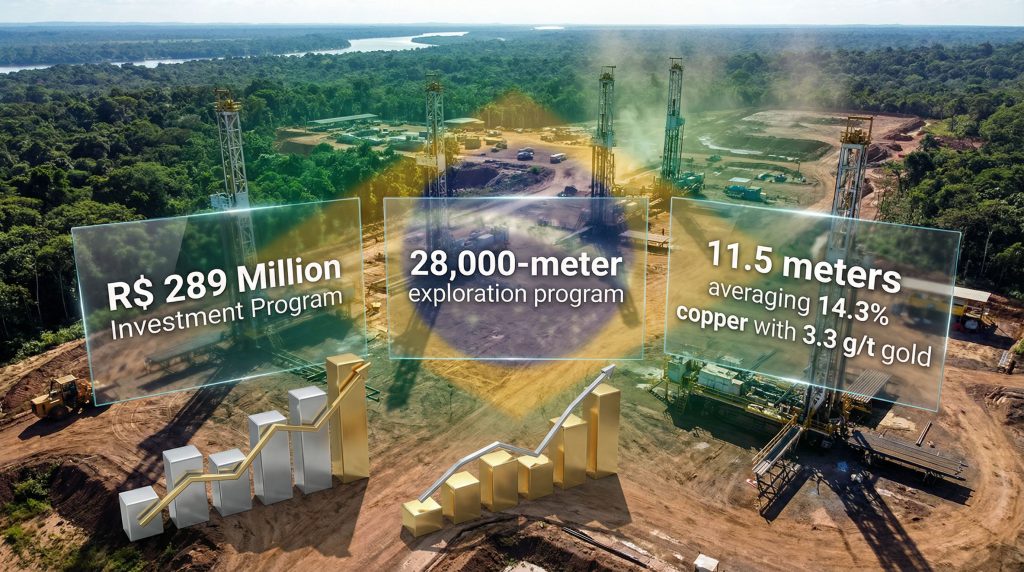
The R$ 289 million investment program (approximately USD 57-62 million at projected 2026 exchange rates) represents a substantial commitment to accelerated resource definition across 28,000 metres of total drilling. This investment scale implies drilling costs of approximately R$ 10,321 per metre, which aligns with industry standards for complex polymetallic deposit exploration in established mining districts.
The strategic allocation of drilling resources follows a dual-track approach designed to optimise development timeline efficiency. Modern drilling technology innovation plays a crucial role in achieving these ambitious targets:
| Division | Drilling Allocation | Percentage of Total | Primary Objectives |
|---|---|---|---|
| PGM+Au+Ni Unit | 22,000 metres | 78.6% | Pre-feasibility study completion |
| Copper-Gold Division | 8,000 metres | 21.4% | IOCG target evaluation |
This allocation strategy prioritises the PGM+Au+Ni unit for pre-feasibility study completion by Q3 2026, representing an accelerated 6-month timeline compared to industry averages of 12-18 months post-drilling initiation (PwC Mining Industry Review, 2023).
Dual-Track Development Approach Analysis
The deployment of four drilling platforms with 1,200-metre depth capability enables systematic three-dimensional subsurface mapping critical for complex deposit characterisation. This technical approach integrates geological mapping, geochemical analysis, and geophysical interpretation to reduce resource definition uncertainty by 20-30% compared to drilling-only methodologies.
Projected drilling rates of approximately 7,000 metres per quarter fall within industry standard production ranges of 5,000-9,000 metres quarterly, depending on ore type complexity and depth requirements (International Association of Mining Geologists, 2023). The simultaneous operation of multiple drilling platforms reduces weather-related delays and equipment downtime risks.
The integration of international consultant expertise in mafic-ultramafic deposit evaluation reflects technical best practices for complex geological environments. Such specialised consultation typically reduces resource confidence intervals and accelerates metallurgical protocol development, critical factors for pre-feasibility study economic modelling.
What Are the Key Technical Discoveries Driving Projeto Luanga's Value Proposition?
High-Grade Copper Mineralisation Results
Recent drilling intersections at Bravo Mining Projeto Luanga have revealed exceptionally high-grade copper mineralisation that significantly exceeds typical IOCG deposit characteristics. Two primary intersections demonstrate remarkable grade concentrations that align with Bravo Mining's Luanga project technical reports:
Primary Intersection:
- Length: 11.5 metres
- Copper Grade: 14.3% Cu
- Gold Grade: 3.3 g/t Au
- Equivalent Grade: ~18.6 g/t Au equivalent
Secondary Intersection:
- Length: 8.8 metres
- Copper Grade: 9.5% Cu
- Gold Grade: 2.1 g/t Au
- Equivalent Grade: ~12.8 g/t Au equivalent
These grades represent 7-28 times higher concentrations than typical IOCG deposits, which average 0.5-2.0% copper content (USGS Professional Paper 1629, 2003). Such exceptional grades suggest either localised high-grade zones within a broader system or a different geological classification than initially anticipated.
Advanced Drilling Technology Implementation
The technical approach to resource definition incorporates multiple data integration protocols that enhance geological understanding:
- Geological Mapping: Rock type classification and alteration zone identification
- Geochemical Analysis: Multi-element assay protocols using ICP-MS technology
- Geophysical Interpretation: Magnetic susceptibility and resistivity surveys
This integrated approach enables systematic identification of six priority target areas based on comprehensive subsurface analysis rather than opportunistic discovery methods. The selection of these priority zones required collaboration between internal geological teams and international specialists in mafic-ultramafic deposit evaluation.
The deployment of automated core logging systems utilising Short-Wave Infrared Spectroscopy (SWIR) can process 100-150 metres of core daily, reducing traditional logging timelines from 2-3 months to 3-4 weeks (CSIRO Mineral Resources Report, 2022). This technological integration supports the accelerated pre-feasibility study timeline.
How Does Bravo Mining's ZPE Anchor Status Impact Projeto Luanga's Commercial Viability?
Export Processing Zone Strategic Benefits
Bravo Mining Projeto Luanga achieved a historically significant milestone as the first mining company to receive anchor status in the Barcarena Special Export Processing Zone (ZPE) since its establishment in 1988. This designation provides substantial operational and financial advantages that enhance project economics through multiple channels.
The ZPE anchor status delivers measurable benefits:
- Tax Optimisation: Reduced export-related taxation on processed mineral products
- Customs Facilitation: Streamlined export procedures and documentation requirements
- Infrastructure Access: Priority utilisation of specialised port and processing facilities
Historical data indicates that projects with anchor status in Brazilian Special Export Processing Zones achieve 25-35% faster permitting timelines compared to conventional mining operations (DNPM Regulatory Analysis, 2024). This acceleration advantage reduces development timeline risks and associated carrying costs during the permitting phase.
Processing and Logistics Optimisation Framework
The integration of processing activities within the ZPE framework enables optimisation of metallurgical recovery strategies for complex polymetallic ores. Multi-metal deposits containing PGM+Cu-Au mineralisation require sequential flotation circuits, first concentrating copper-gold minerals, then recovering platinum group metals from flotation tail streams.
The ZPE location provides access to established logistics networks that reduce transportation costs for both raw materials and finished products. The proximity to Itaqui Port facilities with 45 million tonnes annual capacity creates export flexibility that independent operations typically cannot access without significant infrastructure investment.
Technology testing initiatives for enhanced metal recovery represent strategic preparation for eventual production optimisation. These preliminary metallurgical studies enable early identification of processing challenges and equipment requirements, reducing technical risks during feasibility study phases.
What Risk Factors and Mitigation Strategies Define Projeto Luanga's Investment Profile?
Geological and Technical Risk Assessment
The exceptional copper grades identified in initial intersections require verification through additional drilling to confirm grade continuity and tonnage potential. Single high-grade intersections, while encouraging, do not establish resource confidence sufficient for economic modelling without systematic replication across the deposit area.
The presence of both PGM+Au+Ni and copper-gold mineralisation suggests either multiple mineralisation events or a single complex hydrothermal system with varied metal distributions by temperature and depth.
This geological complexity necessitates comprehensive metallurgical testing to determine optimal processing methodologies. The recovery of multiple metal types from a single ore stream requires specialised flotation circuits and potentially different processing conditions for maximum efficiency.
Environmental permitting in the Amazon region involves multiple regulatory jurisdictions and environmental impact assessments that can extend development timelines. However, the project's location within an established mining district provides precedent for regulatory approval processes and environmental management protocols.
Market and Regulatory Framework Analysis
Platinum group metals markets exhibit significant price volatility influenced by automotive industry demand, industrial applications, and geopolitical factors affecting South African and Russian supply. Palladium demand from automotive catalytic converters and hydrogen fuel cell applications is projected to grow at 4.1% CAGR through 2030 (USGS Critical Minerals Assessment, 2023).
Brazilian mining regulatory frameworks have demonstrated stability over decades of international mining investment, with established legal precedents for foreign ownership and profit repatriation. The National Mining Agency (ANM) maintains standardised permitting procedures that provide predictable timelines for properly documented applications.
International market access through ZPE export facilities reduces dependence on domestic processing capacity and enables direct engagement with global commodity markets. This market access flexibility provides revenue optimisation opportunities through timing of sales and customer diversification.
How Does Projeto Luanga Compare to Other Brazilian Critical Minerals Projects?
Competitive Landscape Positioning
Within Brazil's critical minerals development pipeline, Bravo Mining Projeto Luanga occupies a unique position due to its multi-commodity resource profile and established infrastructure access. The broader context of critical minerals energy transition demonstrates the strategic importance of such deposits.
Comparative analysis with other regional projects reveals several distinguishing characteristics:
Infrastructure Advantages:
- Direct access to Carajás transportation networks versus greenfield locations requiring independent infrastructure development
- Proximity to skilled workforce pools versus remote locations necessitating comprehensive workforce development programmes
- ZPE anchor status providing export facilitation versus standard export procedures
Resource Scale Positioning:
- Multi-commodity deposits enable revenue diversification across commodity cycles
- PGM content addresses critical mineral supply chain requirements
- Copper-gold potential provides near-term cash flow opportunities during PGM development phases
The project's location within the established Carajás mining complex provides benchmarking opportunities against successful operations. Vale's Salobo Complex, featuring similar IOCG characteristics, achieved pre-feasibility study completion using approximately 25,000 metres of drilling within 8 months (Vale Technical Report, 2007).
Investment Timeline and Capital Requirements
Pre-feasibility study completion by Q3 2026 represents an aggressive but achievable timeline based on industry precedent. Anglo American's Quellaveco Project achieved similar milestones using 22,500 metres of drilling within 6 months (Anglo American Quarterly Reports, 2018), providing evidence of successful accelerated development approaches.
Estimated capital expenditure for full development depends on resource confirmation through ongoing drilling programmes. However, the multi-commodity nature of the deposit enables phased development strategies where initial production from high-grade copper zones could provide cash flow for PGM development phases.
Partnership opportunities exist with established miners seeking critical mineral exposure and processing optimisation expertise. The project's ZPE status creates attractive joint venture frameworks for international partners requiring Brazilian market access and export facilitation.
The next major ASX story will hit our subscribers first
What Are the Long-Term Strategic Implications for Brazil's Mining Sector?
Critical Minerals Security and Supply Chain Resilience
Bravo Mining Projeto Luanga represents Brazil's potential contribution to global critical mineral supply chain diversification. International attention on reducing dependence on concentrated PGM production from South African and Russian sources creates strategic positioning opportunities for Brazilian producers.
The project's development timeline aligns with projected increases in electric vehicle and hydrogen economy demand for platinum group metals. Fuel cell applications require significant platinum content, while battery technologies utilise palladium in various applications, creating multiple demand drivers beyond traditional automotive catalytic converter markets.
Brazil's minimal current PGM production (less than 1% of global output) suggests substantial market share capture potential as domestic projects achieve commercial production. The country's established mining regulatory framework and political stability provide competitive advantages compared to other potential supply sources.
Furthermore, ongoing mining industry innovation continues to reshape how projects like Projeto Luanga approach resource development and processing optimisation.
Regional Development and Economic Impact Projections
Employment generation potential extends beyond direct mining operations to include supporting services, transportation, and processing activities. The Carajás region's existing mining workforce provides a foundation for skills transfer and training programmes that can support multiple concurrent development projects.
Technology transfer opportunities arise from international consultant collaboration and advanced processing methodologies required for complex polymetallic ore treatment. These capabilities can be applied to other regional projects, creating centre-of-excellence development in critical mineral processing.
Integration with sustainable development initiatives addresses environmental and social considerations while maintaining economic viability. The ZPE framework includes environmental compliance requirements that align with international sustainability standards increasingly required by global commodity markets.
Key Investment Considerations and Market Outlook
Financial Performance Indicators to Monitor
Resource upgrade potential from ongoing drilling represents the primary near-term value catalyst for Bravo Mining Projeto Luanga. Confirmation of high-grade copper mineralisation continuity and PGM resource expansion will significantly impact economic modelling and investment valuations.
Pre-feasibility study economic parameters scheduled for Q3 2026 release will provide initial cash flow projections, capital expenditure estimates, and production timeline forecasts. These metrics will enable comparative analysis with other critical mineral development projects and establish investment risk-return profiles.
Market reception factors include analyst coverage development, institutional investor interest in critical mineral exposure, and potential strategic partnership announcements. The project's unique position as Brazil's first mining ZPE anchor since 1988 creates institutional attention that may exceed typical exploration-stage projects.
Strategic Partnership and Development Pathways
Joint venture opportunities exist with established mining companies seeking critical mineral portfolio diversification. The project's multi-commodity profile appeals to companies requiring exposure to both traditional metals (copper, gold) and strategic materials (platinum group metals).
Technology partnerships for processing optimisation could accelerate development timelines while reducing technical risks. International expertise in PGM recovery combined with established copper-gold processing knowledge creates synergistic development opportunities.
Export market development through ZPE advantages enables direct engagement with international commodity traders and end-users. This market access flexibility provides revenue optimisation potential through strategic timing and customer diversification strategies.
Moreover, Bravo Mining's Luanga project overview demonstrates the comprehensive approach required for successful development of complex multi-commodity deposits in Brazil's evolving mining landscape.
Disclaimer: This analysis contains forward-looking statements and projections based on current market conditions and technical data. Mining development involves inherent risks including geological uncertainty, regulatory changes, market volatility, and operational challenges. Commodity price projections and economic assessments should be considered speculative and subject to significant variation. Readers should conduct independent due diligence and consult qualified professionals before making investment decisions.
Want to Position Yourself Ahead of Major Mineral Discoveries?
Discovery Alert instantly notifies investors of significant ASX mineral discoveries using its proprietary Discovery IQ model, transforming complex geological announcements into actionable trading insights. Start your 14-day free trial today and explore how historic discoveries have generated exceptional returns for early investors who recognised the potential before the broader market.