June 27, 2026
When Adjacent Ground Becomes a Game Changer: The Strategic Logic Behind Motapa
In gold mining, the economics of discovery are rarely linear. The value of a new deposit is not determined solely by what lies within its own boundaries, but by what surrounds it. Proximity to existing or planned infrastructure, processing capacity, and established operational platforms can transform a promising exploration target into something far more financially compelling. This dynamic is precisely what makes the Caledonia Bilboes Motapa drill results one of the more consequential exploration updates to emerge from Zimbabwe's gold sector in recent years.
Motapa is not being evaluated in isolation. Its significance is inseparable from its relationship to the Bilboes gold project, a large-scale open-pit development that Caledonia Mining is advancing toward first gold production in Q4 2028. Understanding what the 2025 drilling programme has actually uncovered at Motapa, and what it means for the combined asset picture, requires both a technical lens and a strategic one.
When big ASX news breaks, our subscribers know first
The Bilboes Foundation: What Caledonia Is Already Building Toward
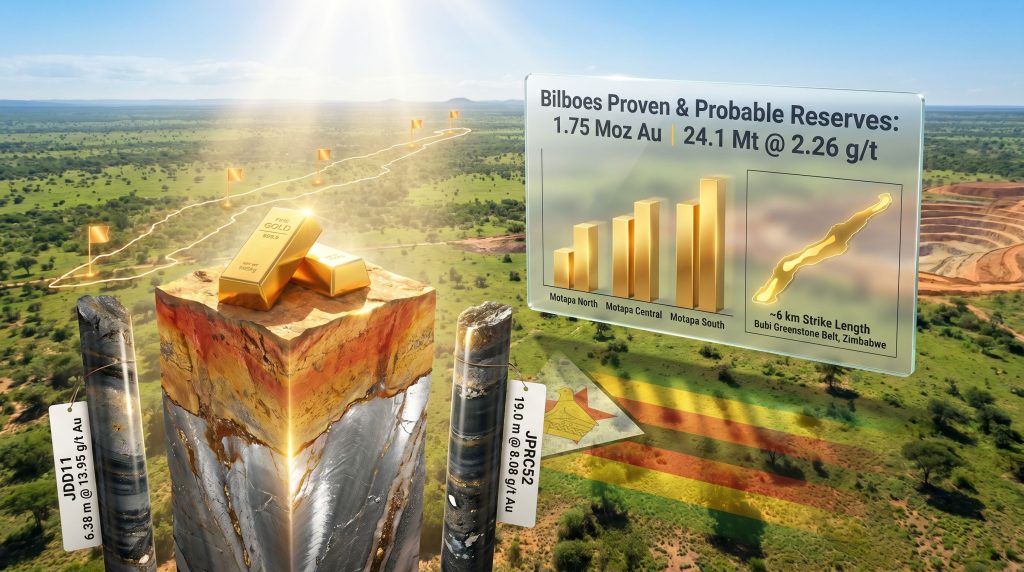
Before examining Motapa's drill results, it helps to understand the asset that gives them context. Bilboes holds proven and probable gold reserves of 1.75 million ounces, contained within 24.1 million tonnes of ore at an average grade of 2.26 g/t. These are not exploration-stage numbers. They represent a formally defined reserve base capable of underpinning a serious development decision.
The planned open-pit operation at Bilboes is designed to become one of Zimbabwe's most significant gold production centres. The combination of scale, grade, and proximity to existing artisanal and small-scale mining history in the Bubi Greenstone Belt gives the project both geological credibility and regional operational context. Furthermore, current gold exploration trends suggest that projects with this level of infrastructure readiness are increasingly rare.
What Bilboes currently lacks, like most single-deposit projects, is the long-term optionality that sustains investor confidence through the full mine life cycle. A defined reserve base supports a mine plan. An adjacent exploration asset with confirmed mineralisation supports a future beyond that plan. That is where Motapa enters the equation.
What the 2025 Motapa Programme Actually Involved
The 2025 exploration campaign at Motapa was among the most intensive ever conducted on the property. The programme was structured around two primary objectives: testing whether sulphide mineralisation extended downward beneath the historically mined oxide open pits, and identifying new mineralised zones that prior work may have missed.
The scale of activity across the programme is summarised below:
| Activity | Volume Completed |
|---|---|
| Reverse Circulation (RC) Drilling | 18,547 m |
| Diamond Core Drilling | 1,561.78 m |
| Trenching | 22,364 m |
| Confirmed Strike Length | ~6 km (Bubi Greenstone Belt) |
The combined figure of over 40,000 metres across RC drilling, diamond drilling, and trenching represents a material step-change in the geological understanding of the Motapa tenement. This is not incremental sampling. It is a systematic effort to define the three-dimensional architecture of a gold system across a substantial portion of the Bubi Greenstone Belt.
Motapa North Drill Results: A High-Grade System Taking Shape
Motapa North has produced the most compelling headline numbers of the 2025 programme. Multiple drill holes have returned intersections that comfortably exceed the 6 g/t threshold widely referenced in the industry as high-grade for open-pit-amenable deposits. More importantly, these intersections are not isolated. They demonstrate structural continuity across multiple holes and both drilling programmes. Interpreting gold drill results of this nature requires careful attention to structural context, not just headline grades.
2025 Programme: Selected Motapa North Intersections
| Hole ID | Intersection (m) | Grade (g/t Au) |
|---|---|---|
| JPRC52 | 19.0 m | 8.08 g/t |
| JDD11 | 6.38 m | 13.95 g/t |
| JPRC63 | 12.0 m | 7.12 g/t |
| PLV5RC4 | 14.0 m | 4.31 g/t |
| JPRC51 | 17.0 m | 3.25 g/t |
| PLV1RC10 | 13.0 m | 3.72 g/t |
| PLV1RC15 | 6.0 m | 6.89 g/t |
Earlier Programme Context: Prior Motapa North Intersections
| Hole ID | Intersection (m) | Grade (g/t Au) |
|---|---|---|
| JPRC01 | 12.0 m | 6.36 g/t |
| JPRC05 | 13.0 m | 5.17 g/t |
| PLVRC06 | 7.0 m | 3.27 g/t |
| PLVDD01 | 8.0 m | 4.00 g/t |
Key Insight: The replication of high-grade intersections across separate drilling programmes is geologically significant. It reduces the probability that these results reflect local grade spikes or sampling artefacts, and instead points toward a mineralised system with genuine lateral and vertical continuity.
The intersection of 19.0 m at 8.08 g/t in hole JPRC52 is particularly notable. Widths of this scale at grades above 8 g/t are highly relevant to open-pit economic modelling, where dilution at the ore-waste boundary is an unavoidable reality. Wider intersections provide a buffer against grade dilution and support more robust strip ratio assumptions.
The highest-grade single intersection, 6.38 m at 13.95 g/t from diamond hole JDD11, reflects what geologists describe as a high-grade shoot. In shear-zone-hosted gold systems, these shoots often plunge along the structural fabric of the host rock, meaning they can persist at depth well beyond the limits of current drilling. In addition, understanding true vs apparent widths in these intersections is essential when assessing their economic significance. This represents a significant exploration upside consideration.
Motapa Central and the Emerging District Picture
While Motapa North commands attention for its headline grades, the Motapa Central zone, also referred to as Mpudzi, adds important context to the broader geological picture. Caledonia's Motapa operations page provides further background on the tenement's history and exploration rationale.
Selected Motapa Central Drilling Highlights
| Hole ID | Intersection (m) | Grade (g/t Au) |
|---|---|---|
| MPZRC79 | 7.0 m | 2.39 g/t |
| MPZRC64 | 3.0 m | 4.79 g/t |
| MPZRC117 | 2.0 m | 5.25 g/t |
| MPZRC02 | 4.0 m | 10.95 g/t |
Analytical Note: The intersection of 4.0 m at 10.95 g/t in MPZRC02 is a standout result for the Central zone. While the width is narrower than the best Motapa North intersections, grade of this magnitude within a separate structural zone indicates the system is not confined to a single corridor.
Narrower widths at Motapa Central are consistent with what geologists expect in zones that have received less drilling intensity. Infill drilling at closer spacings typically resolves apparent width limitations, and the presence of high-grade shoots across multiple zones suggests the overall system has more lateral extent than current data fully captures.
Motapa South remains the least tested of the three zones identified along the approximately 6 km strike corridor. Mineralised shear zones have been confirmed there, but drill density is insufficient for resource estimation purposes at this stage. Consequently, from an exploration perspective, Motapa South represents the most meaningful near-term upside vector within the tenement.
The Bubi Greenstone Belt: Understanding the Host Geology
The geological setting of the Motapa tenement is not incidental to the investment thesis. The Bubi Greenstone Belt is an Archaean-age terrane characterised by structurally controlled, shear-zone-hosted gold mineralisation. This is the same fundamental architecture that hosts the world's most economically significant gold deposits.
Greenstone belts of comparable age and style include:
- The Yilgarn Craton in Western Australia, host to Kalgoorlie, St Ives, and numerous multi-million-ounce deposits
- The Abitibi Greenstone Belt in Canada, one of the most prolific gold-producing regions in history
- The Limpopo and Zimbabwe Cratons in southern Africa, which share Archaean basement characteristics
What these terranes share is a propensity for gold to be concentrated along major structural corridors where deep-sourced fluids have been channelled and focused by faulting and shearing during ancient tectonic events. The confirmation of multiple mineralised shear zones at Motapa across a ~6 km strike length is entirely consistent with this type of district-scale gold system.
A key geological concept relevant here is plunge continuity. In shear-zone-hosted deposits, high-grade shoots do not simply sit at surface or within the oxide zone. They typically plunge along the intersection lineation of the host structure, meaning they can be followed into the subsurface at predictable orientations. The 2025 programme's confirmation of sulphide mineralisation beneath the historic oxide pits validates exactly this depth extension thesis.
The next major ASX story will hit our subscribers first
Infrastructure Synergies: Why Adjacency Multiplies Value
One of the most underappreciated aspects of the Motapa story is the economic leverage created by its location. In gold mining, the economics of adjacent deposits are rarely additive; they are often multiplicative. Shared infrastructure eliminates the most capital-intensive line items from any standalone development budget.
The potential synergies between Motapa and Bilboes include:
- Processing plant sharing: A single carbon-in-leach (CIL) or carbon-in-pulp (CIP) facility at Bilboes could handle ore feed from both properties, eliminating the need for a separate Motapa processing plant
- Haulage and road infrastructure: Direct adjacency means ore transport distances and associated costs are minimal
- Shared utilities: Power and water infrastructure, once established for Bilboes, can serve both operations without proportional additional capital expenditure
- Unified workforce and management: A combined operational structure reduces overhead and improves cost efficiency across both assets simultaneously
The practical implication is that each additional ounce defined at Motapa carries a lower per-ounce development cost than it would if Motapa were a standalone project in a different location. This is a fundamental advantage that reserve and resource estimates alone do not fully capture.
Development Pathways: Mapping the Scenarios
Motapa is not a single-track development story. The presence of both oxide and sulphide mineralisation, combined with its proximity to Bilboes, creates multiple optionality pathways that can be sequenced to match capital availability and the Bilboes development timeline.
| Development Pathway | Timeframe | Key Enabler | Risk Profile |
|---|---|---|---|
| Oxide heap leach (standalone) | Near-term (2-4 years) | Near-surface oxide resource | Moderate, subject to resource outcomes |
| Ore feed to Bilboes CIL plant | Medium-term (4-6 years) | Bilboes plant commissioning | Low, leverages planned infrastructure |
| Integrated open-pit operation | Long-term (6-10 years) | Combined feasibility study | Low-to-moderate, scale dependent |
| Underground sulphide mining | Long-term (8-12 years) | Sulphide resource definition | Higher, requires additional drilling |
Caledonia's CEO Mark Learmonth has been explicit about the sequencing priority. His stated position confirms that Bilboes remains the immediate development focus, with first gold targeted for Q4 2028, while Motapa is viewed as a strategically compelling opportunity to extend mine life and grow production across a combined mining complex. This is a deliberate and capital-efficient approach, not a distraction from the primary asset. Furthermore, the Bilboes definitive feasibility study underpins the confidence with which these timelines are being communicated to the market.
The Q3 2026 Resource Estimate: What to Watch For
Caledonia has confirmed that a maiden mineral resource estimate for portions of Motapa is expected in Q3 2026. This will be one of the most consequential near-term data points for understanding how Motapa fits into the broader Bilboes development strategy.
Several metrics will define the resource's strategic value once published:
- Grade continuity across strike and depth – Do the high-grade drill intersections connect into coherent, mineable ore bodies?
- JORC resource classification – The proportion of Measured and Indicated material versus Inferred will determine whether the resource can support bankable economic studies
- Oxide versus sulphide split – Near-surface oxide tonnes may support near-term production decisions independently of the Bilboes timeline
- Total contained ounces – The absolute scale of the resource will determine whether Motapa is a meaningful life-of-mine extender or a modest addition to the overall reserve base
- Proximity weighting to Bilboes infrastructure – Resources within practical haulage distance of the planned Bilboes processing plant carry inherently higher economic value per ounce
It is worth noting that the initial resource estimate will likely cover only Motapa North and potentially Motapa Central, where drill spacing is sufficient for JORC-compliant classification. Motapa South and other less-tested zones will require additional infill work before inclusion. The maiden estimate should therefore be understood as a floor, not a ceiling, for Motapa's ultimate resource potential.
Key Takeaways for Investors and Industry Observers
The Caledonia Bilboes Motapa drill results, viewed in aggregate, tell a coherent geological and strategic story. However, understanding the full picture requires careful evaluation of both the technical data and the broader development context. For those assessing drill results for investors, the combination of grade, width, and structural continuity demonstrated here is a meaningful signal worth tracking.
- The 2025 exploration programme represents the most comprehensive investigation of the Motapa tenement to date, with over 40,000 combined metres of drilling and trenching completed
- High-grade intersections at Motapa North, including 19.0 m at 8.08 g/t and 6.38 m at 13.95 g/t, are consistent with a structurally controlled gold system capable of supporting economically meaningful extraction
- The presence of significant mineralisation across all three zones, North, Central, and South, over a ~6 km strike corridor elevates Motapa from grassroots target to credible resource development candidate
- Infrastructure sharing with Bilboes creates a per-ounce capital cost advantage that standalone project economics cannot replicate
- The Q3 2026 maiden resource estimate is the defining near-term catalyst for quantifying Motapa's contribution to the combined operation
Investor Note: This article contains forward-looking statements and speculative analysis regarding exploration outcomes, development timelines, and economic projections. Mineral resource estimates, development decisions, and production targets are subject to significant geological, technical, regulatory, and market risks. Nothing in this article constitutes financial advice. Past drilling results do not guarantee future resource definition or commercial viability.
Frequently Asked Questions
What is the Motapa exploration property?
Motapa is a gold exploration tenement in Zimbabwe sitting directly adjacent to Caledonia Mining's Bilboes gold project within the Bubi Greenstone Belt. It hosts multiple mineralised shear zones across an approximately 6 km strike corridor covering Motapa North, Central, and South zones. Global Mining Review's coverage of the initial results offers useful additional context on the programme's origins.
What were the strongest Caledonia Bilboes Motapa drill results from the 2025 programme?
The standout intersections include 19.0 m at 8.08 g/t from hole JPRC52 and 6.38 m at 13.95 g/t from diamond hole JDD11 at Motapa North, alongside 4.0 m at 10.95 g/t from MPZRC02 at Motapa Central.
When is the maiden mineral resource estimate expected?
Caledonia has indicated it expects to publish a maiden mineral resource estimate for portions of Motapa in Q3 2026, covering zones where drill density is sufficient for JORC-compliant classification.
What types of mineralisation have been confirmed at Motapa?
Both oxide and sulphide mineralisation have been identified. Oxide mineralisation, present near surface, supports near-term development optionality, while sulphide mineralisation at depth underpins longer-term production potential consistent with the deeper parts of shear-zone-hosted gold systems.
What is the current reserve base at Bilboes?
Bilboes holds proven and probable reserves of 1.75 million ounces of gold in 24.1 million tonnes of ore at an average grade of 2.26 g/t, with first gold production targeted for Q4 2028.
Want to Know When the Next Major ASX Mineral Discovery Gets Announced?
Discovery Alert's proprietary Discovery IQ model scans ASX announcements in real time, instantly identifying high-potential mineral discoveries across more than 30 commodities and turning complex geological data into clear, actionable insights — so investors can act before the broader market reacts. Explore historic discoveries and their extraordinary returns, then start your 14-day free trial to position yourself ahead of the next significant find.