
July 16, 2026
Brazil's comprehensive trade defense mechanisms are reshaping global steel markets, with new protective measures creating substantial barriers for international suppliers. The Brazil anti-dumping duties on steel imports introduced in February 2026 represent the latest expansion of South America's most sophisticated anti-dumping framework, fundamentally altering competitive dynamics across multiple product categories.
Understanding Brazil's Anti-Dumping Framework and Implementation Strategy
Brazil's steel industry protection strategy has evolved into one of South America's most comprehensive trade defense mechanisms. The country's anti-dumping framework operates under World Trade Organization guidelines, specifically the Agreement on Implementation of Article VI of the General Agreement on Tariffs and Trade (GATT 1994), which establishes legal parameters for member nations to impose duties when imports are sold below fair value and cause material injury to domestic industries.
The current wave of Brazil anti-dumping duties on steel imports began with investigations initiated in early 2024, culminating in three significant measures approved by February 2026. These duties specifically target Chinese and Indian steel imports, with rates ranging from $284.98 to $709.63 per tonne across different product categories. Furthermore, these measures reflect growing concerns about how tariffs impact investment patterns in global markets.
Market participants had anticipated these protective measures for months. Carlos Loureiro, executive president of Brazil's National Institute of Steel Distributors (INDA), expressed optimism about the duties in January 2026, expecting implementation by February at the latest. This timeline proved accurate, with final approval announced in February 2026.
Brazilian distributors framed the measures as necessary protection against unfair competition practices. Industry representatives emphasised their support for legitimate imports while opposing dumping practices that force domestic mills to compete under disadvantageous conditions. The extended investigation timeline, which utilised the maximum allowable deadline, demonstrates the thoroughness of Brazil's approach to trade defense.
When big ASX news breaks, our subscribers know first
Steel Product Categories Facing Maximum Import Barriers
The scope of Brazil's anti-dumping measures encompasses multiple steel product categories, each facing substantial duty rates that effectively reshape import economics. Additionally, these developments occur alongside broader tensions in the US-China trade war affecting global markets.
Cold-Rolled Coil Impact Assessment
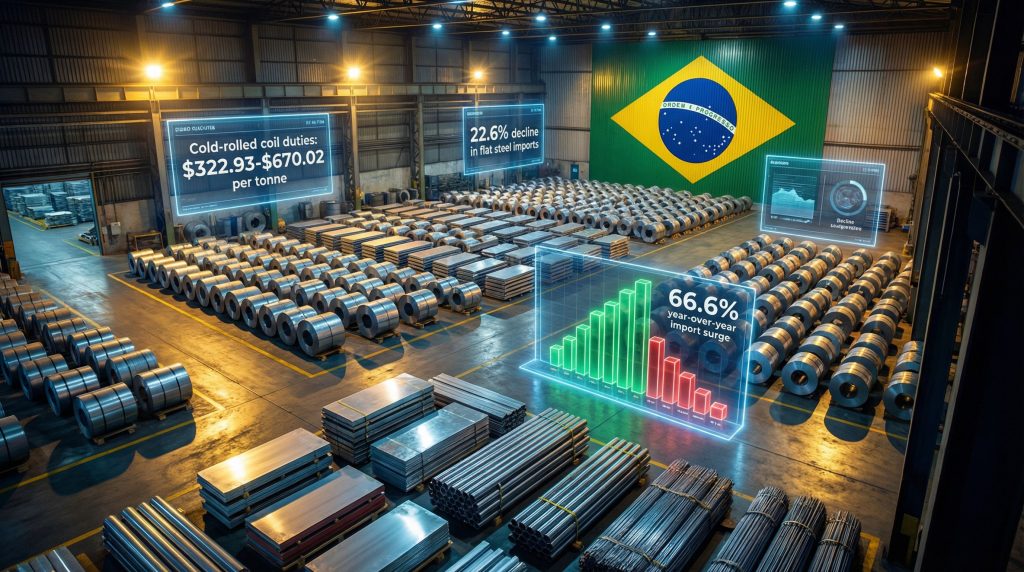
Cold-rolled coil from China faces duties ranging from $322.93 to $670.02 per tonne. These rates represent some of the highest barriers in Brazil's current trade protection framework. Market analysis indicates that in most cases, the duties exceed the current material value per tonne, making Chinese imports economically unviable.
Hot-Dipped Galvanised and Coated Steel Measures
Hot-dipped galvanised coil and other coated steel products face duties between $284.98 and $709.63 per tonne. This range covers multiple coating types and specifications, creating comprehensive barriers across the galvanised steel segment.
Pre-Painted Steel Dual-Country Targeting
Pre-painted steel faces unique treatment as the only category targeting both Chinese and Indian imports. The duty range of $284.98 to $709.63 per tonne applies to both countries, suggesting Brazil's determination to address dumping concerns from multiple Asian suppliers.
Comparative Duty Rate Analysis
| Product Category | Duty Range (USD/tonne) | Target Countries |
|---|---|---|
| Cold-rolled coil | $322.93-$670.02 | China |
| Hot-dipped galvanised | $284.98-$709.63 | China |
| Pre-painted steel | $284.98-$709.63 | China & India |
| Coated steel | $284.98-$709.63 | China |
These duty levels create economic barriers that importers describe as impossible for Chinese mills to absorb. Price increases of approximately 1,000 Brazilian Reais ($193) per tonne have already been implemented by importers to account for the new duty structure.
Import Volume Transformations and Market Disruption
Brazil's steel import patterns experienced dramatic shifts as markets anticipated and then responded to the duty implementations. The data reveals both immediate tactical adjustments and underlying structural trends that complicate the overall trade picture. Moreover, these changes highlight how trade-wars supply chains are being restructured globally.
December 2025 Import Contraction
Flat steel imports declined sharply in December 2025, dropping 22.6% from 265,900 tonnes in November to 205,700 tonnes. This month-over-month contraction reflects market participants' anticipatory behaviour as final duty announcements approached.
The product categories affected include:
- Heavy plate
- Hot-rolled steel
- Cold-rolled steel
- Coated steel products
Paradoxical Year-Over-Year Growth
Despite the December decline, year-over-year import patterns tell a different story. December 2025 imports remained 66.6% higher than December 2024 levels of 123,500 tonnes. This paradox illustrates how cumulative import volumes through 2025 significantly exceeded prior year levels, even with anticipatory reductions in the final month.
Price Escalation Dynamics
Weekly price movements during February 2026 demonstrate the immediate market impact:
- Cold-rolled coil: $610-630/tonne (up $20/tonne week-over-week)
- Hot-dipped galvanised coil: $660-700/tonne (up $10-30/tonne)
- Galvalume coil: $770-820/tonne (up $20/tonne)
These price increases occurred before full duty implementation, suggesting markets were pricing in expected trade barriers and supply disruptions.
Supply Chain Anticipation Strategies
Market participants began adjusting import strategies months before final duty announcements. Brazilian distributors noted that traders and importers were already anticipating anti-dumping measures, leading to the observed December import decline.
Alternative Supplier Emergence and Competitive Repositioning
Brazil's comprehensive duties against Chinese steel have catalysed a fundamental reassessment of global supply sources. Previously uncompetitive alternatives have rapidly gained viability as duty-adjusted Chinese pricing has shifted competitive dynamics. These shifts parallel broader changes in iron ore trends affecting commodity markets.
Vietnam's Strategic Positioning
Vietnam has emerged as the primary beneficiary of Brazil's anti-dumping measures. Market participants who previously considered Vietnamese steel expensive now view it as competitively priced when factoring in Chinese duties. This perception shift reflects the dramatic impact of duty levels that often exceed material values per tonne.
Brazilian importers conducted strategic visits to Vietnam in 2025, anticipating current trade disruptions. These proactive relationship-building efforts positioned early movers to capture alternative supply arrangements before the broader market recognised the opportunity.
Northeast Asian Supplier Advantages
South Korea and Taiwan have gained significant competitive advantages in the post-duty environment. Previously viewed as expensive relative to Chinese alternatives, these suppliers now offer compelling value propositions for Brazilian importers seeking reliable supply chains.
Japan represents a renewed opportunity for market entry. Japanese steel producers, historically challenged by Chinese pricing competition, now find their quality premiums more acceptable to cost-conscious Brazilian buyers facing duty-adjusted Chinese alternatives.
India's Mixed Market Position
India faces a complex competitive landscape in Brazilian steel markets. While subject to anti-dumping duties on pre-painted steel alongside China, Indian producers remain viable suppliers for other steel categories not yet affected by trade measures.
Market Repositioning Timeline
The transition to alternative suppliers follows a predictable pattern:
- Early movers: Companies that established relationships with Vietnamese and Northeast Asian suppliers in 2025
- Market followers: Importers who anticipated lower duty levels and now face supply chain disruption
- Reactive participants: Market players rushing to establish alternative relationships post-implementation
This staggered adoption creates temporary supply chain advantages for early movers while generating premium pricing for alternative suppliers managing increased demand.
Brazil's Expanding Trade Protection Architecture
The February 2026 measures represent the latest expansion of Brazil's increasingly comprehensive steel trade protection framework. Understanding this broader context reveals the systematic nature of Brazil's approach to domestic industry protection. These developments occur within a broader pattern of US tariffs and inflation affecting global economic dynamics.
Historical Protection Measures Timeline
Brazil's current trade defense architecture builds upon multiple layers of protection implemented over recent years:
October 2024: Initial tinplate duties against Chinese imports established the foundation for expanded measures.
September 2025: Significant expansion and extension of existing measures, including 200% duty increases on heavy plate, stainless flat steel, and tinplate from multiple countries including China, South Africa, South Korea, Ukraine, and Taiwan.
February 2026: Three new anti-dumping measures targeting cold-rolled coil, hot-dipped galvanised steel, pre-painted steel, and coated steel from China and India.
Comprehensive Product Coverage Strategy
Brazil's approach encompasses virtually all major steel product categories through overlapping measures:
- Flat steel products: Cold-rolled, hot-rolled, galvanised, and coated variants
- Specialty products: Pre-painted steel, stainless steel, tinplate
- Structural steel: Heavy plate from multiple supplier countries
- Long products: Wire rod investigations ongoing
Duty Escalation Patterns
The 200% duty increases implemented in September 2025 demonstrate Brazil's willingness to dramatically escalate trade barriers when initial measures prove insufficient. This escalation pattern suggests that current duties may face similar increases if import levels remain elevated.
Multi-Country Targeting Approach
Brazil's measures systematically address multiple supplier countries rather than focusing solely on China. Heavy plate duties affect South Africa, South Korea, and Ukraine alongside China, while stainless steel measures include Taiwan. This comprehensive approach prevents simple supply chain diversion strategies.
What Are the Economic Impacts of These Trade Measures?
The implementation of Brazil's anti-dumping duties creates complex economic effects that extend beyond simple import substitution. Market participants face fundamental changes in competitive dynamics, pricing structures, and supply chain reliability.
Price Transmission Mechanisms
The duties create immediate price floor effects that eliminate Chinese competitiveness across affected categories. Brazilian importers report price increases of approximately 1,000 Brazilian Reais ($193) per tonne as they adjust to duty-inclusive Chinese pricing or transition to alternative suppliers.
This price transmission occurs through multiple channels:
- Direct duty costs passed through to end users
- Alternative supplier premium pricing due to increased demand
- Supply chain disruption costs and inventory adjustments
- Risk premiums for uncertain trade policy environment
Market Destruction Risk Analysis
Industry participants express concern about complete market cessation in certain categories, particularly pre-painted steel. Historical precedent from Brazil's heavy plate market demonstrates this risk. According to market sources, Brazil previously maintained an active heavy plate market driven by imports, but when imports ceased due to high duties and local prices remained elevated, the entire market collapsed. Brazil has imposed anti-dumping duties of up to $670 per tonne on Chinese steel products following comprehensive investigations.
The mechanism for market destruction follows a predictable pattern:
- High duties eliminate competitive imports
- Domestic suppliers maintain elevated pricing
- Alternative suppliers raise prices to approach domestic levels
- Total market volume contracts as end users defer purchases
- Market activity levels become unsustainable for all participants
Competitive Rebalancing Effects
Brazilian domestic steel producers benefit from reduced import competition, but face complex challenges in maintaining market share while managing pricing expectations. Companies like Gerdau and CSN gain competitive breathing room but must balance profit maximisation against market development objectives.
End User Adaptation Strategies
Steel consumers are implementing various adaptation strategies:
- Inventory management: Forward buying before duty implementation or price escalations
- Supplier diversification: Developing relationships with multiple country sources
- Product substitution: Shifting to steel grades or specifications with different duty treatment
- Supply chain integration: Vertical integration to reduce exposure to import price volatility
The next major ASX story will hit our subscribers first
How Will Future Trade Measures Affect the Market?
Brazil's current anti-dumping framework represents only a portion of active trade defense investigations. Understanding the pipeline of pending cases provides insight into potential future trade barriers and market disruptions.
Active Steel Investigations
Multiple steel categories remain under active investigation with determinations expected through 2026:
Tinplate investigations: Germany, Japan, and the Netherlands face scrutiny for potential dumping practices in the Brazilian tinplate market.
Hot-rolled flat steel: Chinese hot-rolled products face investigation that could create comprehensive barriers across the flat steel spectrum.
Steel wire rod: Both Chinese and Russian suppliers face potential duties in the long products segment.
Stainless steel expansion: Hot-rolled stainless flat steel from China, India, and Indonesia could face new measures.
Seamless tube reviews: Ukraine faces review proceedings while India, Malaysia, and Thailand face new investigations in the tube segment.
Probability Assessment Framework
Market participants generally expect additional measures based on the comprehensive nature of current investigations and Brazil's demonstrated willingness to implement substantial duties. The pattern of investigation initiation, extended timelines, and high duty levels suggests a systematic approach to trade protection across the steel sector.
Timeline Expectations
Most pending investigations are expected to reach conclusions by late 2026, creating potential for significant additional trade barriers within the next 12 months. This timeline compression could create supply chain planning challenges for importers seeking alternative arrangements.
Regional Trade Architecture and Strategic Implications
Brazil's comprehensive anti-dumping framework extends beyond bilateral trade relationships to influence broader South American trade dynamics and global steel market structures.
South American Market Integration Effects
Brazil's measures create potential opportunities for regional steel trade expansion. Argentina, Colombia, and other South American producers may benefit from Brazilian import barriers against Asian suppliers, though capacity constraints and product specification limitations may limit this potential.
Global Overcapacity Management
Brazil's actions align with broader global concerns about steel overcapacity, particularly Chinese production levels that exceed domestic consumption. These measures contribute to international efforts to address structural oversupply conditions that depress global steel prices.
WTO Compliance Considerations
While Brazil's measures operate within WTO anti-dumping agreement parameters, the comprehensive nature and high duty levels could face potential dispute challenges. The systematic targeting of multiple product categories and countries may draw scrutiny regarding proportionality and material injury determinations. Brazil grants antidumping measures following detailed investigations that span multiple product categories.
Precedent Setting for Developing Economies
Brazil's approach may influence other developing economies facing similar import competition challenges. The comprehensive product coverage and substantial duty levels demonstrate one model for domestic industry protection that other countries may emulate.
Risk Management and Investment Implications
The current trade policy environment creates significant planning challenges for steel market participants, requiring sophisticated risk management approaches and strategic investment considerations.
Supply Chain Diversification Imperatives
Successful navigation of Brazil's trade barriers requires proactive supplier diversification strategies. Companies that established alternative relationships before duty implementation maintain competitive advantages, while those dependent on Chinese supply face immediate disruption costs.
Key diversification considerations include:
- Production capacity verification for alternative suppliers
- Quality certification and specification compliance
- Logistics infrastructure and lead time comparisons
- Long-term relationship development and contract structures
Investment Strategy Implications
Brazil's domestic steel industry may attract increased investment interest as trade barriers reduce competitive pressure from imports. However, investors must consider market demand sustainability and potential policy reversals that could eliminate protective advantages.
Foreign steel producers may evaluate Brazilian market entry strategies through direct investment rather than exports, potentially leading to increased foreign direct investment in Brazilian steel production capacity.
Market Timing and Speculation Considerations
The phased implementation of trade measures creates temporary arbitrage opportunities for sophisticated market participants. Understanding investigation timelines and probable outcomes allows strategic inventory positioning and supplier relationship development.
Risk factors for speculative strategies include:
- Policy reversal possibilities through WTO dispute resolution
- Brazilian domestic political changes affecting trade policy
- Global steel market dynamics that could influence relative competitiveness
- Alternative supplier capacity expansions that could reduce pricing advantages
Disclaimer: This analysis contains forward-looking assessments based on current trade policies and market conditions. Steel trade policies are subject to change through diplomatic negotiations, WTO dispute resolution, or domestic political developments. Investment decisions should consider comprehensive risk assessments and professional guidance. Market predictions and competitive assessments reflect current conditions and may not accurately forecast future developments.
Looking for Steel Investment Opportunities?
Discovery Alert's proprietary Discovery IQ model delivers real-time alerts on significant mineral discoveries across the ASX, helping investors identify actionable opportunities before broader market recognition. With comprehensive coverage of exploration developments and commodity trends that can impact steel supply chains, subscribers gain crucial insights for both short-term trading and long-term investment positioning. Begin your 14-day free trial today to secure a market-leading advantage in the evolving resources landscape.