
July 16, 2026
The Hidden Economics of Royalty Financing in Copper's Next Growth Cycle
The royalty and streaming model has quietly become one of the most structurally sophisticated instruments in the mining finance toolkit. Unlike direct equity participation, where investors absorb the full weight of capital expenditure, operating cost inflation, and execution risk, royalty companies sit above the fray. They collect a percentage of revenue from mineral sales regardless of what it costs the operator to get the metal out of the ground. In copper markets characterised by multi-decade demand growth projections and constrained new supply pipelines, this model has become increasingly attractive to institutional capital seeking long-duration commodity exposure without the operational volatility.
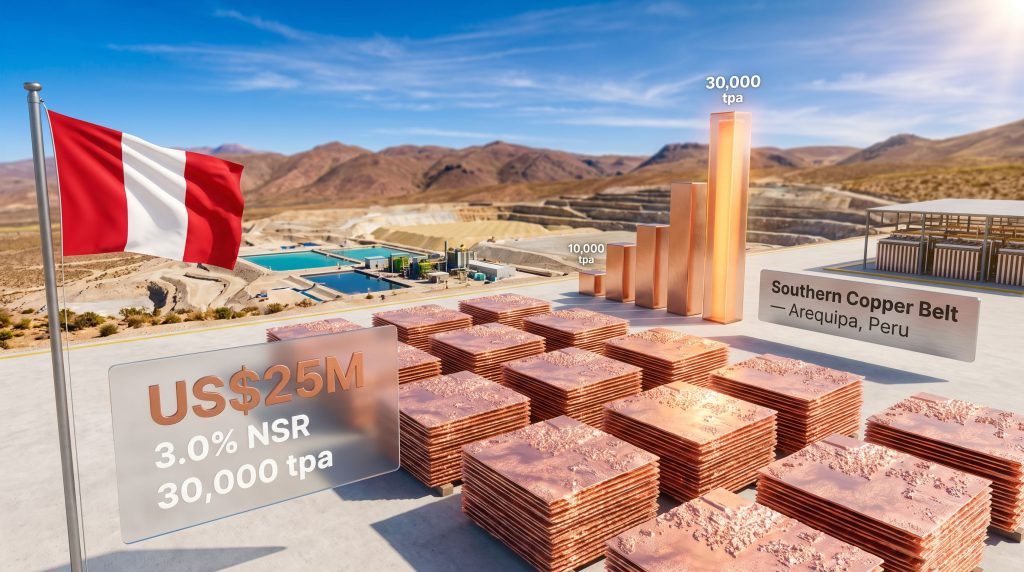
The Elemental Royalty Quilla Resources Peru copper project deserves careful examination within this framework. The US$25 million July 2026 transaction is not simply a royalty expansion. It is a case study in how royalty companies are evolving from passive royalty holders into pre-IPO strategic partners, structuring dual-exposure positions that capture both production-linked cash flow and equity upside ahead of a public listing event.
When big ASX news breaks, our subscribers know first
Why Peru's Southern Copper Belt Commands Premium Royalty Attention
Peru ranks as the world's second-largest copper producer, a position that reflects decades of geological discovery, foreign investment, and processing infrastructure development across its southern departments. The Moquegua and Arequipa regions sit at the heart of what industry geologists classify as the Southern Copper Belt, a structural corridor of exceptional endowment that hosts some of the most significant porphyry copper systems on the planet.
The geological significance of this corridor cannot be overstated. The same belt that contains operating mines associated with Freeport-McMoRan, Buenaventura, Anglo American, and Southern Copper runs directly through the terrain surrounding the Chapi project. This proximity is not merely a marketing talking point. It provides geological validation that the structural and mineralising conditions responsible for giant-scale deposits persist throughout the region, lending credibility to brownfield expansion theses in adjacent concession packages.
Infrastructure Advantages That Reduce Development Risk
One of the less-discussed advantages of the Moquegua and Arequipa corridor for heap leach and SX-EW operations is the existing infrastructure fabric. Road access, power grid connectivity, and regional water supply systems developed over decades of mining activity significantly reduce the capital intensity of reactivating dormant assets compared to greenfield development in remote locations.
For a project like Chapi, which uses solvent extraction and electrowinning (SX-EW) technology to produce copper cathode directly on site, proximity to operational infrastructure is a material cost advantage. The copper leaching process leaches copper from oxidised ore using acid solutions, extracts it through a solvent medium, and then deposits high-purity copper cathode through an electrochemical process. The result is a London Metal Exchange (LME)-grade copper cathode product that can be sold directly to end users without smelting, reducing both logistics costs and smelting charges that erode NSR royalty revenue.
Chapi's Geology and Why Sandstone-Hosted Manto Deposits Matter
The Chapi project hosts what geologists classify as a sandstone-hosted copper manto deposit, a mineralisation style that is partially oxidised and secondarily enriched. Manto-type deposits form when copper-bearing hydrothermal fluids migrate through permeable sedimentary host rocks, precipitating copper minerals in stratiform layers or mantos. The oxidised and enriched upper zones of these systems are particularly amenable to heap leach processing because the copper minerals dissolve readily in dilute sulphuric acid solutions.
What makes Chapi's geology particularly interesting from a royalty economics perspective is its structural position trending along the same corridor as the Cerro Verde and Cuajone porphyry systems, two of Peru's largest copper operations. While Chapi itself is a manto-style deposit rather than a large-scale porphyry, the structural corridor suggests that deeper drilling could intersect porphyry-related mineralisation at depth — a speculative but geologically plausible scenario that could materially expand the resource base over time.
Processing Infrastructure Already in Place
The Chapi mine's existing operational footprint is a critical value driver that differentiates it from a pure exploration-stage royalty. Furthermore, Quilla Resources benefitted from inheriting the following operational assets:
- Two principal open pits with established mine plans and haul road infrastructure
- Underground workings that provide access to deeper mineralisation
- A crushing and agglomeration circuit that prepares ore for heap leaching
- Established heap leach pads capable of processing stacked ore at scale
- A solvent extraction plant and an electrowinning copper cathode facility
- Supporting infrastructure including a mine camp, office facilities, water supply systems, and power connections
This existing processing circuit means Quilla Resources did not need to construct a plant from scratch following its December 2024 acquisition of Chapi from Nexa Resources. The ability to restart copper cathode production in February 2026 within approximately 14 months of ownership transfer reflects the operational readiness of the existing infrastructure and the quality of Quilla's management team.
Dissecting Elemental Royalty's $25 Million Transaction Structure
The architecture of this deal reflects a sophisticated understanding of how to maximise royalty company returns while providing genuine strategic value to the operator. Rather than a simple royalty purchase, Elemental has constructed a dual-instrument position.
| Transaction Component | Details |
|---|---|
| Total Commitment | US$25 million |
| Equity Component | Approximately 9% of Quilla Resources |
| Royalty Addition | 1.0% perpetual, uncapped NSR on Pampa Negra and Candelaria |
| Total NSR Post-Transaction | 3.0% across the Chapi project |
| Candelaria Step-Down | Reduces to 2.0% NSR in July 2034 |
| Original NSR Acquired | 2.0% purchased from EMX Royalty in January 2025 |
| Funding Source | Elemental's existing cash reserves |
| Proceeds Allocation | Exploration drilling, permitting, and Phase 2 engineering |
The Mechanics of a Perpetual, Uncapped NSR Royalty
Understanding why the perpetual and uncapped nature of the Pampa Negra royalty matters requires stepping back to consider how NSR royalties generate value at scale. An NSR royalty entitles the holder to a fixed percentage of gross mineral revenue after deducting smelting and refining costs but before any operating costs are subtracted. Consequently, the royalty holder benefits from every tonne of copper sold regardless of whether the operator is running at a profit or a loss.
"The distinction between a capped and uncapped NSR royalty is often underappreciated. A capped royalty terminates once cumulative production reaches a defined threshold. A perpetual, uncapped royalty continues generating revenue for as long as the mine produces. At a project targeting 30,000 tpa of copper cathode, the difference between a 2.0% and 3.0% NSR at prevailing copper prices represents a meaningful annual cash flow gap that compounds over decades."
The Area of Interest clause embedded in the transaction adds a further layer of optionality. Any new mineral concessions that Quilla acquires within a 2-kilometre radius of the existing approximately 26,000-hectare package will also be subject to Elemental's royalty. In a belt-scale geological setting like the Southern Copper Belt, this clause could prove highly valuable if exploration drilling identifies new mineralised zones beyond the current concession boundaries.
Quilla's Phase 2 Expansion: The 30,000 tpa Growth Ambition
The financial rationale for Elemental's incremental royalty purchase hinges almost entirely on Quilla successfully executing its Phase 2 production expansion. The numbers involved illustrate why the investment thesis is compelling but also why execution risk must be carefully weighted. Understanding available copper investment strategies is therefore essential context for evaluating how royalty structures like this one fit within a broader portfolio approach.
Expansion Targets and Capital Requirements
- Current nameplate capacity: 10,000 tpa copper cathode via SX-EW
- Current operating rate: approximately 5,000 tpa as of mid-2026 (50% utilisation)
- Phase 2 target: 30,000 tpa, representing a three-fold increase
- Estimated capital requirement: US$200 million to US$300 million
- Key deposits underpinning expansion: Pampa Negra, Candelaria, and Atahualpa
- Full utilisation at current capacity: targeted for Q4 2026
The capital required for the full Phase 2 build-out dwarfs the US$25 million Elemental has committed. This creates an important structural dependency: Quilla will need to access capital markets, likely through its planned Toronto Stock Exchange listing in 2027, to fund the expansion. Elemental's approximately 9% equity stake positions it as an aligned pre-IPO shareholder that stands to benefit from any valuation uplift associated with a successful public listing.
2026 Drilling Program and the Path to Feasibility
Quilla's active 2026 drilling campaign across Pampa Negra, Candelaria, and Atahualpa is designed to expand the resource base and underpin the feasibility studies required for Phase 2 permitting and financing. A robust definitive feasibility study will be critical before the TSX listing story can attract institutional capital in 2027. The proceeds from the Elemental transaction are being directed specifically toward accelerating this program alongside the permitting and engineering work needed to advance the expansion.
This sequencing matters. Drilling results that demonstrate resource continuity and grade confidence at Pampa Negra in particular will be critical to supporting the TSX listing story in 2027. For Elemental, the equity stake creates a clear incentive to see this drilling program succeed, since stronger resource estimates translate directly into a higher Quilla valuation at IPO.
Portfolio Implications: Chapi as a Top-10 Royalty Asset
Elemental Royalty, listed on both Nasdaq and the TSX, operates a portfolio strategy focused on royalties over producing and near-production assets. The elevation of Chapi to a top-10 royalty asset following the July 2026 transaction reflects a meaningful re-rating of the project's strategic importance within the portfolio. In addition, the Elemental Royalty Quilla Resources Peru copper project now stands as one of the more structurally nuanced royalty positions in the company's holdings.
| Royalty Metric | Chapi Post-Transaction | Typical Copper NSR Benchmark |
|---|---|---|
| NSR Rate | 3.0% (Pampa Negra) | 1.0% to 3.0% |
| Royalty Duration | Perpetual, uncapped | Often capped |
| Current Output | ~5,000 tpa (50% utilisation) | Project-dependent |
| Expansion Target | 30,000 tpa | Not applicable |
| AOI Coverage | 2 km from ~26,000 ha package | Varies |
| Candelaria Rate Post-2034 | 2.0% NSR | Common step-down structure |
The simultaneous equity and royalty structure creates what portfolio managers sometimes describe as a barbell exposure: royalty cash flows provide downside insulation and inflation-linked revenue growth, while the equity position provides asymmetric upside if Quilla's TSX listing materialises at a premium valuation.
The next major ASX story will hit our subscribers first
Key Risk Factors Investors Should Evaluate
Jurisdictional and Operational Considerations
Peru's mining regulatory environment involves multi-stage permitting processes, community consultation requirements under the principle of prior consultation with indigenous communities, and regional political dynamics that have historically influenced project timelines in the Moquegua and Arequipa departments. Investors should not assume that Phase 2 permitting will follow a linear or predictable timeline.
The ramp-up from 50% to full nameplate utilisation at current capacity by Q4 2026 also introduces near-term execution risk. Heap leach operations are sensitive to ore stacking rates, acid consumption management, and solution flow dynamics, all of which must be optimised before the plant consistently achieves target throughput.
Royalty-Specific Risk Factors
However, beyond operational challenges, investors must also weigh several royalty-specific considerations:
- NSR royalties are revenue-linked rather than profit-linked, providing insulation from operating cost inflation but retaining full exposure to copper price cycles
- The Candelaria step-down to 2.0% NSR in July 2034 moderates long-term revenue projections from that specific concession
- The entire Phase 2 investment thesis depends on Quilla securing approximately US$200 to US$300 million in additional capital, likely through equity markets
- A delayed or undersubscribed TSX listing could defer expansion timelines and push out the period over which the enhanced royalty rate generates meaningful cash flows
Furthermore, the broader copper supply crunch adds a macro-level dimension to these risks — while constrained supply supports higher copper prices that benefit NSR royalty holders, it also intensifies competition for development capital across the sector.
This article contains forward-looking statements and projections based on publicly available information. Actual outcomes may differ materially from those described. Readers should conduct their own due diligence before making any investment decisions.
Frequently Asked Questions: Elemental Royalty, Quilla Resources, and the Chapi Copper Project
What is the Chapi copper project?
Chapi is a brownfield copper cathode operation located approximately 50 km south-southeast of Arequipa in southern Peru. It processes oxidised ore through a heap leach and SX-EW circuit and restarted production in February 2026 under Quilla Resources via its subsidiary Minera Pampa de Cobre S.A.C.
What did Elemental Royalty acquire in this transaction?
Elemental committed US$25 million, receiving approximately 9% equity in Quilla Resources and an additional 1.0% perpetual NSR royalty over the Pampa Negra and Candelaria concessions, taking its total royalty to 3.0% NSR across the Chapi project.
What is an NSR royalty and why does uncapped matter?
An NSR royalty entitles the holder to a set percentage of gross mineral revenue after smelting and refining deductions but before operating costs. An uncapped royalty has no production ceiling, meaning it continues generating revenue indefinitely as mine output scales upward.
What is Quilla's expansion plan?
Quilla is targeting a tripling of output from 10,000 tpa to 30,000 tpa through the Pampa Negra, Candelaria, and Atahualpa deposits, requiring an estimated US$200 to US$300 million in capital investment. The success of majors-junior copper partnerships across the region demonstrates that this type of structured capital support is increasingly a preferred financing pathway for emerging producers.
When is Quilla targeting its TSX listing?
Quilla Resources is targeting a Toronto Stock Exchange listing in 2027, supported by its 2026 drilling campaign and the engineering and permitting work being funded in part by Elemental's investment. First production at Chapi has already been confirmed, which strengthens the operational narrative ahead of the planned listing.
Which major mining companies operate nearby?
The Chapi mine sits within the Southern Copper Belt alongside operations associated with Freeport-McMoRan, Buenaventura, Anglo American, and Southern Copper, providing strong geological and infrastructure validation for the broader corridor.
Want to Track the Next Major Copper Discovery Before the Market Does?
Discovery Alert's proprietary Discovery IQ model scans ASX announcements in real time, instantly identifying significant mineral discoveries across copper and 30+ other commodities — turning complex data into actionable investment insights for traders and long-term investors alike. Explore how historic discoveries have generated substantial returns on Discovery Alert's dedicated discoveries page, and begin your 14-day free trial today to position yourself ahead of the broader market.