July 13, 2026
The Structural Shift Reshaping Global Mineral Supply Chains
For most of the past two decades, the global critical minerals industry operated on a simple and largely unchallenged assumption: resource-rich nations dig, and processing-capable nations refine. That division of labour, heavily concentrated in China's favour at the downstream end, is now fracturing under the pressure of trade realignment, technology nationalism, and the accelerating capital demands of the energy transition. The question is no longer which countries hold the minerals. The question is which countries can control what happens to them after extraction.
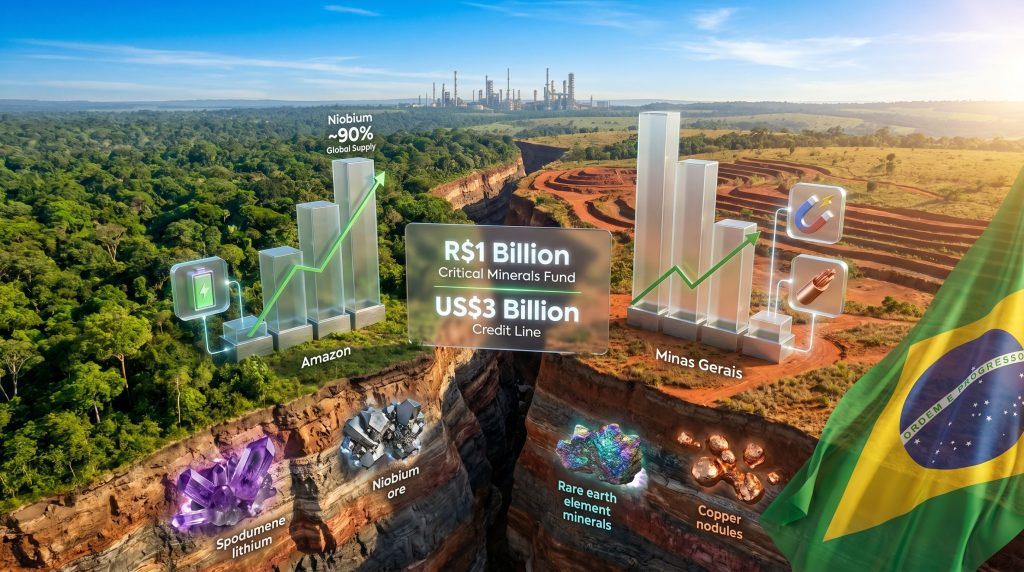
Brazil sits at the centre of this reconfiguration in a way that few observers outside the mining finance community fully appreciate. Its geological endowment is not merely significant in volume terms but exceptional in strategic concentration. The country holds roughly 90% of global niobium production, one of the most supply-concentrated critical mineral positions held by any single nation on Earth. It hosts the so-called Lithium Valley in Minas Gerais state, where hard-rock spodumene deposits rank among the highest-grade known lithium resources globally.
Add meaningful rare earth element (REE) deposits, emerging copper provinces in Pará state, natural flake graphite in Bahia, and laterite nickel accumulations in the Amazon region, and the full picture becomes remarkable. Furthermore, critical minerals demand is accelerating globally, placing Brazil in an increasingly strategic position as energy transition timelines compress.
Yet historically, Brazil has exported the vast majority of these resources in raw or minimally processed form, capturing only a fraction of the value embedded in each tonne. The architecture now being constructed around Brazil critical minerals investment by BNDES and Petrobras represents the most serious institutional attempt to change that equation.
When big ASX news breaks, our subscribers know first
A Multi-Instrument Capital Stack Unlike Any Other in Latin America
What distinguishes Brazil's current approach from previous commodity policy cycles is the deliberate layering of financial instruments across the full project lifecycle. Rather than relying on a single mechanism, BNDES has constructed a capital stack that addresses each stage from grassroots exploration through to industrial-scale processing.
The flagship equity vehicle is the Critical Minerals Fund, anchored jointly by BNDES and Vale, with an initial target size of R$1 billion (approximately US$180 million) and a potential scale-up to R$2 billion depending on private capital mobilisation. Management responsibility sits with a three-party consortium comprising Ore Investments, Régia Capital, and BB Asset, the asset management division of Banco do Brasil.
| Parameter | Detail |
|---|---|
| Initial Fund Size | R$1 billion (~US$180 million) |
| Maximum Fund Size | R$2 billion |
| Anchor Cap per Investor | 25% of total capital |
| Anchor Investors | BNDES and Vale |
| Per-Project Investment Range | R$50M to R$100M |
| Investment Period | 4 years |
| Exit Window | Up to 6 years |
| Total Fund Life | 10 years |
| Target Co-investors | Pension funds, family offices, institutional capital |
The structure is calibrated to pull private capital into a sector that has historically struggled to attract it at the exploration stage. By capping each anchor investor at 25% of total fund capital and engineering a two-to-one private leverage ratio, the mechanism is designed so that every real committed by BNDES or Vale draws two from pension funds and institutional investors.
BB Asset's involvement is not incidental: as the investment arm of Banco do Brasil, it provides a direct distribution channel into Brazil's superannuation and pension ecosystem, which collectively manages trillions of reais in assets. Consequently, Brazil's potential role in diversifying global supply chains has attracted significant attention from international analysts and policymakers alike.
Beyond this fund, BNDES has committed capital across three additional instruments:
| Financing Instrument | Scale | Purpose |
|---|---|---|
| Critical Minerals Fund (with Vale) | R$1B to R$2B | Early-stage exploration equity |
| Credit Line for Critical Mineral Projects | US$3 billion | Debt financing for project development |
| Strategic Minerals Fund (with Finep) | US$815 million | Brazil's positioning as energy transition supplier |
| Equity Acquisition Budget | R$8 billion (~US$1.6 billion) | Direct company shareholdings to de-risk investment environment |
The US$3 billion credit line functions as a bridge mechanism for projects that have advanced beyond exploration but cannot yet attract commercial project finance. The US$815 million strategic minerals fund, developed jointly with federal innovation agency Finep, targets Brazil's broader positioning within global energy transition supply networks.
The R$8 billion equity acquisition budget is perhaps the most aggressive signal of intent: direct shareholdings in critical minerals, battery, and EV-adjacent businesses intended to reduce the risk profile for private investors considering the sector. Across all instruments, the total committed or budgeted capital envelope comfortably exceeds US$5 billion, making this one of the most significant state-coordinated mineral investment programmes assembled anywhere outside Asia.
The Petrobras Dimension: Processing Ambition, Not Fund Participation
A common misconception in early market commentary has conflated Petrobras' role with that of Vale as a direct fund anchor. The distinction matters for understanding where value could ultimately be created. Petrobras is not listed as an anchor investor in the Critical Minerals Fund. Its engagement operates at a different and arguably more strategically significant level: the downstream processing and energy integration layer.
BNDES president Aloizio Mercadante has confirmed a tripartite collaboration framework involving BNDES, Vale, and Petrobras, with Petrobras detailing its own separately announced critical minerals action plan. The logic of Petrobras' involvement becomes clearer when you consider what it actually brings to the equation. The company operates some of the most sophisticated refining and petrochemical infrastructure in the Southern Hemisphere.
Lithium hydroxide production, rare earth element separation, and battery-grade chemical refining all share something critical with petroleum refining: they are capital-intensive, energy-intensive, and technically demanding separation processes. Petrobras understands that architecture in ways that mining companies typically do not.
Scenario Analysis: If Petrobras commits existing refining infrastructure and engineering capability, BNDES provides exploration-stage equity, and Vale contributes operational mining expertise, Brazil could theoretically develop a domestic supply chain running from in-ground resource to battery-grade processed output for minerals including lithium and nickel. This would place Brazil in a rare category of nations capable of competing across both the production and processing tiers simultaneously.
The power demand dimension also deserves attention. Mineral processing, particularly high-pressure acid leach (HPAL) technology required for Amazon region laterite nickel deposits, is extraordinarily electricity-intensive. Brazil's existing energy infrastructure, including its hydroelectric generation capacity, gives it a cost and emissions advantage in powering those facilities that few other mineral-rich nations can match.
What Private Investors Need to Understand Before Entering This Market
The geological foundations are compelling. The financing architecture is substantive. However, experienced investors in frontier mineral jurisdictions know that endowment and capital are necessary conditions, not sufficient ones. Several structural risk factors deserve careful modelling.
Regulatory and Permitting Complexity
Brazil's National Mining Agency (ANM) oversees a permitting environment that has historically been characterised by long processing timelines and procedural complexity. Environmental licensing, particularly for projects located near sensitive biomes including the Amazon and Cerrado, adds another layer of timeline uncertainty. Projects in Pará state, for example, face a different regulatory context than those in the more established mining corridors of Minas Gerais.
Currency Mismatch Risk
The fund is denominated in Brazilian reais, while the underlying commodity revenues for most critical minerals are priced in US dollars. This structural mismatch creates a currency translation exposure that sophisticated institutional investors must explicitly model. A strengthening real compresses USD returns on exit; a weakening real inflates operating costs relative to commodity price benchmarks.
Political Cycle Continuity
Brazil's policy architecture around critical minerals reflects the priorities of the current federal administration. The sustainability of this framework across future electoral cycles is a genuine uncertainty. SOE mandates, BNDES capital allocation priorities, and environmental licensing standards have all shifted meaningfully between Brazilian administrations in the past.
Processing Infrastructure Gaps
Even with Petrobras' potential involvement, Brazil currently lacks the installed capacity to process rare earth elements through to separated oxide form, or to produce battery-grade lithium hydroxide at commercial scale. In addition, the infrastructure gap between geological endowment and market-ready product remains significant, and closing it requires capital commitments and timelines that extend well beyond the 2026 first investment target.
Brazil's Mineral Endowment: Understanding the Geological Advantage
The geological case for Brazil deserves more granular treatment than it typically receives in financial commentary. Each priority mineral carries distinct characteristics that shape its investment and processing thesis:
-
Niobium: Brazil controls approximately 90% of global production, with the Araxá deposit in Minas Gerais operated by CBMM representing the world's largest known niobium reserve. Niobium's role is expanding beyond traditional high-strength steel applications into emerging niobium-lithium battery chemistries, which could meaningfully expand demand if commercialisation proceeds.
-
Lithium (Lithium Valley, Minas Gerais): The hard-rock spodumene extraction processes in this region benefit from exceptionally high grades, which reduce processing costs relative to lower-grade pegmatite deposits common in other jurisdictions. High-grade spodumene concentrate commands premium pricing and faster conversion economics when processing to lithium hydroxide monohydrate for battery cathode manufacturing.
-
Rare Earth Elements: Brazilian REE deposits contain meaningful concentrations of both light and heavy rare earths, though the ratio varies by deposit. Heavy REEs, including dysprosium and terbium, are particularly critical for high-performance permanent magnets used in EV motors and wind turbine generators. Furthermore, rare earth processing gaps at the separation stage represent both a challenge and a significant value-add opportunity for Brazil.
-
Nickel (Amazon laterites): Laterite nickel deposits require HPAL processing rather than the conventional pyrometallurgical route used for sulphide ores. HPAL is technically demanding and capital-intensive but produces the mixed hydroxide precipitate (MHP) or nickel sulphate directly suitable for battery cathode precursor manufacturing.
-
Graphite (Bahia state): Natural flake graphite from Bahia has historically been exported in concentrate form. The value-add opportunity lies in upgrading to spherical graphite for battery anodes, a processing step currently dominated by Chinese manufacturers.
How Brazil Compares to Peer Nations Pursuing Similar Strategies
| Country | Primary Mechanism | Focus Minerals | State Role |
|---|---|---|---|
| Brazil | BNDES fund + SOE partnerships | Lithium, REEs, niobium, copper | Anchor investor + strategic partner |
| Australia | Critical Minerals Facility (EFA) | Lithium, rare earths, cobalt | Concessional loans |
| Canada | Critical Minerals Strategy | Lithium, nickel, cobalt | Grants and tax credits |
| Indonesia | Export restrictions + downstreaming | Nickel | Regulatory mandate |
| Chile | CORFO lithium agreements | Lithium | Licensing and royalties |
Indonesia's nickel downstreaming model is frequently cited as a template, but it carries a warning Brazil's policymakers should heed. Indonesia achieved rapid processing capacity growth by imposing raw ore export bans, forcing investment into domestic smelting. The consequence was a flood of nickel pig iron production that depressed global nickel prices and eroded margins for producers globally.
Brazil's more trade-exposed and diplomatically networked economy makes replicating blunt export restriction policies significantly more complex. Canada's critical minerals strategy, by contrast, relies on grants and tax credits, demonstrating an alternative policy pathway that avoids the distortive effects of export restrictions.
Australia's concessional loan model through the Export Finance Australia Critical Minerals Facility demonstrates that state capital can catalyse private investment without requiring equity participation, but it leaves the value-add processing question largely to market forces. Brazil's approach, by combining equity, debt, and direct shareholding instruments simultaneously, is structurally more ambitious than any comparable programme in the Southern Hemisphere.
The next major ASX story will hit our subscribers first
Three Scenarios for Brazil's Critical Minerals Ambition Through 2035
| Scenario | Conditions Required | Projected Outcome |
|---|---|---|
| Accelerated Integration | Strong private co-investment, permitting reform, Petrobras processing commitment materialises | Brazil enters top-five global critical mineral suppliers by 2035 |
| Partial Execution | Fund deployed but processing capacity lags behind; exports remain primarily concentrate | Brazil captures exploration-stage value but cedes processing margin to Chinese refiners |
| Policy Disruption | Electoral cycle reversal of SOE mandate; private capital retreats from BRL currency risk | Fund underperforms; strategic minerals agenda stalls; geological assets remain underdeveloped |
The partial execution scenario deserves particular attention because it represents the historical default for resource-rich developing economies. Exploration capital gets deployed, deposits get discovered and delineated, but the processing infrastructure investment never materialises at sufficient scale. The result is that Brazil earns spodumene concentrate pricing rather than lithium hydroxide pricing, rare earth concentrate pricing rather than separated oxide pricing, and nickel laterite pricing rather than battery-grade nickel sulphate pricing.
The value gap between those price points is often measured in multiples, not percentages. Moreover, advances in lithium processing technologies are shifting the economics of downstream conversion, potentially compressing the timelines required to close Brazil's processing gap if adopted at scale.
Fundraising commenced in 2024, with first investments targeted for 2026. That four-year deployment window is designed to align capital commitment with the period of peak forecast demand growth for battery minerals as global EV penetration accelerates through the late 2020s. Whether the processing infrastructure can be constructed and commissioned on a timeline that captures that demand peak remains the central execution question for Brazil critical minerals investment by BNDES and Petrobras.
Key Takeaways for Investors and Market Participants
-
BNDES has assembled a multi-instrument financing architecture spanning equity funds, credit lines, and direct shareholdings that collectively exceeds US$5 billion in committed or budgeted capital across the critical minerals sector.
-
The R$1 to R$2 billion Critical Minerals Fund, anchored by BNDES and Vale and managed by Ore Investments, Régia Capital, and BB Asset, is the flagship equity vehicle targeting early-stage exploration with per-project commitments of R$50 million to R$100 million.
-
Petrobras is a strategic partner in Brazil's critical minerals agenda at the processing and energy integration tier, not a fund anchor investor. Its separately announced action plan could prove more consequential than the fund itself if refining infrastructure is genuinely committed.
-
Brazil's niobium dominance (~90% of global supply), high-grade Lithium Valley assets, and REE deposits containing both light and heavy rare earths create a geological foundation with few peers globally.
-
The primary execution risks are permitting complexity via the ANM, currency mismatch between BRL-denominated fund returns and USD commodity pricing, the processing infrastructure gap, and political cycle continuity.
-
The partial execution scenario, in which capital reaches exploration but not processing, remains the historically most probable outcome for resource-rich developing economies and represents the key risk to monitor as the 2026 investment commencement date approaches.
Disclaimer: This article is intended for informational purposes only and does not constitute financial, investment, or legal advice. Projections, scenario analyses, and forecasts discussed herein involve inherent uncertainty and should not be relied upon as predictions of future outcomes. Readers should conduct their own due diligence and seek professional advice before making investment decisions.
Want to Stay Ahead of Major Mineral Discoveries as They Hit the ASX?
Discovery Alert's proprietary Discovery IQ model delivers real-time alerts on significant ASX mineral discoveries across critical commodities — including lithium, rare earths, and nickel — instantly transforming complex geological data into actionable investment insights for both short-term traders and long-term investors. Explore historic discoveries and their exceptional market returns, then begin your 14-day free trial to position yourself ahead of the broader market.