
July 13, 2026
Why Demography Has Become the Blind Spot in Energy Planning
For most of the twentieth century, energy forecasting operated on a simple premise: more people meant more demand. Population growth was treated as a gravitational constant, the kind of variable that could be assumed without much scrutiny. Long-range models were built around it, capital was allocated because of it, and entire supply chain strategies were engineered to serve a world that would simply keep growing.
That premise is now under serious revision. The relationship between falling birth rates and energy demand is emerging as one of the most consequential and underappreciated structural shifts in the global energy landscape, and the industry is only beginning to reckon with what it means.
When big ASX news breaks, our subscribers know first
The Fertility Decline in Numbers: Closer to the Threshold Than Most Realise
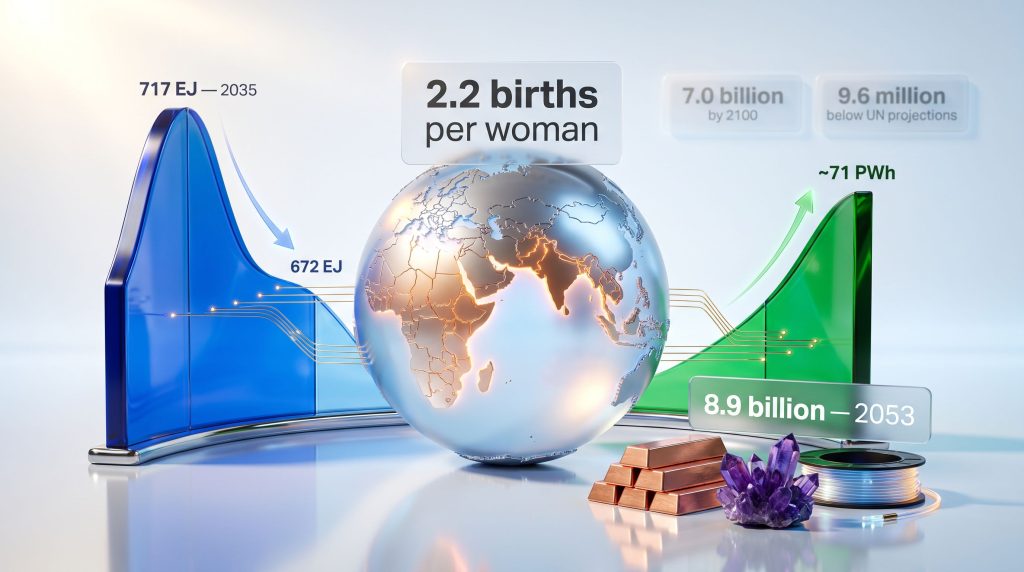
The global fertility rate has not collapsed overnight, but the trajectory is unmistakable. In 2007, the average number of births per woman worldwide stood at 2.6. By 2025, that figure had fallen to 2.2, leaving the world uncomfortably close to the 2.1 replacement rate that demographers define as the minimum required to maintain a stable population without migration.
This is not a story about one or two outlier nations. It reflects sustained fertility decline across Europe, East Asia, Latin America, and increasingly parts of South Asia. The structural implications extend well beyond social policy into the fundamental mathematics of economic output and, by extension, energy consumption.
The United Nations frames this uncertainty through three distinct population trajectories, each carrying radically different implications for energy planners:
| UN Scenario | Peak Population | Peak Year | Population by 2100 |
|---|---|---|---|
| Low Birth Rate | 8.9 billion | 2053 | 7.0 billion |
| Central Projection | 10.0 billion | 2060 | ~10.0 billion |
| High Birth Rate | No defined peak | Ongoing | 12.6 billion |
The gap between the high and low scenarios by 2100 amounts to 5.6 billion people, a figure that exceeds the entire global population of the early 1950s. For energy economists, this is not a modelling footnote. It is a demand uncertainty of civilisational scale. Wood Mackenzie's research on falling fertility rates and long-term energy demand underscores just how significant this uncertainty has become.
Wood Mackenzie's Peter Martin, Head of Economics, has argued that demographic decline belongs in the core scenario of every long-range energy model, not filed away as a tail risk. Shrinking workforces translate directly into slower GDP growth and, from there, into reduced energy consumption across virtually every sector.
How Population Contraction Flows Through to Energy Demand
The mechanism connecting falling birth rates and energy demand runs primarily through gross domestic product. A smaller working-age population produces less economic output. Lower output reduces industrial throughput, construction activity, freight volumes, and household spending. Each of these channels suppresses what energy economists call "molecule demand", the consumption of oil, natural gas, and coal that powers physical economic activity.
Wood Mackenzie's base-case modelling reflects this dynamic directly. The firm projects global primary energy consumption rising 8% from current levels, reaching a peak of 717 exajoules (EJ) in 2035, before declining to 672 EJ by 2060.
What Is an Exajoule?
One exajoule equals 10¹⁸ joules, or one quintillion joules. The entire United States consumes approximately 100 EJ of primary energy annually, making it the standard unit for national and global energy accounting.
These figures are already lower than projections produced in earlier analytical cycles, suggesting that demographic constraints are already influencing the trajectory of global energy consumption, even before any low-birth-rate scenario fully materialises.
Importantly, the aggregate picture masks significant regional variation. Even under the most pessimistic fertility assumptions, global population still grows by an estimated 700 million people by 2060, with the bulk of that growth concentrated in Sub-Saharan Africa and parts of South and Southeast Asia. These regions carry large unmet energy needs, rising household incomes, and rapidly expanding infrastructure. Their demand trajectory remains structurally intact regardless of fertility trends in wealthier nations.
Electricity Demand: The Striking Exception to a Moderating Trend
Perhaps the most counterintuitive element of the falling birth rates and energy demand story is what happens to electricity specifically. While total primary energy consumption is projected to peak and then decline, electricity demand is forecast to double over the same period, reaching approximately 71 petawatt-hours (PWh) by 2060.
The driver is automation. As workforces shrink, the economic incentive to substitute capital and technology for human labour intensifies sharply. Robotics, artificial intelligence infrastructure, automated logistics, and smart manufacturing are all highly electricity-intensive by nature. Furthermore, the labour shortage created by demographic decline effectively accelerates the adoption of exactly the kind of technology that drives electricity consumption upward.
| Metric | Projected Peak | Projected 2060 Level | Direction |
|---|---|---|---|
| Global Primary Energy | 717 EJ (2035) | 672 EJ | Declining after peak |
| Global Electricity Demand | Continuous growth | ~2× current levels | Rising throughout |
This divergence, falling total energy against rising electricity, defines the structural character of the demographic-energy nexus. It is not a clean story of demand destruction. It is a story of demand transformation, with combustion-based consumption retreating while electron-based consumption accelerates.
Data centres and AI investment implications amplify this further. Demand for digital processing capacity is largely population-agnostic, driven by economic and technological activity rather than headcount. Grid operators therefore face a paradox: aggregate demand growth moderates while localised capacity pressure from technology clusters intensifies, creating uneven stress across transmission and distribution networks.
Critical Minerals: Why a Smaller Population Does Not Mean Lower Demand
One of the more significant misconceptions worth addressing directly is the assumption that population decline automatically relieves pressure on critical mineral supply chains. However, the evidence points in the opposite direction.
As automation replaces human labour at scale, critical minerals demand intensifies for the specific basket of minerals that underpin electrification and intelligent systems:
- Copper, essential for electrical wiring, motors, and grid infrastructure
- Lithium, the foundational element of battery storage across EVs and grid applications
- Cobalt and nickel, critical to high-energy-density battery chemistries
- Rare earth elements, including neodymium and dysprosium, required for permanent magnets in EV motors and wind turbines
- Manganese, increasingly important in emerging lower-cost battery formats
Prakash Sharma, Head of Energy Transition at Wood Mackenzie, has stated clearly that a lower population does not diminish the draw on critical minerals. According to Sharma, energy transition minerals, electrification, and AI adoption together generate unprecedented demand for these resources while simultaneously accelerating the structural retreat from hydrocarbons.
The capital required for deployment exists, but the window for building the necessary supply chains is finite, with the period after 2060 presenting potentially more constrained conditions as demographic contraction deepens in key producing economies. In addition, a critical minerals reserve strategy is increasingly viewed as essential for nations seeking to insulate themselves from supply chain disruption.
This creates a strategic urgency that operates independently of climate policy. Even in a world focused purely on economic efficiency, the automation imperative driven by labour scarcity would still generate intense mineral demand pressure.
China as a Real-World Preview of Demographic Contraction
While most discussions of demographic decline remain theoretical, China offers a live case study of what early-stage population contraction looks like in the world's largest energy consumer.
The numbers are striking. China's birth rate fell to 5.6 per 1,000 people in 2025, the lowest figure ever recorded in the country's modern history. The population contracted by 3.4 million in a single year, leaving the total at 1.4 billion, some 9.6 million below the UN's 2024 central projection. That is a material and growing deviation from consensus forecasting assumptions.
The energy implications run in two directions simultaneously:
- Demand compression for industrial energy, petrochemicals, cement, and steel, as construction activity and manufacturing output moderate in response to a shrinking domestic market
- Accelerating electrification and automation investment, as the government and private sector respond to labour force contraction by deploying capital-intensive technology
The China steel outlook reflects this duality clearly, with structural demand pressure weighing on traditional heavy industry even as electrification investment surges. China's experience consequently illustrates a broader point about consensus forecasts. If actual population data is already running nearly 10 million below central UN projections, energy models anchored to those projections may be systematically overestimating future demand. The revision risk is not symmetric, and it skews downward.
A revised UN World Population Prospects report due in July 2026 is expected to prompt a fresh round of scrutiny across the sector. Even a modest downward revision to central projections carries real economic weight, given the cascading effects on GDP growth assumptions and public finance capacity in ageing economies.
The next major ASX story will hit our subscribers first
Does Demographic Decline Help or Hurt the Energy Transition?
The relationship between population trends and decarbonisation is more complicated than it first appears. There is an intuitive appeal to the idea that fewer people means fewer emissions. A moderating demand curve does offer energy planners something valuable: the ability to build out clean capacity in a structured way rather than scrambling reactively to meet accelerating growth.
However, climate researchers urge caution about treating population decline as a proxy solution to the emissions problem. Zeke Hausfather, climatologist at the Breakthrough Institute, has argued that consumption patterns and economic activity levels are far more powerful emissions drivers than population size. Research consistently shows that individuals in the world's wealthiest nations generate roughly 50 times more emissions than those in the lowest-income countries.
Population growth is most rapid precisely in the regions with the lowest per-capita carbon footprints. As Hellenic Shipping News analysis has explored, the framing of population as an emissions lever risks diverting attention from the structural consumption changes required in high-income economies, where the per-capita emissions burden is orders of magnitude larger than in the regions driving population growth.
Beyond the emissions calculus, there is a fiscal dimension that further complicates the optimistic reading. A shrinking workforce erodes the tax base available to fund energy transition infrastructure. Fewer workers means lower income tax receipts, compressed pension system sustainability, and rising aged-care expenditure, all competing directly for the capital that would otherwise flow into grid modernisation, renewable deployment, and mineral development.
Population decline may ease aggregate demand pressure while simultaneously undermining the public and private finance architecture needed to execute the transition.
The Strategic Planning Window: What Energy Investors and Planners Need to Understand
For those making long-range capital allocation decisions, the implications of the falling birth rates and energy demand relationship can be structured across three distinct planning horizons:
| Planning Horizon | Key Demographic Variable | Primary Energy Implication | Electricity Implication |
|---|---|---|---|
| 2025 to 2035 | Fertility decline accelerates | Demand peaks earlier than prior models suggested | Rapid growth from AI and automation buildout |
| 2035 to 2060 | Workforce contraction in developed markets | Fossil fuel demand ceiling lowers progressively | Electrification drives consumption toward double current levels |
| 2060 to 2100 | Potential global population contraction | Structural demand reduction across fossil categories | Automation sustains electricity load independently of population |
The core strategic insight is that the period between now and approximately 2060 represents a critical deployment window for the infrastructure the global energy transition requires. After that point, demographic contraction in key economies is likely to reduce both the workforce capacity and fiscal headroom available for large-scale infrastructure programmes.
This reframes clean energy investment not merely as a climate response but as a demographically time-sensitive economic imperative. The constraint is not only whether to build the necessary capacity, but whether the window for doing so at scale will remain open long enough to complete the task.
Investors and planners who treat demographic decline as a background variable risk systematically underestimating both the speed at which fossil fuel demand ceilings arrive and the structural nature of electricity demand growth. Integrating the full range of UN population scenarios, rather than anchoring to central projections, is no longer optional rigour. It is basic analytical prudence.
Disclaimer: This article is intended for informational purposes only and does not constitute financial or investment advice. Projections referenced are based on third-party modelling and are subject to revision. Readers should conduct independent research before making any investment decisions.
Want to Stay Ahead of the Critical Minerals Driving the Energy Transition?
As demographic shifts accelerate automation and electrification, demand for copper, lithium, rare earths, and battery minerals is intensifying — and significant ASX mineral discoveries in these sectors can generate substantial returns, as highlighted on Discovery Alert's dedicated discoveries page. Powered by the proprietary Discovery IQ model, Discovery Alert delivers real-time alerts the moment significant ASX mineral discoveries are announced, giving subscribers an immediate edge — begin your 14-day free trial today.