June 23, 2026
The Invisible Ceiling Above Brazil's Ocean Floor Ambitions
Few resource frontiers generate more strategic excitement than the deep seabed. Beneath thousands of metres of water lies a geological archive of cobalt, manganese, nickel, and copper — minerals that sit at the centre of the global energy transition and the battery supply chains underpinning it. Nations with access to these deposits are positioning themselves as future critical mineral powers. Yet for Brazil, the tension between what lies beneath its Atlantic waters and what its governance architecture can actually accommodate is becoming the defining constraint on the country's deep-sea mining plan.
When big ASX news breaks, our subscribers know first
Brazil's Marine Mining Reality: Coastal Activity, Deep-Sea Aspiration
The single most important thing to understand about Brazil's deep-sea mining plan is that it remains, at present, almost entirely aspirational. The country does not operate commercial deep-sea extraction. Brazil's National Mining Agency, the ANM, has confirmed that it has not received formal requests for mineral research in deep-water zones, which places the entire deep-sea conversation in the realm of future policy rather than current operations.
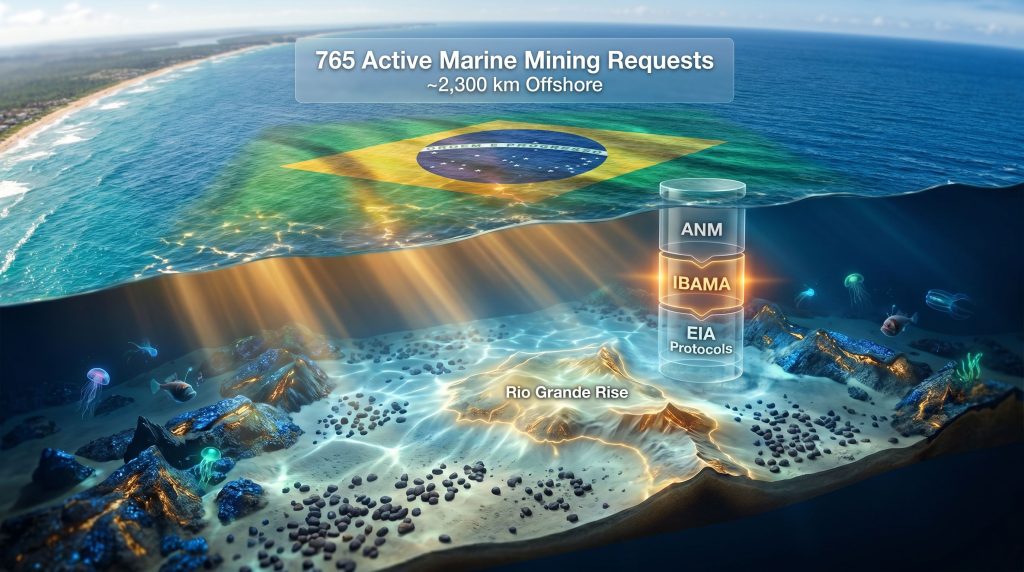
What is actively happening occurs in shallower marine environments. Across Brazilian marine zones, 765 active mining applications are currently on record. Of these, roughly 70% were filed after 2010, reflecting a pronounced surge in commercial interest in marine mineral resources over the past decade and a half.
The critical nuance is that the overwhelming majority of these applications target coastal phosphate and potassium salt deposits, not the polymetallic nodules or cobalt-rich crusts that generate the most geopolitical attention.
| Mineral Type | Location | Current Status |
|---|---|---|
| Phosphate | Coastal marine zones | Active applications |
| Potassium salts | Coastal marine zones | Active applications |
| Sand and limestone | Shallow coastal waters | Concessions active |
| Deep-sea polymetallic minerals | Deep oceanic zones | No active applications |
| Rio Grande Rise resources | ~2,300 km offshore | Pending EEZ claim, no exploration permitted |
The period between 2020 and 2024 saw particularly intense application activity, almost entirely concentrated in those coastal mineral categories. This distinction matters enormously for anyone interpreting Brazilian marine mining policy, because the regulatory pressures emerging around deep-sea operations are being shaped partly by what is happening in shallower waters and partly by what regulators anticipate coming next.
The Legislative Vacuum That Is Shaping Everything
At the heart of Brazil's regulatory challenge is a foundational legal problem that receives far less attention than it deserves. Brazilian mining law does not currently distinguish between submarine and terrestrial extraction operations. The same statutory framework that governs an iron ore operation in Minas Gerais theoretically applies to a hypothetical extraction project three kilometres below the Atlantic surface. No dedicated regulatory instrument exists for deep-sea mining, and that absence has created both a loophole and a warning signal.
In 2025, that loophole became consequential. A deep-sea extraction request was reportedly processed and approved without the completion of a full environmental licensing review, exposing a gap in the approval architecture that regulators and environmental bodies are now under significant pressure to close. This single event has arguably done more to accelerate the conversation around dedicated deep-sea mining legislation than years of academic advocacy.
The IBAMA Checkpoint and Its Growing Significance
Brazil's federal environmental licensing authority, IBAMA, sits at the critical juncture between mining ambition and operational reality. Its mandate requires environmental licensing before any extraction activity can legally proceed, and recent decisions have demonstrated that IBAMA is prepared to apply that authority vigorously, even in the absence of sector-specific regulatory standards.
The challenge IBAMA faces is a structural one. Without established protocols specifically designed for deep-sea contexts, the agency must apply general environmental principles to a domain that operates by entirely different physical and ecological rules. Furthermore, the key gaps currently undermining effective oversight include:
- No deep-sea-specific environmental impact assessment standards within Brazilian law
- No established ecological baseline data for Brazilian deep-water zones against which disturbance can be measured
- Absence of sediment plume modelling requirements as a pre-condition for licensing
- No legislative separation between nearshore extraction and abyssal zone operations
- No independent scientific review mechanism for deep-water mineral applications
Each of these gaps represents not just a bureaucratic deficiency but a genuine scientific problem. You cannot measure harm against a baseline that has never been established.
What the Science Actually Says About Deep-Sea Extraction Risk
The precautionary stance adopted by Brazil's environmental authorities is grounded in a body of scientific evidence that has grown considerably over the past decade. Deep-sea ecosystems are among the least understood environments on Earth, and what researchers have learned about them has generally reinforced caution rather than confidence.
Brazil's environmental authorities have explicitly determined that the current state of scientific knowledge is insufficient to responsibly evaluate deep-sea mining applications. This position reflects the precautionary principle embedded in international environmental law and is shared by a growing coalition of national regulators and scientific bodies worldwide.
The specific ecological risks that have shaped Brazil's position fall into several distinct categories:
- Marine biodiversity loss — Deep-sea ecosystems are characterised by extremely slow biological recovery rates. Species adapted to stable, low-energy environments may require decades or centuries to recolonise disturbed areas, if recovery is possible at all.
- Sediment plume dispersion — Extraction machinery generates fine particle clouds that can travel hundreds of kilometres from the extraction site, smothering filter-feeding organisms and disrupting food webs across vast areas of the seabed.
- Carbon sequestration disruption — The deep seabed functions as a long-term carbon reservoir. Physical disturbance of sediment layers risks mobilising stored carbon into the water column, with potential implications for ocean chemistry and atmospheric carbon budgets.
- Toxic metal mobilisation — Polymetallic nodules contain elevated concentrations of heavy metals including cadmium, lead, and mercury. Disturbing these formations can release these substances into surrounding water in ways that are difficult to predict or contain.
- Acoustic pollution — Industrial-scale deep-sea machinery generates noise at frequencies that interfere with the communication, navigation, and feeding behaviour of deep-sea fauna, many of which have evolved in near-silence.
What makes these risks particularly challenging from a regulatory standpoint is that they interact with each other in ways that are poorly understood. A sediment plume does not simply settle; it carries mobilised metals into ecosystems that are simultaneously disrupted by acoustic pollution and stripped of carbon-sequestering biological material. Consequently, the deep-sea mining controversy surrounding these compounding risks has intensified scrutiny from both scientific and policy communities worldwide.
The Rio Grande Rise: A Jurisdictional Frontier With Everything at Stake
Approximately 2,300 kilometres off the Brazilian coast, a submerged plateau known as the Rio Grande Rise represents Brazil's most strategically significant deep-sea resource target. This geological feature is believed to host substantial concentrations of cobalt-rich ferromanganese crusts, along with other minerals critical to battery technology and clean energy infrastructure.
Brazil has submitted a formal claim to extend its Exclusive Economic Zone to incorporate the Rise, but that claim remains pending before international bodies. Critically, no economic exploration is currently permitted on the Rio Grande Rise under any circumstances. The area sits in a jurisdictional grey zone that will only be resolved through the international process, and the outcome will have direct consequences for the urgency and direction of domestic regulatory reform.
Cobalt-rich crusts, the primary target at the Rio Grande Rise, differ significantly from the polymetallic nodules that attract attention in the Pacific's Clarion-Clipperton Zone. Crusts form over millions of years by precipitation directly onto hard rock surfaces, typically on seamount flanks and plateaus. They tend to carry higher cobalt grades than nodules but present different extraction challenges because they are bonded to substrate rather than resting loosely on the seabed. This distinction has significant implications for both environmental impact modelling and the technology requirements of any future extraction programme.
Brazil in Global Context: Where Does It Actually Sit?
| Country | Deep-Sea Mining Status | Regulatory Maturity | Environmental Stance |
|---|---|---|---|
| Brazil | Research phase only | Low, no dedicated framework | Precautionary, moratorium-aligned |
| Norway | Areas opened for exploration | Moderate | Conditional, with environmental caveats |
| China | Active ISA exploration contracts | High domestic capacity | Commercially aggressive |
| United States | Limited engagement | Evolving | Environmentally contested |
| Nauru | Triggered ISA two-year rule | Minimal domestic capacity | Commercially motivated |
| Canada | No active programme | Moderate | Precautionary |
Brazil occupies a genuinely distinctive position in this landscape. The country has developed world-class offshore operational expertise through its deep-water petroleum industry, particularly through Petrobras operations in the pre-salt layer, giving it technical capabilities that most other nations in the precautionary camp lack entirely. However, rather than leveraging that expertise to accelerate commercial deep-sea mining, Brazil has deliberately chosen to maintain research-phase constraints while advocating for stronger international governance.
On the international stage, Brazil has aligned itself with a 10-year precautionary moratorium on deep-sea mining in international waters. Its policy framework within multilateral forums rests on several consistent principles:
- Opposition to commercial extraction in areas beyond national jurisdiction until comprehensive environmental standards exist
- Active engagement with the International Seabed Authority to strengthen environmental management plans
- Maintenance of research-phase activity while withholding support for exploitation licensing
- Insistence on independently verified environmental studies as a pre-condition for any transition to commercial operations
The next major ASX story will hit our subscribers first
Three Scenarios for Where Brazil's Deep-Sea Mining Plan Goes Next
Scenario One: Regulatory Reform Leads Commercial Activity
Brazil develops dedicated submarine mining legislation, establishes enforceable deep-sea EIA protocols, and creates a licensing pathway capable of satisfying IBAMA's environmental requirements. In addition, commercial activity becomes viable in the early 2030s under a structured approval regime built on genuine scientific baselines, provided that deep-sea mining regulations at the international level also mature sufficiently to guide domestic frameworks.
Scenario Two: Jurisdictional Expansion Creates Political Pressure
The Rio Grande Rise EEZ claim is approved, generating immediate commercial and political momentum to develop an exploitation framework. Regulatory development is accelerated beyond what the underlying science can support, potentially replicating the 2025 licensing loophole at far greater scale.
Scenario Three: Sustained Alignment with International Precaution
Brazil maintains its moratorium-aligned stance throughout the decade, prioritising multilateral governance reform over domestic extraction. Deep-sea mining remains in the research phase indefinitely, with commercial activity deferred until international standards reach a level of rigour that satisfies domestic environmental requirements.
What Regulatory Reform Would Actually Require
For Brazil to responsibly unlock its deep-sea mineral potential, a sequence of specific reforms would need to occur:
- Legislative separation of submarine and terrestrial mining under a purpose-built statutory framework
- Mandatory deep-sea EIA standards with distinct protocols for abyssal and hadal zone conditions
- Establishment of ecological baseline surveys across target zones before any licensing proceeds
- Sediment plume modelling as a non-negotiable pre-licensing requirement
- Formal closure of the approval pathway that permitted a 2025 extraction decision without full environmental review
- Alignment of domestic standards with ISA environmental management frameworks for transboundary zones
The Deeper Structural Problem Brazil Must Confront
Brazil's deep-sea mining plan is not constrained by a lack of resources, technical capacity, or commercial interest. It is constrained by the fundamental mismatch between a legislative system designed for terrestrial extraction and a resource frontier that operates under entirely different physical, biological, and jurisdictional conditions.
The intervention of environmental oversight bodies like IBAMA is not an obstacle to progress in the conventional sense. It is the predictable and appropriate response to a governance system that has not yet caught up with the sector it is being asked to regulate. Every nation that has moved faster than its regulatory science in extractive industries has eventually paid a cost, whether in environmental damage, legal liability, or the erosion of public trust that makes future resource development politically untenable.
Furthermore, the broader stakes extend well beyond Brazilian borders. The critical minerals energy transition depends on resolving precisely these governance questions at both national and international levels. The demand for green transition materials is only accelerating, and nations that establish robust, scientifically grounded regulatory frameworks now will be far better positioned to contribute responsibly to that supply chain.
Brazil's path to becoming a meaningful player in the critical minerals landscape that will define the next energy era runs through the difficult, unsexy work of building regulatory infrastructure that is genuinely fit for purpose. Until that work is done, the country's extraordinary deep-sea mineral endowment will remain exactly what it currently is: a geological fact waiting for a governance framework capable of translating it into responsible, durable economic value.
This article is intended for informational purposes only and does not constitute financial, legal, or investment advice. Regulatory developments, jurisdictional claims, and scientific assessments referenced herein are subject to change. Readers should conduct independent research and consult qualified professionals before making any decisions based on the information provided.
Want to Stay Ahead of the Next Major Critical Minerals Discovery?
While Brazil's deep-sea mineral ambitions remain constrained by governance gaps, significant critical mineral discoveries are already being made and announced on the ASX — and Discovery Alert's proprietary Discovery IQ model ensures subscribers receive real-time alerts the moment they hit the market, turning complex geological data into actionable investment insights. Explore the historic returns that major mineral discoveries have delivered by visiting Discovery Alert's dedicated discoveries page, and begin your 14-day free trial today to position yourself ahead of the broader market.