June 23, 2026
The Sanctions Architecture Reshaping Gulf Bunkering Economics
When diplomacy intersects with energy infrastructure, the consequences rarely unfold in neat, predictable sequences. The Gulf bunkering market offers a textbook illustration of this complexity. Decades of sanctions architecture, regional conflict, and bilateral mistrust have converged to create one of the most structurally distorted marine fuel markets in recent memory. Understanding what the Fujairah return of Iranian HSFO actually means requires moving well beyond the diplomatic headlines and examining the layered mechanics of sanctions frameworks, infrastructure damage, and competitive supply dynamics simultaneously.
When big ASX news breaks, our subscribers know first
How OFAC's General Licence Works and Why It Matters for HSFO Trade
The US Treasury Department's Office of Foreign Assets Control issued a general licence on 22 June 2026 that permits buyers to purchase Iranian crude, refined products, and petrochemical outputs without triggering US sanctions liability. Critically, this authorisation extends to the full service chain surrounding Iranian oil trade, including freight services, vessel management, crewing, bunkering, insurance, classification, flagging, and salvage.
The licence also permits USD-denominated payment for Iranian oil transactions, a significant departure from the shadow-trade arrangements that previously routed Iranian oil revenue through third-country intermediaries to avoid dollar-clearing exposure. It even authorises the import of Iranian oil into the US for subsequent trans-shipment purposes, a provision that signals the breadth of the waiver. The sanctions impact on Russian oil trade provides a useful parallel for understanding how rapidly these frameworks can shift commercial behaviour.
However, the following limitations define the boundaries of what this licence actually authorises:
- Sanctions on Iranian sellers remain fully intact — the waiver applies only to buyer-side enforcement
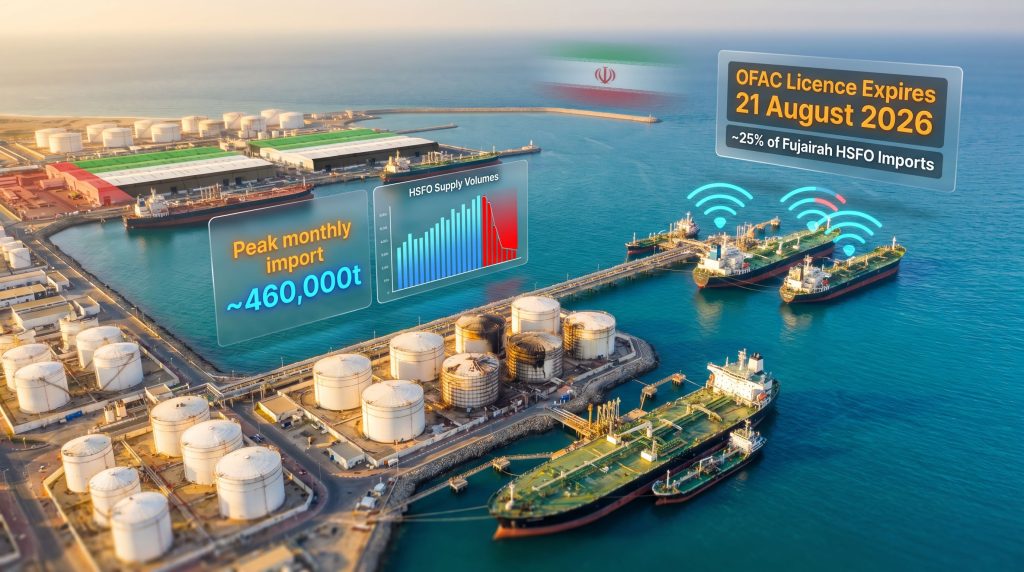
- The licence expires on 21 August 2026, creating a hard 60-day window aligned with the US-Iran memorandum of understanding
- A breakdown in negotiations could trigger early termination before the deadline
- Buyers operating under EU, UK, and US dual-jurisdiction frameworks face residual compliance exposure
- Chinese state-controlled companies, despite being among the most likely beneficiaries, have shown limited immediate buying interest partly due to the short licence duration and uncertainty risk
Policy Insight: Market participants treating the OFAC general licence as a structural normalisation of Iranian oil trade are misreading the instrument. It is a conditional, diplomatically contingent window with a hard expiry date. Compliance exposure does not disappear simply because sanctions enforcement is temporarily suspended on the buyer side.
Fujairah's Strategic Position and the Scale of Iranian HSFO Dependency
Fujairah's geographic location at the mouth of the Gulf of Oman, outside the Strait of Hormuz chokepoint, has historically made it the premier marine fuel hub serving East-West shipping lanes. This positioning enables vessels to bunker without transiting the strait, which has long been a critical operational advantage. However, that advantage is only as durable as the supply chains feeding the port's storage and blending infrastructure.
Iranian straight-run high-sulphur fuel oil became structurally embedded in Fujairah's bunkering economics over years of consistent supply, primarily because it offered competitive pricing and geographic proximity that alternative origins could not match. The scale of that dependency is illustrated in the data below, based on Vortexa analytics figures cited in reporting by Argus Media. These crude oil market dynamics further help contextualise how supply dependencies develop over time.
| Supply Metric | Data Point |
|---|---|
| Iranian HSFO share of Fujairah imports (2025) | ~25% of total |
| Iranian HSFO volume (2025 average) | ~70,000 b/d |
| Peak monthly Iranian imports (Feb 2026) | ~460,000 tonnes |
| Peak monthly Iraqi imports (Feb 2026) | ~260,000 tonnes |
| Combined Iranian + Iraqi share at peak | Dominant supply position |
Iranian straight-run HSFO is produced as a direct output of atmospheric distillation, meaning it requires minimal secondary processing before use. For Fujairah's bunker blending operations, this simplicity translates into cost efficiency. The fuel's high sulphur content (typically 3.5%) makes it suitable for vessels operating under IMO Emission Control Area exemptions and for blending into compliant bunker grades.
The Three Barriers Blocking a Near-Term Supply Recovery
Despite the OFAC licence opening a theoretical pathway for the Fujairah return of Iranian HSFO, three distinct barriers are simultaneously preventing meaningful supply restoration. Each operates on a different timeline and responds to different resolution mechanisms.
Layer 1: The Regulatory Window and Its Compliance Constraints
The OFAC general licence creates legitimate buyer-side clearance until 21 August 2026. Banking channel normalisation for USD-denominated Iranian transactions is underway but not instantaneous. Financial institutions that spent years building compliance infrastructure around Iranian sanctions exclusions will not reverse those systems within days.
Buyers must also assess their obligations under EU and UK sanctions frameworks, which are not automatically aligned with US OFAC waiver terms. Furthermore, the global commodity market distortions created by recent geopolitical shifts add another layer of commercial complexity for buyers navigating multiple jurisdictions simultaneously.
Layer 2: UAE-Iran Diplomatic Damage
This layer represents perhaps the least quantifiable but most operationally significant barrier. During the conflict period, Iran targeted Fujairah's infrastructure repeatedly, with Tehran framing the attacks as a response to what it characterised as UAE collaboration with US and Israeli military operations. Senior market participants have noted that the commercial logic of resuming trade is real, but the trust deficit created by deliberate infrastructure attacks creates a bilateral relationship problem that cannot be resolved through a regulatory instrument alone.
The asymmetry is notable: Iran has a clear economic incentive to resume HSFO exports to a proximate, high-volume buyer, but the UAE faces legitimate security-driven hesitation about re-engaging a counterparty that repeatedly targeted its port infrastructure.
Layer 3: Physical Infrastructure and Logistics
Drone and missile strikes in March 2026 caused fires, terminal suspensions, and fuel tank damage within the Fujairah Oil Industry Zone (FOIZ). Major bunker suppliers declared force majeure following incidents involving intercepted drone debris. Bunkering at the port has been sustained primarily by pre-conflict barge stocks and onshore storage reserves rather than active inbound cargo flows.
The Hormuz situation adds further complexity. Iran declared a maritime control zone and announced a closure of the strait on 20 June 2026. US Central Command contradicted this, reporting that 55 merchant vessels transited the strait that day carrying more than 17 million barrels of oil to global markets. Ship-tracking data from Kpler showed continued vessel movement, though with notable anomalies: some tankers switched off AIS signals, others were routed closer to Omani coastal waters, and at least one bulk carrier halted during its eastward crossing.
This operational ambiguity is precisely the environment in which Protection and Indemnity (P&I) club insurers withdraw coverage or impose prohibitive war risk premiums. Without commercially viable transit insurance, tanker operators cannot commit to Fujairah HSFO deliveries through Hormuz regardless of what the regulatory framework permits.
Risk Framework: Even if the regulatory and diplomatic layers are resolved within the 60-day negotiating window, the physical infrastructure and logistics layer is unlikely to support meaningful HSFO volumes reaching Fujairah before Q4 2026 at the earliest. Recovery requires all three layers to align simultaneously.
The Asian Refinery Competition Factor: A Structural Threat to Fujairah's Position
One of the least widely discussed dynamics surrounding the potential Fujairah return of Iranian HSFO is the competitive threat from sophisticated Asian refinery complexes. Iranian straight-run HSFO is not just a bunker blending component; it is also a premium cracking feedstock for refineries with advanced secondary processing units, including fluid catalytic crackers and hydrocracking units.
Asian refiners that have invested in upgrading their secondary processing capabilities can extract substantially more value from Iranian HSFO than Fujairah's bunker blending operations. The economics are straightforward: a refinery that can crack HSFO into higher-value distillates commands a better return per barrel than a bunker blender mixing it into a 380cst marine fuel product. This means Asian buyers can systematically outbid regional blenders once banking channel normalisation enables legitimate, large-scale purchasing.
Before the conflict, a significant proportion of Iranian crude and HSFO reached Chinese independent refiners through shadow-trade arrangements that bypassed dollar-clearing requirements. With the OFAC licence now permitting USD-denominated transactions, China's state-controlled companies alongside buyers in India and other major Asian markets gain access to Iranian barrels on a fully legitimised basis. The broader geopolitical market landscape reveals how consistently Asian demand centres reshape commodity flows when regulatory conditions shift.
The scenario analysis below captures the range of outcomes for Fujairah's HSFO supply position:
| Scenario | Iranian HSFO Flow Outcome | Fujairah Impact |
|---|---|---|
| Gradual Normalisation (Base Case) | Incremental return over 6-12 months; Asian refiners absorb majority at premium | Fujairah receives residual volumes at elevated cost |
| Rapid Sanctions Removal (Optimistic) | Immediate Asian demand surge prices out bunker blenders | Fujairah requires alternative supply origins |
| Negotiations Collapse (Downside) | Sanctions snapback before 21 August 2026 | Market tightens further; benchmark divergence sharpens |
The Separate VLSFO Crisis: Al-Zour Constraints and the Dangote Factor
While the HSFO discussion dominates near-term market attention, Fujairah's very low-sulphur fuel oil (VLSFO) market is experiencing an entirely independent supply emergency driven by structural constraints at Kuwait's Al-Zour refinery.
Al-Zour has a nameplate processing capacity of 615,000 barrels per day, making it one of the largest refining complexes in the Middle East. It has become a critical VLSFO supply source for Fujairah's bunkering market. However, Kuwait's domestic power utilities face peak summer electricity and air conditioning demand, creating a seasonal incentive to prioritise low-sulphur fuel oil for domestic power generation rather than exporting it. Export caps from Al-Zour are expected to persist through at least late Q3 2026.
The pricing consequences have been extraordinary. This kind of supply dislocation is consistent with broader oil price shock dynamics that have rippled across global energy markets in recent years:
| Market Condition | Fujairah VLSFO Premium vs. Singapore Cargo Benchmark |
|---|---|
| Historical normal range | $5-$15/t |
| Peak premium (early June 2026) | ~$700/t |
| Post-Dangote cargo arrival premium | ~$300/t+ |
| Dangote cargo delivered (20 June 2026) | 100,000 tonnes |
The arrival of a 100,000-tonne VLSFO cargo from Nigeria's Dangote refinery on 20 June temporarily relieved acute supply pressure, with additional end-June offers emerging from other suppliers. However, premiums remained above $300/t even after the cargo arrival, because falls in the Singapore cargo benchmark price have been sharper than falls in Fujairah's absolute pricing.
Elevated freight netbacks from the Hormuz risk premium embedded in shipping costs further reinforce the premium regardless of absolute product price movements. The emergence of Nigeria's Dangote refinery as a meaningful alternative VLSFO supply corridor for the Middle East bunkering market is one of the more significant structural developments to emerge from this supply crisis, representing a new geographic diversification pathway that did not exist at scale two years ago. For context on how Fujairah's HSFO trade may evolve as conditions shift, Argus Media's analysis on Fujairah's uncertain future offers valuable market intelligence.
The next major ASX story will hit our subscribers first
Key Indicators Market Participants Should Monitor
The market outlook for Fujairah's bunkering sector is contingent on a set of observable triggers across the regulatory, operational, and pricing dimensions. Tracking these indicators provides the clearest framework for anticipating supply normalisation timelines.
Regulatory Triggers:
- OFAC licence renewal or termination announcement ahead of the 21 August 2026 deadline
- Progress of US-Iran negotiations in Switzerland on nuclear, Hormuz, and Lebanon ceasefire issues
- Alignment of EU and UK sanctions frameworks with the US OFAC buyer-side waiver
Operational Triggers:
- Resumption of P&I club insurance coverage for Hormuz transits at commercially viable premiums
- Restart of FOIZ terminal loading operations following infrastructure repair completion
- First confirmed Iranian HSFO cargo delivered to Fujairah under the new licence framework
- Reactivation of shadow fleet tanker routes and confirmation of vessel operator re-engagement
Pricing Triggers:
- Normalisation of Fujairah VLSFO premiums back toward the $5-$15/t historical range
- Al-Zour export volume recovery in Q4 2026
- Iranian HSFO differential versus the Singapore 380cst benchmark
Long-Term Structural Questions: Diversification and Market Repositioning
The supply dislocations of 2026 have exposed a fragility in Fujairah's supply model that existed before the conflict but was masked by the consistent flow of competitively priced Iranian HSFO. Alternative origins each carry their own structural limitations:
- Russian HSFO: Subject to separate G7 price cap enforcement mechanisms and shipping restrictions that add compliance complexity
- Iraqi HSFO: Historically a supplementary rather than dominant supply source; Hormuz transit exposure remains
- West African HSFO (including Dangote): Longer freight routes increase delivered cost, though Dangote's emergence is a genuine diversification development
- Blending from alternative feedstocks: Technically possible but constrained by infrastructure specifications and product grade requirements
A genuinely post-conflict Fujairah bunkering market could take several different forms. Accelerated investment in FOIZ terminal capacity would improve resilience. Deliberate supply origin diversification would reduce dependency on any single geopolitically exposed corridor. There is also a credible long-term scenario in which Fujairah repositions as a VLSFO-dominant hub if HSFO supply remains structurally constrained, reflecting IMO 2020 sulphur compliance trends that continue to shift vessel demand toward lower-sulphur grades regardless of geopolitical developments.
The ultimate trajectory depends heavily on whether UAE-Iran bilateral relations can be rebuilt on a commercially functional basis, and on the post-conflict configuration of Iran's oil export strategy as it navigates between maximising revenue and managing the competing claims of Asian refinery buyers and traditional regional customers.
This article is intended for informational purposes only and does not constitute financial or investment advice. All forecasts, scenario analyses, and market projections represent analytical frameworks subject to significant uncertainty. Readers should conduct independent due diligence before making any commercial or investment decisions based on the information presented.
Want to Capitalise on the Next Major Commodity Market Shift?
Discovery Alert's proprietary Discovery IQ model delivers real-time alerts on significant ASX mineral discoveries, instantly translating complex market data into actionable investment insights — the same kind of structural shifts analysed above play out across the resources sector every day. Explore historic discoveries and their market returns, then begin your 14-day free trial at Discovery Alert to position yourself ahead of the market.