August 23, 2026
When Fuel Quality Becomes a Grid Emergency
Across the global energy landscape, power supply crises are most commonly framed as shortage events: not enough generation capacity, not enough fuel in reserve, not enough transmission infrastructure. Yet one of the most underappreciated failure modes in coal-dependent power systems has nothing to do with how much fuel is available. It has everything to do with whether the fuel being delivered actually matches what the power plant was engineered to burn.
This distinction sits at the heart of Indonesia's recent Java grid emergency, where Indonesia medium-CV coal purchases became a national priority after rolling blackouts affecting millions of consumers were triggered not by an empty stockpile, but by a systematic mismatch between the coal specification that arrived at plant gates and the combustion parameters the boilers were designed to operate within.
When big ASX news breaks, our subscribers know first
Understanding Calorific Value Classifications in Thermal Coal
GAR vs NAR: The Measurement Standard That Shapes Power Output
Thermal coal is classified by its energy content, expressed as calorific value (CV). The most widely used commercial benchmark is Gross As Received (GAR), which measures the total energy content of coal in its delivered state, inclusive of surface moisture. A related measure, Net As Received (NAR), subtracts the energy consumed in evaporating that moisture, producing a slightly lower figure that more closely reflects the usable energy during combustion.
In Indonesia's domestic power sector, GAR is the standard specification metric used in procurement contracts, plant design parameters, and regulatory frameworks. The distinction matters practically: a plant tendered for GAR 5,200 kcal/kg coal operates its combustion controls, steam temperature targets, and fuel feed rates based on that specific energy density. Substituting significantly lower-grade material without adjustment is not a neutral act.
Indonesia's Coal Grade Spectrum and Domestic Plant Requirements
Indonesia produces coal across the full CV spectrum, making it the world's largest thermal coal exporter by volume. The domestic supply landscape divides broadly into three bands:
| Coal Classification | Typical CV Range (GAR kcal/kg) | Primary Domestic Use | Export Demand Profile |
|---|---|---|---|
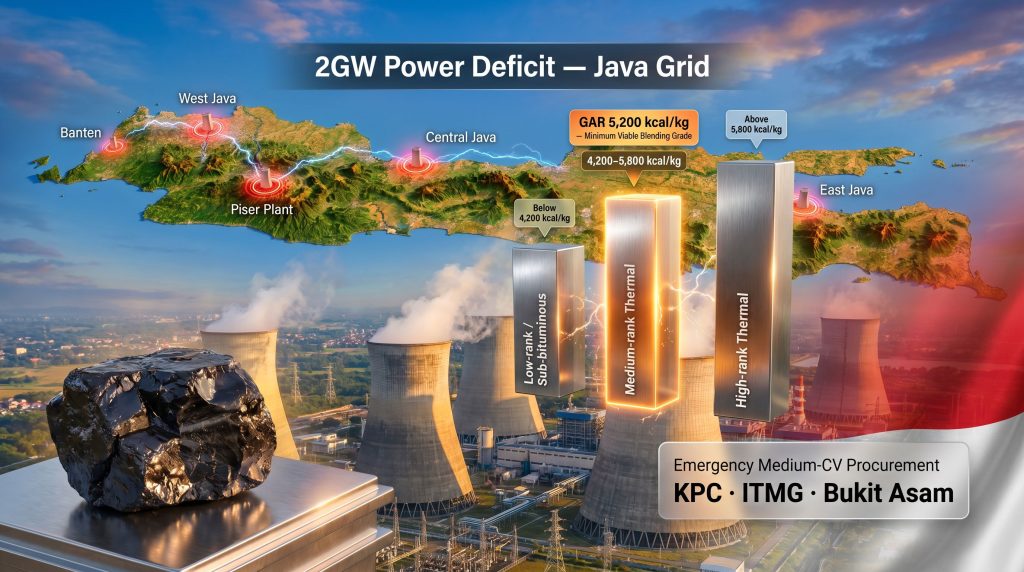
| Low-rank / Sub-bituminous | Below 4,200 | Older, lower-efficiency plants | Limited; niche demand from some Asian buyers |
| Medium-rank thermal | 4,200 to 5,800 | Blending feedstock; mid-efficiency plants | Moderate; Southeast Asian importers |
| High-rank thermal | Above 5,800 | High-efficiency supercritical and ultra-supercritical units | Strong; Japan, South Korea, India, Taiwan |
The Java grid's affected fleet spans multiple generations of plant technology, from older subcritical units at Suralaya to newer ultra-supercritical facilities at Jawa 7, 9, and 10. The newer, higher-efficiency units carry particularly tight fuel specification tolerances, meaning that fuel quality deviations have an amplified operational consequence at these facilities.
The Mechanics of a Coal Specification Mismatch Crisis
How Sub-Specification Fuel Degrades Plant Output
When a coal-fired boiler receives fuel with a lower calorific value than its design specification, several interconnected performance penalties emerge simultaneously:
- Reduced steam generation per unit of fuel mass processed, because each kilogram of coal releases less thermal energy than the combustion system anticipated
- Lower steam temperatures and pressures, which translate directly into reduced turbine output
- Higher moisture content in lower-rank coal, which consumes additional thermal energy during evaporation before combustion can proceed efficiently
- Increased slagging and fouling risk, as lower-rank coals often carry higher ash content and different ash fusion temperatures that can deposit on heat exchange surfaces
- Mechanical de-rating, where plant operators deliberately cap output to protect equipment from prolonged off-specification operation
Furthermore, research across operational coal plant datasets suggests that sustained combustion of coal falling significantly below design specification can reduce effective plant output by 10 to 30 percent, depending on boiler technology and the severity of the quality gap. This is a fuel quality failure, not a fuel supply shortage.
This de-rating phenomenon is particularly consequential at baseload plants, which are expected to run continuously at or near nameplate capacity to provide the grid's foundational power layer. When multiple baseload units simultaneously reduce output due to specification mismatches, the cumulative supply reduction can be substantial.
The Compound Failure That Created a 2GW Deficit on the Java Grid
Indonesia's Java grid blackout crisis emerged from the convergence of two simultaneous stress events, each serious in isolation but collectively severe:
- Coal specification mismatches across multiple Java grid plants caused widespread de-rating of baseload coal generation capacity, reducing total available output below the grid's demand requirements
- Unplanned technical outages at two major independent power plant (IPP) complexes in Cilacap and Paiton disconnected significant baseload generation from the grid at precisely the same time
The combination of these two events produced a power deficit of approximately 2 gigawatts (GW) on the Java grid, according to state utility PLN. Faced with a supply shortfall of that magnitude, PLN implemented controlled load shedding to prevent the more catastrophic outcome of a cascading grid collapse, resulting in the rolling blackouts that affected consumers across the region over a two-week period.
Baseload IPP outages are particularly destabilising compared to peaking plant failures. Peaking plants are, by design, intermittent contributors to grid supply. Baseload plants provide the continuous, predictable power floor that grid operators rely upon for frequency stability and demand matching. When both a fuel quality degradation event and a baseload IPP disconnection occur together, the grid stability margin erodes rapidly.
PLN confirmed that one of the two disconnected IPPs was successfully reconnected over the weekend following the crisis, with the second facility expected to return to service within the same week. However, the Indonesia medium-CV coal specification problem required a separate and more complex procurement intervention.
Which Plants Were Identified with GAR 5,200 kcal/kg Shortfalls
According to Indonesia's energy ministry (ESDM), the following facilities were identified as experiencing inadequate supplies of specification-grade coal:
| Power Plant | Location | Generation Role |
|---|---|---|
| Suralaya Units 1 to 8 | West Java | One of Indonesia's largest coal-fired complexes |
| Jawa 7, 9, and 10 | West Java | Newer ultra-supercritical units |
| Paiton Units 1, 2, and 9 | East Java | Major IPP complex |
| Indramayu | West Java | State-owned PLN facility |
| Pelabuhan Ratu | West Java | Southern Java coastal plant |
| Lontar | Banten | Western Java baseload unit |
| Labuan | Banten | Smaller baseload unit |
| Rembang | Central Java | Inland coal-fired plant |
| Pacitan | East Java | Southern coast baseload unit |
| Tanjung Awar-Awar | East Java | Eastern Java grid anchor |
The geographic spread of affected facilities across West Java, Banten, Central Java, and East Java underscores the systemic rather than localised nature of the coal quality issue. This was not a logistics failure at one plant; it was a procurement and specification management failure distributed across the entire fleet.
Indonesia's Emergency Procurement Response
The Cross-Sector Procurement Mechanism
ESDM's response centred on the formation of a dedicated cross-sector procurement team tasked with accelerating the sourcing and delivery of coal meeting the minimum blending specification of GAR 5,200 kcal/kg. Rather than waiting for standard procurement cycles, which operate on longer timelines suited to steady-state supply management, the ministry fast-tracked contract signing with major domestic producers.
The choice of GAR 5,200 kcal/kg as the target specification reflects its function as a blending feedstock rather than a direct substitution fuel. At this calorific level, Indonesia medium-CV coal purchases can be proportionally combined with lower-rank stockpiles already held at plant sites, raising the blended fuel's effective energy density toward the plant's design specification without requiring a complete swap of the existing inventory.
The Producers Engaged for Emergency Supply
Three major coal producers were confirmed as supplying emergency medium-CV volumes:
- Kaltim Prima Coal (KPC): Indonesia's largest thermal coal producer, operating extensive mining operations in East Kalimantan and producing a broad CV range from medium to high-rank thermal coal for both domestic and international markets
- Indo Tambangraya Megah (ITMG): A diversified Indonesian coal producer with multiple operating mines across Kalimantan, serving as a significant domestic supply contributor
- Bukit Asam (PTBA): The state-owned coal mining enterprise, strategically positioned as a domestic supply backstop for PLN-operated power generation assets
The engagement of both major private producers and the state-owned Bukit Asam signals that the procurement effort was treated as a national energy security priority operating outside normal commercial dynamics. State-owned enterprises carry both supply obligations and strategic importance that make them natural anchors for emergency interventions of this type.
How Blending Restores Plant Performance: A Step-by-Step Process
The blending strategy is the technically preferred solution to a coal specification mismatch for several reasons: it avoids the mechanical risks of abrupt fuel switching, preserves existing lower-grade stockpile inventory rather than discarding it, and allows plant operators to incrementally optimise the blend ratio as medium-CV deliveries arrive. The process works as follows:
- Incoming coal shipments are sampled and laboratory-tested for calorific value, moisture content, ash percentage, and sulphur content before acceptance
- Medium-CV coal at approximately GAR 5,200 kcal/kg is proportionally combined with lower-rank coal from existing stockpiles to achieve a target blend specification approaching the plant's design parameter
- The blended material is transferred to the coal handling system and fed into the boiler according to the adjusted combustion programme
- Plant engineers monitor steam pressure, steam temperature, and generator output in real time to confirm that combustion efficiency is recovering toward rated performance
- The blend ratio is refined over successive deliveries as medium-CV supply volumes build, progressively restoring full nameplate output
Executing this process simultaneously across ten or more geographically dispersed Java grid plants, each with different stockpile compositions and boiler configurations, represents a significant logistical coordination challenge for both the procurement team and plant operations staff.
The Structural Paradox: A Coal Exporter with a Quality Supply Problem
Indonesia's Domestic Market Obligation and Its Unintended Consequences
Indonesia's domestic energy supply framework includes the Domestic Market Obligation (DMO), a policy mechanism that requires coal producers to allocate 25 percent of their annual production to domestic buyers, with prices capped at levels historically set below prevailing export market benchmarks.
The DMO price cap creates a structural pricing differential between domestic and export markets. When international coal prices are elevated, this differential widens considerably, creating an economic incentive gradient that influences which grades of coal producers direct toward each destination. Higher-CV product commands a premium in export markets that the DMO price ceiling does not capture, which can encourage producers to prioritise their higher-specification output for export while fulfilling domestic obligations with lower-rank material.
Over time, this dynamic may systematically populate domestic power plant stockpiles with a disproportionate share of lower-rank coal, quietly eroding the specification quality of the fuel mix available for plant operation without triggering any immediate procurement alert. The Java grid crisis suggests this erosion had reached a point where blending was no longer achievable from existing stockpiles alone.
The structural irony is difficult to overstate: Indonesia holds the position of the world's largest thermal coal exporter by volume, yet faces a domestic power crisis rooted in insufficient availability of medium-specification coal at its own power plants.
Export Market Evolution and Its Domestic Knock-On Effects
A secondary structural pressure compounds the DMO dynamic. Major Indonesian coal import markets, particularly those with growing China steel demand and industrial energy consumption, have been progressively upgrading their generation fleets toward supercritical and ultra-supercritical boiler technology. These higher-efficiency units are designed to operate on higher-CV coal, shifting import demand up the quality spectrum.
As Asian buyers increasingly compete for higher-rank Indonesian coal, the domestic medium-CV pool faces competitive pressure from international demand that the DMO framework was not designed to address. This is not a static problem. As Indonesia's own domestic fleet upgrades toward newer, more efficient technology, its need for specification-grade fuel will rise precisely as global competition for that fuel intensifies. Indeed, China demand prospects for high-CV material continue to reshape the broader Asian commodity supply chain in ways that have direct knock-on effects for domestic Indonesian supply management.
Moreover, trade impacts on bulk commodities across the Asia-Pacific region are adding further complexity, as tariff pressures and shifting trade flows alter the competitive dynamics between exporting nations. Consequently, analysts examining the China steel outlook and broader Asian industrial demand note that Indonesia's medium-CV volumes are increasingly caught between competing domestic and export imperatives. These broader resource export challenges facing commodity-exporting nations underscore how domestic energy security and international market pressures are becoming increasingly difficult to balance simultaneously.
In addition, recent reporting indicates that China and India are actively shifting toward higher-grade coal imports, further tightening the medium-to-high CV supply pool available for domestic Indonesian consumption and reinforcing the structural pressures outlined above.
Regional Context and Longer-Term Policy Implications
Load Shedding as a Grid Protection Mechanism
PLN's implementation of controlled load shedding during the deficit period reflects established grid management practice rather than a sign of institutional failure. Load shedding involves the deliberate, temporary curtailment of electricity supply to specific geographic areas on a rotating basis, distributing the impact of a supply shortfall across the consumer base rather than concentrating it.
The critical distinction between controlled load shedding and an uncontrolled grid collapse is significant. A rolling blackout, while disruptive, allows grid operators to maintain system frequency and voltage stability. An uncontrolled collapse can damage generation equipment, grid infrastructure, and industrial processes in ways that take far longer to restore. PLN's decision to implement load shedding was a protective intervention, not a failure of grid management.
Reforming the DMO for Quality, Not Just Volume
The Java grid crisis makes a compelling operational case for a quality-differentiated DMO framework. Under the current structure, the 25 percent domestic allocation requirement does not distinguish between coal grades, meaning that a producer can technically satisfy its domestic obligation by delivering low-rank material while directing higher-CV output entirely toward export markets.
A reformed framework might include:
- CV-banded allocation requirements, specifying minimum volumes of medium-rank coal that must be made available domestically, separate from general DMO tonnage
- Specification-linked price caps, allowing the domestic price ceiling to vary with CV content rather than applying a flat cap across all grades
- Blending reserve protocols, requiring large baseload plants to maintain minimum stockpiles of specification-grade blending coal above their standard inventory targets
- Procurement quality audits, building coal quality verification into the DMO compliance monitoring process rather than relying on volumetric reporting alone
Each of these reforms involves trade-offs between domestic electricity affordability, producer economics, and national energy security that will require careful calibration.
Scenario Outlook: Resolution Pathways and Residual Risk
| Scenario | Likelihood | Grid Consequence | Policy Action Needed |
|---|---|---|---|
| Emergency procurement resolves shortage within weeks | High | Short-term blackouts; gradual plant output restoration | Near-term: enforce accelerated DMO quality compliance |
| Medium-CV tightness extends through dry season | Moderate | Continued partial de-rating; further load shedding risk | Medium-term: quality-differentiated procurement protocols |
| Structural domestic supply-quality gap widens over years | Lower but rising | Chronic underperformance of Java baseload fleet | Long-term: DMO structural reform; CV-linked pricing |
The next major ASX story will hit our subscribers first
Frequently Asked Questions
What is GAR 5,200 kcal/kg coal and why is it the target for Indonesia's medium-CV purchases?
GAR 5,200 kcal/kg refers to coal with a Gross As Received calorific value of 5,200 kilocalories per kilogram, measured in the delivered condition including surface moisture. This specification represents the minimum viable energy density for use as a blending feedstock at the affected Java grid plants. By blending this medium-rank material with lower-grade coal already in stockpile, plant operators can bring the combined fuel's effective calorific value closer to the boiler's design parameter, restoring combustion efficiency without requiring a complete fuel replacement.
Why can't Indonesia's power plants simply burn more of the lower-rank coal already available?
Boiler design parameters are calibrated to a specific calorific value range. Burning coal significantly below specification does not simply mean generating less power proportionally; it introduces compounding mechanical penalties including elevated slagging on heat transfer surfaces, fouling of boiler tubes, reduced steam temperatures, and increased wear on ash handling systems. Prolonged off-specification operation accelerates maintenance requirements and risks unplanned equipment failures. Blending to raise the fuel's effective CV is both more efficient and safer for plant equipment than attempting to push higher volumes of sub-specification coal through an unadjusted combustion system.
How does Indonesia's Domestic Market Obligation work?
The DMO requires that coal producers operating in Indonesia allocate 25 percent of their annual production to domestic buyers. Domestic supply prices are capped by regulation at levels that have historically sat below prevailing export market prices. The policy was designed to ensure affordable coal for domestic power generation, but the flat price cap structure does not differentiate by coal grade, creating the incentive dynamics described above. Coal market analysts have periodically flagged the DMO's quality incentive gap as a potential supply risk for specification-sensitive domestic plants.
Which Indonesian producers supply the domestic power sector under the DMO?
All major Indonesian coal producers carry DMO obligations proportional to their production volumes. The three producers engaged for emergency Indonesia medium-CV coal purchases during the Java grid crisis — Kaltim Prima Coal, Indo Tambangraya Megah, and Bukit Asam — represent the large-scale end of the domestic supply network. Bukit Asam, as a state-owned entity, carries particular strategic importance as a domestic supply anchor that can be directed toward priority supply situations in ways that private producers may not be contractually obligated to replicate.
Key Takeaways
- The Java grid blackouts were caused by a coal specification mismatch, not a volumetric fuel shortage — a distinction with significant implications for how policy responses are designed
- The targeted procurement of GAR 5,200 kcal/kg coal enables blending with lower-rank stockpiles, progressively restoring plant combustion efficiency and generator output
- A 2GW power deficit emerged from the combined effect of specification-driven plant de-rating and simultaneous technical outages at two baseload IPP facilities
- Kaltim Prima Coal, ITMG, and Bukit Asam were mobilised to deliver emergency medium-CV volumes under accelerated contract timelines managed by a cross-sector ESDM procurement team
- Indonesia's DMO framework, while essential for domestic energy affordability, creates incentive structures that may systematically under-supply medium-rank coal to the domestic market over time
- Resolving this issue structurally will require quality-differentiated procurement policy, potentially including CV-banded DMO allocation requirements and specification-linked domestic price caps
This article contains forward-looking analysis and scenario assessments that are inherently speculative. Readers should not rely on scenario projections as predictions of future events. Energy market conditions, regulatory frameworks, and operational outcomes are subject to rapid change.
Want to Stay Ahead of the Next Major ASX Resource Discovery?
Discovery Alert's proprietary Discovery IQ model delivers real-time alerts on significant ASX mineral discoveries — cutting through complex commodity data to surface actionable opportunities the moment they emerge on the exchange. Explore historic examples of major mineral discoveries and their returns on Discovery Alert's dedicated discoveries page, and begin your 14-day free trial today to position yourself ahead of the broader market.